
What should a Singapore merchant compare before signing a gateway contract, the headline card rate, the PayNow or SGQR coverage, or the speed of settlement at the till? In practice, all three matter, and the wrong mix can slow checkout, split reconciliation, or leave a café, salon, clinic, or shop with awkward payment gaps. This list of payment gateways in Singapore is ordered from in-store SME setups to enterprise platforms, so the first names lean toward terminals and local checkout needs, while the later ones suit larger or more technical operations.
A second trap is pricing opacity. Several providers do not publish full rates, so merchants should expect quote-based pricing and ask for written terms instead of assuming the cheapest-looking option is the cheapest in practice. The comparison below covers payment methods, pricing transparency, integrations, settlement, support, and business fit. That is the fastest way to separate a decent gateway from a usable one.
For Singapore, local rails matter as much as card acceptance. The country's payment behaviour is highly cashless, with 100.0% of resident households making at least one electronic-payment transaction in 2023, according to Singapore's Department of Statistics report. That is why the strongest shortlist is usually not “cards only.” It is cards, PayNow, SGQR, wallets, and clear settlement.
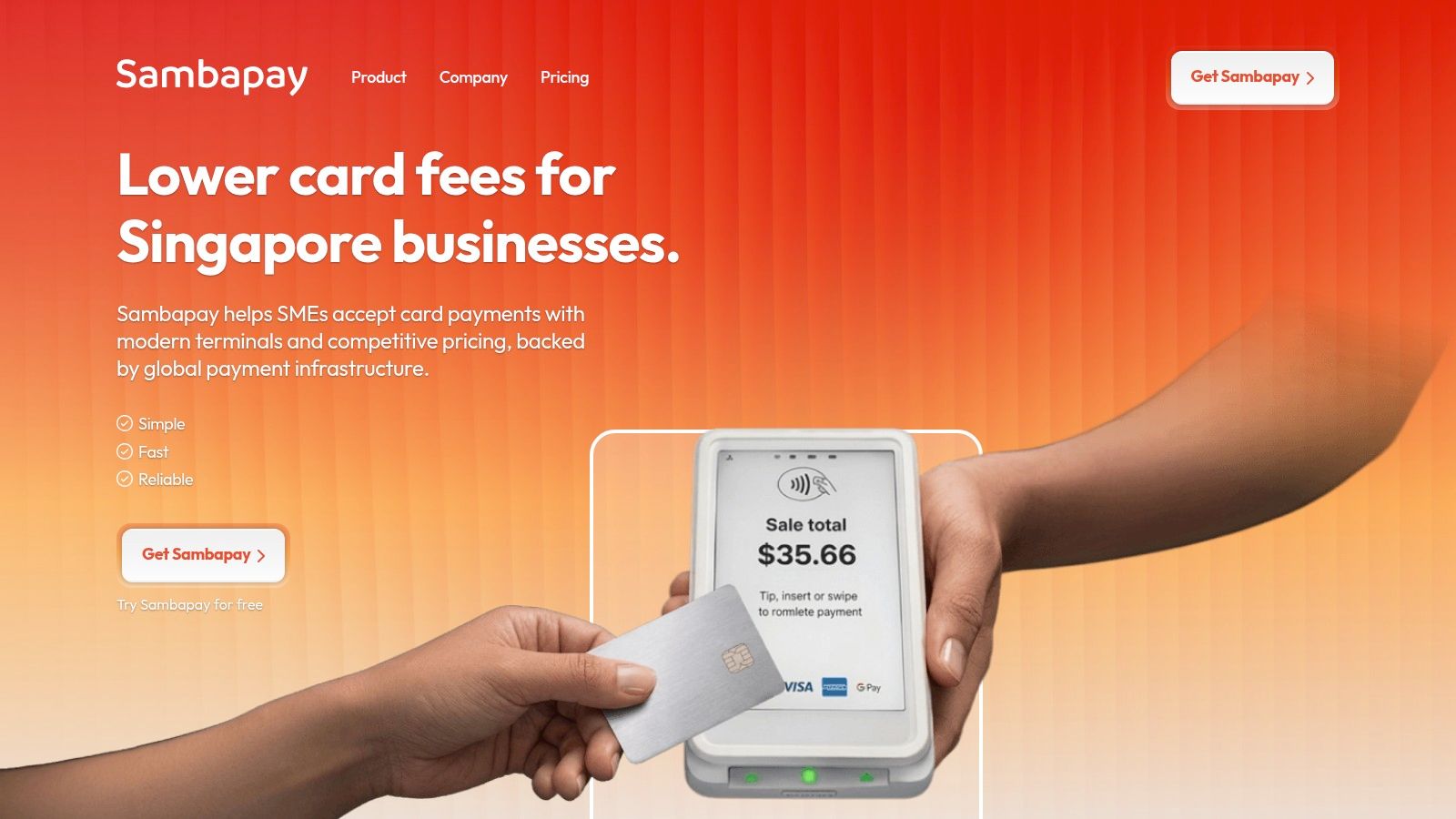
Sambapay is a practical first option for a Singapore SME that wants an in-store setup without much fee noise. It focuses on blended pricing, standard deployments without monthly terminal rental, and local onboarding that fits day-to-day counter work, not just a sales presentation. The website says there are no binding periods or cancellation fees, which suits merchants that do not want to be locked into the wrong contract.
Best fit for: brick-and-mortar SMEs that want modern terminals, broad card acceptance, and a local support team that can handle migration without much drama.
The checkout mix is broad. Sambapay says it accepts Visa, Mastercard, American Express, JCB, China UnionPay, and selected wallets including Apple Pay, Google Pay, Alipay, GrabPay, and PayNow. That gives it a clear role for retailers, cafés, clinics, salons, and gyms that need one setup to handle card-heavy customers and local payers who prefer to scan or tap.
Settlement timing is another practical point. Sambapay says funds can be available from T+1, depending on the merchant agreement, and the setup is built to reduce disruption during installation. For many small businesses, faster access to funds and local migration support matter more than chasing the lowest quoted rate. The trade-off is simple. Pricing is quote-based, so merchants need to request a custom quote and confirm the current terminal, support, and settlement terms before switching.
The company also says it is an authorized Independent Sales Organization of Fortune 500 payment infrastructure providers, which adds some credibility on the processing side. For merchants comparing options in a list of payment gateways in Singapore, Sambapay stands out as one in-store choice among several, especially when the goal is a clean counter setup with clear commercial terms rather than a wide product suite.
A merchant that wants fewer moving parts should ask for one quote, one terminal plan, and one settlement timeline.
Website: Sambapay
FOMO Pay makes sense for merchants that want a wider local payment mix than a plain card gateway usually offers. It is a Singapore-headquartered provider with coverage across cards, PayNow, SGQR, Alipay+, WeChat Pay, and GrabPay, plus in-store choices such as SGQR stands, mPOS, and POS integrations. That combination is useful when the counter has to handle both domestic customers and wallet-heavy footfall.
Its biggest strength is breadth across online and in-store use cases. The provider also offers APIs, plugins, a merchant app, and payment links, so a business does not have to treat its counter and web checkout as separate worlds. For retailers and food-and-beverage operators, that reduces the need to stitch together too many tools.
Pricing is the downside. FOMO Pay does not publish granular rates, so merchants need a quote based on method mix and profile. That is not unusual in Singapore, but it does mean the actual cost only becomes clear after sales has seen the business. For merchants with high wallet usage or tourist traffic, that quote can still be worthwhile if the accepted methods fit the actual customer base.
Its real-time reporting is another operational advantage. That matters when a store manager needs to see what came through PayNow, what came through cards, and what still needs reconciliation.
Website: FOMO Pay
Pick FOMO Pay when the checkout has to speak QR, wallet, and card in the same aisle.
HitPay is one of the clearest SME-friendly options because the product is easy to understand and the pricing is published. It supports PayNow, cards, GrabPay, and BNPL options, and it stretches across payment links, invoicing, subscriptions, and in-person acceptance through terminals or Tap to Pay. That makes it suitable for merchants that sell both in shop and online without wanting a heavy implementation project.
The appeal is simplicity. HitPay publishes pricing and says there are no setup or monthly fees on the standard offering, which lowers the barrier for smaller businesses that want to test a gateway before committing. For a boutique, café, or service business, that usually beats an enterprise-style sales cycle.
The trade-off is that published convenience can come with less negotiating room. A merchant with larger volume or more complex card mix may find that negotiated rates elsewhere are better suited to its economics. Still, if the goal is to start quickly and keep the setup manageable, HitPay is one of the easier entries on a list of payment gateways in Singapore.
It also suits businesses that want a light stack, one provider for payment links, recurring billing, and in-person collections, instead of juggling separate tools for every channel.
Website: HitPay
Opn Payments, formerly Omise, sits in a useful middle ground for businesses that want published pricing and developer-friendly tools. It supports PayNow, selected local payment methods, GrabPay, Alipay+, and WeChat Pay, alongside payment links, APIs, and dashboard tools. That blend makes it practical for SMEs that still want some technical flexibility.
The standout is predictability. When rates are publicly listed, finance teams can model costs without waiting for a sales reply. The Singapore pricing page also notes no transfer fee for SGD bank payouts, which is a relevant detail for cash flow planning.
That said, the method list is narrower than some larger enterprise platforms, so it may not cover every merchant ambition. A retailer with broad international needs, complex omnichannel operations, or a large in-store estate may outgrow it quickly. For leaner teams, though, it offers enough structure without forcing a heavy procurement process.
Website: Opn Payments
NETS is familiar because it sits close to Singapore's domestic payment habits, and that makes it a sensible option for merchants who care about local bank payments and SGQR-style acceptance. Its eNETS Gateway supports direct debit, major cards, and NETS QR Online, with a merchant portal for reconciliation and security features such as 3-D Secure.
The main advantage is trust. Many Singapore customers already recognise the brand, and that matters when a business wants a checkout flow that feels local rather than imported. For merchants serving domestic buyers, especially those with routine bill-style payments, the bank-transfer angle can be more useful than a flashy international feature set.
The weakness is that pricing and product details can be layered. Some models involve multiple components or subscription-style charges, and published fee examples may be dated. Merchants should confirm current terms with NETS directly, especially if they are comparing it with a simpler published-rate platform.
For anyone who wants to understand the PayNow side of Singapore checkout behaviour, the PayNow primer is worth reading before the final decision. It helps explain why local account-to-account rails belong in the same conversation as cards.
Website: NETS
Local payment familiarity can reduce checkout friction faster than a slight fee difference.
Stripe is the default answer for many developer-led businesses, and for good reason. It supports PayNow, GrabPay, cards, Apple Pay, and Google Pay, plus a broad set of APIs, SDKs, billing tools, invoicing, and fraud controls. That makes it suitable for companies that want one payment layer across web, app, and recurring billing.
The advantage is speed of launch. Stripe's documentation, integrations, and ecosystem are strong, which helps teams move quickly without building every payment workflow from scratch. For SaaS companies, online stores, and tech-forward SMEs, that can be worth more than a slightly lower rate elsewhere.
The trade-off is that standard card pricing may not be the best fit for businesses with low average order values or very tight margin pressure. Advanced features can also become paid add-ons, so the apparent simplicity of the core plan does not always reflect the full monthly spend.
For the Singapore market, Stripe works best when the business wants a developer-friendly stack and already values online scale over in-store terminal management. It is less of a pure counter product than some of the other names in this list.
The payment processor explainer is a useful companion here, especially for merchants that still mix up gateway, processor, and merchant account responsibilities.
Website: Stripe Singapore

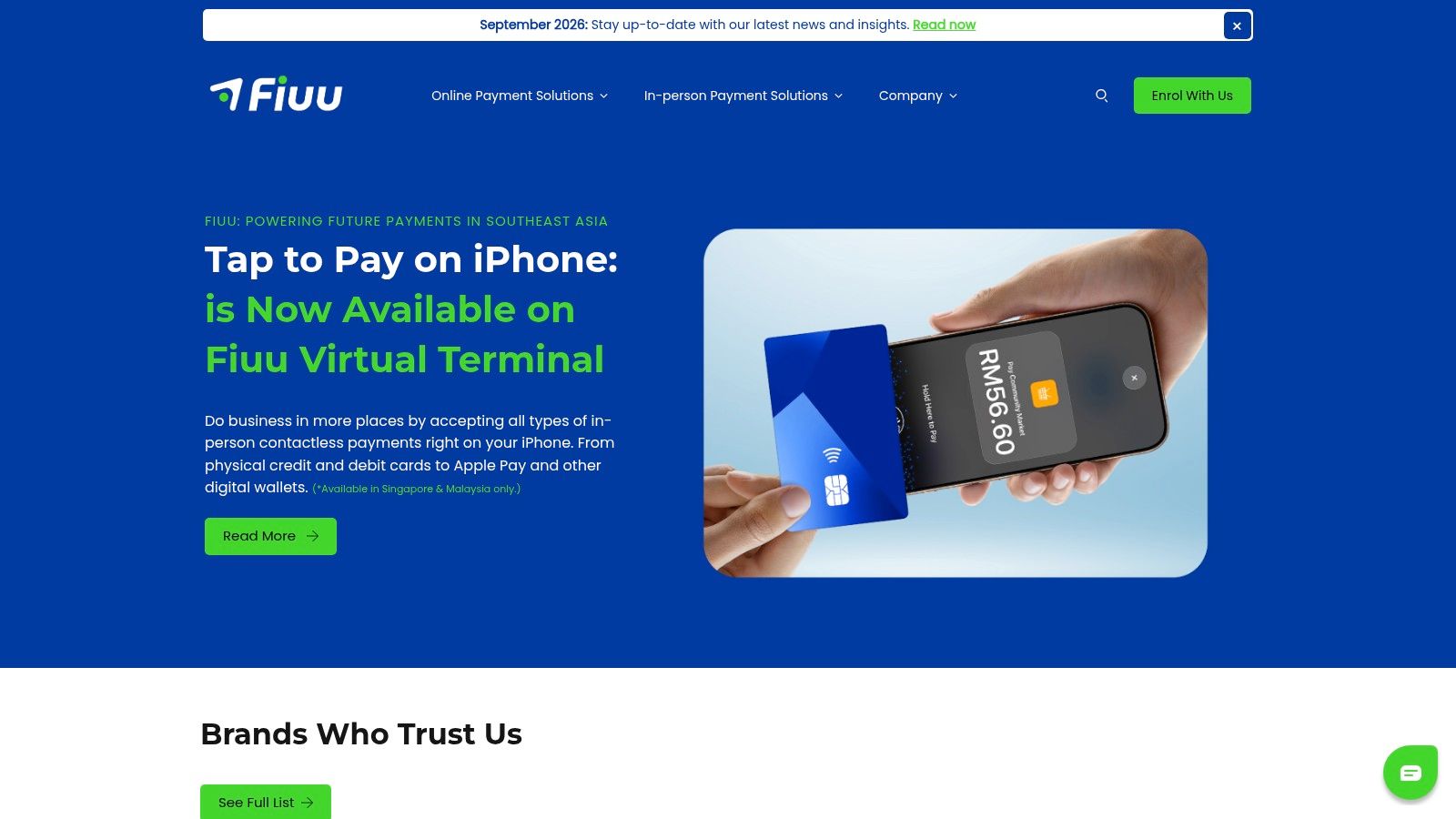
Razer Merchant Services now operating under the Fiuu brand, still matters for merchants that want regional wallet coverage with Singapore presence. Its Singapore options include cards, Alipay+, BNPL, Google Pay, and PayNow channels, and it supports both online and in-person acceptance. That gives it a wider consumer-facing mix than a card-only gateway.
The chief benefit is regional reach. Businesses that expect customers from different Southeast Asian markets often need more than standard card acquiring, and Fiuu's broader integration options can help there. It is also listed in the MAS Financial Institutions Directory, which adds a layer of local regulatory comfort.
The limitation is the usual one for many regional providers, public pricing is not posted. That means the only honest way to compare it is by quote, not by website headline. For merchants with a complicated wallet mix or regional expansion plans, that may still be worth the extra sales step.
Website: Fiuu
2C2P by Antom is built for businesses that think beyond one market. It has a Singapore Major Payment Institution licence and offers gateway services, payment links, softPOS, instalment payment plans, and multi-currency pricing. It also covers cards and wallets such as Alipay+ and UnionPay, which matters for regional merchants and tourist-facing businesses.
The practical upside is breadth. If a merchant is expanding across Southeast Asia, a platform like 2C2P can reduce integration sprawl and simplify multi-country operations. It also comes with security accreditations such as PCI, ISO, and SOC 2, which enterprise buyers tend to expect.
The trade-off is fit. This is a broader platform than many small merchants need, and pricing is quote-based. A compact retailer or local service business may find the offering heavier than necessary, especially if all it really wants is fast in-store acceptance and simple settlement.
Website: 2C2P
Adyen is a serious enterprise platform, not a lightweight SME tool, and that distinction matters. It supports PayNow alongside cards and wallets, with unified reporting across online and in-person channels and a pricing model that is usually bespoke. For a large merchant, that structure can simplify a lot of internal reporting pain.
The biggest appeal is consolidation. Adyen combines gateway, acquiring, and risk capabilities, which means fewer disconnected vendors and a cleaner view of transactions across channels. That makes sense for omnichannel retailers and larger businesses with global operations.
The catch is fit and pricing. Adyen is usually better suited to larger merchants than to small teams that just want quick terminal rollout. Onboarding is bespoke, and most pricing is not self-serve, so the buying process is more consultative than many SMEs would want.
For merchants comparing advanced platforms, Adyen is best judged on operational control, not on a single fee line. If the business needs stronger payment optimisation and one reporting layer for multiple channels, it earns a close look.
The merchant-account guide is a useful reference point for businesses that want to separate the gateway decision from the account and acquiring side.
Website: Adyen
Checkout.com is another enterprise-grade name that works best when payments are part of a broader operating system. In Singapore, it supports PayNow alongside global cards and digital wallets, with tools for payment performance, risk management, and multi-region operations. That makes it relevant to mid-market and enterprise merchants with serious scale requirements.
The practical advantage is control. Checkout.com is built for businesses that need one integration for multiple methods and care about transaction performance, not just acceptance. PayNow is especially useful here because it gives the platform a local anchor in Singapore while still serving larger cross-border ambitions.
The limitation is the same one seen with other enterprise platforms, custom pricing and a sales-led process. Smaller merchants that want a self-service setup or a simple terminal bundle will probably find it too heavy. It is better evaluated as a strategic payments stack than as a basic checkout tool.
Website: Checkout.com
Enterprise gateways earn their place when one dashboard replaces a mess of regional contracts.
| Provider | Payment Acceptance | Standout Strength | Pricing & Settlement | Best Fit |
|---|---|---|---|---|
| Sambapay (Recommended) | In-store cards and selected wallets; Android POS terminals | Singapore-based SME support, guided installation, no standard terminal rental | Tailored blended quote; settlement from T+1 may be available; no stated lock-in or cancellation fee | Brick-and-mortar SMEs seeking hands-on local service |
| FOMO Pay | In-store and online cards, PayNow, SGQR, and wallets | Broad QR and tourist-wallet coverage; merchant app and APIs | Custom pricing; confirm terms | Retailers and F&B businesses serving wallet users |
| HitPay | Online and in-person cards, PayNow, wallets, and BNPL | Payment links, invoicing, subscriptions, and POS options | Published pricing; no setup or monthly fees stated | SMEs wanting online and in-store payments |
| Opn Payments | Cards, PayNow, selected local methods, and wallets | APIs, payment links, and regional wallet support | Public price card; no SGD bank payout transfer fee stated | SMEs and mid-market businesses wanting listed rates |
| NETS (eNETS Gateway) | Online cards, direct debit, and NETS QR; SGQR options | Strong connections to Singapore domestic payment rails | Confirm current fees; some products may include subscriptions | Businesses prioritising local payment methods |
| Stripe | Online and in-person cards, PayNow, GrabPay, and wallets | Extensive APIs, integrations, billing, and fraud tools | Published standard pricing; advanced features may cost extra | Digital businesses and scale-ups needing flexible tools |
| Razer Merchant Services (Fiuu) | Online and in-person cards, wallets, BNPL, and PayNow channels | Regional network and wallet coverage | Custom pricing; confirm available methods | Merchants seeking regional payment options |
| 2C2P (by Antom) | Cards, wallets, softPOS, payment links, and instalments | Regional reach and multi-currency capabilities | Sales quote required | Businesses expanding across Southeast Asia |
| Adyen | Online and in-person cards, PayNow, and wallets | Unified global acquiring, reporting, and risk tools | Bespoke pricing; card pricing typically quoted | Larger merchants with omnichannel or global needs |
| Checkout.com | Cards, PayNow, and digital wallets | Payment optimization and enterprise risk tools | Custom sales quote | Mid-market and enterprise merchants |
The right shortlist starts with your actual transaction pattern, not with a brand ranking. A retailer with steady in-store traffic should compare terminal options, card mix, and local wallet coverage first. A service business with deposits or recurring billing should care more about payment links, invoicing, and settlement timing. An online brand should look harder at APIs, plug-ins, fraud tools, and how easily the gateway handles PayNow, cards, and wallets in one flow.
A practical shortlisting method works better than a broad search. Pick two or three providers from this list of payment gateways in Singapore that match your monthly card volume, average ticket size, and online versus in-store mix. Then ask each one for a written quote that breaks out transaction fees, payout timing, terminal rental, refund treatment, and any extra costs for wallets, cross-border cards, or FX. That is the only reliable way to compare a blended SME setup against a quote-based enterprise platform.
For many Singapore merchants, the decision narrows fast once local methods are fixed. If PayNow or SGQR is mandatory, treat it as a firm filter. If the business wants a single in-store terminal and one reconciliation workflow, check that the provider can support it without fragmented reporting. If the sales team says a method is available but the contract does not spell out settlement and support terms, assume nothing and ask again.
Keep a short checklist before switching. Confirm supported payment methods, published or quoted fees, settlement timing, hardware or integration needs, and contract terms. Then verify current details directly with the provider, because pricing, availability, and method coverage change.
For businesses that want a simple in-store setup with clear commercial terms, online payment gateway for SMEs is a useful next step when evaluating options against your own checkout mix.
If the goal is a Singapore in-store payment setup with blended pricing, modern terminals, and local support, Sambapay deserves a close look. It's built for merchants that want card acceptance, selected wallets, and practical onboarding without the usual fee clutter. Visit Sambapay to review its checkout options and request a quote that matches your business.