
A payment processor is the technology and service that lets a business accept card payments, securely connects the merchant, customer's bank, and card networks, and arranges settlement into the merchant's bank account. Singapore's modern electronic payment infrastructure traces back to NETS EFTPOS in 1986, with PayNow adding another major local payment rail in 2017 (MAS explains this payment infrastructure history).
A customer taps a card at a café, the terminal displays an approval, and the transaction appears complete. Behind that quick moment, several organisations check the payment, move information across networks, manage risk, and eventually transfer funds to the café's bank account. For a Singapore retailer, restaurant, clinic, salon, or fitness studio, understanding that chain matters because payment acceptance affects checkout speed, cash flow, troubleshooting, and the true cost of every sale.
A shop owner usually notices payment processing at the wrong moment. A customer is waiting, the queue is growing, and the terminal rejects a card that worked earlier in the day. In another common scenario, the payment succeeds but the merchant's payout arrives later than expected, making it harder to replenish stock or plan the week's expenses.
A payment processor sits behind these events. It carries the transaction request between the merchant's terminal or online checkout, the acquiring side, the card network, and the customer's issuing bank. It doesn't just "take the money". It helps obtain approval, transmits the transaction record, supports risk controls, and coordinates the eventual movement of funds.
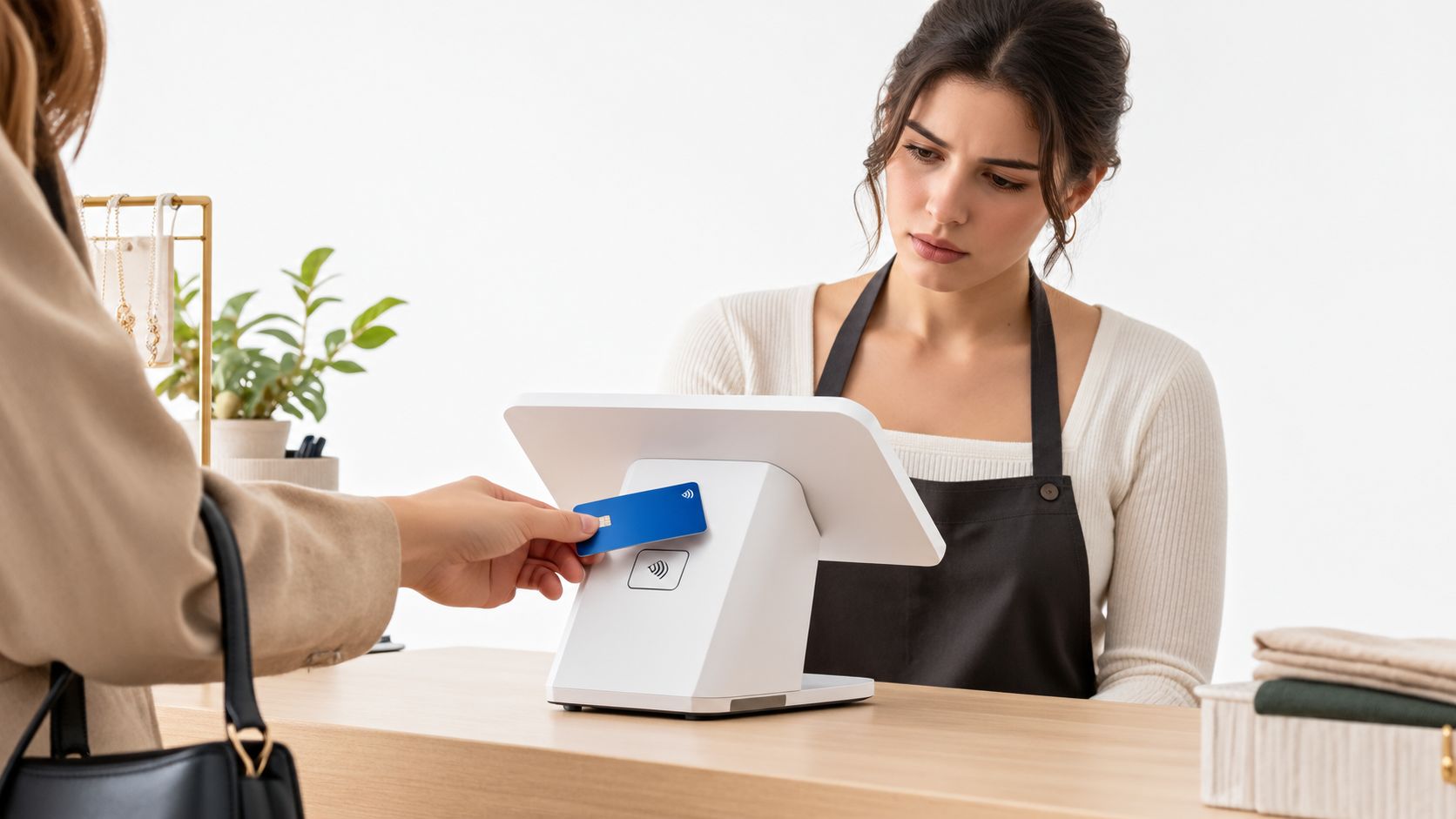
For the customer, a good payment experience feels uneventful. The terminal recognises the card, the bank approves the purchase, and a receipt is produced. The merchant needs that same process to work across busy periods, different card schemes, contactless wallets, refunds, and occasional connectivity problems.
MAS defines merchant acquiring as accepting and processing payment transactions for a merchant under contract, commonly through a point-of-sale terminal or online payment gateway. MAS also notes that an acquirer can provide money transfer services when it facilitates the movement of funds, which places payment acceptance within a regulated funds-flow chain rather than treating it as ordinary checkout software (MAS describes merchant acquiring and payment services).
Practical rule: A terminal is only the visible endpoint. The provider behind it determines how reliably transactions are authorised, recorded, and settled.
This is why a merchant shouldn't compare providers only by looking at the device on the counter. The more useful questions concern accepted payment methods, payout timing, support, refunds, chargebacks, connectivity, and the complete fee structure. A low-looking transaction rate can become less attractive if separate charges, delayed settlement, or support gaps create operational friction.
A card payment follows a sequence that can be understood as a three-part journey: authorisation, clearing, and settlement. The customer sees only the first few seconds, but each stage has a different job and timing.
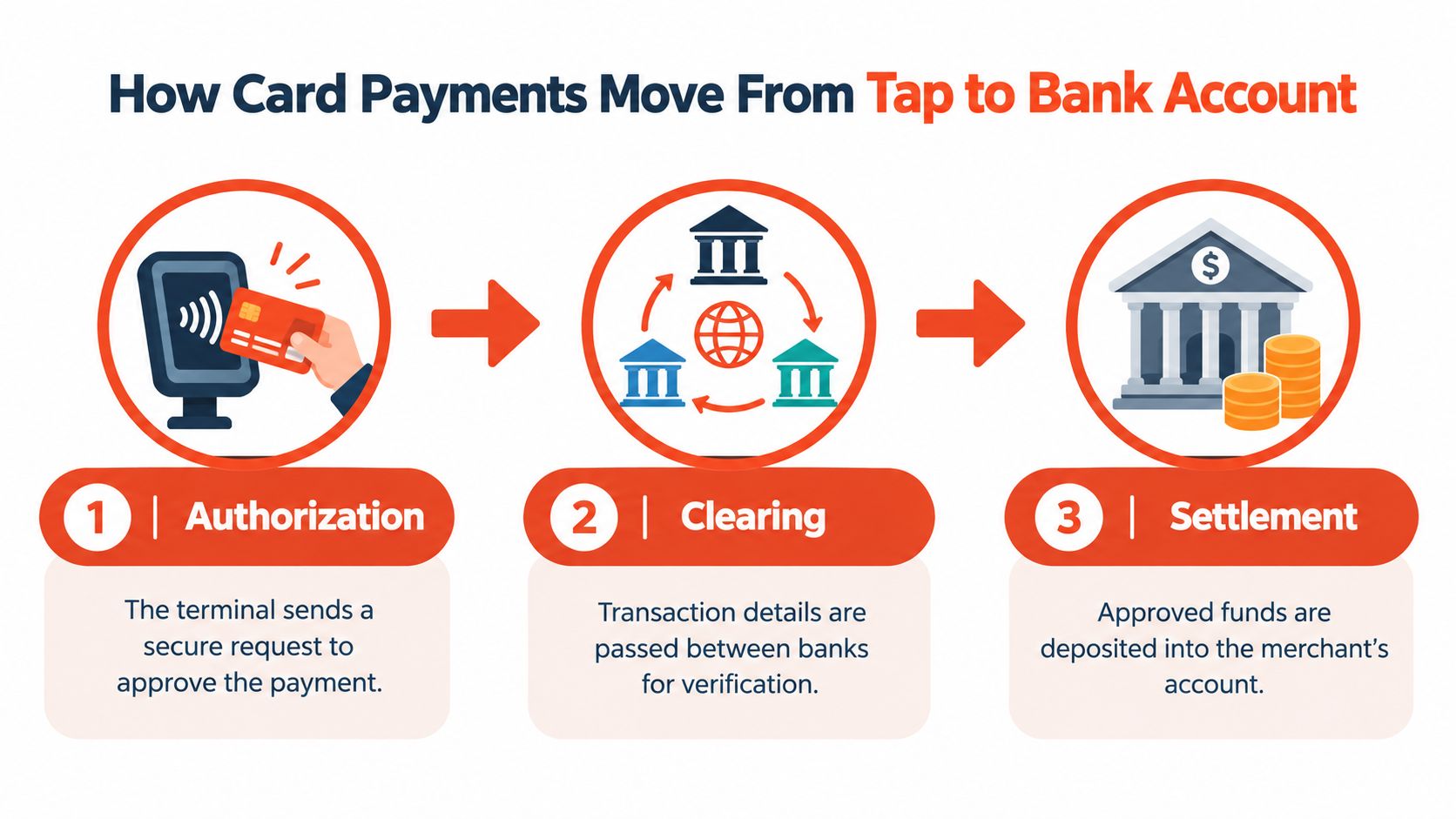
The customer taps, inserts, or enters card details. The terminal or checkout sends a secure request containing the transaction amount and payment credentials to the processor or gateway. The request moves through the relevant card network to the issuing bank, which checks factors such as account status, available funds or credit, and fraud signals.
The issuer then returns an approval or decline. An approval means the merchant can complete the sale, but it doesn't mean the merchant has already received the money. It confirms that the transaction can move to the next stages.
After approval, the transaction details are exchanged for verification and reconciliation. The acquiring side records the merchant's transaction, while the card network and issuer use the submitted information to calculate and communicate the obligations between the participating financial institutions.
Errors at this stage can affect settlement, reporting, refunds, or dispute handling. That's why a processor needs accurate transaction records, stable connectivity, and systems that can match payments to the correct merchant account.
Settlement is the point at which funds are made available to the merchant according to the agreed schedule. The processor and acquiring partners coordinate the transfer, while fees and adjustments are reflected in the merchant's payout or statement.
A merchant comparing providers should ask whether the advertised timing refers to an approval, a batch submission, or actual bank-account availability. The distinction matters for daily cash-flow planning. A detailed explanation of this process is available in Sambapay's guide to card payment settlement.
The journey looks simple from the counter, but each handoff can create a failure point. A declined authorisation, an incomplete clearing record, or a delayed settlement instruction affects the merchant differently. Separating the stages helps staff describe a problem accurately instead of reporting that “the processor is down” for every issue.
The terms processor, gateway, acquirer, and issuer often appear together, but they describe different roles. Providers can bundle several roles into one commercial relationship, which makes the terminology feel interchangeable even when the functions remain distinct.
| Role | Primary Function | Merchant Interaction |
|---|---|---|
| Payment processor | Routes transaction data, supports authorisation, and processes payment records between participants | Usually works through the merchant's provider, terminal, or checkout integration |
| Payment gateway | Securely captures and transmits payment details from a terminal or online checkout | Provides the connection point used by the merchant or customer |
| Acquirer | Accepts card transactions for the merchant and arranges the merchant's side of settlement | Holds or manages the merchant relationship and payout arrangement |
| Issuer | The customer's bank or financial institution that issued the card | Decides whether the customer's payment should be approved |
A gateway can be compared with a secure doorway. It collects the payment request and sends it onward, but it may not be the party that manages the merchant account or settles funds. A processor acts more like the operational routing and record-keeping engine, moving transaction information between the gateway, acquirer, networks, and issuer.
The acquirer represents the merchant's side. It contracts with the business, receives card transaction information, and coordinates the merchant's settlement. MAS's description of merchant acquiring is useful because it connects acceptance with the regulated movement of funds, rather than reducing acquiring to a terminal rental.
The issuer represents the customer. When a transaction is declined because the bank cannot approve it, changing the merchant's terminal may not solve the problem. Conversely, a terminal or gateway fault can prevent a valid card from reaching the issuer at all.
The right troubleshooting question is not “Which company owns the payment?” It is “Which handoff failed?”
Merchants also need to examine how fees are divided across these roles. A practical 10Seat payment cost analysis can help readers think beyond the headline rate and look for less visible components in electronic payment costs. For a related explanation of intermediary relationships, Sambapay's overview of ISOs in payment processing provides useful context.
Security controls protect more than card numbers. They help ensure that a legitimate customer can complete a transaction, that a merchant can prove what happened during a dispute, and that payment data doesn't become an avoidable business liability.
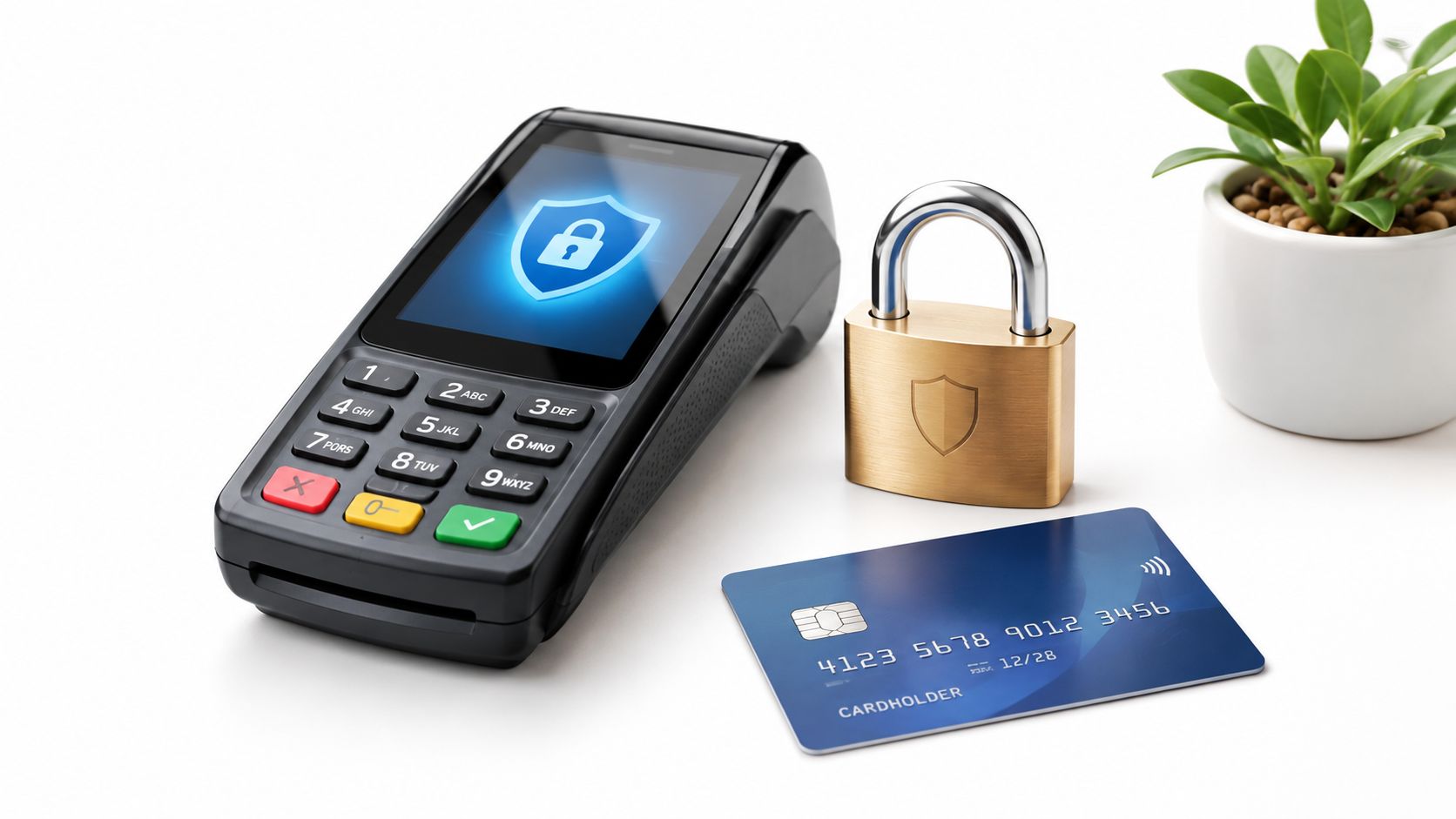
A modern terminal protects card information during the transaction and supports authentication methods such as chip-and-PIN or contactless verification. For online payments, encryption and tools such as 3D Secure add an extra cardholder authentication step when the transaction needs stronger verification.
The customer may only see a prompt on a phone or a request for a verification code. The processor uses the result as one part of its risk decision. Strong authentication can reduce unauthorised use, but it shouldn't be treated as a guarantee that every dispute disappears.
A merchant should ask how card data is captured, where it travels, who can access it, and what records are retained. Hosted checkout pages, tokenisation, encrypted connections, and modern terminals can reduce the amount of sensitive data that passes through the merchant's own systems.
That doesn't remove every responsibility. Staff still need controlled access, sensible device handling, clear refund procedures, and a process for reporting suspicious activity. A processor can provide secure infrastructure, but the merchant's operating habits remain part of the overall control environment.
A useful provider discussion should cover security as an operating service, not a badge in a sales presentation. Merchants should ask who monitors incidents, how support handles a compromised terminal, and whether the provider helps explain suspicious transactions in plain language.
Singapore's card market turns a terminal tap into part of a much larger operating system. MAS reported total card payments of S$148.909 billion in one full-year period and S$153.164 billion in the next comparable full-year period in its MAS retail payment statistics.
POS credit and charge card payments alone reached S$54.540 billion in one half-year period and S$56.490 billion in the following half-year period. Earlier figures in the same MAS series show total card payments rising from S$85.782 billion in H1 2018 to S$97.936 billion in H2 2018, while POS credit and charge card payments rose from S$37.575 billion to S$41.669 billion.
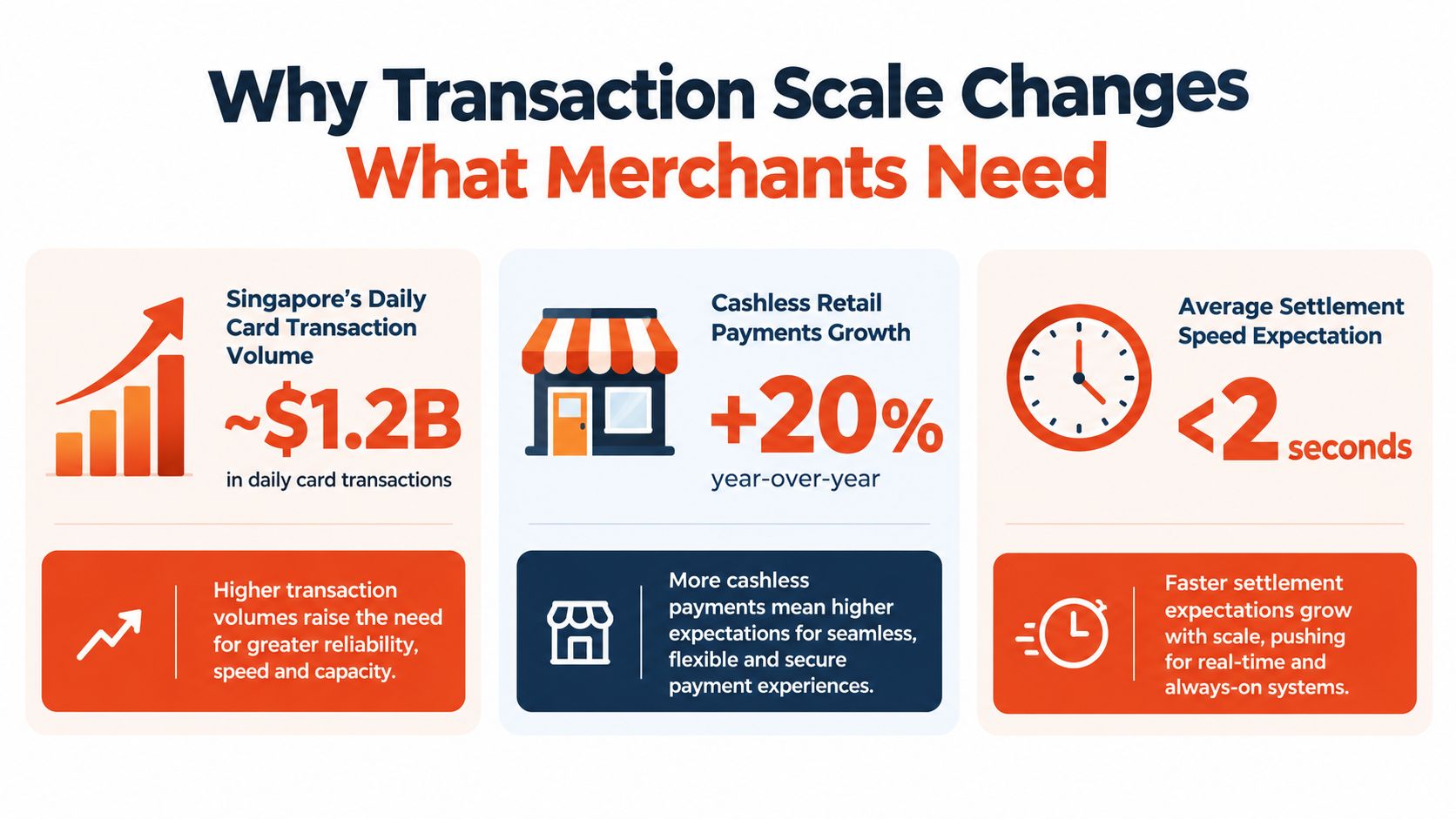
These amounts come from purchases at stores, cafés, clinics, salons, and other businesses. A processor must handle a steady stream of requests, keep transaction records accurate, support refunds and reversals, and provide settlement information that staff can understand.
For an SME, scale affects cash planning. Predictable payouts help an owner schedule stock purchases, payroll, supplier payments, and reserves. Fragmented records or unclear settlement descriptions make reconciliation slower and leave the owner uncertain about the balance actually available.
Downtime also has a different cost at different times. A brief interruption during a quiet hour may cause little disruption. The same failure during lunch service, a weekend rush, or a fully booked clinic can lead to abandoned purchases and pressure on staff.
Singapore's hybrid acceptance model adds another test. The provider may need to bring card transactions, digital wallets, and PayNow into reporting that makes the money flow easy to follow. Separate settlement files or dashboards can hide fees, delay reconciliation, and make it harder to compare sales with the funds received.
Cash-flow test: A provider's value extends beyond an approved transaction to whether the merchant can reconcile sales and access the resulting funds with confidence.
Settlement timing, reporting quality, terminal reliability, and local support therefore belong in the comparison. The payment may take seconds, but its commercial effect continues through payout, reconciliation, refund, and dispute handling.
Singapore merchants increasingly operate a hybrid acceptance environment. PwC reports that 92.0% of Singaporeans used a digital payment method in the year to November 2025, while cards still led both e-commerce and POS in 2025 and wallets and account-to-account payments continued gaining share (PwC's Singapore payments analysis).
That mix changes the provider question. A retailer may need Visa and Mastercard for card customers, Apple Pay and Google Pay for mobile shoppers, and PayNow or FAST-connected account-to-account acceptance for customers who prefer direct bank payments. A provider that handles only one rail can leave the merchant stitching together separate terminals, dashboards, settlement files, and support contacts.
The first comparison should be coverage. Merchants should list the payment methods customers request, then check whether each method settles into the same reporting and reconciliation workflow. The second comparison should be commercial. Singapore doesn't publish an authoritative merchant discount rate benchmark, so provider pricing remains a commercial decision rather than a public regulated tariff.
That makes the written quote important. It should identify the transaction pricing model, settlement terms, refund treatment, chargeback charges, hardware costs, account fees, and any conditions that can alter the rate. A blended rate can be easier to budget, but it still needs a clear explanation of what it includes.
A provider should also explain how it verifies the merchant during onboarding and how changes to the business are handled. Teams comparing compliance processes can review business verification workflow examples to understand why KYB information and documentation often form part of the setup process.
For a fuller look at the local wallet scene, Sambapay's guide to e-wallet acceptance in Singapore offers additional context. A merchant should then ask:
The strongest choice is rarely the provider with the longest method list. It's the one that combines the needed rails with understandable pricing, dependable operations, and a workflow the merchant can manage every day.
The useful answer to what is a payment processor is operational rather than academic. It's the service layer that helps a business accept payment, communicate securely with the relevant financial institutions, record the transaction, and receive settlement. For an SME, the decision is whether that layer supports the business's customers and cash-flow needs without creating unnecessary complexity.
A boutique may need contactless cards and mobile wallets. A restaurant may prioritise fast counter service and reliable connectivity. A clinic may care more about clear receipts, refunds, and reconciliation across multiple staff members. The provider should be assessed against those workflows instead of a generic feature list.
The acceptance review should include:
A merchant shouldn't judge a processor by one percentage or one advertised rate. Singapore's hybrid market means the cost can vary by payment method, and the absence of a public merchant discount rate benchmark makes direct comparison especially important.
A useful quote should make the commercial model understandable. It should explain transaction charges, settlement conditions, terminal costs, refund handling, chargebacks, and any additional service fees. The owner can then compare the likely total cost against the operational value of faster reconciliation, fewer vendor relationships, and more predictable payouts.
A new payment provider affects staff routines, printed materials, terminal placement, receipts, refunds, and accounting. A coordinated migration plan reduces the risk of a busy trading day beginning with untested hardware or unclear escalation procedures.
Sambapay is one example of a Singapore-based provider offering POS terminals, card acceptance across major schemes, selected digital wallets and PayNow, blended pricing, settlement options from as early as T+1 depending on the merchant agreement, and local onboarding and support. Those features should still be compared with competing proposals against the merchant's own volumes, ticket sizes, payment mix, and service requirements.
Decision principle: The right processor makes payment acceptance easier to operate, easier to price, and easier to reconcile.
Before signing, the merchant should request a written fee schedule, confirm the settlement timetable, test the terminal workflow, and ask who owns each support issue. That small amount of diligence can reveal whether the provider is offering an integrated payment operation or only a device with a rate attached.
Sambapay helps Singapore SMEs accept cards, selected digital wallets, and PayNow through modern POS terminals with transparent blended pricing, settlement options from as early as T+1 depending on the agreement, and local support. Merchants comparing payment processors can visit Sambapay to review the available acceptance and onboarding options.