
A Saturday queue is building at a neighbourhood clinic. The receptionist needs to hand a patient a specialist's card, keep the clinic's own cards visible, and avoid adding another loose rectangle to a counter already crowded with receipts, pens and a POS terminal. A small holder can make that exchange orderly, or it can become one more dusty object that nobody uses.
That distinction matters in Singapore. The Monetary Authority of Singapore's H1 2025 retail payment statistics recorded SGD 148.909 billion in total card payments, including POS payments of about SGD 54.540 billion for credit and charge cards and SGD 28.516 billion for debit cards. The same official market figures show that fast, dependable card-present activity sits at the centre of everyday SME operations.
Business card holders belong in that same operational conversation. They organise referrals, supplier contacts and customer handovers, while the payment counter handles frequent transactions. The right choice depends less on appearance than on format, capacity, material, hygiene and whether physical cards still fit the firm's workflow.
At a busy optical shop, the receptionist may pass a customer a lens-lab contact, receive a supplier's card and point a walk-in towards a nearby service, all within a few minutes. Without a holder, those cards drift beneath receipts, get mixed with appointment notes or disappear into a drawer. With one well-placed holder, each card has a visible home.
That makes business card holders practical counter equipment, not desk decoration. A business keeps its own cards available, gives visitors a tidy place to leave contact details, and makes referrals easier to complete. The holder also signals that the team has organised the small details around the customer interaction.
A card placed flat beside a till often looks temporary. A card presented from a clean, stable holder feels deliberate, particularly in clinics, salons, gyms and professional reception areas where the customer is already speaking with staff. The holder doesn't create trust by itself, but it prevents a useful contact from looking like an afterthought.
This is especially relevant in a market where physical and digital payment experiences meet. Singapore's card-payment environment remains highly active, and a business card holder often sits beside the terminal as part of the same customer-facing zone. Guidance on cashless payment in Singapore helps explain why that zone has become so important for SMEs handling frequent in-person purchases.
Practical rule: If staff hand out cards during a normal shift, the holder should sit within one clean movement of the conversation, not in a drawer behind the counter.
A holder works when staff can refill it, customers can identify the cards and the counter remains uncluttered. It fails when it is oversized, hidden behind equipment or filled with cards that no longer match the current service offer.
The best setup is usually modest. One holder for the firm's own cards and, where relevant, one separate space for partner or supplier cards keeps the handover clear. Mixing every contact in one container saves counter space but creates hesitation, especially when the receptionist has to search while the customer waits.
The holder format should follow the counter task. A clinic reception needs controlled access and easy filing. A salon may want customers to browse partner services themselves. A minimart might need a compact place for supplier contacts rather than a display that invites every visitor to take a card.
A flat desk holder suits a clinic or office reception. Staff can pull cards one at a time without lifting a lid, and the low profile leaves room for forms or a sign-in area. An angled countertop display rack works better for a salon, gym or retail shop where visitors browse and take partner cards independently.
A pocket or sleeve holder is useful beside a till when the cards are mainly for staff reference. It protects the stack and takes little space, although it slows customer self-service. A wall-mounted or shelf-mounted holder suits a tight retail counter or kiosk where drawers are already occupied.
| Format | Best For | Typical Capacity | Watch-out |
|---|---|---|---|
| Flat desk holder | Clinic reception and office desks | Qualitative, small to medium stack | Cards remain exposed to dust |
| Countertop display rack | Salons, gyms and retail partner displays | Qualitative, medium to large stack | Takes more counter space |
| Pocket or sleeve holder | Till-side supplier and staff cards | Qualitative, compact stack | Less convenient for browsing |
| Wall or shelf-mounted holder | Tight counters and kiosks | Qualitative, depends on pocket depth | Requires suitable mounting |
Capacity should be treated as a planning decision rather than a catalogue feature. Singapore print-vendor guidance describes desk and card cases that commonly hold roughly 10 to 60 cards, depending on the form factor. Singapore business card holder specifications provide a useful starting point, but actual stock thickness and refill habits matter more than the headline capacity.
An owner selecting an everyday carry design should also separate personal portability from counter display. A slim leather case such as the everyday carry card holders collection is intended for staff or owners carrying cards, not necessarily for open customer access. That distinction prevents a common purchasing mistake, using a pocket case as a reception display.
Open racks make grabbing easy but leave cards exposed to dust, fingerprints and edge wear. Sleeves protect better but add friction. A clinic that controls every handover may favour protection, while a gym promoting several partner services may accept more exposure in exchange for self-service access.
The strongest choice is the one that supports the actual movement around the counter. A beautiful holder in the wrong position becomes clutter. A plain holder that staff can reach without turning away from the customer usually performs better.
A holder can look correct online and still fail at the counter if its internal slot is too tight. Singapore business cards commonly follow the 90mm x 54mm format, so procurement teams should check the internal dimensions rather than relying on a product photograph. Singapore supplier guidance on business card holders also shows that related holder formats vary considerably in size and geometry.
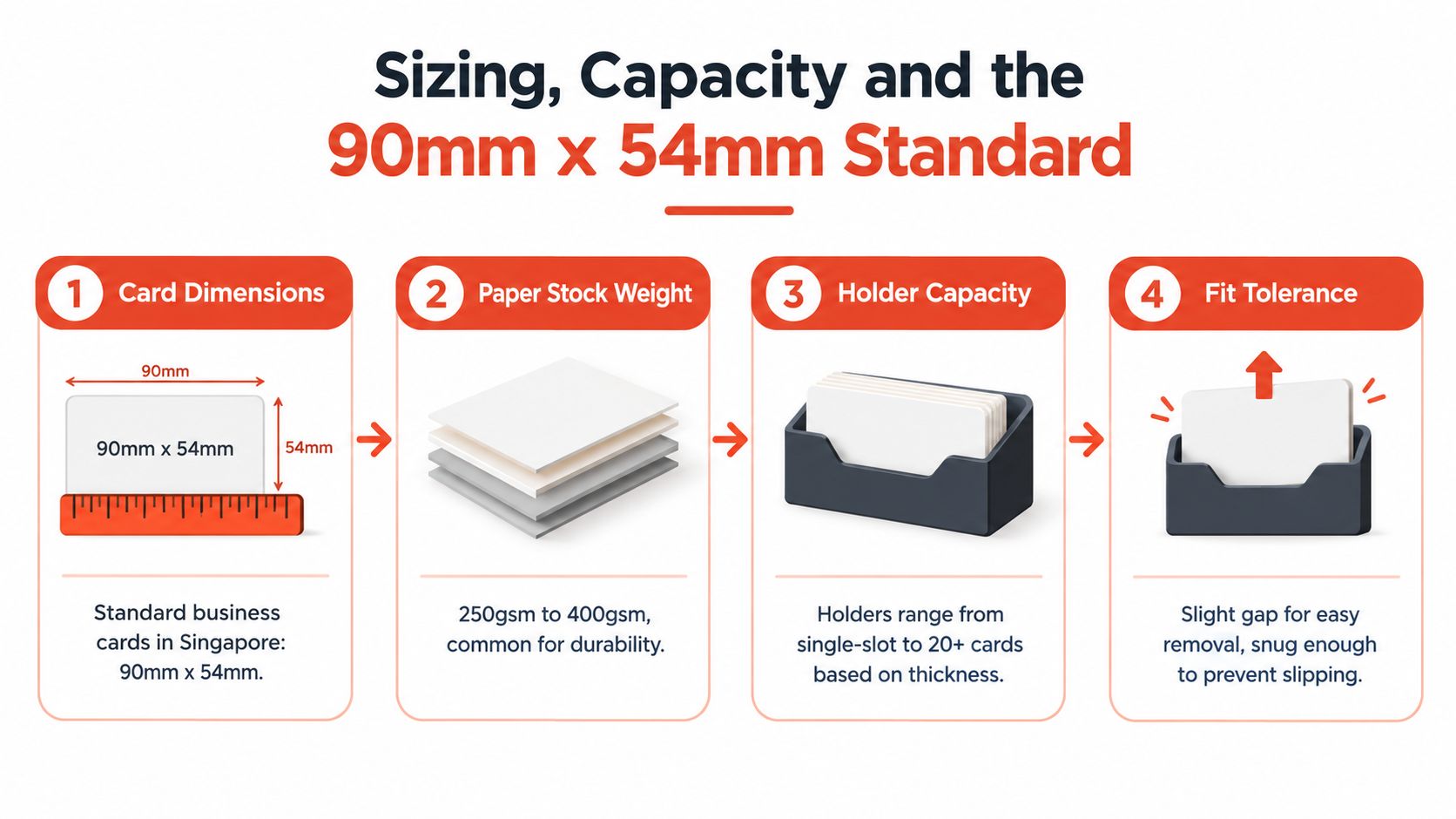
Before placing a bulk order, test three samples:
The card should enter without bending and leave with a thumb movement. A little clearance helps staff remove one card cleanly, but excessive space allows the stack to lean, slip or curl at the corners.
Capacity should follow refill frequency. A small clinic may need only a modest working stack, while a retail counter with regular handovers benefits from a larger rack. Overbuying creates its own problem. Cards sit exposed for longer, collect dust and develop edge curl before anyone notices.
A holder's capacity also depends on card thickness, not just the number printed on the supplier listing. Procurement teams should ask whether the stated capacity assumes thin cards and whether the internal slot can accommodate the business's actual stock. A holder that technically fits the cards but requires force at every handover isn't fit for daily use.
The accompanying business card holder sizing video can help teams visualise the difference between a neat fit and a slot that creates unnecessary friction.
Material selection affects how the holder feels after repeated handling, wiping and exposure to Singapore's humid environment. Supplier quotes commonly feature PU leather, stainless steel, aluminium, PVC or acrylic, and eco-friendly materials, each with a different balance between presentation and maintenance.
Exact small-order prices vary by supplier, branding method, finish and order quantity. Since the verified supplier information does not establish reliable SGD price bands for each material, a responsible buyer should request a current quotation rather than rely on a made-up “indicative” figure.
| Material | Durability in tropical use | Hygiene and wipe-clean | Branding area | Indicative SGD per holder |
|---|---|---|---|---|
| PU leather | Presentable, but surface wear and peeling can develop | Easy to wipe gently, sensitive to harsh cleaning | Often limited, such as a small imprint panel | Request supplier quotation |
| Stainless steel | Strong, moisture-resistant and scratch-resistant | Very easy to wipe clean | Suitable for engraving or surface branding | Request supplier quotation |
| Aluminium | Light and resistant to ordinary moisture | Easy to wipe clean | Good for engraving or printed panels | Request supplier quotation |
| PVC or acrylic | Affordable-looking display option, but can haze or scratch | Easy to clean, fingerprints may show | Usually generous for printed branding | Request supplier quotation |
| Recycled or bamboo composites | Depends on the formulation and finish | Check cleaning instructions carefully | Branding varies by surface | Request supplier quotation |
Stainless steel is the dependable option for clinics and high-touch reception areas. It resists moisture and scratches better than softer finishes, and its surface tolerates routine wiping. Aluminium is lighter, which helps when staff need to move a display, but a dropped unit can dent.
PU leather offers a warmer branded appearance and can suit a boutique reception desk. The trade-off is maintenance. A small imprint area may limit the logo treatment, and aggressive cleaning can damage the finish. Buyers comparing card stock should also understand how material and card thickness interact. A printer's guide to 16pt to 32pt cardstock options offers useful background for teams choosing cards that must slide smoothly through a holder.
Acrylic and rigid PVC make sense where visibility and low complexity matter, but scratched or hazy surfaces quickly make a counter look neglected. Eco materials can support a brand position, yet the owner should verify moisture resistance and cleaning instructions before using them in an F&B or clinic environment.
For most SMEs, the sensible answer is simple: metal for hard daily use, PU leather for controlled presentation, acrylic for temporary or highly visible displays, and eco materials when the maintenance requirements are understood.
Placement determines whether a holder becomes part of the workflow or disappears into the background. Staff should be able to reach it without crossing the customer's paperwork, turning away from the queue or touching the card faces unnecessarily.
At reception, place the holder near the visitor but outside the signing zone. That keeps pens, forms and appointment documents from knocking it over. A pocket-style unit works when staff control the handover, while a low desk holder suits a clinic that files or distributes cards throughout the day.
The till needs speed and visibility. An angled display lets the cashier hand over a card with the logo facing the customer, while a compact footprint protects the payment area from clutter. The holder shouldn't obstruct the terminal, receipt printer or customer's view of the amount.
Businesses reviewing POS machines for small business should assess the whole till layout together. A payment terminal, receipt space and card holder need clear movement paths, particularly during busy service periods.
A consultant at a clinic, salon or professional-services desk usually needs a single sleeve or narrow pocket. One card can be pulled cleanly during the conversation, without fanning through a stack or exposing unrelated contacts. The holder should sit on the staff side unless customers are expected to take a card themselves.
For gyms, cafés and takeaway counters, a wall or shelf-mounted pocket can sit beside the queue line. Staff can point to it or pass a card without reaching into a drawer. Every holder should retain a visible working minimum, so it never appears abandoned. If the stack is almost empty, the person responsible for opening or closing should refill it as part of the daily counter check.
Digital name cards have changed the handover, but they haven't removed every reason to keep printed cards available. A customer may scan a QR code, save the contact immediately or receive details through a messaging app. Another customer may nod, accept the digital prompt and never return to it.
The practical test is whether the physical card supports an existing conversation. It remains useful where people queue, wait or speak directly with staff, including clinics, salons, car showrooms, F&B collection points and B2B reception desks. It is less useful for a pure e-commerce firm or remote-first consultancy with no customer-facing counter.
Singapore's shift towards digital name cards is real. A 2023 CNA report described more than 90 government agencies using digital business cards through Workpal Mobile, while companies such as PropNex were phasing out printed cards. The CNA report on digital business name cards makes the purchasing question more nuanced: the issue isn't whether physical cards are fashionable, but whether the counter still needs a tangible prompt.
A practical hybrid setup uses a small physical holder beside a QR-enabled digital option. A service business can offer a printed card to a customer who wants something to keep, while directing another customer to a digital profile. Resources such as SigFinch QR code business cards show how QR-based identity can sit alongside, rather than automatically replace, a physical handover.
A premium holder doesn't earn its place because it looks expensive. It earns its place when staff repeatedly use it and the counter needs a reliable way to distribute contact details. For businesses with no in-person handover, a single sleeve in a drawer is usually sufficient.
The same discipline applies to payment hardware. A business comparing a credit card terminal in Singapore should keep the holder decision connected to the wider counter workflow, including queue movement, staff reach and the space needed for secure card acceptance.
A neglected holder can undermine the presentation it was meant to support. The routine doesn't need to be elaborate, but someone must own it. A short weekly check catches dust, warped cards, empty pockets and outdated contact details before customers see them.
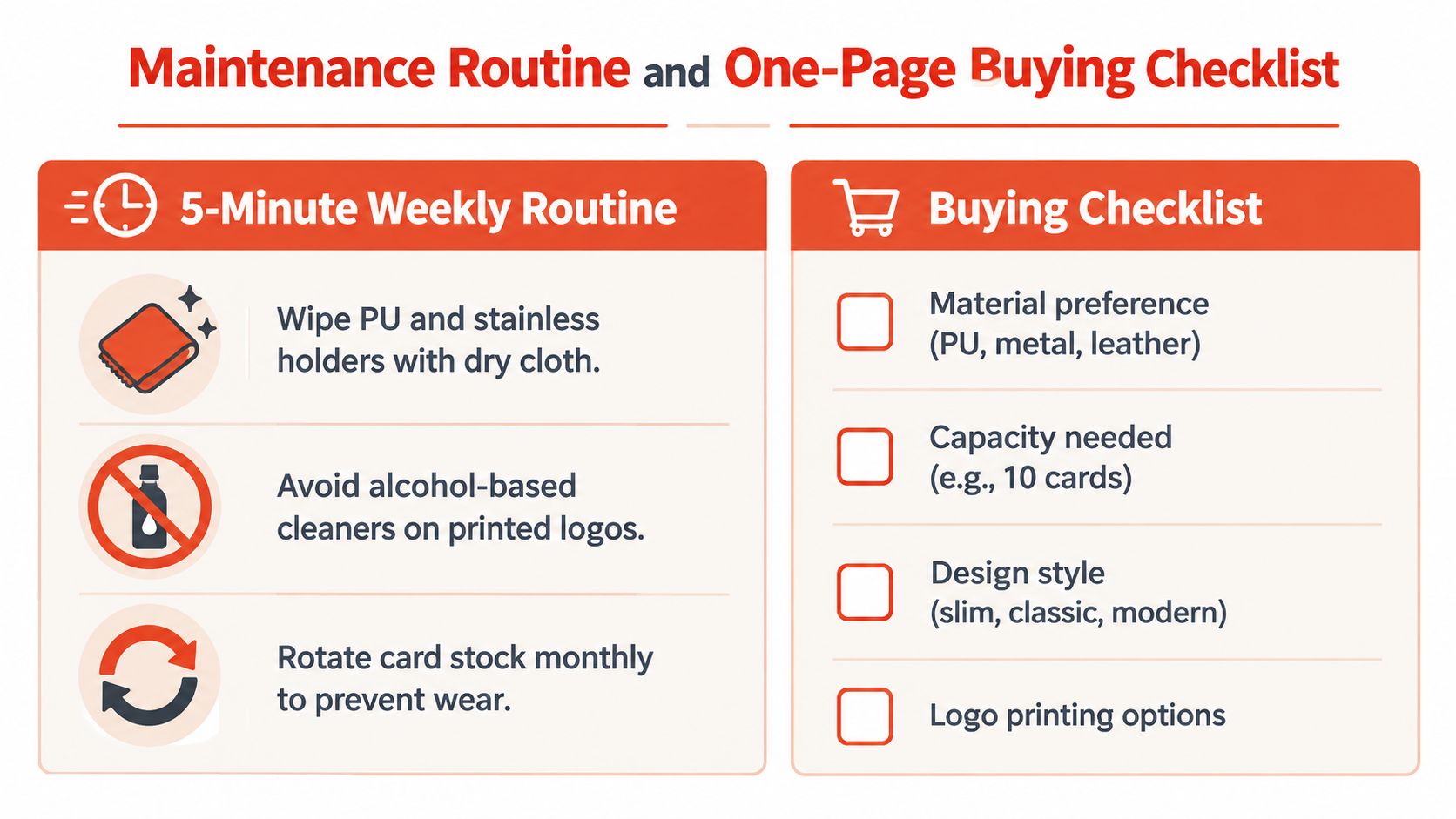
Before ordering, the purchaser should confirm:
The final decision rule is straightforward. If cards are handed out more than once a week, a physical holder earns counter space. If handovers are rare or entirely digital, one tidy sleeve in a drawer is enough.
Sambapay helps Singapore SMEs organise the payment side of the same customer-facing counter with modern Android POS terminals and in-store acceptance for major card schemes and selected digital wallets. Visit Sambapay to discuss a payment setup that fits the business's workflow, counter space and settlement needs.