
It's a Tuesday lunch peak in a small Singapore café. The queue's moving, staff are calling orders, and a customer taps a blue Amex card on the terminal. That tap either works cleanly in seconds, or it triggers an awkward pause, a second attempt, and a queue that starts watching.
Whether a merchant can let customers pay by Amex isn't decided in that moment. It's decided days earlier, in the acquirer settings, terminal parameters, staff routines, and dispute process behind the counter.
The tap looks simple from the customer's side. The card touches the screen, the terminal beeps, the receipt prints, and the next person steps forward. For staff in a busy café, boutique, salon, or clinic, that beep is the only visible signal that several checks have already happened.
Behind the screen, the transaction doesn't stay inside the shop. It travels from the terminal through the card network to the issuer, which checks available credit and transaction authenticity before returning an approval or decline. If any link in that chain isn't configured for Amex specifically, the customer sees a failure even though Visa and Mastercard worked five minutes earlier.
Frontline staff often assume a terminal that accepts cards accepts all cards. That assumption breaks down at the busiest moment, when there's no time to inspect settings or call support. A declined Amex tap then looks like a card problem, when the underlying cause may be commercial enablement or terminal configuration that was never switched on.
Customers notice the difference. An Amex cardmember who chose the café for a client lunch, or a boutique for a larger purchase, expects the card on the window sticker to work. When it doesn't, staff have to ask for another card, explain the delay, and manage a queue that didn't cause the problem.
A logo on the door is a promise to the next customer in line. The terminal configuration has to keep that promise before peak hour tests it.
For a brick-and-mortar SME, pay by Amex acceptance affects more than checkout choice. It shapes how staff handle refunds to the original card, how the owner reconciles settlement that night, and what evidence survives if the customer later disputes the charge. Each step depends on work done before the first live tap.
The useful question isn't whether Amex should appear on a sticker. It's whether the shop can answer three practical points: is the brand enabled, can staff recognise a healthy authorisation, and can the business produce the receipt and delivery proof later? A café that can answer those questions turns a blue card at lunch into a routine transaction. A café that can't treats every Amex tap as a surprise.
Amex occupies a distinct, smaller position in Singapore. In the cited country-level breakdown, cards accounted for 53% of e-commerce payment methods, with 48% attributed to local schemes, 27% to Visa, 19% to Mastercard, 3% to American Express, and 3% to other methods, figures set out in the PPRO country breakdown for Singapore payment methods.
That breakdown isn't an official MAS measure of Amex point-of-sale share, and it shouldn't be read as one. It does give an owner a directional sense of scale. Amex isn't the mass-market workhorse, and it isn't invisible either. It's a narrower cardholder segment that a merchant either serves deliberately or turns away at the till.
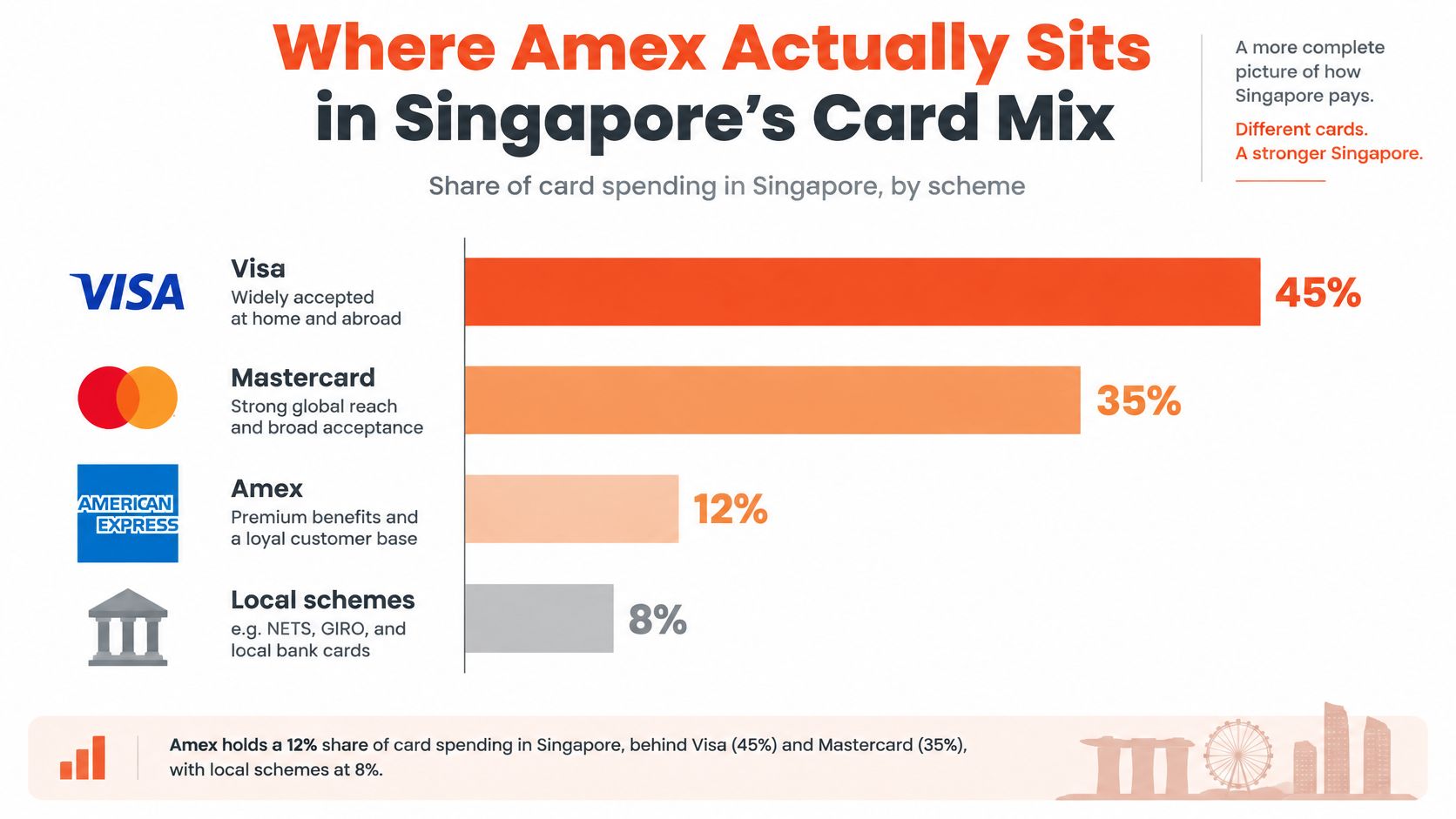
The addressable card market around that segment is large. Singapore recorded 1.049 billion point-of-sale credit- and charge-card transactions worth S$73.147 billion in the first half of 2024, implying an average near S$70, according to the figures summarised on Sambapay's American Express payment page. Those totals cover card schemes collectively, not Amex alone.
For a salon in Bugis, a dental clinic, or a restaurant near offices, the maths is personal. The relevant test isn't national share in isolation, it's the customer profile at that counter. Corporate diners, travellers, and clients who deliberately carry Amex for rewards will notice its absence, even if most other customers never ask.
A smaller share changes the operating case, not necessarily the answer. The merchant carries the same setup, training, and dispute discipline for fewer transactions, so sloppy processes hurt more per sale. At the same time, refusing the card can mean losing the whole basket, not just swapping one tender for another, especially when the customer doesn't carry a backup card.
Owners should also avoid inflating the figure. MAS publishes semi-annual retail-payment data across schemes collectively, so those volumes describe workload and card habit, not Amex market share. The sound conclusion is narrow: Amex serves a defined minority, and the merchant should decide based on who walks in, what they spend on, and whether staff can support the method properly.
Setup starts with the merchant agreement, not the terminal screen. The acquirer configuration must explicitly enable the Amex brand for that merchant, with the correct merchant category and routing in place. MAS identifies American Express as one of the major charge-card operators in Singapore and describes card operators as providing the network linkage between merchants and issuing banks in its EMEAP Red Book Singapore chapter on payment systems.
Once commercial enablement is active, the terminal needs the correct acceptance parameters and application loaded. On a device such as a PAX A920 Pro, staff shouldn't treat a software update or a visible Amex logo as proof of readiness. Routing, terminal certification, and category configuration all have to line up, details an owner can sanity-check against the guide to a contactless payment terminal for in-store acceptance before go-live.
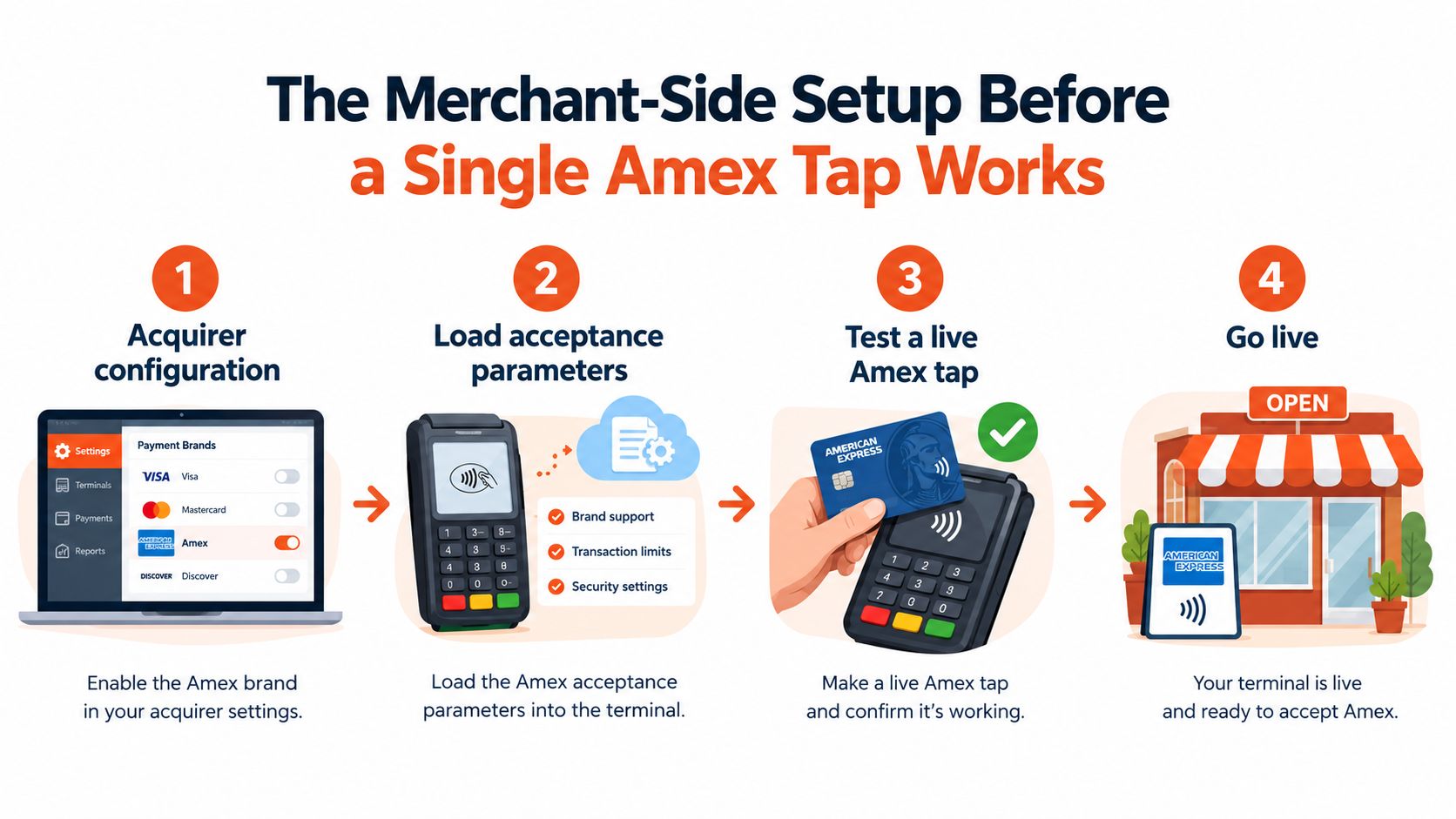
A controlled pilot should run before the first customer relies on it. Test chip insert, contactless tap, and the fallback path staff will use if a tap fails. Then test the money-out flows while there's still time to fix them: a refund to the same card, a reversal of a mistaken entry, and, for F&B, a tip or gratuity flow.
Volume testing matters too. Singapore POS credit and charge-card payments reached 321 million transactions worth SGD 26.293 billion in H1 2025, implying an average ticket of around SGD 82, in the MAS H1 2025 semi-annual retail payment statistics. A merchant can use that rough SGD 80 basket as a workload benchmark for lunch rushes, salon packages, and retail baskets, without pretending MAS published an Amex approval rate.
Go-live rule: Don't test only the happy path. The refund, reversal, and fallback flows are where new setups usually embarrass staff.
The order matters because each step exposes a different failure:
That sequence turns acceptance into a verified state rather than a hope. When the first decline appears, staff can then distinguish an issuer decision from a setup fault, because the setup fault should already have been found.
From the customer's side, pay by Amex usually arrives in four forms. There's the physical card tap, the chip insert, a phone or watch with Amex loaded into a wallet, and the less visible case: a refund returning to a card used days earlier. Staff need to recognise each path without slowing the queue.
A healthy tap on a PAX terminal is uneventful. The amount shows, the cardholder taps, the terminal contacts the network, and the screen moves to approval with Amex branding reflected in the transaction record and receipt. At busy periods that authorisation can take a half-beat longer, so staff shouldn't snatch the card away or re-key the amount at the first pause.
Chip insert is the steady fallback when a tap doesn't read. The customer leaves the card in the slot until the terminal completes its checks, and staff should watch for the prompt rather than pulling the card early. Mobile wallet payments look different again, because the customer authenticates on the phone before presenting it, and owners weighing acceptance can check which wallet type suits your business to understand what's happening on the customer device.
Refunds complete the picture. The customer may tap or insert the same card, or staff may process the return against the original transaction details held in the system. Either way, the receipt should clearly show it's a refund, not a new charge, because that's the document the customer checks against a statement later.
In a retail shop, staff can learn the healthy pattern within a shift. Amount confirmed, card presented, brief processing state, approval message, receipt available. Anything outside that pattern deserves calm attention, not repeated tapping. A timeout, a request to insert instead of tap, or a decline message means the next step should follow the terminal prompt or the shop's fallback procedure.
That discipline protects the customer experience. Nobody wants three attempts and a whispered conversation about whether the card works. Clear prompts, one attempt at a time, and a receipt the customer can read make Amex feel as ordinary as any other card, which is exactly the point.
Most merchant anxiety about Amex focuses on the processing rate. That's understandable, because the rate is visible on every statement. The sharper cost, though, often arrives later and in one lump, when a dispute becomes a chargeback and the merchant discovers the paperwork was never filed properly.
American Express states that a dispute can become a chargeback where the disputed amount is deducted from the merchant account and credited to the cardmember, and missing the response deadline can expose the merchant to a chargeback for the full amount, as set out in the American Express Singapore merchant disputes guidance. On a high-value clinic treatment or salon package, that single deduction can dwarf weeks of rate differences.
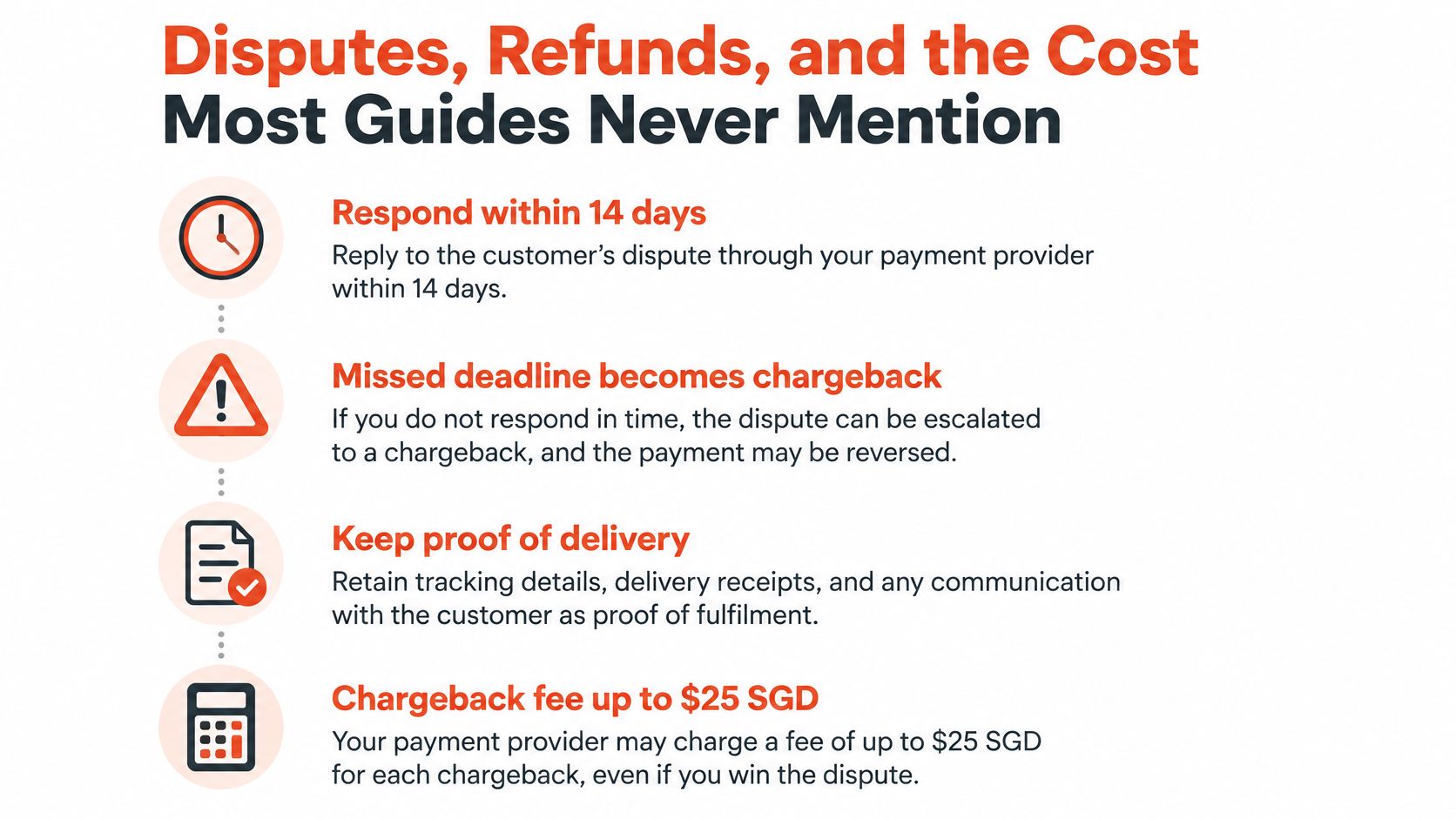
The same guidance points to documents a merchant should be able to produce quickly. An itemised receipt shows what was sold. Proof of authorisation shows the transaction was approved. Delivery or service documentation shows the customer received what was paid for, whether that's a signed collection note, an appointment record, or a completed treatment log.
Staff should file those items at the time of sale, not after a dispute letter arrives. A supervisor hunting through paper rolls weeks later has already lost time. Owners who need to trace a transaction through settlement records can use the reference explained in the guide to an acquirer reference number for payment tracing to connect the receipt to the processed payment.
The owner's decision is practical, not emotional. If the service wasn't delivered, or a duplicate charge occurred, a prompt refund closes the matter and protects the relationship. If the goods were collected and the evidence is strong, representing the charge with a complete pack gives the merchant a fair chance to keep the sale.
A refund decided by the merchant is controlled. A chargeback decided after a missed deadline isn't.
Timing decides much of the outcome. Every dispute notice should go to a named person, with the deadline written where the team can see it. That person gathers the receipt, authorisation, and service proof first, then decides whether the evidence supports a challenge. Guessing, delaying, or sending a bare card slip wastes the one opportunity to respond properly.
This is why pay by Amex should be treated as a post-transaction risk-management process, not only a checkout feature. The terminal work gets the sale. The filing habit, deadline discipline, and refund judgement determine whether the merchant keeps it.
Go-live isn't the end of the work. It's the point where a merchant starts learning whether Amex behaves like the other tenders on the same terminal, in the same store, during the same trading hours. Without that comparison, one bad afternoon can trigger panic, and a slow fault can run unnoticed for weeks.
Context helps set expectations. MAS figures for H1 2025 show in-store POS credit and charge-card payments formed about 30.6% of all card-payment volume and 36.0% of value, calculated from 321 million POS transactions worth SGD 26.293 billion against 1.049 billion total card transactions worth SGD 73.147 billion across POS and card-not-present channels, as published in the MAS H1 2025 dataset cited earlier. That mix is a workload benchmark, not an Amex performance target, because MAS aggregates schemes.
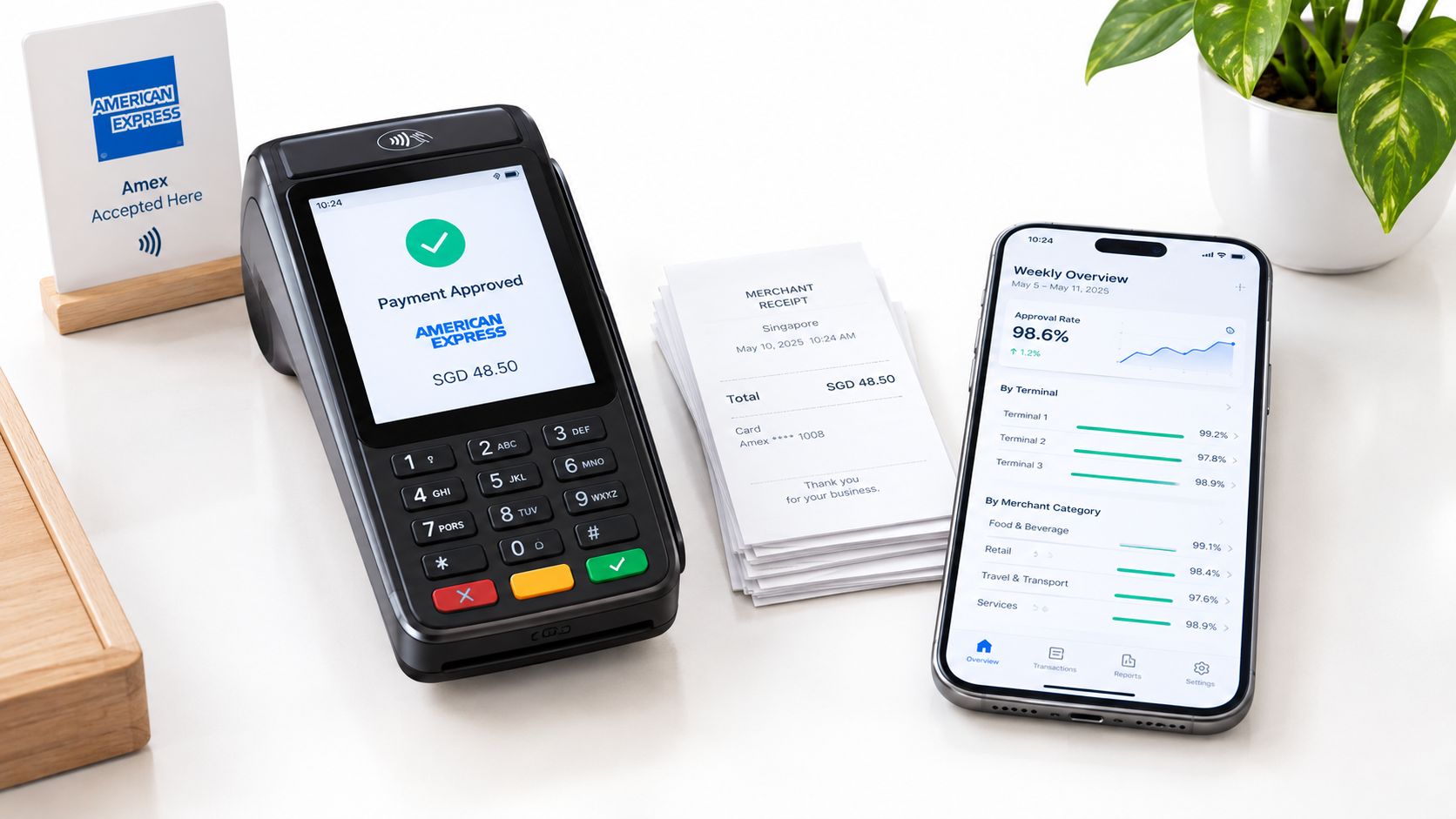
A short weekly review beats a monthly surprise. The owner or manager should look at a handful of tender-level measures per terminal and per merchant category, then agree in advance what gap triggers a call to the provider.
Amex results should be compared with other card brands using the same ticket bands. A clinic with larger tickets will see different decline patterns from a café, and mixing POS with card-not-present results muddies the comparison further. Sustained gaps deserve investigation. Single declines usually don't.
Settlement discipline closes the loop. Providers such as Sambapay offer settlement from as early as T+1 under merchant agreements, and owners should confirm how Amex funds land relative to other tenders by reading the explanation of card payment settlement timelines for merchants before assuming every scheme pays on the same cycle.
Statements need the same care. Blended pricing can keep the headline rate simple, but the owner should still inspect the per-tender breakdown, refund lines, and any chargeback deductions. Blending the whole month into one card total hides exactly the variances the weekly dashboard is meant to catch.
Once that loop runs, Amex becomes manageable. Setup is verified, staff recognise the flows, dispute evidence is filed at the point of sale, and settlement is checked while discrepancies are still small. The blue card at the till stops being a special event and becomes what it should have been from the start, one more reliable way for a customer to pay.
Sambapay supplies Singapore SMEs with PAX smart POS terminals that accept Amex alongside other major cards and selected wallets, with transparent blended pricing, settlement from as early as T+1, and local onboarding support to get the configuration right before the first tap. Owners planning to switch on Amex properly, from terminal parameters to settlement checks, can visit Sambapay to discuss a setup matched to their shop, café, salon, clinic, or studio.