

Saturday lunch is underway. A customer at a Singapore restaurant taps an American Express card on the counter terminal, the cashier keeps the queue moving, and the terminal returns an approval. For the merchant, that quick moment raises practical questions: Is Amex enabled for this payment method? What fee applies? When will the funds arrive?
An American Express payment is both a checkout experience and a commercial decision. The right setup lets a business serve customers who prefer Amex while keeping fees, security controls and settlement visible enough to manage.
At the counter, the cashier enters the amount and the customer taps an Amex card on a PAX terminal. The terminal reads the contactless credential, packages the transaction details and sends them securely through the merchant's acquiring setup. The cashier doesn't need to see the routing behind the screen, but the result depends on several parties handling the request in sequence.
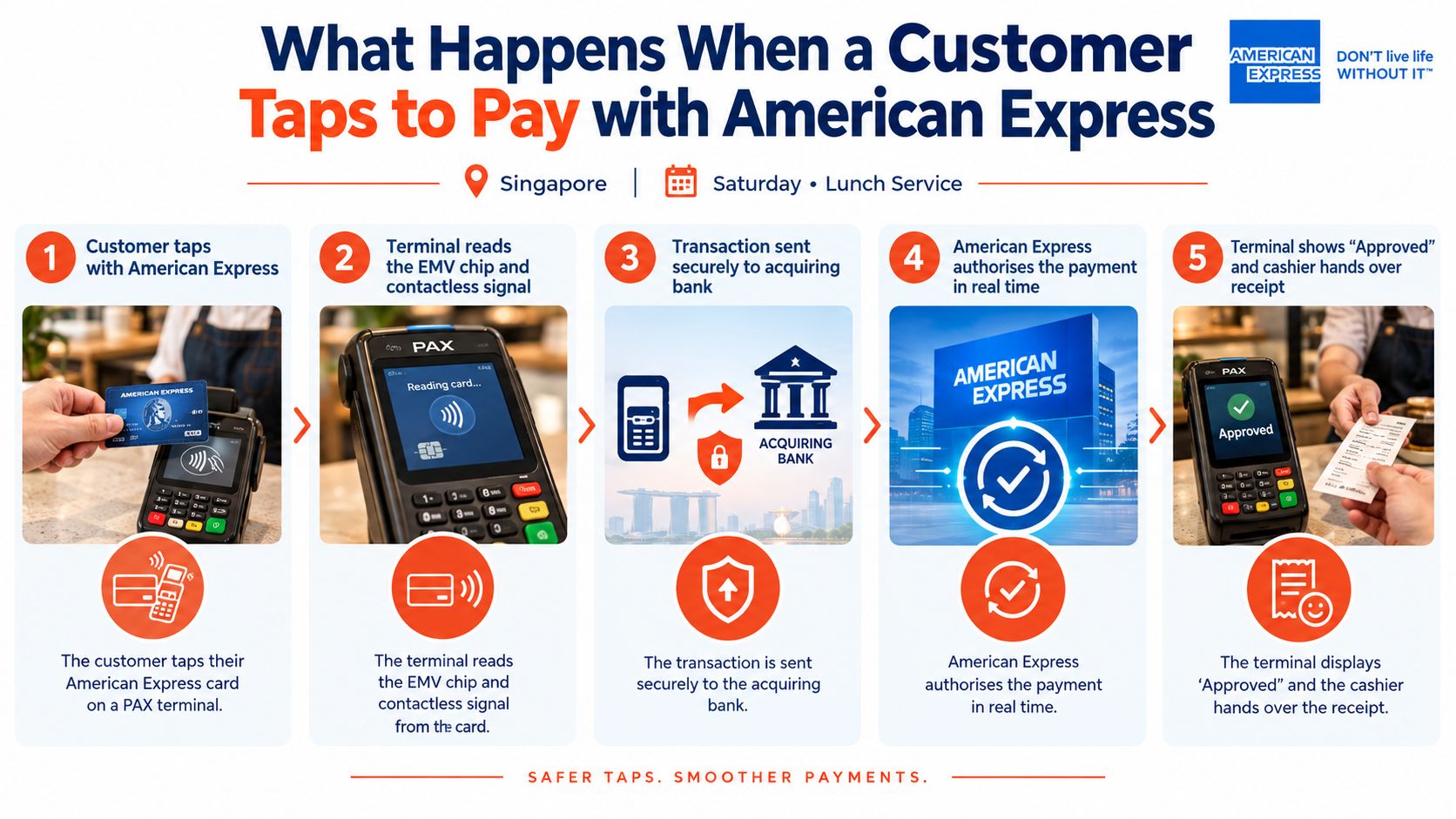
The terminal captures the payment data and starts the authorisation request. The acquirer, which connects the merchant to payment processing, passes that request to American Express. The network routes it to the card issuer, the institution responsible for the cardholder's account. The issuer checks the request and returns an approval or decline through the same chain. The terminal then displays the result so the cashier can complete the sale or offer another payment method.
An approval means the payment has been authorised, not that the merchant's bank account has already received the money. After the sale is submitted for processing, settlement follows the terms of the merchant agreement. That distinction matters at the counter: staff need to respond to the terminal's result, while the owner tracks the eventual payout and its fees in the back office.
Counter rule: Treat the terminal response as the checkout decision. Treat settlement as a separate back-office process that needs its own reconciliation.
For a new staff member, the short version is simple: the terminal captures the tap, the acquirer routes it, American Express and the issuer process the request, and the result returns to the terminal. If the merchant account or terminal isn't configured to accept Amex, a technically capable device alone won't complete that chain.
A restaurant order passes from the server to the kitchen, through the right station, and back to the table. A card payment also moves through handovers, but each party has a defined job.
The cardholder presents the card. The issuer manages the cardholder's account and decides whether to authorise the purchase. The merchant accepts the payment for goods or services, while the terminal captures the transaction and sends it into the acquiring route. The acquirer connects the merchant to the relevant scheme, and American Express routes the request to the issuer and returns the response.
American Express can sit both as the card scheme and as the network handling its own card transactions. That's different from assuming every card follows the same route as Visa or Mastercard. For a merchant, the practical point is that Amex acceptance depends on the merchant agreement and processing configuration, not merely on whether the terminal has a contactless symbol.
In the kitchen analogy, a ticket doesn't reach the right station just because the kitchen is open. The order must be routed correctly, the station must be equipped to prepare it, and the finished dish must return to the server. Likewise, the merchant needs Amex enabled through the acquiring arrangement, the terminal must support the required transaction method, and the response has to make it back to the cashier.
The same operational split matters for reporting. A sale can be approved at checkout and then appear later in submission, settlement and transaction records. Those records help the owner match card receipts to the payout rather than treating the screen's approval as the end of the financial process.
Merchants comparing broader card acceptance can review Sambapay's credit-card payment options. For online shops, a well-designed checkout can also reduce avoidable friction; this guide to an express checkout conversion boost offers useful context on simplifying the customer's payment journey.
“Accepting Amex” can mean several different things at a Singapore business. A boutique may take a physical card at its counter, a clinic may send an invoice link, and a fitness studio may bill a member on a recurring basis. Each route has a different customer experience and a different configuration to verify.
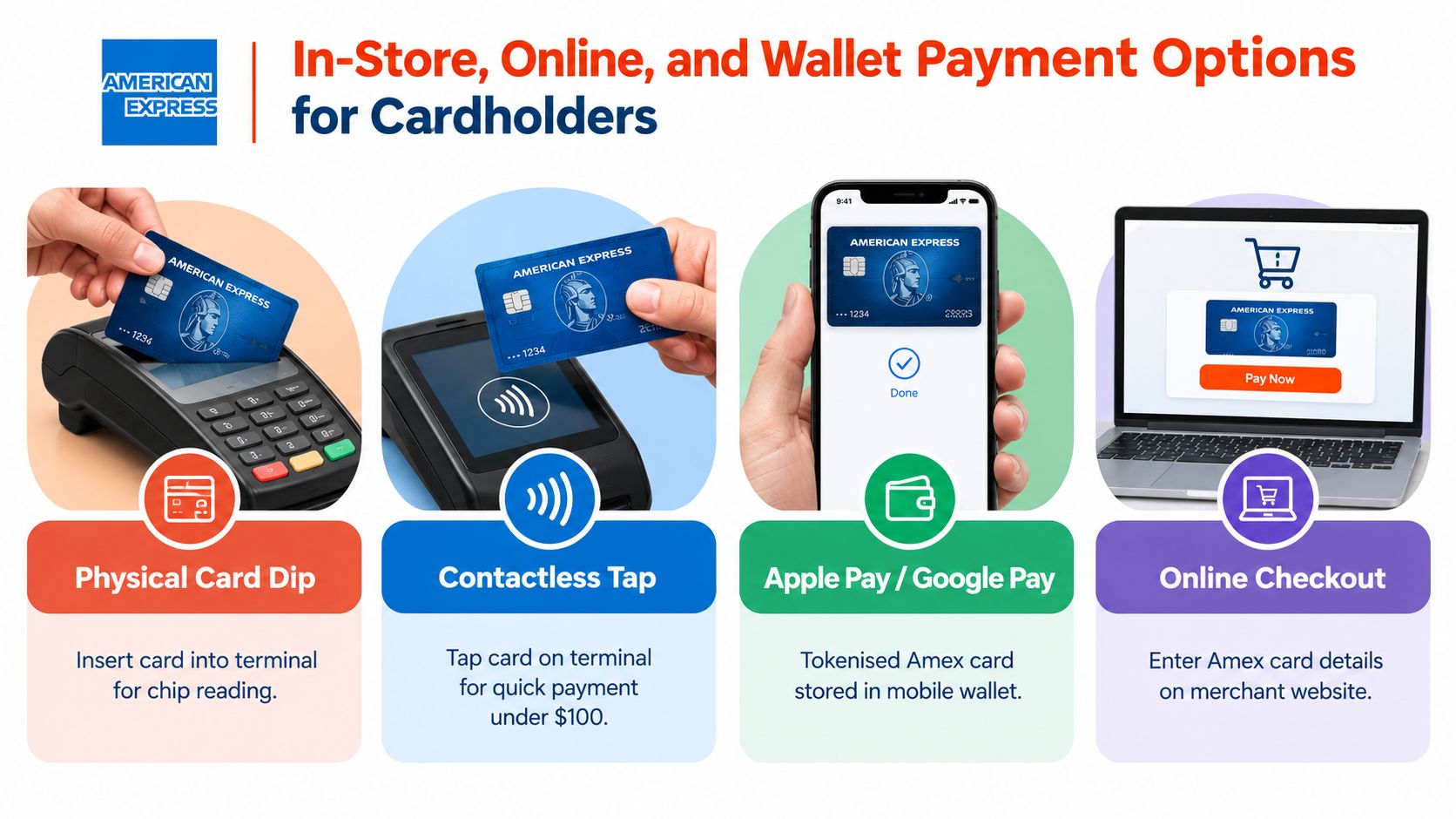
| Payment method | What the customer does | What the merchant needs to check |
|---|---|---|
| Physical chip card | Inserts the card into the terminal. | Amex acceptance is enabled, and the terminal reads chip data correctly. |
| Contactless card | Taps the card against the terminal. | The terminal's certified contactless capability and merchant configuration support the transaction. |
| Mobile wallet | Taps a phone or wearable containing a tokenised Amex card. | The wallet is supported and the device verification flow works as expected. |
| Online or app payment | Enters card details or selects a stored card. | The acquiring setup supports remote Amex payments and the checkout handles authentication and transaction details correctly. |
A physical card and a wallet version of that card aren't interchangeable from the merchant's point of view. A wallet uses a tokenised credential and may require device-based cardholder verification. An NFC-capable terminal can read contactless payments, but that doesn't prove that Amex is enabled on the merchant account or that every supported wallet flow has been tested.
For remote payments, the merchant doesn't have a card or phone at the counter to verify. A clinic sending an invoice link or a retailer taking an app order should check the online setup separately from the in-store terminal. Recurring billing also needs its own configuration and customer communication, rather than being assumed to work based on a one-off Amex sale being approved.
A successful test with a physical card confirms only that test path. Test each payment method the business plans to offer.
Amex acceptance is a contribution-margin decision, not a slogan about whether one scheme is “too expensive”. The relevant question is whether the margin from retaining and serving Amex customers covers the fee and any operational costs involved.
Singapore's payment environment gives merchants a substantial card base to consider. In the first half of 2024, the country recorded 1.049 billion point-of-sale credit and charge-card transactions worth S$73.147 billion, with an average transaction size of S$70, according to the Monetary Authority of Singapore's retail payment statistics. The figures aggregate card schemes and don't identify Amex separately, so they describe the broader point-of-sale environment, not Amex market share.
Consider a restaurant that serves a group whose preferred payment card is Amex. If the restaurant declines that card, the business may lose the sale or ask the customer to find another way to pay. If the sale goes through, the merchant keeps the contribution left after food, labour and other variable costs, but pays the applicable processing charges. The sensible comparison is the contribution retained against the fee, not the full sale value against the fee.
A salon or boutique should make the same assessment using its own customer mix and typical basket. If Amex customers tend to add services or products, that can affect the calculation, but it should be measured in the business's own records rather than assumed. A higher ticket doesn't automatically make acceptance worthwhile, and a smaller purchase doesn't automatically make it unprofitable.
Amex's Singapore merchant terms say settlement deducts a merchant discount rate and other applicable fees, with the specific rate set in the merchant agreement rather than published as one universal price. Before signing, ask whether the provider's quote is blended or separately priced for Amex, and whether any blended rate conceals a scheme-specific component. The merchant discount rate guide for Singapore can help frame the discussion.
Also ask how refunds and chargebacks are treated, whether their costs differ by scheme, and whether settlement timing changes. Then compare the quote with actual sales mix and contribution margin. That's more useful than accepting or rejecting Amex based on a generic fee claim.
For in-store Amex payments in Singapore, the terminal should process EMV chip and contactless data, not rely on magnetic-stripe capture. American Express's Singapore acceptance terms require merchants to capture chip data and obtain authorisation for contactless chip-card transactions of S$200 or less. Digital-wallet contactless payments must support Consumer Device Cardholder Verification Method (CDCVM), as set out in the American Express Singapore merchant acceptance terms.
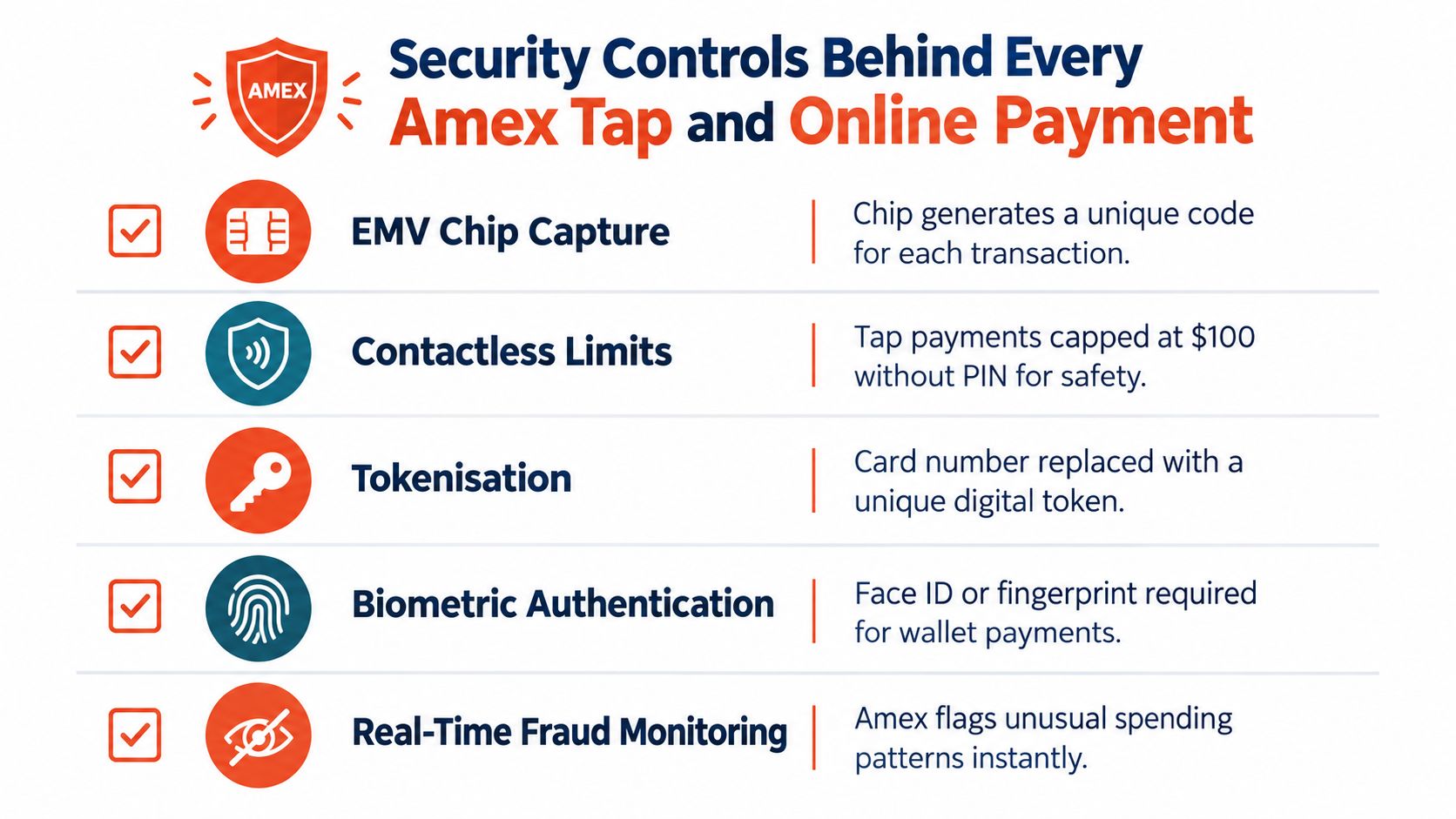
At the counter, verify that the Android POS terminal has certified EMV contactless capability, supports wallet-based device verification and routes transactions for online authorisation where required. For a wallet payment, CDCVM means verification happens through the customer's device credentials, rather than relying only on the fact that a phone was tapped. These controls use chip or device credentials instead of reusable stripe data, which reduces exposure to counterfeit-card and lost-card fraud.
For online and app payments, SafeKey adds an EMV 3-D Secure authentication layer that can request cardholder verification before authorisation. American Express also describes risk systems that assess purchase behaviour and flag irregular activity. Merchants should send accurate transaction details, including billing information, order context and available device or channel data, so the issuer can assess the request with useful context.
American Express's Singapore merchant security materials also describe Enhanced Authorization, which evaluates the transaction party in real time, and address and name validation for added verification. These tools are different from terminal controls: SafeKey and transaction metadata apply to remote-payment risk, while EMV and CDCVM relate to in-person chip or wallet acceptance. Operators looking for broader store-side practices can also find fraud prevention tactics for stores.
The practical go-live test is not “does the terminal tap?” Ask the provider to confirm the correct contactless configuration, wallet verification and authorisation route, then test the online authentication flow separately if the business takes remote payments.
An approved payment and a settled payment are different entries in the merchant's records. Once the transaction is submitted, the acquirer processes it under the merchant agreement and the funds are paid out according to the agreed schedule. Sambapay settlement options can begin as early as T+1, subject to the merchant agreement and operational requirements, as described in its card payment settlement information.
American Express provides merchant account tools with daily-refreshed settlement, submission and transaction information. That gives an owner a way to compare the day's approved sales with submitted transactions and the resulting settlement record. A bank reconciliation process helps catch missing submissions, mismatched amounts or refunds that haven't been matched to the original sale; this bank reconciliation guide for small businesses provides a useful reference for organising the routine.
Suppose a café takes an Amex payment at lunch. The terminal records the authorisation, the sale is submitted, and the merchant later checks the settlement information against the bank credit. If the customer returns the item or the café corrects the charge, the staff initiate a refund through the supported process and retain the receipt and transaction details so the reversal can be matched to the original sale.
A chargeback is different from a refund. It's a dispute raised through the card-payment process, and the merchant may need to provide transaction records or other relevant evidence. Keeping receipts, order details and refund records organised helps the owner respond with the information available, rather than trying to reconstruct the transaction after the dispute arrives.
Settlement timing can vary with the merchant agreement and operational requirements, so owners should confirm the expected schedule with their provider before launch. They should also know which support channel handles payout questions, refunds and disputed transactions. A daily routine that matches terminal, merchant-account and bank records makes exceptions easier to spot while they're still fresh.
A useful launch test follows the payment from the customer's tap to the merchant's records. Amex expanded island-wide acceptance on Singapore buses and the MRT in May 2025, a change reported by AsiaBizToday's coverage of the expansion. That makes it sensible for merchants to check how their own terminal, account and wallet setup behaves, rather than assuming all tap transactions follow the same path.
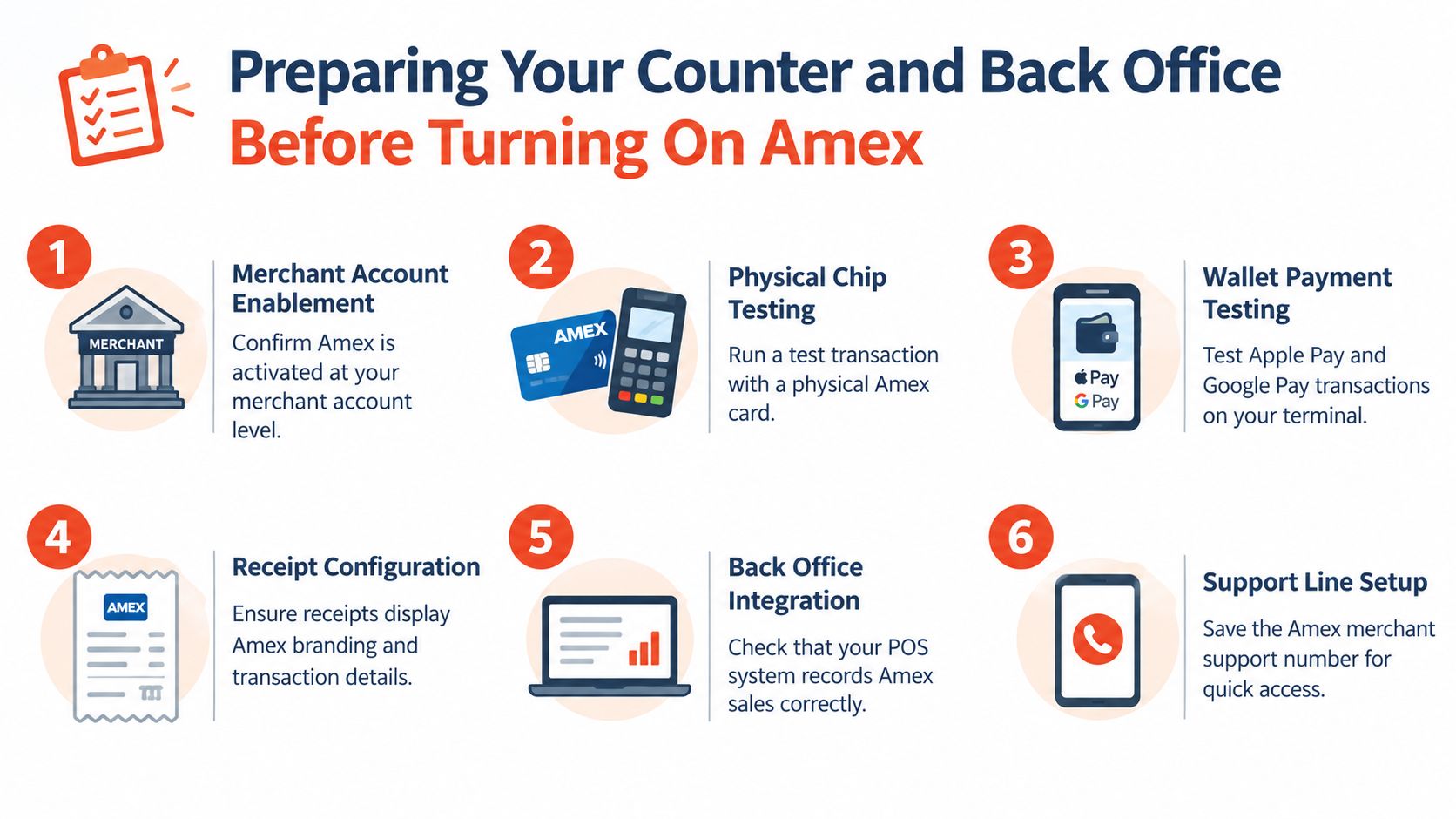
Before switching on acceptance, work through this checklist:
A working setup needs more than a capable terminal. The commercial terms should make sense for the business's customer mix, the required security controls should be enabled, and the reconciliation path should be clear before the first busy shift. If those pieces are in place, the owner can make a measured decision about Amex acceptance rather than relying on assumptions.
Sambapay provides Singapore SMEs with Android POS terminals, card acceptance across supported schemes and selected wallets, and settlement options from as early as T+1, subject to merchant terms. To discuss Amex configuration, pricing and settlement for a retail, F&B, clinic, salon or fitness business, visit Sambapay for a practical conversation with its local team.