

The weakest point in many salon operations isn't the stylist, the service menu, or even the booking app. It's the till. A client finishes colour, another wants to redeem a package bought half a year ago, a third is ready to leave a deposit for next Saturday, and the front desk is trying to make one tablet, one card terminal, and one spreadsheet behave like a single system.
That's where a proper pos system for salon work starts to matter. In Singapore, where digital payments adoption reached 92.0% in 2025 and 97% of retail point-of-sale transactions were cashless, the salon counter has to keep up with how people already pay, not how shops used to operate (PwC Singapore payments review). For salon owners, the right setup isn't just about taking money. It's about keeping appointments, deposits, packages, retail add-ons, commissions, and receipts moving through one clean workflow.
The line starts building before the last blow-dry is done. Two colour clients are still in the basins, a keratin treatment has just wrapped, and the receptionist is dealing with three payment jobs at once. One client wants to redeem a prepaid package bought months ago, another is paying for a SGD 180 colour service plus a SGD 45 retail add-on, and a walk-in wants to leave a SGD 50 deposit for next Saturday's slot.
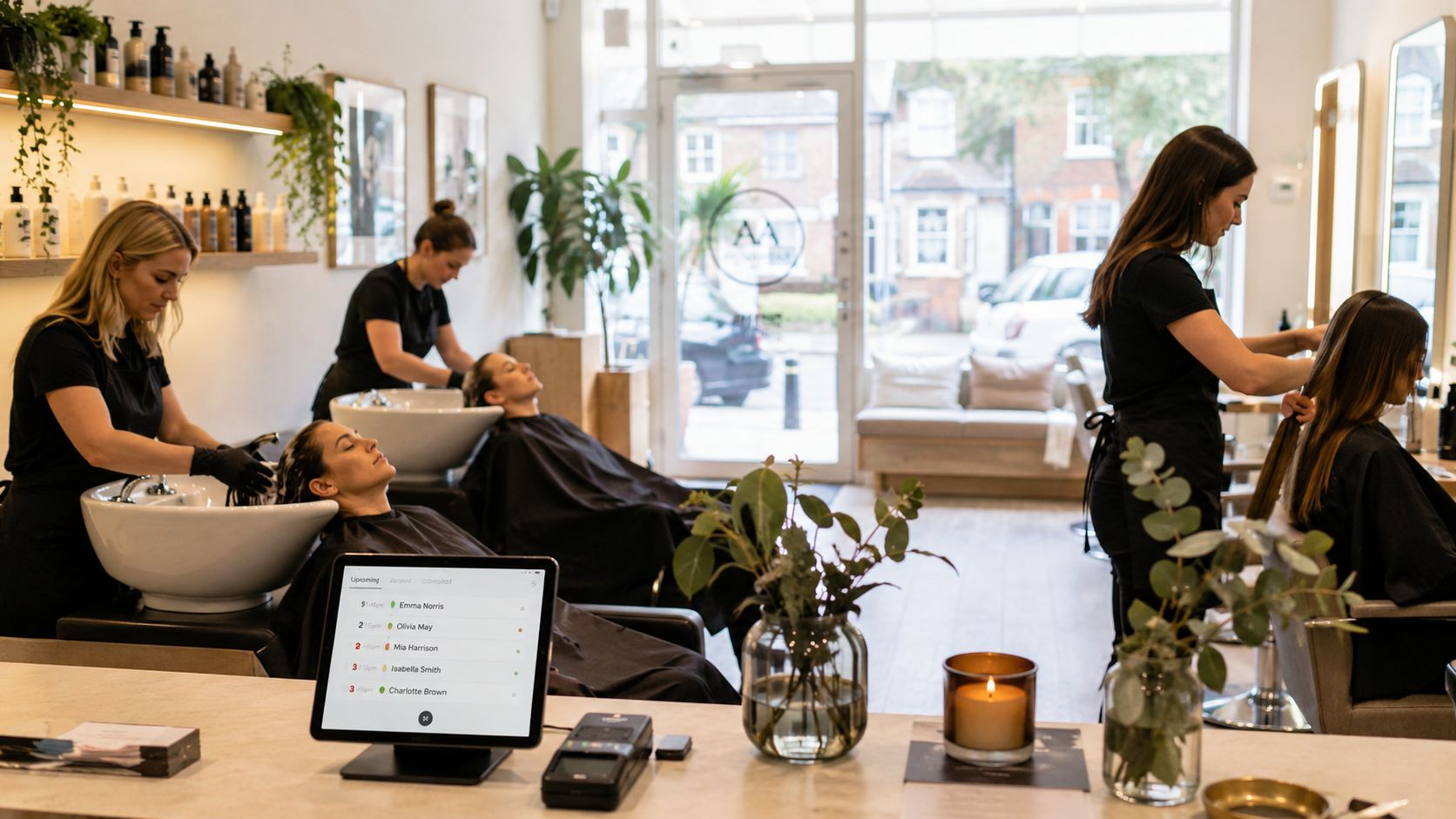
The problem isn't that any one step is hard. It's that each step sits in a different place. The appointment lives in one screen, the payment terminal sits beside it, the package balance is in a paper note or separate app, and commission is being mentally tracked by the manager while the queue stretches to the door.
A salon can survive that setup on a quiet Tuesday. It breaks on a fully booked Saturday because no one has time to reconcile the system sprawl in their head. That's why the till becomes the bottleneck, not the chairs.
Practical rule: if the front desk has to re-enter the same client details more than once, the checkout flow is already too fragmented.
The promise of a better setup is simple. One system should handle the appointment, the payment, the package redemption, the deposit capture, and the stylist split in a single flow. When that works, the front desk stops acting like traffic control and starts acting like a proper revenue point.
A card machine is the part the customer sees. It takes the tap, insert, or wave. A POS system sits behind that payment step and records what was sold, who performed the service, what stock moved, what commission is due, and whether the client still has package credit.
The card reader handles payment. The POS handles the business logic. It ties the service, the stylist, the deposit, and the product sale into one record so the front desk does not piece everything together after the client has already left.
A generic retail till is built around SKUs and prices. A salon POS has to treat a chair booking as a sellable item, a stylist as a payee, a prepaid package as stored credit, and a no-show deposit as payment that is captured or released under the salon's policy. That matters because one visit often includes a treatment, a retail add-on, and a future booking.
Singapore salons also work in a payment environment where cashless checkout is now the default expectation. PwC's review projects digital payments transaction value in Singapore to grow strongly over the coming years, which means the counter has to handle more than just taking money. It has to support the way salon revenue moves, across deposits, package redemptions, and add-on sales.
A good salon POS keeps the appointment and the payment close enough that checkout can lead straight into the next booking. For owners comparing device roles and setup choices, this overview of a POS machine for small business is a useful reference, because the hardware only makes sense when it fits the salon workflow at the till.
The best salon systems aren't built from a random feature checklist. They're built around the order in which a salon day happens, from booking to checkout to payroll.
The calendar should show the stylist, the chair, and the duration of the service. When the client arrives, the front desk should be able to convert that booking into an invoice without rebuilding the sale from scratch. If a colour service is booked, the menu item should already know its price and time block.
That matters because salons don't sell one-off products in isolation. They sell repeated services, timing, and confidence. If the system makes the receptionist hunt for the right menu item every time, the queue slows down and the service feels less premium.
The payment layer needs to accept cards and wallets without splitting the transaction into separate steps. Client records should carry visit history, formulas, allergies, retail purchases, and any outstanding package balance so the next visit starts from what the salon already knows, not from another round of questions.
For appointment reminders and no-show reduction, many teams keep a separate reminder tool alongside their salon software. A practical reference is Clepher appointment reminder tools, especially when a salon wants reminders without overhauling the whole front desk stack.
Clock-in, commission rules, tips, and end-of-day reconciliation need to live in the same reporting view. If a manager has to stitch together service totals, product sales, and stylist pay from different exports, the system is pushing admin onto the people least able to absorb it.
| Workflow Cluster | Must-Have Features | Moment of Use |
|---|---|---|
| Appointment to invoice | Calendar, stylist resource view, service menu mapped to duration and price | When a booking becomes a payable visit |
| Payment acceptance | Cards, wallets, PayNow, stored cards, reliable failover | At the counter, especially when the queue is active |
| Client records | Visit history, formulas, allergies, retail and package balance | Before and after each service |
| Staff and reporting | Clock-in, commissions, tips, reconciliation, GST-ready reports | End of day and payroll prep |
A salon POS only earns its keep when the receptionist can finish the transaction without improvising.
The payment layer deserves more scrutiny than many salon owners give it. Salon tickets are usually mid-sized, not huge, so fee structure and payment method mix matter a lot more than they do in higher-ticket retail.
A SGD 45 cut, a SGD 80 colour service, and a SGD 120 combined visit don't behave the same way under a blended fee. The smaller the ticket, the more the fee can eat into margin, especially when the service itself already has labour built into it. That's why a flat rate that looks harmless on a payment statement can still feel expensive at the till.
Salons sometimes get tempted by surcharges or minimums when card costs feel heavy. That can be a mistake if it's applied clumsily, because the salon experience is built on convenience and repeat visits. The better approach is usually to make acceptance broad, keep reconciliation clean, and pick a pricing model that matches the ticket profile.
Singapore salons typically need Visa, Mastercard, Amex, NETS, UnionPay, and wallet support in one checkout flow, plus PayNow and QR-based acceptance where it helps reduce friction. The point isn't to collect every method for its own sake. It's to avoid making a customer split payment across devices or abandon the counter while staff search for a workaround.
The operations side matters just as much. End-of-day matching should take minutes, not an hour, because salon teams are reconciling service income, retail, deposits, and prepaid redemptions together. That becomes harder if the terminal, gateway, and booking system all keep separate records.
| Payment Method | Typical Share | Avg Fee | Best For |
|---|---|---|---|
| Card-present credit and charge | Varies by ticket mix | Higher than debit in published examples | Premium services and higher-ticket colour work |
| Card-present debit | Varies by ticket mix | Lower than credit in published examples | Regular cuts and lower-friction checkout |
| Wallets and PayNow | Varies by client preference | Depends on processor setup | Fast checkout and cashless convenience |
| Stored cards | Used by regulars and package clients | Depends on the agreement | Deposits, memberships, recurring visits |
For salons that want to compare how card acceptance fits into a broader checkout stack, protect your Shopify revenue is more relevant than the title suggests, because the useful question is how payment acceptance and dispute handling behave when a business lives on repeat transactions.
A practical distinction also matters. Terminal-based acceptance can keep fees tighter, while gateway-based acceptance can broaden wallet coverage and speed up certain workflows. A salon should choose the mix that fits its front desk, not the one that sounds slickest in a sales deck. For a payments-first setup, pay with credit card is the kind of operational capability that sits at the centre of this decision.
Salon inventory is not just retail stock. It's the backbar consumables used during services, the shelf products sold at the counter, and the prepaid package balance that has to be tracked against future visits.
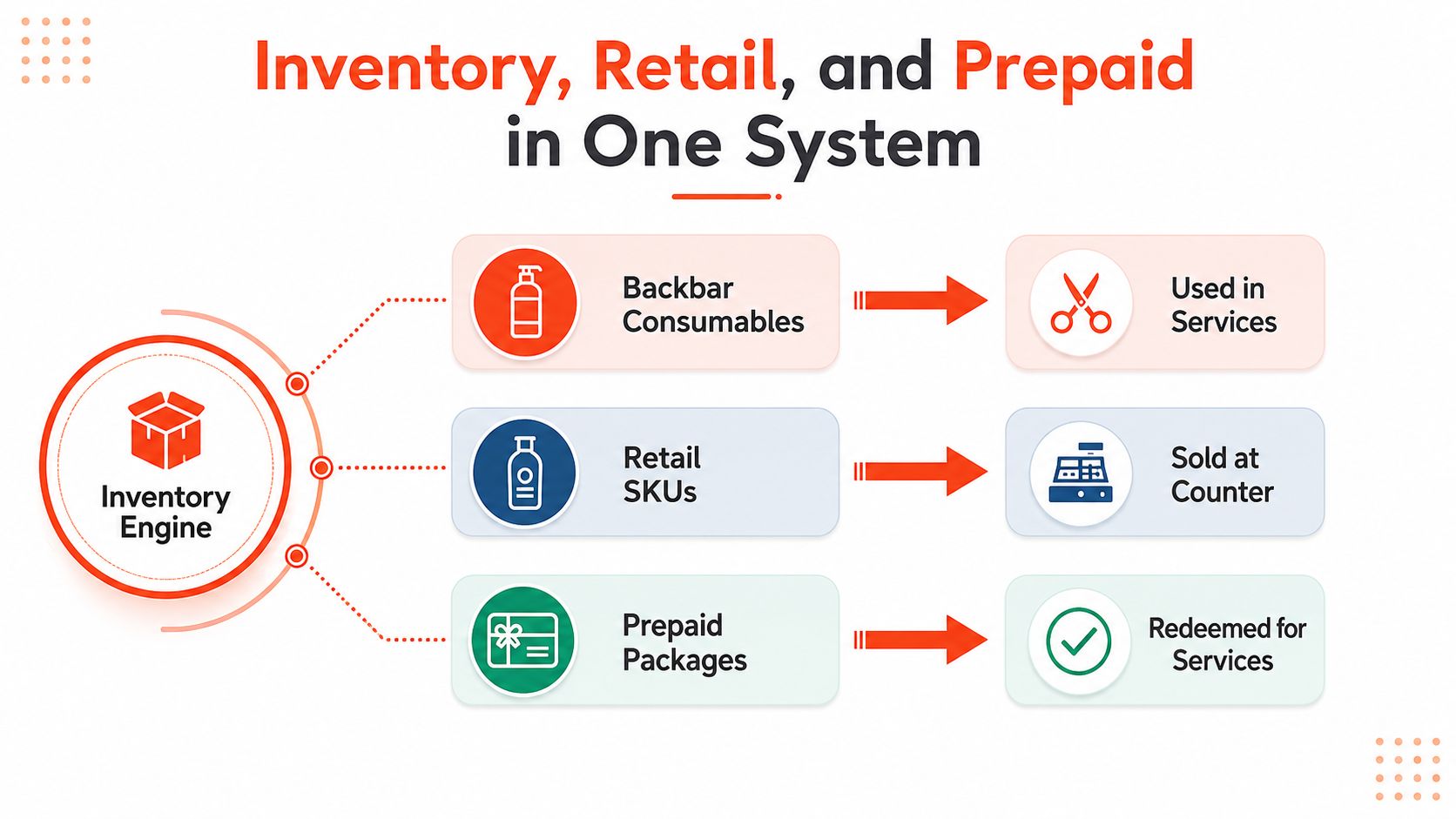
A useful example is stylist Mei finishing a colour service. The POS should deduct 30ml of developer from stock, add a retail upsell like Kérastase shampoo at SGD 42, and reduce the customer's remaining package balance by one visit if the client is redeeming from a package. That's not a fancy feature. It's the only way the salon knows what was consumed.
The same system should support low-stock alerts, supplier purchase orders, and the ability to see whether a product line is moving because stylists are recommending it or because it's sitting in the retail corner. If stock counts happen in a separate spreadsheet, the salon is always reacting too late.
Prepaid packages need the same discipline. Expiry handling, redemption tracking, and remaining balance have to be visible at checkout, or the receptionist will spend time hunting through old records while the client waits. GST reporting also becomes cleaner when service items, retail items, and package redemptions land on the same receipt.
A salon that treats retail as an afterthought usually loses the chance to make those add-ons effortless. A salon that tracks the full transaction properly can see what sold, what was used, and what still needs to be replenished.
Commission is where a lot of salon systems become messy, because the payment at the till has to flow into payroll logic without losing the detail of who did what. If the POS can't do that well, managers end up doing manual calculations after closing.
Suppose senior stylist Priya performs a SGD 180 balayage service and sells SGD 65 of retail. Her commission is 45% on service and 10% on retail, and the customer leaves a SGD 30 tip that goes entirely to her. The POS should calculate SGD 81 for the service, SGD 6.50 for the retail, and SGD 30 for the tip, for a total payout of SGD 117.50.
| Item | Amount (SGD) | Rule | Payout |
|---|---|---|---|
| Balayage service | 180 | 45% commission | 81 |
| Retail sale | 65 | 10% commission | 6.50 |
| Customer tip | 30 | 100% to stylist | 30 |
| Total | 275 | Combined payout | 117.50 |
That calculation needs to be visible in the stylist report, not reconstructed later. If a refund happens on a package or a discounted service, clawback rules should also be traceable so payroll doesn't become a dispute exercise.
Stylist-level dashboards should show service mix, retail conversion, and rebooking behaviour, because those are the metrics that tell a salon where the money is really coming from. Cash tips and card tips should be handled differently in the report if the business pays them out differently.
Payroll becomes manageable when the POS knows the stylist behind every line item.
A strong reporting view does not just help the accountant. It helps the salon manager spot which stylists need retail coaching, which services are underpriced, and which team members consistently drive repeat bookings.
The difference between a generic checkout setup and a salon-tuned one shows up when the front desk is under pressure. The best optimisations are boring in the right way, because they stop little failures from compounding.
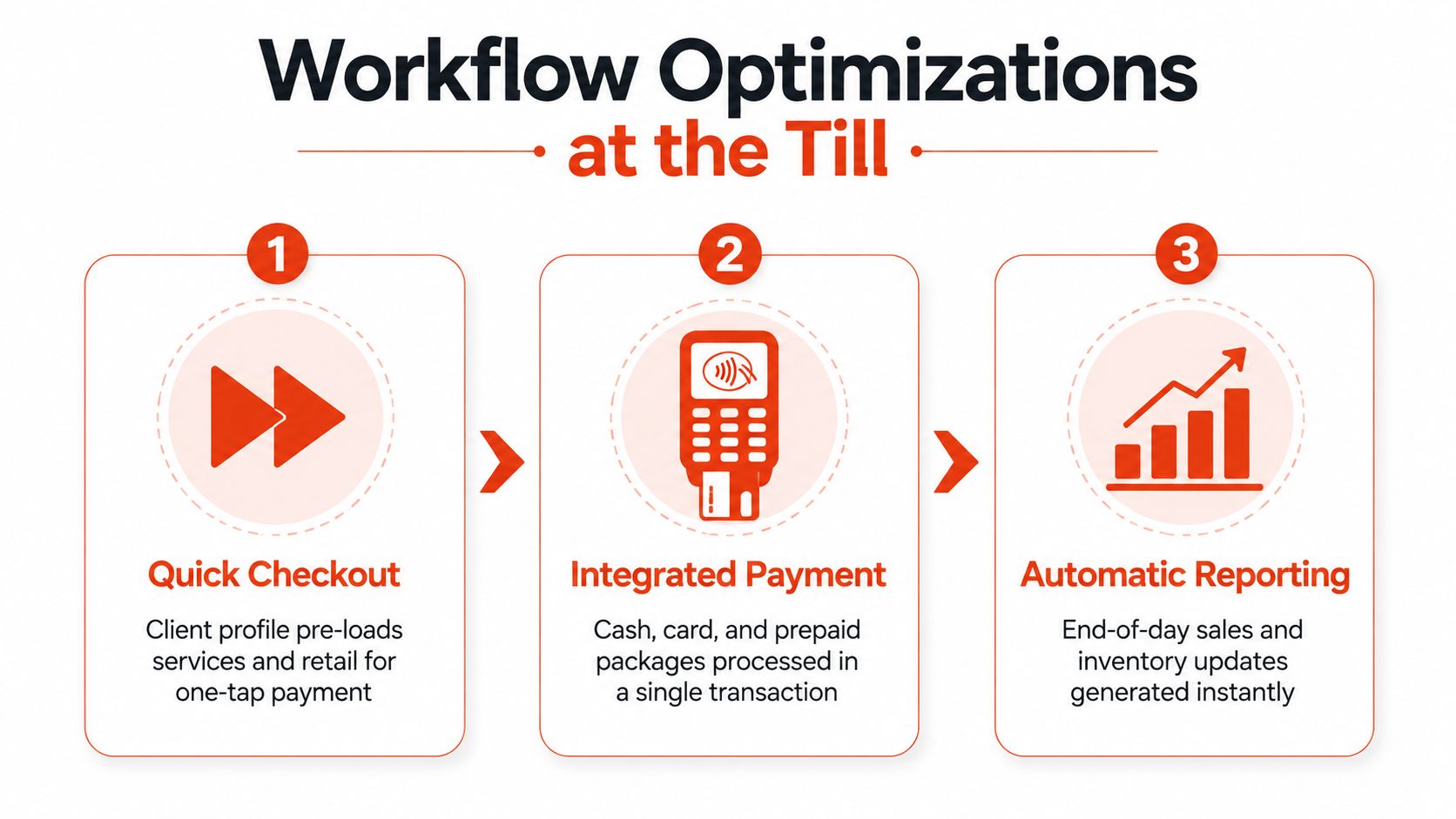
Barcode lookup for retail items saves time when a stylist recommends a product and the receptionist doesn't want to type out the full name. One-tap repeat-service keys help regulars move through faster, especially when they book the same treatment every few weeks. Saved client preferences matter too, because the front desk shouldn't rekey what the salon already knows.
A solid deposit workflow is one of the most practical protections a salon can have. A common policy is a S$30 deposit for first-time colour clients, captured from a saved card at booking and later applied against the final bill. That only works if the system supports card-on-file properly and the policy is visible before the appointment is confirmed.
When one stylist is still finishing a service, the next client's card-on-file should already be checked and ready. That kind of hand-off keeps the receptionist from scrambling when the queue gets long or a walk-in wants to hold a slot quickly. It also reduces the chance that a stylist is booked into the wrong slot because someone was rushing.
For salons that still rely on separate tools for booking, receipts, and card acceptance, streamline your aesthetic clinic workflows is a useful adjacent reference, because the same operational principle applies, the front desk should not have to improvise under load.
A good buying decision comes down to whether the system matches the way the salon earns money. That means checking the appointment flow, the payment mix, the retail shelf, and the payroll rules before signing anything.
If the salon already has an appointment tool but needs a stronger payment layer, a merchant like Sambapay fits that narrow role by supplying in-store card acceptance, settlement options, and Android POS terminals without forcing the business to rebuild the whole front desk. That makes it a useful option for operators who want the payments piece handled separately from the booking stack, instead of locking everything into one vendor.
For a broader shopping checklist, the practical comparison at best POS system Singapore is worth reviewing alongside any appointment software already in use. The right answer usually isn't the flashiest interface, it's the one that keeps the Saturday queue moving without breaking package, payroll, or payment logic.
If the front desk still feels like the weakest point in the salon, Sambapay can help with the payment side of that workflow. It provides in-store card acceptance, fast settlement options, and POS terminals that fit salon counters without forcing a full software replacement. Visit Sambapay to review the setup with a Singapore payments team that works through the till, not just the brochure.