
The most popular advice about e wallet Singapore is also the least useful for merchants: choose the most popular wallet and build around it. Singapore's counter doesn't work that way. PayNow, SGQR, contactless cards, bank-linked payment apps, and selected cross-border wallets split the basket, often within the same shop and across the same day.
For shoppers, that means the “best” wallet depends on the payment context, funding source, rewards, and whether the merchant has made the checkout path obvious. For SMEs, it means acceptance should be designed as a payment stack, not a collection of disconnected wallet logos. A reliable QR option, card acceptance, and a focused wallet mix usually matter more than signing up for every available app.
Singapore is already a digital payments market, yet the checkout is not controlled by one wallet. 92% of Singaporeans used a digital payment method in the 12 months through November 2025, and digital wallets became a major everyday channel over the past decade, according to PwC's Singapore payments research. That adoption spans cards, account-to-account transfers, mobile banking, QR payments, and wallets, rather than stored-value apps alone.
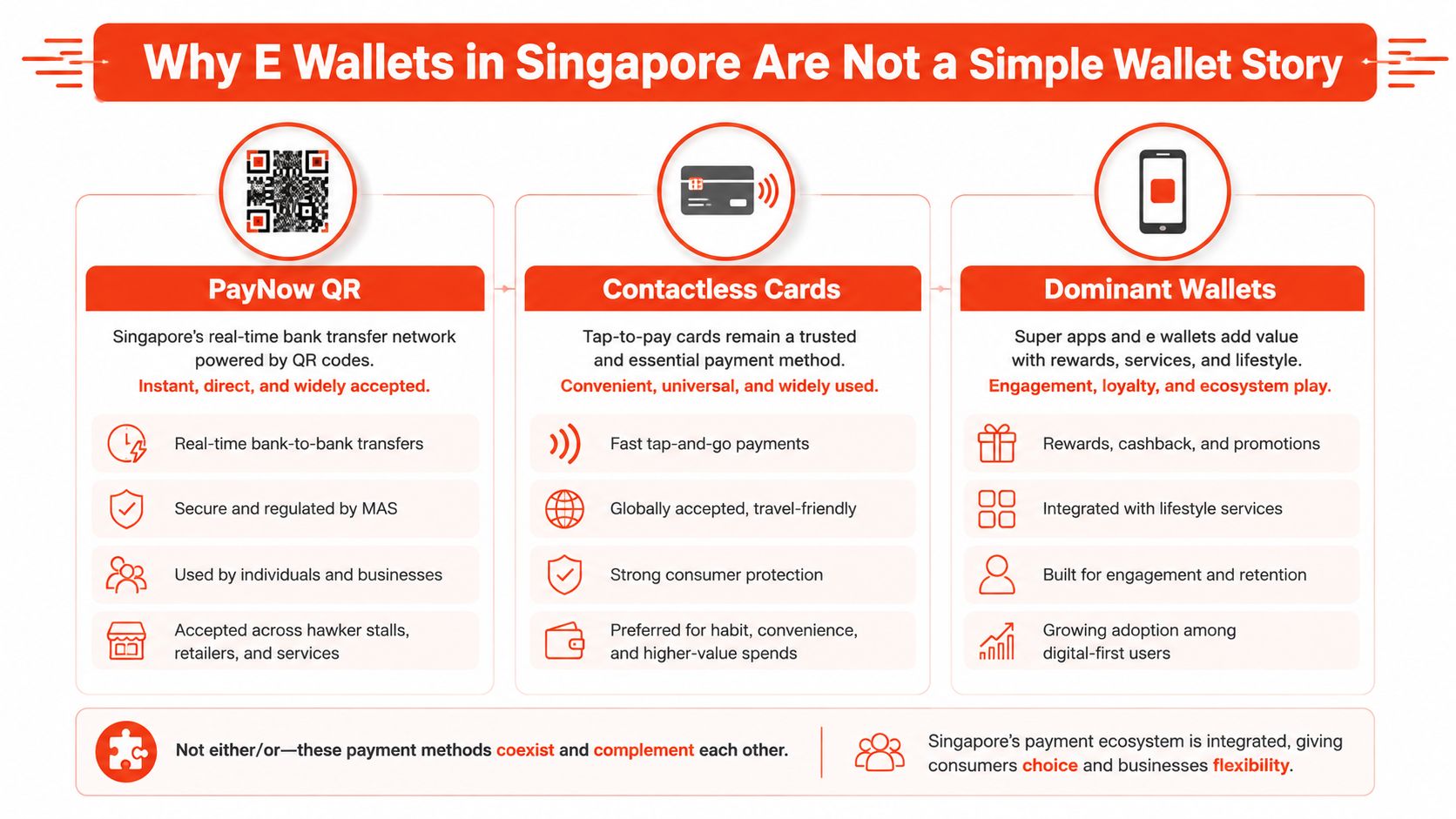
The distinction affects how a merchant builds acceptance. A customer may scan PayNow from a bank app, tap a physical card, use Apple Pay with a card provisioned on a phone, or open GrabPay with a funded balance. Each looks digital at the counter, but the payment rail, settlement timing, dispute process, and reporting can differ.
Singapore's payment mix has grown across several rails. In e-commerce, digital wallet share rose from 7% in 2014 to 39% by 2024, while point-of-sale wallet share increased from 1% to 29% over the same period, based on market data linked to PwC's Singapore payments research. The growth is clear, but it does not show that wallets replaced cards or PayNow for every purchase.
UOB's ASEAN Consumer Sentiment Study gives merchants a broader comparison. Singapore e-wallet usage was 43%, compared with 56% for PayNow scan-to-pay, 52% for physical credit cards, 44% for mobile banking apps, and 43% for debit cards, as reported in UOB's Singapore consumer study. The useful question is which rails target customers already use, and which ones the business can reconcile without adding checkout friction.
Practical rule: Treat wallets as one layer of Singapore acceptance. Keep the checkout usable when customers choose PayNow or a contactless card.
An e-wallet in Singapore can mean several different things. The label usually describes a digital interface that stores value, stores payment credentials, or routes a payment through an app. Those functions overlap at checkout, but merchants should separate them before comparing providers.
A stored-value wallet holds funds or prepaid value for later spending. EZ-Link and NETS Pay are local examples of products that can fit this model, although their payment contexts and features differ. The customer adds value or maintains a balance, then uses the wallet through an app, card, or supported payment experience.
Stored-value products bring a specific operational question: who holds the customer funds, and under what regulatory framework? In Singapore, the Monetary Authority of Singapore regulates relevant payment services, including stored-value facilities. Merchants and users should check the provider's status, terms, safeguarding arrangements, transaction limits, and withdrawal or refund rules instead of assuming that every wallet balance works like a bank deposit.
Apple Pay and Google Pay usually act as account-linked wallets. They store a tokenised representation of a payment card on a device and present that credential through contactless or online checkout. The customer may call the experience a wallet payment, while the merchant often receives it through the card acceptance path.
That distinction affects integration. A terminal that accepts contactless card payments may also accept Apple Pay or Google Pay, provided the acquiring setup and device configuration support the relevant schemes. The merchant doesn't necessarily need a separate commercial relationship for every account-linked wallet.
GrabPay and ShopeePay represent app-led wallet experiences, while other wallets serve visitors from regional markets. These platforms can combine payments with loyalty, promotions, transport, shopping, or other services. Their value often comes from the surrounding app ecosystem, not only from the ability to move money.
PayNow complicates the vocabulary further. A customer may scan a QR code inside a bank app or use a mobile number, UEN, NRIC/FIN, or virtual payment address to initiate a transfer. That can feel like wallet use even though the transaction is an account-to-account payment. For merchants, the payment rail matters more than the consumer label because it determines authorisation, settlement, refunds, and reconciliation.
In-store acceptance data points to a concentrated wallet environment rather than a long tail of equally important apps. Worldpay-based coverage cited by Fintech News Singapore places DBS PayLah! at 25% of in-store wallet usage, Apple Pay at 22%, and GrabPay and Google Pay at about 12% each. These figures are useful for prioritisation, but they describe wallet usage, not every payment made in Singapore.
A merchant should read the list as a signal about acceptance priorities. DBS PayLah! can matter for local bank-connected customers, Apple Pay for contactless card users, and GrabPay for customers already active inside the Grab ecosystem. Google Pay has a similar account-linked role for Android users, although the actual funding source may still be a card.
| Rank | Payment Method | Approx. In-store Usage | Notes |
|---|---|---|---|
| 1 | DBS PayLah! | 25% | A prominent local wallet option in the cited in-store mix |
| 2 | Apple Pay | 22% | Account-linked, contactless experience |
| 3 | GrabPay | About 12% | App-led wallet with broader Grab ecosystem relevance |
| 4 | Google Pay | About 12% | Account-linked option for Android users |
The data shouldn't be turned into a blanket instruction to accept only these four options. Customer composition changes the answer. A neighbourhood F&B outlet serving local bank users may obtain more practical coverage from PayNow through SGQR than from a dedicated wallet integration. A tourist-facing retailer may value Alipay or another cross-border route more than a local stored-value product.
Ticket size also changes behaviour. A quick, low-value purchase rewards speed and a familiar scan or tap. A larger purchase gives cards more room to compete through rewards, instalments, credit availability, or purchase protections. The wallet interface may still initiate the transaction, but the customer's underlying funding choice can determine which acceptance route converts.
The useful ranking is not “most popular wallet.” It's “most relevant payment path for the customers standing in front of this counter.”
PayNow changes the merchant decision because it lets customers make near-instant account-to-account payments without maintaining a separate wallet balance. The PayNow factsheet from the Association of Banks in Singapore describes a flow in which the user authenticates in a bank or non-bank financial institution app, enters a mobile number, NRIC/FIN, UEN, or VPA, optionally scans a PayNow QR code, verifies the recipient name, and confirms the transfer.
That workflow has a different operating profile from a conventional stored-value wallet. Funds transfer almost instantly, and the customer already has the payment app. The merchant still needs a clear transaction reference and a reliable way to confirm that the correct amount reached the correct account.
SGQR helps consolidate the customer-facing experience. Instead of displaying a separate sticker for every supported QR service, a merchant can present an SGQR configuration that brings together relevant payment schemes, including PayNow, NETS, and card QR options. The customer scans with a supported app, while the merchant avoids turning the counter into a wall of competing codes.
The result is a subtle shift in wallet strategy. A consumer may use a wallet application to scan the code, but the payment can still rely on an account-linked or bank transfer rail. This is why a wallet-only acceptance plan can miss actual demand. QR acceptance reaches customers who don't want to download, fund, or choose a dedicated wallet.
FAST processed 500 million transactions worth SGD 661,748 million in 2024, according to PwC's Singapore payments report. The same source records e-money payments at SGD 2.52 billion, or 1.79% of POS transaction value, indicating that much everyday spending is moving through account-to-account infrastructure such as FAST, PayNow, and SGQR rather than stored-value wallets.
Merchants should compare more than headline acceptance. PayNow and SGQR can offer rapid confirmation, but refunds and mistaken transfers require carefully defined operating procedures. Wallet and card transactions may offer more familiar refund workflows, while cards also bring chargeback exposure. A QR-first stack therefore works best when paired with a proper POS record, clear payment references, and a daily reconciliation process.
A practical SME acceptance stack starts with the rails customers already understand. For many Singapore businesses, that means PayNow through SGQR, contactless card acceptance, and a focused selection of wallets matched to the customer profile. A merchant serving regional visitors may add a cross-border wallet, while a local service business may prioritise bank-linked QR and cards.
Standalone QR: The lowest-friction route uses a properly configured SGQR display and a staff process for verifying successful payment. It can work well for small counters, but manual reconciliation becomes harder as volume grows.
SoftPOS: A compatible smartphone can act as a contactless acceptance device. This suits mobile operators and businesses that need flexibility, though device compatibility, connectivity, staff training, and receipt handling need attention.
Cloud POS terminal: A modern Android POS can combine payment acceptance with order, inventory, and receipt workflows. This reduces keying errors and gives managers a single transaction record across card and supported wallet payments.
Gateway API: Online businesses can connect payment methods to a checkout page through a gateway. The integration requires more technical work, but it can unify authorisation responses, webhooks, refunds, and reporting across digital channels.
Acquiring banks and payment service providers both handle merchant onboarding, but the commercial structure can differ. Expect business verification, beneficial-owner checks, bank account details, product review, and configuration of payout settings. Settlement may be next business day or later depending on the agreement, payment rail, cut-off time, risk controls, and weekends or public holidays.
| Payment Rail | Integration Complexity | Typical Fee Range | Settlement Speed | Refund / Dispute Behaviour |
|---|---|---|---|---|
| PayNow through SGQR | Low to moderate | Varies by provider and agreement | Often rapid payment confirmation, with merchant payout terms set by the provider | Refunds require a defined merchant process; transfer disputes differ from card chargebacks |
| Contactless cards | Moderate | Varies by scheme, acquirer, industry, and agreement | Set by acquiring agreement | Familiar refund flow, with possible card dispute or chargeback exposure |
| Apple Pay and Google Pay | Moderate when contactless is enabled | Usually tied to the underlying card acceptance arrangement | Follows the configured card route | Refund and dispute behaviour generally follows the underlying card transaction |
| GrabPay or other app wallets | Moderate | Provider-specific | Depends on wallet and merchant agreement | Wallet-specific refund rules and reconciliation |
| Online payment gateway | Moderate to high | Provider and method-specific | Depends on the gateway and payment method | Centralised tools may help, but each rail retains its own dispute rules |
Merchants should compare total operating cost rather than a single quoted rate. That includes transaction pricing, terminal costs, integration work, payout timing, refund administration, and the staff time spent matching provider reports to sales records. For businesses evaluating card acceptance alongside wallet support, Sambapay's credit card payment options provide one example of how an SME can approach major card acceptance through a dedicated POS provider.
A reliable setup also needs a fallback. If a QR display fails, staff should know whether to present a terminal, generate a new QR request, or use a second authorised method. If the POS records a payment as pending, the team shouldn't ask the customer to pay again until the status has been checked.
A payment rail wins when it removes the biggest objection in that purchase. For a small coffee, that objection is often friction. For a larger shop, it may be rewards, credit availability, instalments, or the customer's preferred funding source.
| Scenario | Ticket Size | Likely Customer Profile | Dominant Rail | Why It Wins |
|---|---|---|---|---|
| Neighbourhood kopitiam coffee | S$4 | Local regular, speed-focused | PayNow QR | The customer can scan from an existing bank app without a separate wallet top-up |
| Casual lunch basket | S$28 | Mixed local customer base | Contactless card or PayNow | Cards suit tap-first behaviour, while PayNow remains familiar for scan-to-pay users |
| Supermarket run | S$220 | Household shopper or rewards-focused customer | Card, with wallet support as a secondary option | Credit rewards, available credit, and stored-value promotions can influence the funding choice |
The S$4 coffee illustrates why wallet top-up friction matters. If the customer has to open an unfamiliar app, add funds, or search for a promotion, a PayNow scan can be the quicker route. A merchant doesn't need a separate wallet integration to capture that customer if the SGQR experience is visible and the recipient details are clear.
At S$28, the answer becomes less predictable. A younger customer may tap a card through Apple Pay, another customer may scan PayNow, and a regular may choose a wallet promotion. The terminal or QR display should make each supported route obvious without slowing the queue.
A S$220 basket creates more room for card economics and loyalty incentives to influence behaviour. Credit cards can offer rewards or payment flexibility, while stored-value wallets may attract customers through targeted rebates. The merchant's job is to support the options that appear often enough to justify their operational cost, not to predict one universal winner.
At a neighbourhood café, the morning rush starts with customer-presented scans. A regular opens a bank app and pays through the café's SGQR display, while another customer taps a contactless card. A visitor may use GrabPay or Apple Pay because that credential is already available on the phone.
The café's end-of-day report should separate those outcomes. PayNow confirmation may arrive quickly, but the operator still needs to match the payment reference to the order. Card transactions carry their own authorisation and settlement records, while wallet transactions may appear in a provider portal with different descriptors.
A dental clinic sees a different basket. Patients paying larger bills may prefer cards for familiarity, available credit, or rewards. A business payer may use PayNow to the clinic's UEN, provided the clinic has a process for identifying the invoice and confirming the transfer.
Stored-value wallet top-ups matter less in this environment because the customer's priority is usually a clean receipt and an accurate account allocation. The clinic's reconciliation should connect payment status to patient or invoice records, with access restricted to authorised staff.
A beauty retailer may see a wider wallet mix in the evening. A customer might use ShopeePay for an app promotion, another might select a card instalment option, and a third might tap a card through a mobile wallet. Each route affects the settlement report differently.
A modern Android POS can reduce the number of disconnected screens staff must manage. For businesses comparing that approach, Sambapay's Android POS system is one example of a terminal-led setup that can support in-store card and selected wallet workflows.
Reconciliation test: A payment setup is not finished when the terminal approves a transaction. It's finished when staff can identify the sale, confirm the rail, trace the payout, and process the appropriate refund.
The business day closes with three questions: which payments were authorised, which funds have settled, and which transactions still need action? The answer should be visible without manually comparing a stack of screenshots, bank entries, wallet portals, and POS records.
Adding every wallet can create the appearance of choice without improving conversion. Each extra provider brings another onboarding process, settlement report, refund rule, support route, and possible reconciliation mismatch. The right acceptance mix depends on the business's customers and basket, not on the length of a wallet logo list.
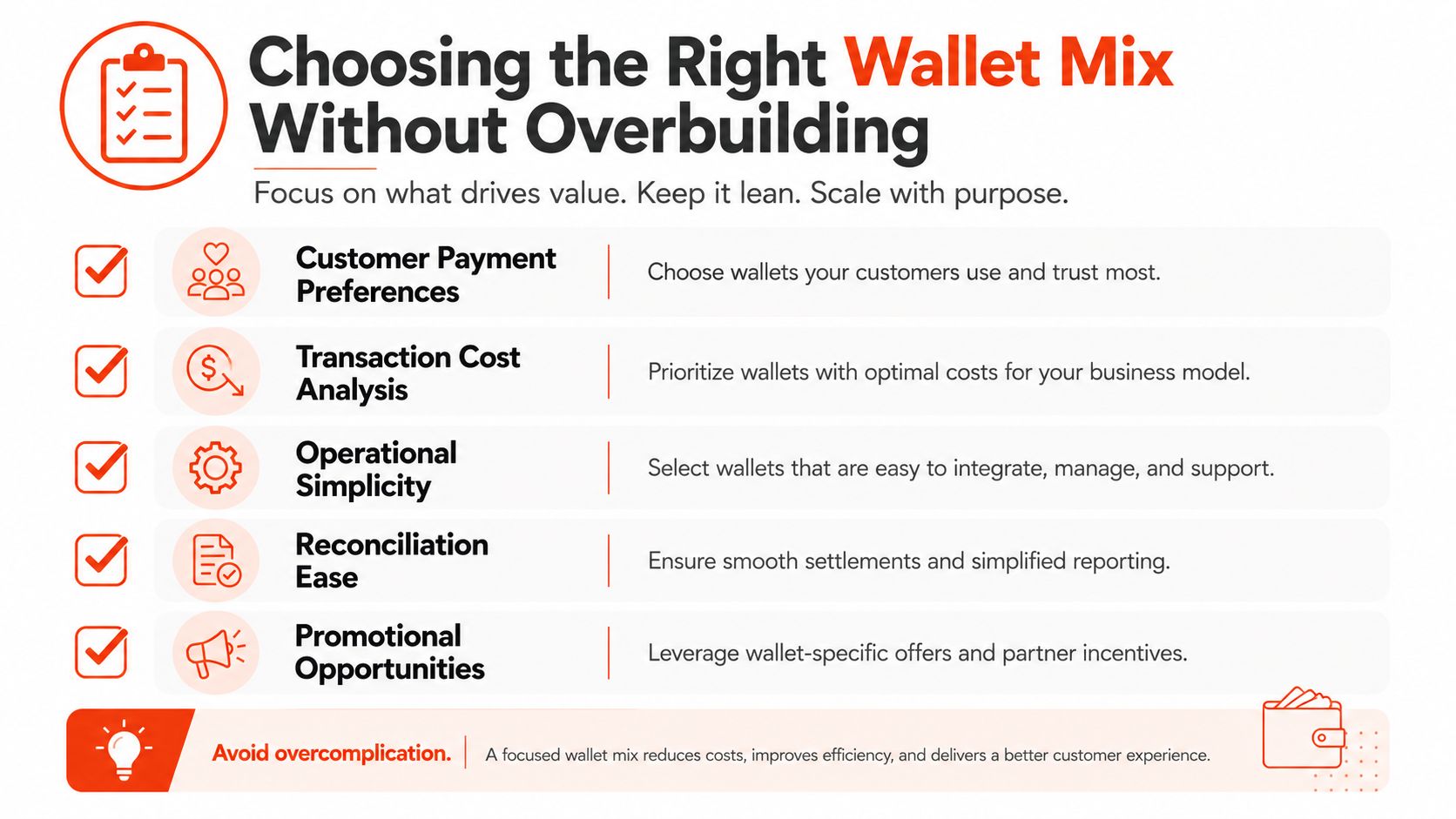
Customer payment preferences: Review whether customers usually scan PayNow, tap cards, use mobile wallets, or arrive from regional markets. A local neighbourhood shop and a tourist-facing boutique may need different priorities.
Transaction cost analysis: Compare the full cost of each route, including processing charges, hardware, payout timing, refunds, and administration. A low quoted rate may not remain low if staff spend significant time resolving exceptions.
Operational simplicity: Make PayNow through SGQR and contactless cards easy to find first. Add a major local wallet or cross-border option only when customer demand, promotions, or the business model supports it.
Reconciliation ease: Require every provider to produce usable references, transaction statuses, settlement details, and refund records. If staff can't match a payment to a sale, the acceptance method is creating risk.
Promotional opportunities: A wallet can earn its place through loyalty, targeted offers, or app-based convenience. Those benefits should be measured against the work required to maintain the integration.
A focused stack often performs better operationally than a sprawling one. PayNow via SGQR, contactless cards, selected account-linked wallets, and one relevant cross-border wallet can cover the main counter scenarios without forcing staff to manage a dozen low-volume rails.
Merchants should also review the mix after launch. Track failed payments, abandoned checkouts, refund requests, customer questions, and settlement exceptions by rail. The purpose isn't to eliminate choice. It's to keep the choices that customers use and remove the ones that add clutter without producing meaningful demand.
For SMEs that need to evaluate hardware, card acceptance, QR support, and merchant workflows together, Sambapay's POS system options for Singapore businesses offer one provider route to compare against bank acquirers and other payment service providers.
Sambapay provides Singapore SMEs with modern Android POS terminals, major card acceptance, and selected digital wallet and PayNow support, with onboarding, installation, settlement options from as early as T+1 depending on the agreement, and local assistance. Visit Sambapay to compare an acceptance setup that fits the business's basket size, customer mix, and reconciliation needs.