
A Visa debit card is a Visa-branded card that draws funds straight from the cardholder's bank account at the point of sale, and Singapore's 97% card use versus 82% cash use shows why acceptance matters. For the merchant standing behind the terminal, the important question isn't only whether the card can tap, but whether the debit rail authorises, settles and completes the sale smoothly.
A customer reaches the counter, taps, and waits for the familiar approval sound. The shop owner sees a Visa logo and may assume the transaction behaves exactly like a credit-card payment. That assumption is understandable, but it hides the operational difference: debit depends more directly on the customer's available bank balance and issuer controls.
For a Singapore SME, Visa debit is best treated as a core acceptance rail, not as a minor variation of credit. The card's funding source affects authorisation, the network affects routing and security, and the terminal setup determines how much friction the cashier and customer experience.
At a Singapore checkout, a customer taps a Visa debit card, hears the approval tone, and expects the sale to finish immediately. Behind that simple moment, the payment request travels through the Visa network to the issuing bank. The bank checks the account, card status, spending controls, and other rules before approving or declining the transaction. An approval then enters the acquirer's usual authorisation and settlement process.
The merchant needs to manage three practical effects.
First, an authorisation hold can temporarily reserve money in the customer's account. This matters for businesses that set aside goods before final fulfilment or complete a transaction later. An approved payment can still require accurate completion, reversal, and settlement handling. If those steps are missed, the customer's available balance and the merchant's stock decisions may be affected.
Second, payment cost depends on the agreement with the acquirer and on the card mix. Debit and credit transactions can sit in different pricing categories, while a blended rate may hide the contribution of each rail. Reviewing only the headline merchant discount rate can therefore make it harder to see how customer payment preferences affect margins.
Third, customers increasingly expect to pay with the card already in their wallet. Visa's Singapore Consumer Payment Attitudes study reported card use among 97% of consumers, compared with cash use among 82%. For a shop owner, that makes debit acceptance an operating decision, not just an extra logo on the terminal.
Practical rule: A terminal that accepts credit but mishandles debit isn't fully card-ready.
The baseline is straightforward. The terminal should recognise Visa debit and support both contactless and chip transactions. Staff should know how to respond when an issuer declines a payment, requests another verification step, or leaves a transaction incomplete. Reviewing guidance on cashless payment acceptance in Singapore can help place debit within the wider checkout setup.
Test the debit path separately from credit. Confirm the customer prompt, receipt, reversal process, settlement record, and staff recovery steps. A card-ready counter is one that can complete the sale reliably across the payment rails customers use.
A useful way to picture a Visa debit card is as a direct payment pipe between a customer's bank account and a merchant's terminal. The pipe isn't completely direct, because several institutions handle the message, but the source of funds is the customer's deposit account rather than a credit facility or a prepaid balance.
Three participants matter.
The issuing bank provides the card and holds the customer's current or savings account. When the terminal requests approval, that bank evaluates the transaction against the account balance, card status, spending controls and other issuer rules.
The Visa network carries the transaction message between the relevant parties and applies the acceptance framework associated with the Visa brand. Visa is therefore the merchant-facing acceptance layer. It helps a terminal and acquiring bank recognise how to route the transaction, but it doesn't itself hold the customer's deposit account.
The acquiring bank or payment acquirer supports the merchant's acceptance setup. It receives the transaction from the terminal, sends it through the network for authorisation, and later credits the merchant according to the settlement arrangement.
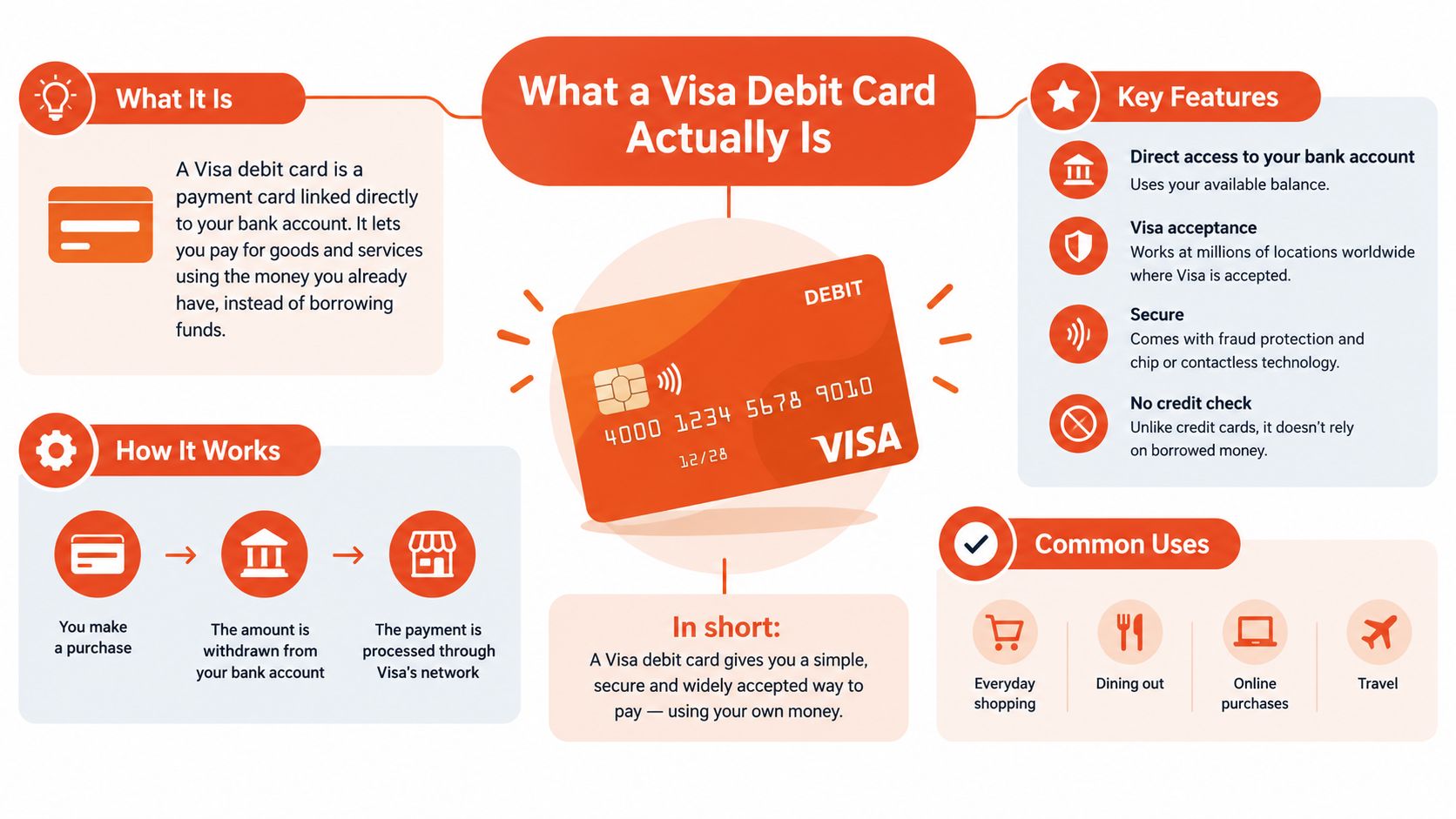
The distinction between Visa and debit sits at two different levels. Visa describes the acceptance network and brand. Debit describes the funding logic. A Visa credit card uses the Visa acceptance network but draws against a revolving credit line. A Visa prepaid card can also use Visa acceptance while relying on funds loaded into a separate stored-value arrangement.
For the merchant, the logo answers only one question: which network can process the card. The debit classification answers another: where the issuer expects the money to come from and how the issuer may respond when the customer attempts a purchase.
That is why two cards carrying the same Visa mark can produce different authorisation outcomes. One customer may have sufficient funds in a deposit account, another may have reached an issuer spending control, and a third may be using a credit line. The terminal needs to support the card product, while the issuer decides whether the particular transaction can proceed.
At the counter, debit, credit and prepaid cards can look almost identical. Each may carry a Visa mark, use contactless technology and produce an approval or decline on the terminal. The merchant-facing differences emerge from funding source, authorisation behaviour, dispute handling and settlement arrangements.
| Dimension | Visa Debit | Visa Credit | Visa Prepaid |
|---|---|---|---|
| Funding | Draws from the cardholder's bank account | Draws against an approved credit line | Draws from a loaded stored balance |
| Settlement | Proceeds through the issuer, network and acquirer after authorisation | Proceeds through the issuer, network and acquirer under credit-card processing rules | Proceeds through the issuer, network and acquirer under prepaid programme rules |
| Chargeback exposure | Disputes can involve Visa dispute processes and intervention by the issuing bank | Disputes can involve the issuing bank's credit-card process and Visa dispute rules | Disputes depend on the prepaid programme, issuer and applicable Visa rules |
| Authorisation behaviour | Can decline when available account funds or issuer controls don't support the purchase | Can decline when the credit line, issuer controls or risk checks don't support the purchase | Can decline when the available stored balance or programme controls don't support the purchase |
The funding source is the first difference a cashier needs to understand. A debit approval usually confirms that the issuer is willing to release funds from the customer's account. A credit approval confirms access to borrowing capacity. A prepaid approval confirms that the stored balance and programme rules permit the purchase.
Settlement can look similar from the merchant's perspective because the acquiring bank handles the payout in each case. The commercial classification still matters, however, because pricing, reporting and dispute treatment can differ by product type. An acquirer that offers blended pricing may group several categories into one visible rate, while another arrangement may report them separately.
Chargebacks also need careful handling. A debit customer can still dispute a transaction through the Visa framework and the issuing bank. The merchant shouldn't assume that debit means lower dispute exposure, or that a credit transaction is automatically more vulnerable. Documentation, transaction records and clear refund procedures matter for every card type.
Authorisation failures tend to feel different. A debit card may decline because the customer's available account funds don't cover the purchase at that moment. A credit card may decline because of a credit-line or risk decision, while a prepaid card may fail because the stored balance is too low. The terminal only displays the response, so staff need a neutral recovery script rather than an assumption about the customer's finances.
A customer taps a Visa debit card, receives an approval, and leaves with the goods. For the shop owner, the more useful question is what that tap represents in the payment mix. Singapore's card-payment announcement from Visa describes a market where electronic card payments are established at the checkout. That makes Visa debit a payment rail merchants need to support, rather than a niche option for a small customer group.
The strongest merchant evidence is transaction value. Debit cards generated SGD 28.52 billion in Singapore POS transaction value in 2024. That was 20.27% of POS transaction value, while total card payments reached SGD 148.91 billion, according to the Visa Consumer Payment Attitudes report. The figures show debit's scale at physical counters, while also showing that debit is one part of a larger card market.
| Metric | Debit | Credit | Prepaid |
|---|---|---|---|
| Singapore POS transaction value in 2024 | SGD 28.52 billion | Not specified in the provided data | Not specified in the provided data |
| Share of POS transaction value in 2024 | 20.27% | Not specified in the provided data | Not specified in the provided data |
| Overall card-payment context in 2024 | Included in total card payments of SGD 148.91 billion | Included in total card payments of SGD 148.91 billion | Included in total card payments of SGD 148.91 billion |
For a merchant, this points to a practical acceptance decision. A terminal that accepts Visa debit gives customers access to funds held in their bank accounts, while the same setup can also accept other card products under the merchant's acquiring arrangement. The terminal does not need a separate customer-facing workflow for every product. The merchant still needs accurate product reporting and an acquiring plan that makes the applicable fees and settlement treatment clear.
Contactless usage is also part of the operating context. Visa's regional research reported Singapore contactless card usage at 82%, the highest in Southeast Asia, and online card-payment preference at 74%, as recorded in the Singapore Consumer Payment Attitudes report. A shop should therefore support tap payments, while retaining a chip-and-PIN fallback for cards or transactions that require it. Online behaviour should be assessed separately because a payment preference on a website does not automatically predict the best in-store method.
Channel differences matter. MoneySense debit-card guidance reports digital-payment adoption at 92.0% in 2025, while debit represented about 9% of e-commerce transaction volume. Wallets led online volume at 40%, and cards and wallets together accounted for 74%. Debit has a substantial role at the physical checkout, but a merchant should not treat it as the leading option for every sales channel.
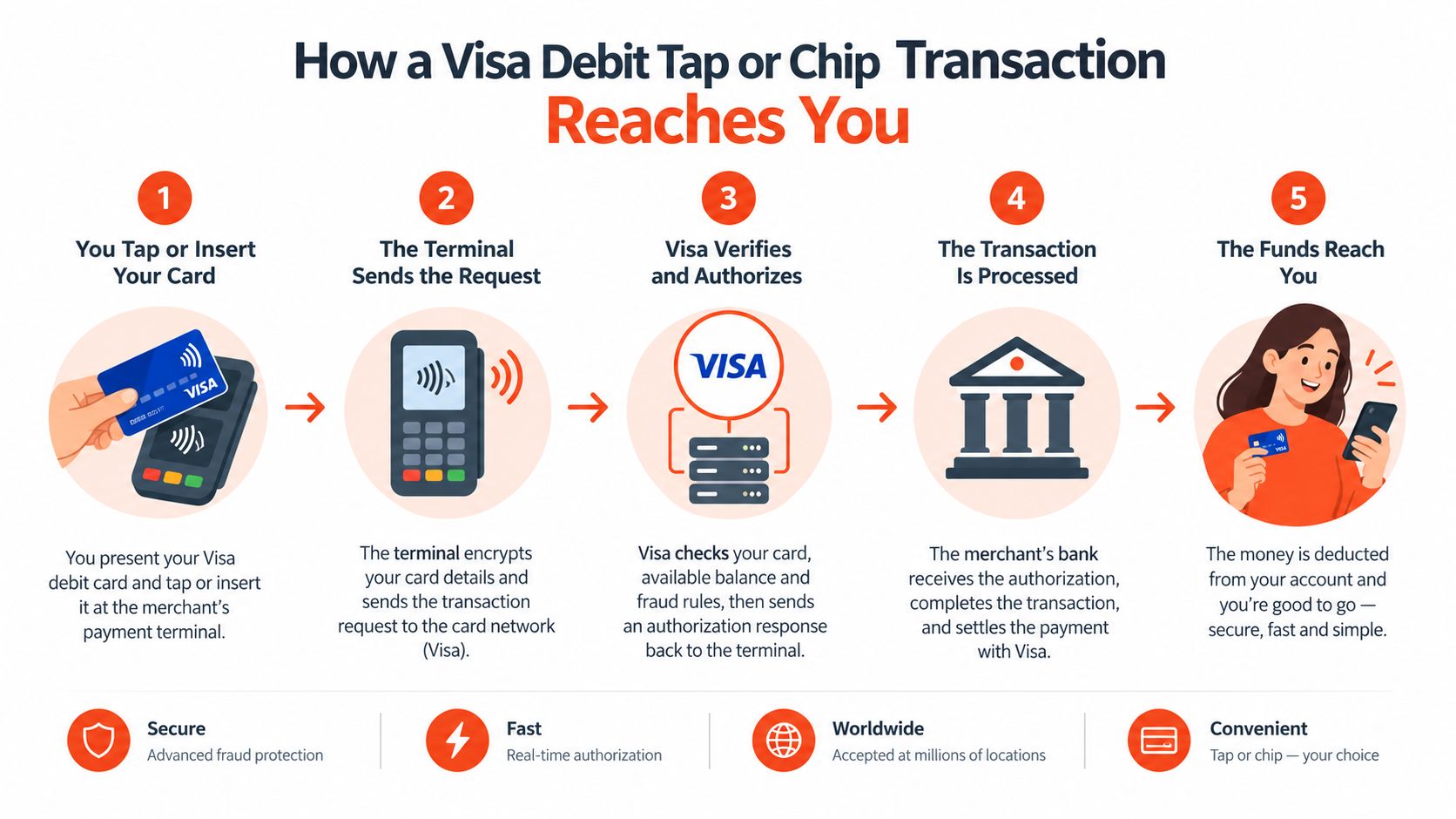
A Visa debit transaction begins before the customer hears the approval tone. The terminal identifies the card interaction, the acquiring setup prepares the authorisation request, and the issuer decides whether the transaction can proceed. A fast tap hides that sequence from the queue, but the merchant still needs to understand each stage when something goes wrong.
The terminal starts the interaction. The cashier enters the amount, and the customer taps or inserts the card. The terminal reads the card's contactless or chip data and identifies the payment application it should use.
The card provides transaction data. Contactless and chip payments use card-authentication methods designed to protect the transaction. Visa's contactless payment explanation for Singapore states that each tap generates a transaction-specific one-time code, so the card number isn't reused in transit.
The issuer checks the request. The request travels through the acquiring and Visa rails to the issuing bank. For debit, the issuer checks the account and its controls. An insufficient available balance or another issuer restriction can produce a decline even when the card appears physically undamaged.
The terminal requests any required verification. A low-friction contactless transaction may complete with a tap, while another transaction may require a PIN or a chip insertion. The exact prompt depends on the card, terminal configuration, issuer rules and transaction conditions, so staff shouldn't treat every PIN request as a fault.
The merchant completes settlement. An approval allows the sale to proceed, but the merchant still needs the transaction to be captured and included in settlement. The acquirer then credits the merchant under the agreed payout schedule.
Visa's Singapore materials also state that newly issued contactless cards and newly deployed contactless readers must support qVSDC, a contactless method intended to preserve low-latency acceptance while strengthening card-present fraud controls. The merchant doesn't need to explain qVSDC to customers, but the terminal and processor must support the relevant configuration.
When a transaction fails, the display message is only the starting point. A decline may come from the issuer, while a repeated read error may indicate a card, antenna or terminal issue. Staff should ask the customer to insert the card, try another approved payment method, or contact the issuing bank, without promising that a retry will succeed.
A contactless payment terminal for Singapore merchants should therefore be assessed on more than its ability to accept a tap. It needs reliable connectivity, current software, clear prompts and a process for distinguishing a declined authorisation from a failed card read.
A Visa debit card can work well for everyday in-store purchases, yet the rail can still underperform at the counter when funding, issuer rules, or customer habit do not line up with the basket. For a merchant, that matters because the terminal only sees the payment attempt, not the reason behind it.
The clearest problem is insufficient available funds. A customer may have money in the account, but not enough free balance for the full charge. Pending transactions, account restrictions, or bank-set spending controls can also lead to a decline. The terminal cannot see the bank's internal reason, so staff should avoid guessing.
Larger baskets often create a second layer of friction. Some customers use debit for day-to-day spending and prefer credit for a bigger purchase, even when both cards are accepted. Others expect an extra step at the terminal. If staff are unsure whether to ask for a PIN, retry a tap, or move to chip insertion, the queue slows.
A successful tap is only part of the outcome. The basket, the channel, and the customer's funding preference still shape whether the payment completes cleanly.
The online and remote-payment side is less forgiving for debit in some cases. As noted earlier, MoneySense guidance reports debit at about 9% of e-commerce transaction volume, while wallets account for 40% and cards and wallets together account for 74%. For a merchant, the practical lesson is simple. Keep debit as a fast tap option for in-store baskets, but do not assume the same acceptance pattern will carry over to phone orders, payment links, or checkout pages. Test wallet checkout alongside debit if you sell through those channels.
Phone orders and manually entered payments need extra care because they do not give the issuer the same card-present signals as a tap or chip read. The gateway may ask for stronger authentication or more customer verification. A debit card with incomplete or failed 3D Secure authentication can be declined even when funds are available.
A calm recovery sequence helps staff avoid guesswork:
Debit acceptance works best when the merchant treats configuration as an operational project rather than a checkbox on a payment application. The acquirer, gateway and terminal should support the card interactions customers typically use, while staff should know what each prompt means.
The first check is contactless and PIN support. The processor and gateway should support contactless verification and online PIN flows where the card or issuer requires them. The terminal should also use the Singapore configuration supplied by the acquirer, rather than relying on a generic imported profile.
The second check is the transaction environment. Offline acceptance settings, floor limits and risk controls should match the acquirer's and issuers' expectations. A merchant shouldn't alter these limits independently to force more approvals. An overly permissive setup can increase risk, while an overly restrictive setup can create unnecessary declines.
The third check is card-product recognition. The acquirer should confirm that the terminal and its BIN configuration recognise Visa debit and prepaid products correctly. Error messages that classify a supported card incorrectly often originate in configuration, software or routing rather than in the customer's card.
A merchant should ask the acquirer how debit and credit are priced. Some arrangements use blended pricing, while others distinguish payment categories. The quote should identify what is included, how refunds are handled, and whether online and in-store transactions follow different terms.
Surcharging and customer-facing pricing require particular care. The merchant should obtain current Singapore guidance from the acquirer or relevant authority before adding any fee to a card payment, rather than assuming that debit, credit and prepaid products can be treated identically.
Settlement deserves the same attention as the rate. The owner should know when approved transactions become available in the bank account, how weekends and public holidays affect timing, and where daily reconciliation data can be downloaded. Reports from the terminal, acquirer and bank should be matched against sales records so that missing, duplicated or reversed payments are identified quickly.
The merchant discount rate guidance for Singapore is a useful starting point for questions about pricing structure, but each business still needs its own review based on ticket size, transaction volume and channel mix.
A short staff playbook should cover three responses: a declined authorisation, a card-read error and a PIN or verification prompt. Cashiers should never ask for a customer's PIN aloud or write it down. They should also know when a second attempt is reasonable and when the customer should contact the card issuer.
Terminal software should stay current, and staff should test contactless, chip and fallback flows during quiet periods. Overseas-issued cards may present different verification prompts, so a cashier should follow the terminal instructions rather than assume that every Visa debit card follows the same path.
Operations check: A terminal demo isn't enough. The merchant needs a live test that covers tap, chip, PIN, decline messaging, refund handling and end-of-day reconciliation.
Visa debit should sit in the baseline acceptance layer of a Singapore SME's payment strategy. The data shows that card use is widespread, contactless behaviour is established and debit still represents a meaningful share of in-store POS value. Turning off debit to simplify the terminal rarely solves the underlying cost or conversion question.
The stronger approach is to separate essential acceptance from optional services.
Essential acceptance includes Visa debit, Visa credit, contactless, chip, appropriate verification and a reliable settlement process. These capabilities help the cashier complete ordinary purchases without asking customers to change their preferred payment method.
Optional services need a business case. Cashback, ATM-style functions, wallet acceptance and payment links may suit one retail model but add little value to another. A convenience shop, restaurant, clinic and fitness studio can all accept debit while needing different combinations of speed, receipts, refunds and reconciliation.
Staff training should place debit alongside PayNow, GrabPay, Apple Pay, Google Pay and credit rather than presenting one rail as the universal answer. The cashier's job is to recognise the prompt, protect customer information and offer an approved alternative when an issuer declines the transaction.
For high-volume, lower-ticket categories such as F&B and convenience retail, debit can be especially relevant because customers often use it for routine spending and expect a quick tap. The commercial question is whether the merchant's pricing arrangement and terminal performance support that behaviour at an acceptable cost. That requires reviewing actual transaction reports, not guessing from the card logo.
The useful mental model is straightforward: debit is a throughput and basket-completion tool. It belongs in the acceptance foundation, while the merchant's real optimisation work happens around routing, pricing transparency, terminal reliability, staff response and the mix of digital payment options offered at each checkout.
Sambapay provides Singapore SMEs with POS terminals and processing for Visa and other major card schemes, selected digital wallets and PayNow, with settlement options that can start from T+1 depending on the merchant agreement. Merchants reviewing Visa debit acceptance, terminal setup or payment pricing can visit Sambapay to discuss a practical configuration for their business.