
A commuter reaches the fare gate, taps a prepaid card, and sees the payment fail because the stored value is too low. A mobile user can face the same problem when a prepaid number runs out during an urgent call, while a small retailer may discover that staff are repeatedly adding small amounts without tracking the fees or failed attempts. In Singapore, knowing how to top up a prepaid card means more than knowing which button to press. The funding source, reload limit, verification step and recovery process all affect the outcome.
Singapore's prepaid ecosystem was shaped by daily transport. Stored-value cards made commuters comfortable with loading money in advance, checking a balance and replenishing it before the next journey. By 2017, NETS had issued more than 10.7 million FlashPay cards, while EZ-Link had issued more than 17 million cards. NETS also reported S$24 billion in customer spending during the preceding year, showing that stored-value instruments supported substantial payment activity, not just occasional travel. These figures are reported by Channel NewsAsia's account of Singapore's stored-value card ecosystem.
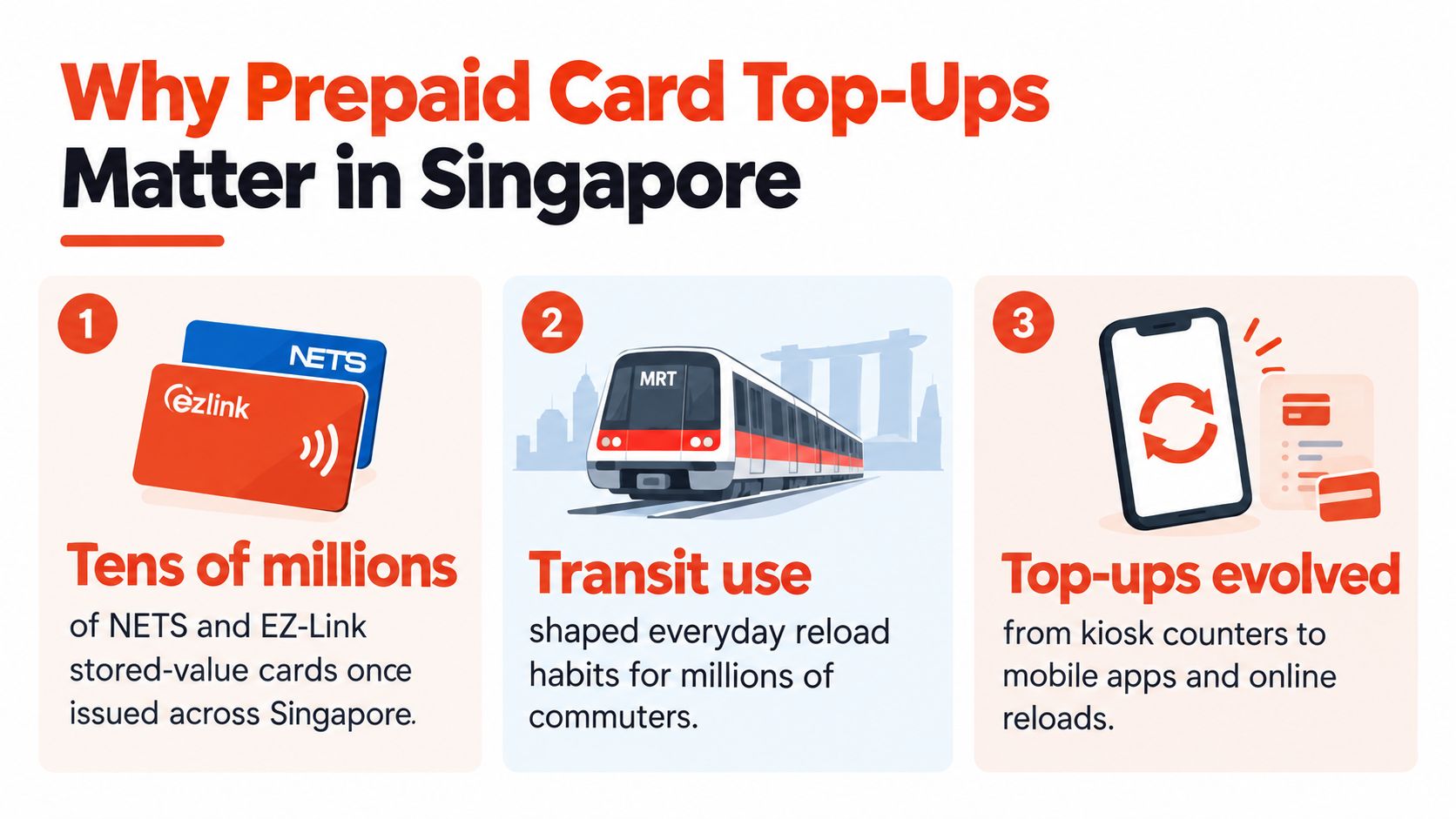
A retail customer may now reload through an app rather than at a physical counter, but the operational need hasn't changed. The card still needs enough value at the moment of use, and the user still needs a reliable way to confirm that the money arrived. For merchants, failed reloads can slow a queue, create support requests and complicate reconciliation.
The market is also moving towards app-supported servicing. Industry market intelligence estimates Singapore's prepaid-card and digital-wallet market at approximately US$9.66 billion in 2025, with a projection of about US$15.51 billion by 2030 and a forecast compound annual growth rate of 9.6% from 2026 through 2030. The same assessment describes transit stored-value cards managed through SimplyGo and multi-currency prepaid cards used for travel and cross-border e-commerce, as reported in this Singapore prepaid-card and digital-wallet market assessment.
For people trying to organise recurring spending, an AI finance app may help bring balances, reload patterns and payment activity into one view. It shouldn't replace checking the official prepaid or banking app, but it can support better budgeting around repeated top-ups.
A controlled reload starts inside the official banking, telco or prepaid-card app. The exact labels vary, but the logic is consistent: authenticate, select the prepaid service, enter the relevant account details, choose the amount, verify everything and authorise only after the final review. DBS documents this sequence through digibank under “Pay & Transfer”, then “Top-ups & Cheques”, followed by “Prepaid Mobile”. The service supports Singtel, StarHub and M1, according to DBS's prepaid mobile top-up instructions.
For a prepaid mobile number, the most important checkpoint is the recipient field. Enter the Singapore mobile number, select the denomination and compare the displayed number with the SIM or account that should receive the value. PayLah! requires a Singapore-registered eight-digit mobile number, so a user should verify the number before pressing the authorisation button.
A successful bank debit doesn't prove that the correct account received the top-up. After authorisation, check the updated mobile balance and retain the SMS or in-app confirmation. A reload sent to the wrong number may not be reversible, which makes a ten-second verification more valuable than trying to resolve the error later.
Practical rule: Treat the recipient number as payment information, not as a minor form field. Read it back before authorisation.
NETS reloads involve the card rather than a mobile number. The documented process is to ready the card, open the NETS App, choose “Top-Up”, hold the card against the back of a compatible phone for NFC reading, select the amount and authorise with a saved or newly entered debit or credit card. The phone must support the required NFC interaction, and the card must be eligible for reloading.
If the balance doesn't update, avoid immediately repeating the payment. Retry the NFC tap, relaunch the app or test with another compatible device. If the funding card has already been charged but the stored value remains unchanged, the safer response is to record the transaction details and contact NETS rather than creating another possible debit.
Users comparing mobile payment routes may also benefit from understanding the difference between PayNow and PayLah!, especially when deciding which account or app should handle a particular payment.
The headline phrase “top up by card” hides an important distinction. For NETS Prepaid Card reloads, the cost depends on the card funding the transaction. A Singapore-issued bank card can be used without a convenience fee, while other bank-issued Visa or Mastercard cards and American Express cards incur S$0.50 per transaction. NETS states that this fee is non-refundable, including when the top-up is disputed, as set out in its NETS Prepaid Card fee and limit guidance.
The card also has a reload range of S$10 to S$100 per top-up and allows five top-ups per card per day under the stated rules. That creates a practical maximum of S$500 per day, calculated from the published S$100 maximum and five permitted top-ups. The calculation is useful, but it isn't a separate NETS guarantee beyond those individual limits.
| Funding method | Convenience fee | Daily limit pattern | Fee refundable on dispute? |
|---|---|---|---|
| Singapore-issued bank card | No convenience fee | S$10 to S$100 per reload, five top-ups per card per day | Not applicable as no convenience fee applies |
| Other bank-issued Visa or Mastercard | S$0.50 per transaction | S$10 to S$100 per reload, five top-ups per card per day | No |
| American Express | S$0.50 per transaction | S$10 to S$100 per reload, five top-ups per card per day | No |
The practical difference appears when someone makes repeated small reloads. A user funding several S$20 transactions with a fee-bearing card pays the fee each time, while a locally issued bank card avoids that convenience charge under the published NETS terms. That doesn't make the fee-bearing route unusable. It may still be preferable when speed or the available funding card matters, but the user should price the full pattern rather than judging a single reload.
A business that accepts card payments should also separate customer-facing acceptance costs from a customer's prepaid reload costs. Guidance on Visa debit cards can help explain how debit-card funding differs from prepaid stored-value behaviour, but the prepaid provider's own fee rules remain decisive.
Manual reloads suit occasional users, but they create a predictable failure point for commuters and staff who use a card throughout the day. NETS supports auto-top-up thresholds of $10, $20 or $50, with a maximum reload of $100 per trigger. The reload occurs after a transaction pushes the balance below the selected threshold, not during point-of-sale authorisation, according to NETS support guidance on auto top-up.
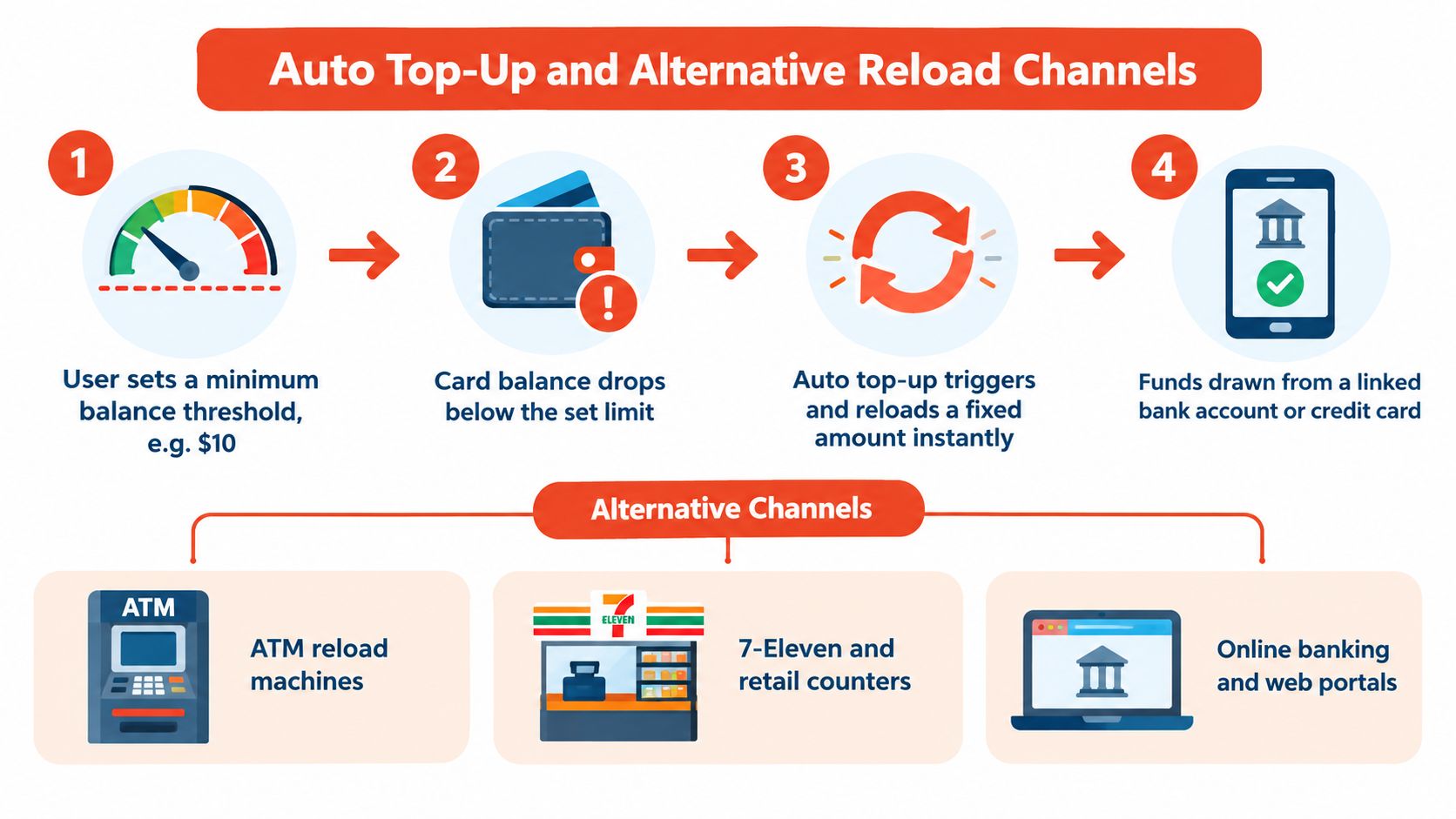
That timing matters. A card can still have insufficient value for the transaction that exposes the low balance, even if an automatic reload is configured to follow it. Users shouldn't treat auto top-up as a substitute for checking available value before an important journey or purchase.
The NETS App provides a mobile NFC route, but it depends on the device and a readable card. The practical sequence is straightforward:
Kiosks, retail counters and other supported reload points can be useful when the phone lacks compatible NFC or the app is unavailable. They trade digital convenience for a more location-dependent process, so users should confirm the updated balance before leaving the counter where possible. Anyone comparing stored-value products can also review how an e-wallet in Singapore fits alongside a physical prepaid card.
A short visual guide can reinforce the difference between automatic and manual reload behaviour:
The best channel is the one that matches the risk. Auto top-up reduces forgotten reloads, NFC is convenient when the device works properly, and a staffed channel may be easier when a card or app is already showing an exception.
The lowest advertised fee isn't always the lowest-risk option. A sensible decision considers cost, frequency, balance timing, device reliability and recoverability together.
A commuter who reloads regularly may favour a locally issued bank card where the published NETS convenience fee doesn't apply. A user who reloads only occasionally may accept a fee-bearing card if it avoids a delay, but should avoid splitting one planned reload into unnecessary repeated transactions. Someone with a stable routine may use auto top-up, provided the trigger timing is understood and the linked funding method remains secure.
Singapore's fraud environment makes the final point operational, not theoretical. Scam-related losses reported in the fintech sector reached S$840.3 million by November 2025, compared with S$1.1 billion for all of 2024, according to PwC Singapore's payments analysis.
A convenient reload is only successful when the value arrives, the cost is understood and the user can prove what happened afterwards.
Physical security still matters where cards are used at terminals. Readers who want a practical overview of terminal tampering can consult this guide on how to avoid skimmers at terminals. The same habit applies to prepaid use: inspect the payment environment, avoid exposing card details unnecessarily and review alerts promptly.
The most cost-effective method therefore depends on behaviour. Fee-free funding is attractive, but a reliable verification habit and a clear recovery path can prevent a small reload problem from becoming a larger account problem.
A failed reload needs a different response from a suspicious reload. In the first case, the balance may not have changed despite a legitimate attempt. In the second, the user may not recognise the funding transaction, recipient or device activity.
Start by checking the prepaid balance and the bank or card transaction record. Save the confirmation screen, timestamp, amount, card identifier where available and any error message. If the funding card was debited, don't submit the same reload repeatedly, because another attempt could create a duplicate charge.
Next, contact the prepaid-card operator with the transaction reference. Contact the bank or card issuer as well if the debit is missing, duplicated or still unresolved. The operator can investigate whether stored value was posted, while the issuer can address the funding transaction.
Freeze or disable the prepaid account and remove automatic reload access if the service allows it. Then contact both the funding-card issuer and the prepaid operator, preserve screenshots and report suspected scam activity promptly through the relevant channels.
A dispute doesn't necessarily recover every associated cost. NETS states that its convenience fee remains non-refundable in a top-up dispute, so the user should distinguish between the underlying reload amount and any separate fee when documenting the complaint.
Anonymous reloads can make the initial payment simpler, but they may leave fewer account records for ownership checks. A recognised account, retained receipt and complete transaction reference usually give support teams more useful evidence than a recollection of the amount alone.
Sambapay helps Singapore SMEs reduce payment friction with modern POS terminals, broad card and wallet acceptance, transparent blended pricing and local support. Businesses reviewing how customer payments connect with prepaid and digital-wallet behaviour can visit Sambapay to discuss a practical in-store setup.