
A Saturday afternoon queue has formed inside a Singapore boutique. One customer has tapped a card, but the terminal is still showing a loading screen. The cashier checks the connection, the customer checks the time, and the next few shoppers start wondering whether to leave the items behind. The problem isn't only a slow device. It affects the sale, the shopper's confidence, staff composure, and the shop's ability to keep serving.
That is why a retail point of sale (POS) system deserves more attention than a simple hardware purchase. The visible terminal is only one part of a connected setup that records sales, accepts payments, updates inventory, sends information to reports, and eventually moves funds into the business bank account. In Singapore, where in-store payments are overwhelmingly cashless by value, the POS sits at the centre of everyday trading.
A customer at a boutique counter taps a card, receives approval, and leaves with the purchase. The work is not finished there. The sale should reduce the stock count, appear in the day's report, and move through the provider's settlement process into the business bank account. If those steps sit in separate systems, the owner may spend the evening matching receipts, stock records, and payment statements.
A retail point of sale (POS) system works like the shop's operating centre. The terminal handles the customer-facing transaction, while the software records what was sold and how the business should account for it. Inventory, receipts, reporting, payment processing, and integrations form the wider system around the device.
That distinction matters because a standalone terminal can approve a card transaction without knowing which product was sold, how many units remain, or whether the day's takings match the sales record. A POS system joins those jobs into one workflow. A staff member can scan an item, accept a tap, issue a receipt, and update stock without copying the same sale into several tools.
Singapore's payment mix makes the choice commercially important. Card payments reached S$148.909 billion in 2024, with POS credit and charge cards accounting for S$54.540 billion and POS debit cards for S$28.52 billion, while e-money contributed S$2.52 billion, or 1.79% of POS transaction value, according to PwC's Singapore payments publication. The figures support reliable card acceptance, but they also point to a wider question: how much does accepting each payment type cost after processing, settlement, reconciliation, and support are included?
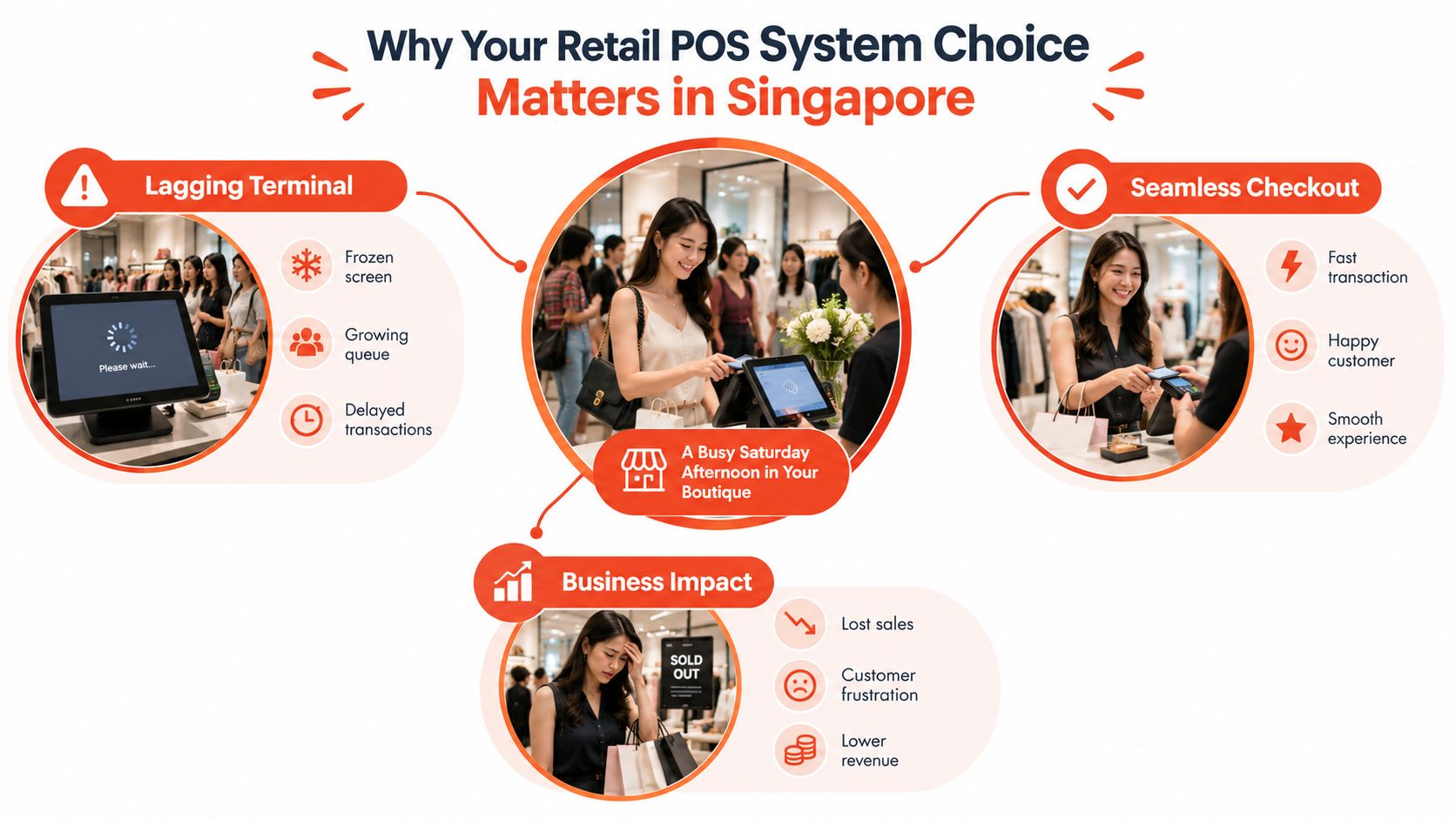
A boutique owner may check stock before opening, serve shoppers through the afternoon, and reconcile sales after closing. A connected POS can keep those tasks in one record instead of spreading them across notebooks, spreadsheets, and payment portals. Each completed sale can update inventory and the daily report, while staff permissions can separate cashier activity from manager actions such as refunds or discounts.
The same principle applies in other service businesses. A café needs orders to reach the correct preparation point. A salon may need payment records alongside appointments and service details. A clinic needs clear transaction records without making front-desk staff switch between unrelated systems. The system should follow the existing workflow, with configuration that reduces repeated entry and manual checking.
A lower advertised payment rate can still produce a higher operating cost if settlement is slow, scheme pricing is unclear, or staff must reconcile several reports. A transparent blended model may cost more per transaction on paper while saving time and reducing avoidable errors. The useful comparison is the total cost of acceptance, not the headline rate alone.
Practical rule: A terminal succeeds when staff can complete and record a sale accurately, while the owner can see what was accepted, what was settled, and what remains in stock.
A provider's payment coverage, scheme mix, settlement schedule, support model, and contract terms all affect the cost and reliability of accepting money. The right questions include:
The strongest POS decision connects checkout performance with cash flow and staff time. A reliable system can support customer confidence and accurate records, but the owner should judge it by the full cost of taking payment, from the customer's tap to the money's arrival in the business account.
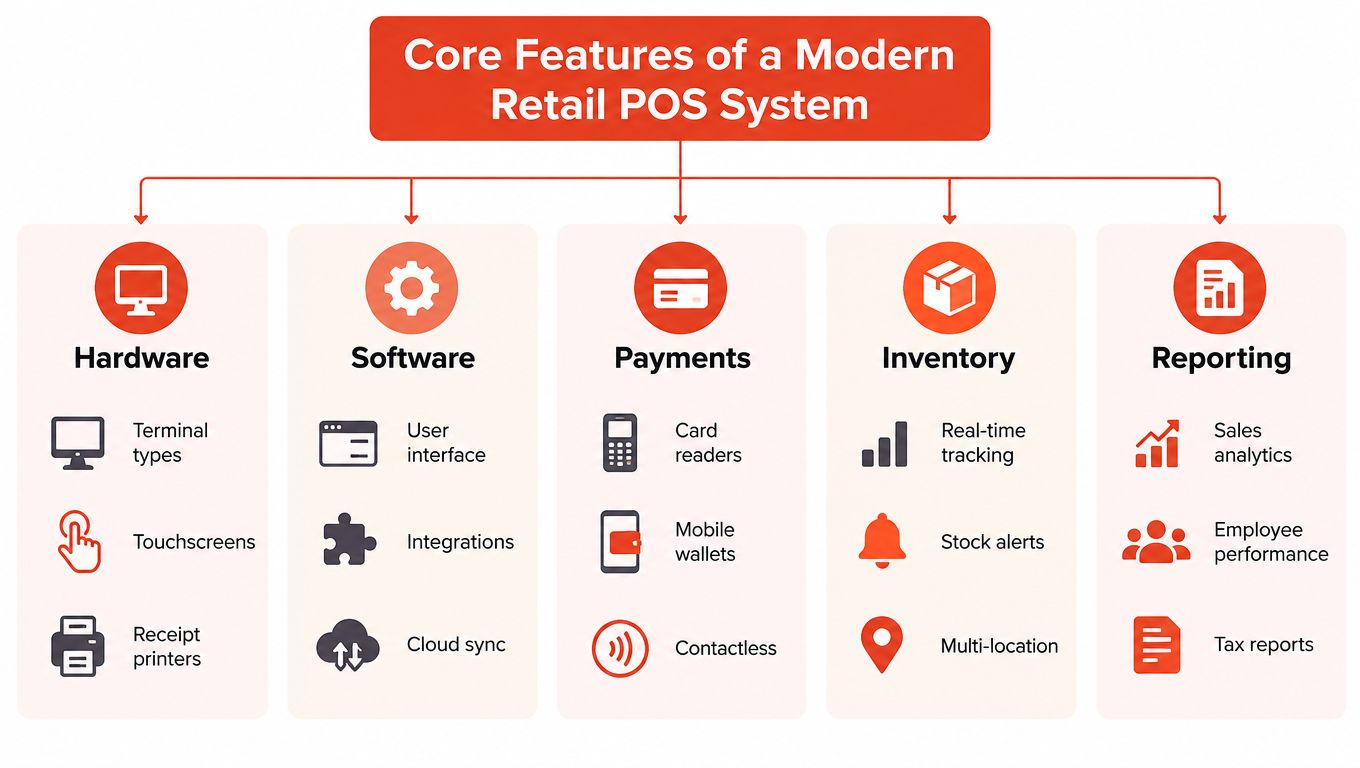
A useful POS can be assessed in five layers: hardware, software, payments, inventory, and reporting. The layers should connect cleanly. A fast screen with poor payment coverage still creates friction, while accurate inventory data is less useful if staff avoid the system during a busy period.
A fixed touchscreen terminal suits a boutique with a dedicated checkout. A portable Android terminal can help a café take payment at a table or a pop-up complete a sale away from a permanent counter. Receipt printers, cash drawers, barcode scanners, customer displays, and stable Wi-Fi or wired connectivity should be selected according to the shop's physical layout.
A café may need a compact device that sends order details into its service workflow. A salon may value portability because staff move between reception and treatment areas. A boutique may prioritise a barcode scanner and a screen that makes product variants easy to find.
Staff shouldn't need a long technical lesson to process a normal sale, apply a discount, issue a refund, or find a product. A clean interface reduces hesitation when the queue grows, while user permissions help managers control refunds, discounts, and other sensitive actions.
Cloud synchronisation can also give authorised staff access to current sales and inventory information from connected devices. The important test is practical: can a new cashier complete a mock transaction accurately after limited training?
The reader should handle chip, contactless cards, and supported mobile wallets without staff switching between unrelated devices. A customer taps, the transaction is authorised, and the sale is recorded against the correct basket.
When a boutique sells a particular size and colour, the inventory record should reflect that specific item rather than only reducing a general product count. Stock alerts and product-level reporting can help staff decide what needs replenishment and which items are moving slowly.
Reports should answer questions that arise during normal trading. Which products sold today? Which hours needed more coverage? Which payment types are being used? Which transactions were refunded? A useful dashboard turns sales activity into information for purchasing, staffing, and reconciliation.
A POS demonstration should therefore use real counter scenarios. The café should test order routing, the salon should test appointments and payments, and the boutique should scan a product, apply a variant, complete a tap, and check whether stock changes correctly.
A Singapore retailer usually serves several payment audiences at the same counter. Local shoppers may use PayNow or a contactless bank card. A visitor may use a card issued overseas or a wallet linked to a phone. Corporate customers and tourists can bring different scheme preferences, so a checkout that accepts only one route can create avoidable friction.
The relevant acceptance question isn't whether a terminal accepts “cards” in a broad sense. A vendor conversation should identify the actual schemes and wallets supported, including Visa, Mastercard, American Express, JCB, CUP, Apple Pay, Google Pay, Alipay, GrabPay, and PayNow where relevant to the merchant's customer base. The provider's product setup should state which methods are included, which require separate onboarding, and how each payment appears in settlement and reporting.
A Singapore e-wallet acceptance guide can help merchants map wallet requirements before a vendor demonstration. The purpose isn't to collect every possible method without reason. It is to avoid a situation where staff must remember which device handles which customer.
A card tap, a phone wallet payment, and a PayNow-style QR transaction may use different payment rails, but staff shouldn't need three unrelated operating routines. A connected retail POS should associate the approved payment with the correct basket, receipt, refund process, and end-of-day report.
That matters because Singapore retail handles both substantial value and frequent activity. The PwC dataset reported 726 million POS credit and charge transactions and 960 million POS debit transactions in the second half of 2025, which illustrates the transaction frequency that retail infrastructure may need to handle in the same payments dataset. A queue can become difficult quickly when a device freezes, a QR flow requires manual confirmation, or staff must reconcile separate provider screens.
A retailer can ask each provider to demonstrate the following with a test basket:
The right answer depends on the shop's audience and ticket profile. A tourist-focused boutique may prioritise international scheme coverage, while a neighbourhood café may place greater weight on fast local payment flows and high-frequency staff use.
The cheapest-looking rate isn't automatically the lowest cost of acceptance. A retailer needs to evaluate the fee structure alongside payment mix, settlement timing, hardware terms, support, refunds, disputes, and the internal time spent reconciling payments.
Singapore SMEs have historically shown sensitivity to card pricing. A source citing IDC data reported that 33% of surveyed SMEs in Singapore still see heavy cash usage in day-to-day operations, while card fees can be around 3% for Visa and Mastercard compared with lower network fees on local rails, as described in this Singapore payment methods analysis. That context explains why some merchants focus too narrowly on the headline MDR, even though cash handling and delayed funds also carry operational costs.
| Pricing model | Headline rate | Cost predictability | Hidden layers | Best suited for |
|---|---|---|---|---|
| Blended transparent rate | One stated rate across an agreed payment mix | High, provided the scope is clear | Check for exclusions, refunds, hardware, and chargeback fees | SMEs that value straightforward forecasting |
| Tiered or teaser rate | A low entry rate may apply to selected transactions | Variable as scheme mix changes | Higher rates, add-ons, minimums, or later increases may apply | Merchants able to monitor detailed transaction categories |
| Interchange-plus style pricing | Network and processor components are separated | Detailed but less simple | Assessment, scheme, service, and other pass-through charges | Larger or data-driven merchants comfortable with granular reconciliation |
The better question is not, “Which terminal is cheapest?” It is, “Which pricing model minimises total cost of acceptance?” That calculation should include the payment fee, cash counting time, banking effort, delayed settlement, dispute exposure, hardware rental, software charges, cancellation fees, and any binding period.
A low rate can look attractive if it applies only to a narrow class of local transactions. A transparent blended model can be easier to budget when a shop serves a mixed audience, provided the merchant confirms exactly which schemes and wallets the rate covers. A detailed explanation of blended rates and interchange-plus pricing in Singapore can support that comparison before contract discussions begin.
Settlement isn't only an accounting detail. Card payments typically settle in T+1 to T+3 business days, while PayNow transfers are instant, according to this Singapore guide to settlement speed and small-business cash flow. A retailer that needs to replenish fast-moving stock or manage staffing liquidity may value predictable access to funds even when another provider advertises a lower transaction rate.
The commercial review should therefore ask:
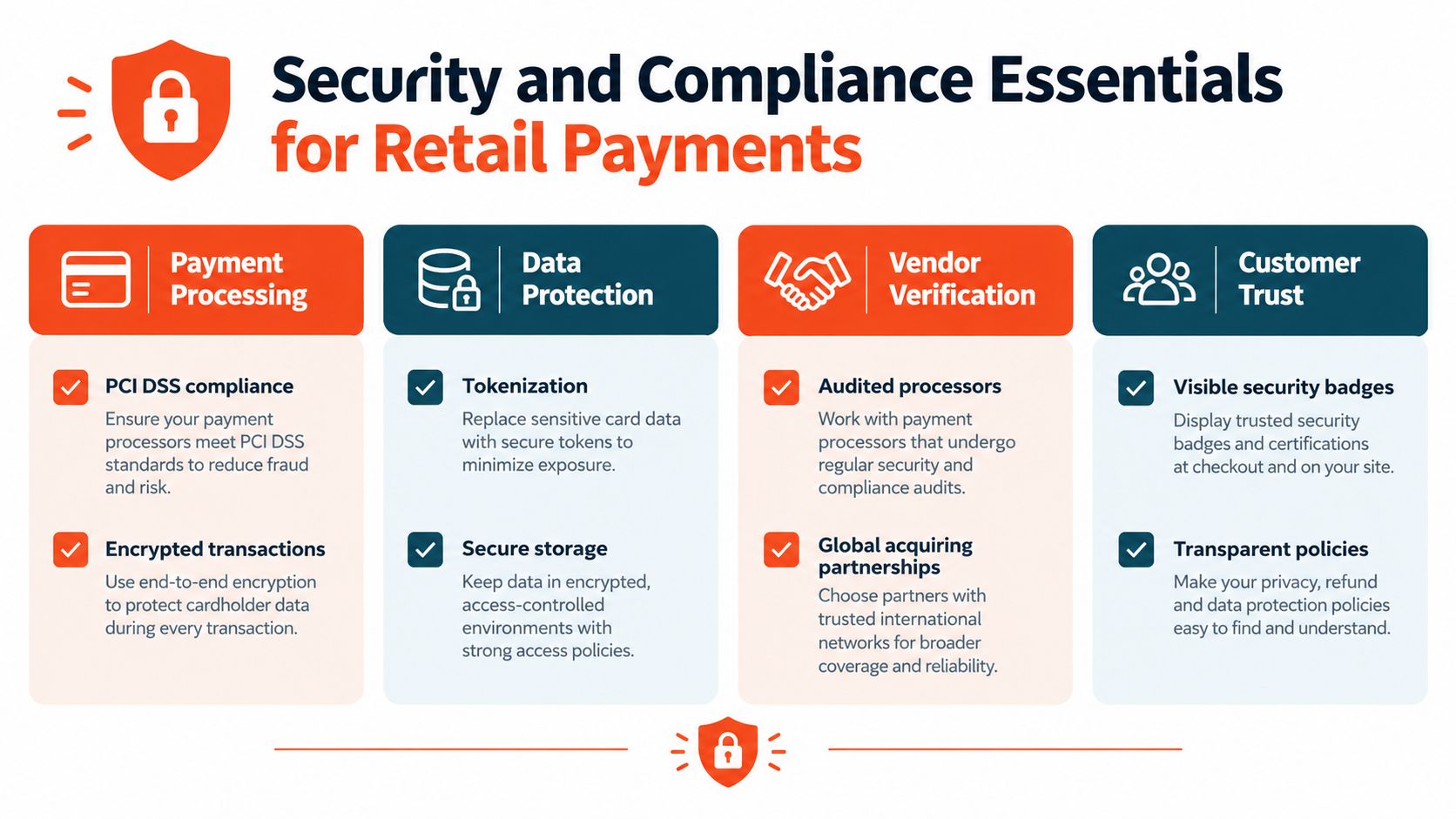
Payment security should be treated as a vendor verification exercise, not as an intimidating list of acronyms. A merchant needs to know how the provider protects transaction data, how the terminal connects to the processing environment, and who responds when a payment looks suspicious or fails unexpectedly.
A vendor should be able to explain whether transactions run through established acquiring infrastructure, how payment data is encrypted, and what controls prevent sensitive card details from being stored unnecessarily. PCI DSS, tokenisation, encrypted connections, and access permissions matter because they reduce exposure when staff handle refunds, terminals, receipts, and reports.
A practical vendor checklist includes:
For a plain-language technical reference, the 2026 practitioner guide to PCI DSS gives merchants a useful starting point for understanding testing and compliance responsibilities. The guide shouldn't replace a provider's own compliance documentation, but it can help a business ask more precise questions.
A failed payment creates more than an awkward pause. Staff may retry a transaction without knowing whether the first attempt succeeded, or a customer may leave after an unclear authorisation result. Stable connectivity, clear status messages, and a reliable reversal or refund process help prevent duplicate charges and reconciliation problems.
Established acquiring relationships can also reduce the number of unknown parties in the payment chain. Merchants can review Singapore merchant payment services as one reference point, then compare the provider's stated safeguards, support arrangements, and documentation with competing offers.
Customers notice whether the terminal looks current, whether the amount is visible before tapping, and whether the receipt clearly identifies the transaction. Staff should never ask for unnecessary card details or record sensitive information outside approved systems. Clear refund procedures and transparent privacy practices reinforce the technical safeguards that customers cannot see.
Switching POS providers feels risky when the old terminal is still processing sales. The risk becomes manageable when the handover is treated as a staged operational project rather than a single installation appointment.
The merchant should list the existing terminals, payment methods, product catalogue, staff accounts, refund rules, settlement schedule, integrations, and contract terms. The audit should also identify the busiest trading periods and any equipment that cannot be removed until historical reports or settlement records have been checked.
The contract deserves close attention. Hardware rental, minimum commitments, notice periods, cancellation charges, and data-export rights can affect the timing and cost of a switch. A vendor that gives a clear migration plan should explain which records can be imported and which need to be retained separately.
Installation should take place during a quieter trading window, not immediately before the busiest service period. The new terminal can be configured, connected, and tested while the old provider remains available as a fallback, subject to the agreed activation process.
A sensible sequence looks like this:
Funds arriving later can create a working-capital gap between a completed sale and the next inventory order. Faster settlement can shorten that gap, which may support replenishment and staffing liquidity for cash-flow-sensitive businesses.
The first post-launch review should compare the promised settlement schedule with actual payouts, not just confirm that transactions were approved. Staff should also record queue issues, failed attempts, refund questions, and any manual work that remains. Those observations show whether the new system works in real trading conditions rather than only during a demonstration.
A controlled handover protects trading continuity better than an improvised replacement after the old terminal fails.
A vendor comparison becomes clearer when every provider is tested against the same five dimensions. The shop's size matters, but reliability matters just as much because a payment problem affects every customer standing at the counter.
Payment acceptance coverage comes first. The provider should confirm support for the card schemes, contactless methods, wallets, and PayNow flows that match the shop's customers. “Card acceptance” is too broad a description for a contract unless the actual schemes are named.
Pricing transparency determines whether the merchant can forecast costs. A blended rate may be easier to understand, but the quote should state its coverage, exclusions, refund treatment, dispute charges, and any non-transaction fees. Teaser rates that rise later make comparison harder.
Commercial terms can change the economics of the terminal. Merchants should ask whether standard setups involve monthly terminal rental, cancellation fees, a binding period, or compulsory accessories. A low MDR doesn't compensate for an unsuitable commitment.
Settlement speed should be assessed against stock purchases, payroll, rent, and daily liquidity. The provider should state the expected timing, conditions, reconciliation method, and escalation route for delayed funds.
Local support matters when a terminal fails during service. A Singapore-based human support team can be easier for staff to reach than a general ticket queue, especially during installation, migration, or a disputed transaction.
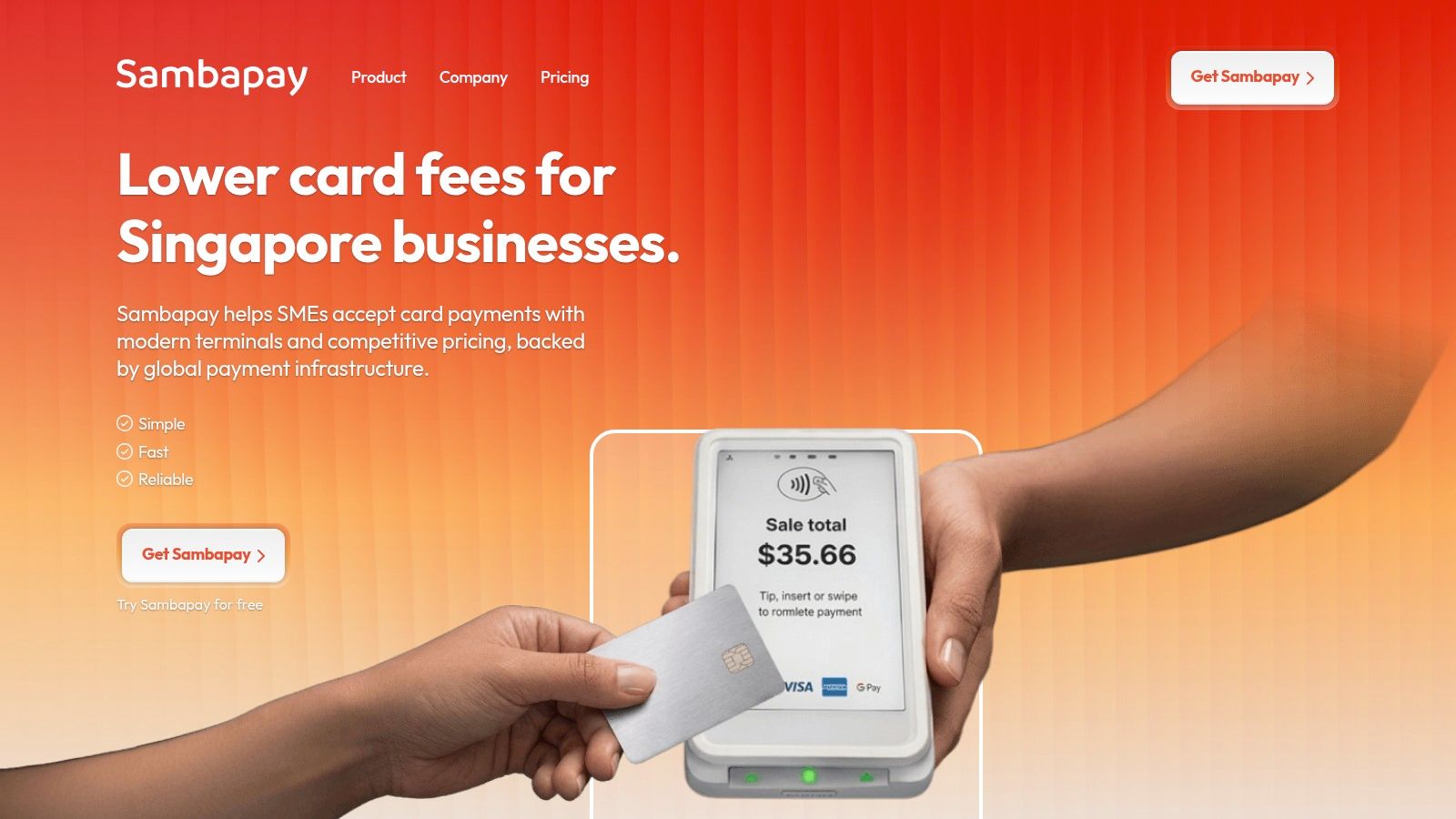
Sambapay offers Smart Android POS terminals supplied by PAX, acceptance across major card schemes and selected wallets including PayNow, settlement from as early as T+1 depending on the merchant agreement, transparent blended pricing, no monthly terminal rental for standard setups, and Singapore-based support. Its offering is designed for brick-and-mortar SMEs such as retail shops, F&B businesses, clinics, salons, and fitness studios.
Those features should still be tested against the merchant's actual ticket size, monthly volume, customer mix, and workflow. A vendor demonstration should include a real product basket, a contactless transaction, a wallet payment, a refund, a receipt, and a report export. The merchant should also request the full commercial terms in writing rather than relying on a verbal headline rate.
The transaction-frequency figures reported by PwC show why a vendor must demonstrate reliability under sustained retail use, not only during a quiet sales demo. A shop owner can shortlist providers this week by sending the same five questions to each one, requesting an industry-specific quote, and asking for a practical migration timetable.
The boutique queue from the opening scene should end differently. The customer taps, the payment status is clear, the receipt is issued, and the product record updates without a second manual entry. Staff keep serving instead of explaining a frozen screen, while the owner can review sales and settlement through connected records.
The central lesson is simple. A POS system links the counter to inventory and reporting, payment coverage must reflect Singapore's mix of cards and local rails, and security should be verified through direct vendor questions. Pricing needs a total-cost view that includes settlement, cash handling, scheme mix, hardware terms, and disputes. Implementation should be phased so training and activation don't interrupt trading.
The next practical step is a vendor comparison using the five checks above. Retailers can request quotes based on their industry, typical ticket size, payment mix, and trading pattern, then test the proposed workflow before signing. The right system isn't merely a terminal. It is a repeatable checkout process that supports customer experience, staff confidence, and cash-flow planning across every sale.
Sambapay provides Singapore SMEs with Smart Android POS terminals, card and wallet acceptance, blended pricing, settlement options from as early as T+1 subject to agreement, and local support for onboarding or migration. Retailers, cafés, salons, clinics, and fitness studios can review the offering and request a customized discussion through Sambapay.