
A customer taps a card at a café counter, the terminal beeps, and the receipt appears. To the customer, the payment looks complete. Behind that quick moment, the POS terminal, acquiring provider, card scheme, customer's bank, security checks, and settlement process must work together without slowing the queue.
That hidden chain matters to a Singapore SME. A retail shop needs reliable acceptance for everyday purchases. A restaurant may need portable terminals for pay-at-table service. A clinic, salon, or gym may care more about stable connectivity, clear reconciliation, and predictable access to funds. Merchant services in Singapore therefore involve much more than renting a card machine or comparing a transaction rate.
Singapore's card market makes the decision especially important. Card payments reached about S$148.9 billion in 2024 and are projected to reach S$158.2 billion in 2025, according to Singapore card payments market coverage. In the second half of 2025, POS credit and charge card payments totalled 726 million transactions worth S$56.49 billion, while POS debit payments reached 960 million transactions worth S$28.399 billion, as recorded in MAS retail payment statistics.
The practical question isn't, “Which provider has the lowest rate?” It's whether the setup accepts the payment methods customers prefer, keeps checkout moving, protects sensitive information, and puts usable cash into the business bank account when the business needs it. The sections below help owners evaluate those trade-offs across pricing, settlement, compliance, hardware, onboarding, and day-to-day support.
For a small business owner, payment acceptance often becomes visible only when something goes wrong. A customer taps a card, the terminal pauses, the cashier retries the transaction, and a queue forms. If the payment succeeds but the payout arrives later than expected, the problem moves from the counter to stock purchasing, payroll planning, and bank reconciliation.
Merchant services describe the wider system that supports payment acceptance. That can include the POS terminal, card processing, acquiring arrangements, payment gateways, settlement, reporting, onboarding, fraud controls, and technical support. A terminal supplier may provide the physical device, but the acquirer and processing partners handle the commercial and operational work that allows the merchant to accept and receive payment.
This distinction helps a business avoid a common mistake. A low-cost terminal rental may look attractive until the owner discovers that the provider offers limited card-scheme coverage, unclear settlement timing, weak reporting, or support that operates only through a distant ticketing queue. A slightly different commercial structure may be more suitable if it gives the shop reliable acceptance and faster access to working capital.
Practical rule: A payment quote should be judged by its effect on the whole checkout and cash-flow cycle, not by its headline rate alone.
The audience for this guide includes retailers, cafés, restaurants, clinics, salons, spas, gyms, and fitness studios operating physical locations in Singapore. Each business has a different payment mix. A boutique may process moderate-value purchases at one countertop. A café may handle many smaller transactions during concentrated peak periods. A clinic may need a stable countertop device and careful handling of refunds and receipts.
Singapore merchants also need to think beyond cards. The country's payment environment supports major card schemes and growing use of wallets and account-to-account payments. BIS data on Singapore's cashless payment environment notes that digital payments adoption reached 92.0% in 2025, while digital wallets and A2A payments accounted for about 48% of retail consumer-to-business commerce value in card-led peer markets such as Singapore. Cards remain central to in-store acceptance, but a modern acceptance stack should reduce friction across the payment types customers use.
A card transaction works like a relay race. The customer starts the race by tapping, inserting, or swiping a card. Several participants then pass the transaction message along, check whether it can proceed, and move the funds to the merchant.
POS terminal: The terminal reads the card or mobile wallet, records the purchase amount, and sends an encrypted request through the payment network. Stable connectivity matters because a delayed or failed connection can interrupt an otherwise valid sale.
Acquirer: The acquirer, or acquiring provider, acts for the merchant. It receives the transaction request, routes it through the relevant payment rails, supports merchant onboarding, and later arranges settlement. A company that supplies the terminal isn't automatically the acquirer.
Card scheme: Visa, Mastercard, American Express, JCB, CUP, and other networks provide the rules and rails that connect the merchant side with the customer's bank. Singapore's card infrastructure is highly standardised, with Visa and Mastercard identified by MAS as the main card operators, and American Express and Diners Club identified as the main charge card operators in MAS material on payment and settlement systems.
Issuer: The issuer is the customer's bank or card company. It checks available funds or credit, card status, risk signals, and transaction details before returning an approval or decline.
Settlement: After the transaction is captured, the acquiring side transfers the proceeds to the merchant's nominated bank account according to the agreement. The customer sees an approval quickly, but the merchant's usable cash arrives according to the settlement schedule.
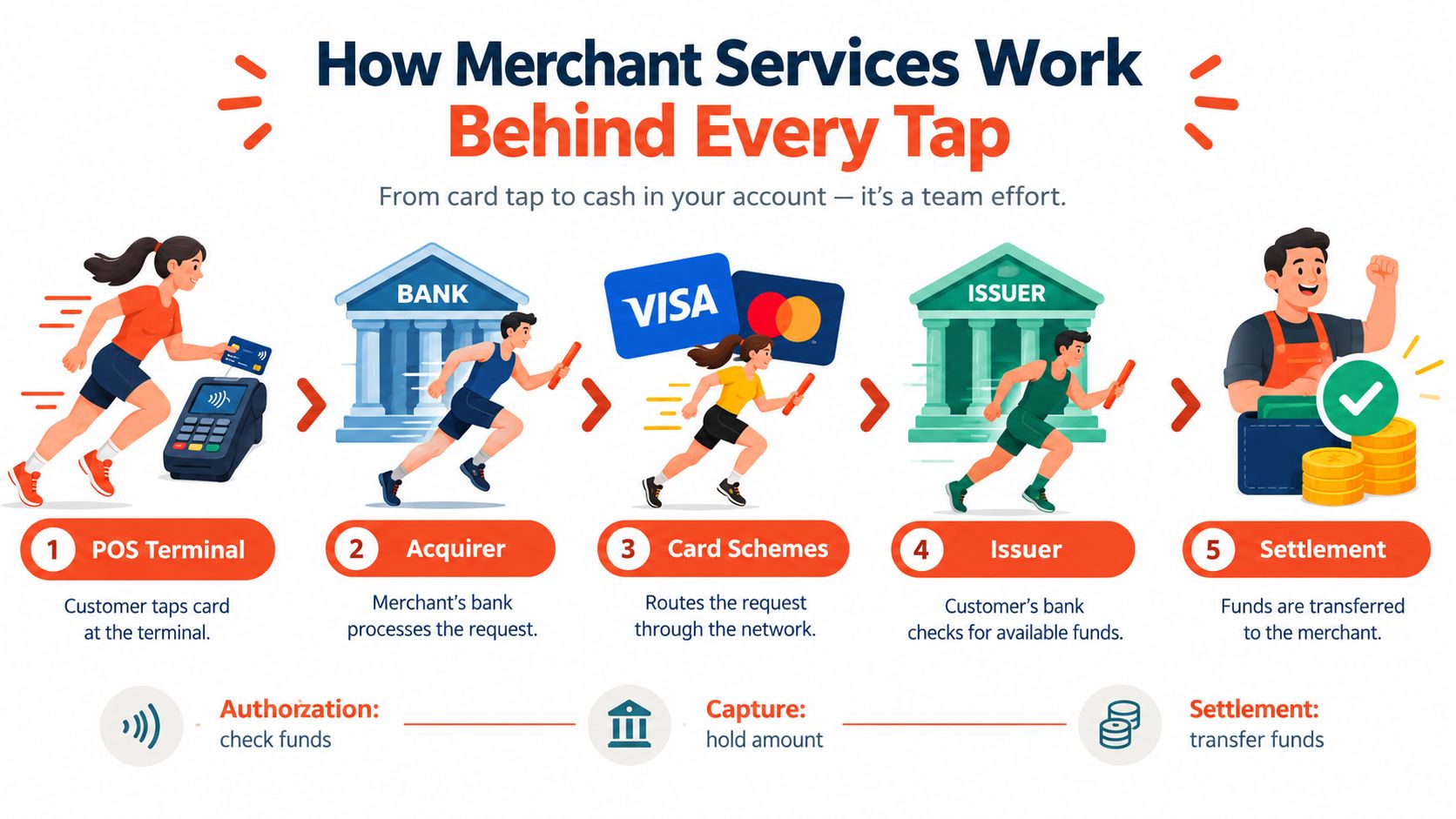
Authorisation asks whether the payment may proceed. Capture confirms the amount for processing, while settlement moves the money to the merchant. These stages explain why a terminal can show an approved sale even though the business bank account doesn't update at that exact moment.
Online payments use a related flow through a payment gateway. For businesses adding an online channel, practical guidance on reducing friction in payment fields is available in Smart Receipts payment form tips. For in-store card acceptance, a merchant can also review how paying with a credit card through a POS flow fits into the customer journey.
Security controls sit across the relay. EMV chip and contactless standards help protect card-present transactions, while encryption and authentication controls reduce exposure as payment data moves between participants. For online card payments, 3D Secure can add an issuer authentication step. The provider's connectivity, monitoring, and exception handling matter just as much as the device on the counter.
Singapore treats merchant acquisition service as a regulated payment activity under the Payment Services Act. MAS defines the activity as accepting and processing payment transactions for a merchant under contract, usually with a POS terminal or online payment gateway, as described in the MAS overview of regulated payment services.
That definition is broader than “providing a card machine”. It covers the acquiring function behind acceptance, including transaction processing, merchant contracting, onboarding, operational controls, and the movement of funds. For an SME, the distinction matters because the business is handing a provider responsibility for customer payments and settlement proceeds.
A provider operating within the regulated framework should have a clear licensing position and explain which entity performs each part of the service. The licence category, contractual structure, processing partners, and responsibilities can vary, so a business shouldn't rely on a sales description alone.
Onboarding commonly includes business verification and information about the owners, directors, products, sales channels, expected transaction activity, and bank account. These checks support anti-money-laundering controls and help the provider identify unusual activity. They can also affect approval, reserve requirements, transaction limits, and the time needed to activate particular payment methods.
A terminal rental agreement alone doesn't answer the important questions. The merchant should identify the acquiring entity, the contracting party, the settlement bank account, the refund process, the dispute process, and the party responsible for security incidents. A provider may also work through an ISO, or Independent Sales Organisation, that introduces merchants while a licensed acquiring partner performs the regulated processing. This explanation of ISOs in payment processing helps clarify why the sales contact and the regulated service provider may not be the same organisation.
The card schemes create technical and operating requirements that terminals must support. Singapore merchants serving broad consumer demand may need acceptance for Visa, Mastercard, American Express, JCB, CUP, and selected wallets, depending on their customer base and provider arrangement.
EMV compliance, secure key management, device updates, and clear receipt handling are operational issues rather than marketing features. A merchant should ask how the provider supports failed transactions, offline behaviour, reversals, refunds, chargebacks, and terminal replacement. Those answers reveal whether the provider understands the full acquiring relationship or is mainly selling hardware.
Licensing doesn't remove every business risk, but it gives the merchant a clearer framework for checking who accepts the payment, who controls the funds, and who handles problems.
Payment pricing usually becomes difficult when a provider presents a single attractive rate without explaining what sits behind it. Blended pricing combines the main processing costs into one merchant-facing rate. Itemised pricing, often called interchange-plus pricing, separates the components so the merchant can see more detail.
Neither structure wins for every SME. The right choice depends on transaction volume, card mix, ticket size, operational preference, and how much time the owner wants to spend reviewing statements.
| Feature | Blended Pricing | Itemised Pricing |
|---|---|---|
| How it appears | One combined rate for eligible transactions | Separate processing, scheme, and underlying card cost components |
| Budgeting | Easier to forecast from a straightforward rate | Requires more detailed statement review |
| Transparency | Simple at the point of sale, but the provider must disclose exclusions | More visibility into how different transactions are priced |
| Card mix | Can smooth differences across card types | May reflect differences between card products and transaction categories |
| Suitable use | SMEs prioritising predictable administration and clear budgeting | Merchants with sufficient volume or complexity to benefit from granular analysis |
| Questions to ask | Which cards, wallets, refunds, and adjustments are included? | Which components can change, and which fixed fees apply? |
| Potential add-ons | Minimums, terminal charges, gateway fees, refund costs, or non-standard card surcharges | Statement fees, gateway charges, network assessments, refund costs, and separate hardware charges |
A neighbourhood salon with a mixed customer base may prefer a clearly stated blended rate because staff and owners can reconcile sales without interpreting multiple fee lines. A larger retailer with a broader card portfolio may value itemisation if the finance team can identify which transaction categories drive cost.
The headline rate isn't the total cost. The owner should request a sample statement and ask whether the quote includes refunds, chargebacks, settlement changes, terminal replacement, manual entry, cross-border cards, and digital wallets. A teaser rate that applies only to a narrow transaction category can create an unpleasant surprise once real sales begin.
The price comparison should include settlement. A lower apparent rate may not be the better commercial choice if the payout schedule leaves the business waiting for funds needed to replenish stock or cover operating expenses. Conversely, a faster settlement option may carry a different commercial price, so the owner should compare the net cost of usable cash, not just the deduction from each transaction.
This comparison of blended rates and interchange-plus pricing in Singapore provides useful terminology for that discussion. A practical quote request should ask the provider to model the merchant's actual payment mix, not an abstract example.
Decision test: If two providers appear close on price, compare the money received, the settlement date, the exceptions, and the time required to reconcile each statement.
The owner can then assess whether simplicity has real value. A transparent blended structure may suit a business that wants predictable administration. Itemised pricing may suit a merchant able to analyse detailed data and negotiate around its transaction profile. The commercial terms should remain understandable to the people who operate the shop, not only to a payments specialist.
A payment sale becomes useful to an SME only when the proceeds reach the business bank account. Settlement timing affects how quickly a retailer can reorder stock, how a restaurant manages supplier payments, and how a service business plans payroll and recurring expenses.
Providers may describe settlement as T+1, T+2, or another schedule. The exact meaning should be confirmed in writing, including the cut-off time, business-day definition, weekends and public holidays, refunds, reserves, risk reviews, and whether different payment methods settle separately. “Approved at the terminal” doesn't necessarily mean “available in the bank account”.
Ask the provider to state:
MAS data shows the scale that makes this a daily operating issue. In H2 2025, combined card payments reached 2.528 billion transactions worth S$153.164 billion, according to the MAS retail payment statistics PDF. A busy merchant doesn't need every dollar immediately, but the settlement arrangement should match the business's cash cycle.
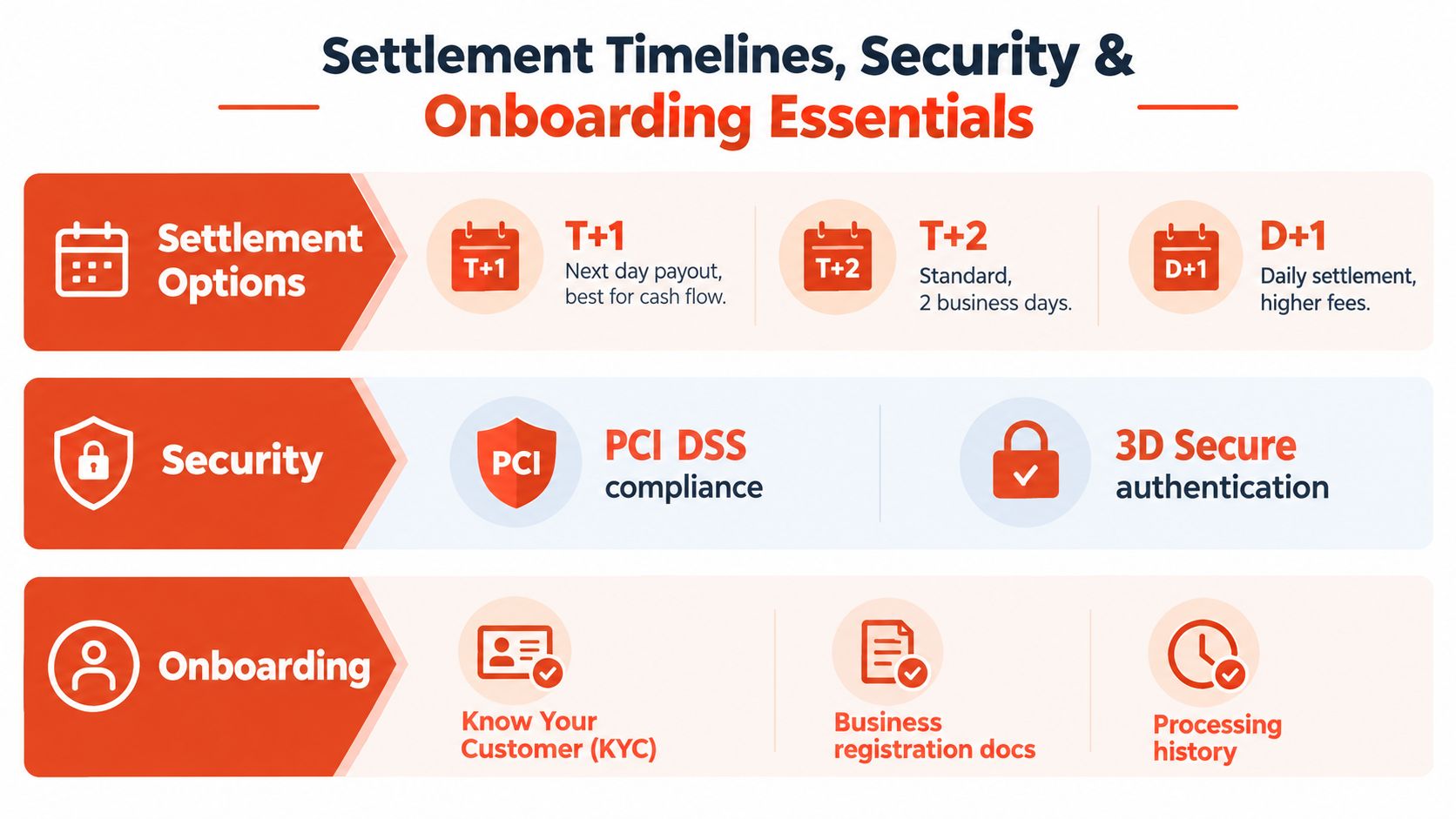
A provider should explain how its terminals and processing environment support PCI DSS, encryption, EMV controls, SSL, and 3D Secure where relevant. PCI DSS isn't a badge that transfers every responsibility away from the merchant. Staff still need procedures for terminal access, refunds, receipts, suspicious activity, passwords, and device replacement.
The merchant should also ask how the provider handles a lost terminal, software updates, suspected fraud, chargebacks, and customer data requests. Clear escalation routes reduce uncertainty when a payment issue occurs during trading hours.
A clean onboarding process usually starts with business registration documents, identity and ownership information, bank details, outlet information, and an outline of products and expected payment activity. The provider then verifies the business, confirms the commercial terms, configures the terminal, tests connectivity, and trains staff.
The safest migration keeps the existing setup active until the replacement is tested. Staff should practise sales, refunds, voids, receipt delivery, end-of-day reporting, and offline contingencies before the new terminal becomes the only option. Installation timing also matters. A provider that coordinates activation around opening hours can reduce the risk of losing a trading day.
The same terminal won't suit every Singapore storefront. A merchant should start with the customer journey, then choose the hardware and payment mix that support it.

A boutique or retail shop may need a compact countertop terminal, fast contactless acceptance, printed or digital receipts, and integration with inventory or POS software. Staff should be able to handle a customer using a physical card, an Apple Pay or Google Pay wallet, or another accepted method without changing the sales routine.
A café or restaurant has a different rhythm. A busy counter may benefit from a device that processes orders quickly and stays connected during peak periods. A full-service restaurant may need a portable Android POS terminal that travels to the table, supports tipping or service workflows where applicable, and lets staff confirm payment without sending customers back to a fixed counter.
A beauty salon or spa often processes appointments, deposits, packages, and refunds. Its provider should make it easy to identify transactions and reconcile them against bookings. A clinic may prioritise a dependable countertop device, privacy at the payment point, clear receipts, and a settlement schedule that fits recurring operating costs.
A gym or fitness studio may combine membership payments, retail sales, class bookings, and occasional higher-value purchases. It may need a counter terminal for walk-in transactions and a separate online payment flow for renewals or bookings. The business should check whether the provider can keep the reporting understandable across those channels.
Payment method selection should follow the customer base rather than a feature list. Cards remain a major in-store rail, while wallets and PayNow may reduce friction for customers who prefer mobile or account-to-account payments. The provider should state exactly which methods are active, whether they share the same terminal, how each is priced, and when each settles.
A merchant can use the following operational test:
The hardware should support the workflow, not force staff to redesign it. A clean Android terminal can be useful where the business needs mobility and a modern interface, but a stable countertop device may be the better choice for a clinic or service desk.
The following video gives merchants another visual reference for how card acceptance can fit into an in-store process.
A reliable provider should make five areas clear before the contract is signed: pricing, settlement, hardware, onboarding, and local support. The merchant doesn't need the most complicated platform. The merchant needs a setup that works during real trading conditions and remains understandable after the first statement arrives.
A simple comparison can use a written scorecard. Each provider can be assessed against the following questions:
The owner can then compare providers using the same transaction assumptions and the same business workflow. A quote that looks cheaper but requires manual reconciliation or leaves unclear settlement gaps may create more work than it saves. A higher level of detail can also be valuable if it helps the finance team identify where costs arise.
Sambapay is one Singapore-based option for brick-and-mortar SMEs. It offers PAX Android POS terminals, acceptance across major card schemes and selected wallets, transparent blended pricing, settlement options from as early as T+1 depending on the agreement, coordinated onboarding, and Singapore-based support. Those features should still be assessed against the merchant's own ticket size, payment mix, outlet layout, and cash cycle.
The final step is practical. The merchant should provide each shortlisted provider with outlet details, expected payment methods, typical transaction patterns, current settlement needs, POS requirements, and any planned migration date. A quote and a written implementation plan are more useful than a generic rate card.
For a Singapore SME comparing merchant services, Sambapay can provide modern PAX Android terminals, major card and selected wallet acceptance, transparent blended pricing, and settlement options from as early as T+1 subject to the merchant agreement. Visit Sambapay to request a tailored quote and plan an in-store setup with local onboarding and support.