
Friday service is underway. A queue is forming, one staff member is entering orders, another is holding a card terminal, and delivery tablets are chiming beside the cash drawer. A customer wants to split a bill, the kitchen is waiting for a modifier, and a popular dish has just sold out, but the delivery menu still shows it as available.
That scene exposes the job of a POS system for F&B. It isn't merely a device for accepting cards. It is operational infrastructure that must keep orders, kitchen production, payments, inventory and settlement aligned while the team is working at full speed.
Singapore's customers are already accustomed to cashless service. A 2023 Visa study reported that 82% of Singapore consumers used contactless cards, while 97% used contact and contactless card payments and 95% used debit and credit cards. The same report found that 89% of contactless card holders used contactless payments at least once a week, with 41% doing so at least four times a week. The Singapore contactless payment findings make the operating requirement clear, fast, dependable tap-to-pay acceptance belongs at the centre of the F&B workflow.
At a small restaurant, kopitiam or hawker stall, the Friday rush rarely breaks one process at a time. It breaks several processes together. The cashier takes an order on one screen, the card payment happens on a separate terminal, the kitchen receives a handwritten docket, and a GrabFood or Foodpanda order appears on another tablet. Each device may work by itself, but staff still have to connect the pieces manually.
That manual connection creates the bottleneck. A modifier such as “no ice” or “extra chilli” can disappear between the order screen and the kitchen. A cancelled delivery order can remain in the production queue. A payment can be approved on the terminal but fail to match the sale in the till. The business then loses time during service and spends more time later checking what happened.
Practical rule: A POS should remove decisions from the busiest part of service, not add more screens for staff to monitor.
The pressure is also financial. Singapore F&B sales value was about S$962 million in June 2025, and online F&B sales accounted for 26.7% of total F&B sales that month, according to a Singapore F&B industry summary. Yet the sector's F&B Services Index rose only 0.1% year on year in June 2025, while restaurants declined 5.6%, food caterers grew 18.5%, and fast-food outlets grew 2.3%. Those figures describe an environment where a small mistake in ordering, wastage or reconciliation matters.
Closures add to the urgency. The same summary reported restaurant and café closures averaging roughly 307 per month in the first five months of 2025, compared with about 241 per month in 2023. A POS can't fix rent, labour or ingredient costs, but it can give operators tighter control over sales, payment acceptance, item availability and staff execution.
The right contactless payment setup for Singapore merchants should therefore connect with the operating workflow. The useful question isn't whether a terminal looks modern. It is whether the whole system keeps the floor moving when orders, payments and kitchen tickets arrive together.
A proper F&B POS works like the communication system between a restaurant's floor and kitchen. The front of house records what the customer wants. The back of house receives a clear production instruction. The payment layer records how the customer paid and makes the transaction visible for settlement.
A card machine alone handles only the last part. Adding a menu to that machine doesn't automatically create an F&B system. The POS has to pass information between each layer without forcing staff to re-enter the same order.
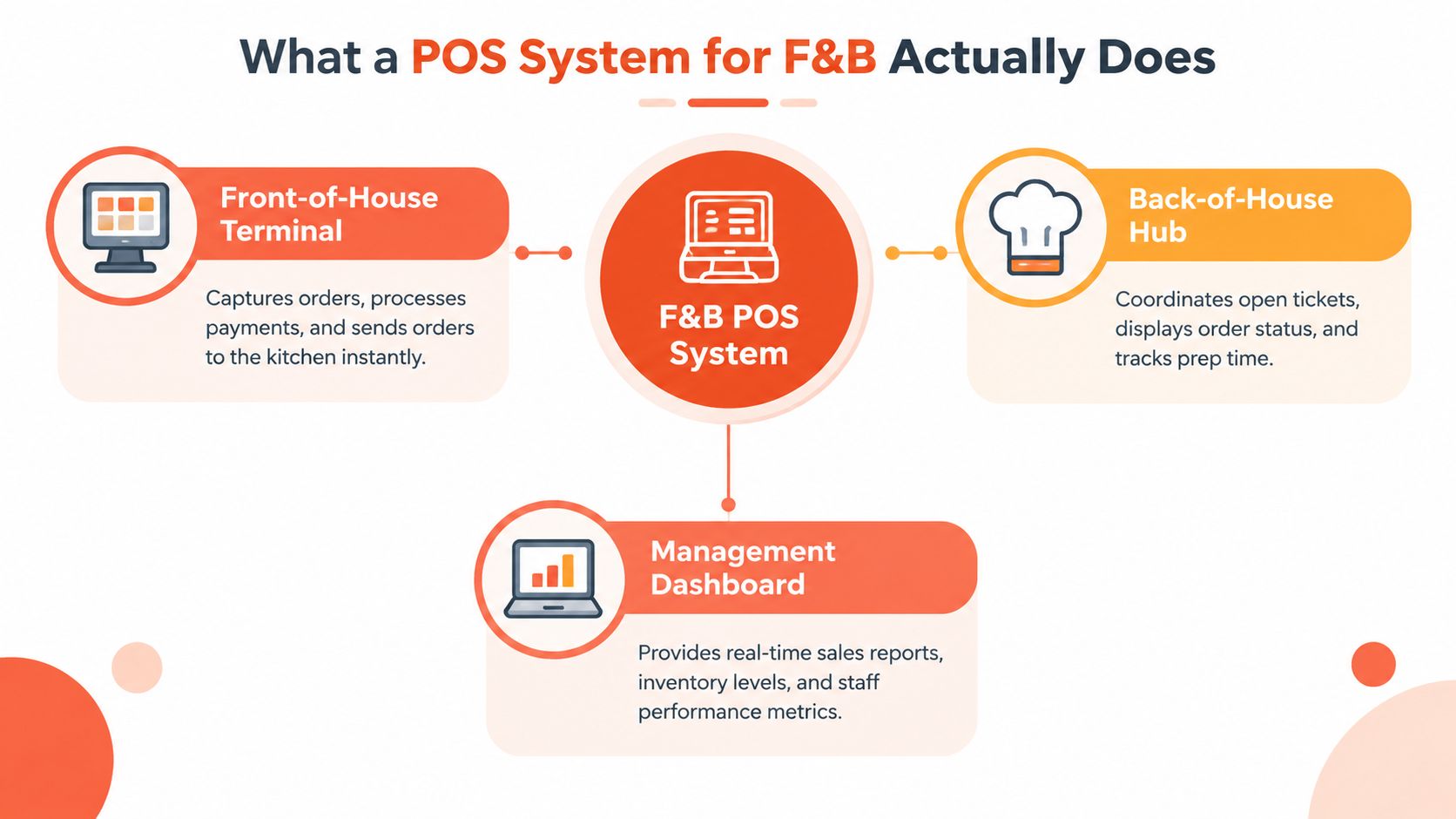
The front-of-house terminal captures orders at the counter, table or self-order point. It should handle menu variants, modifiers, discounts, service charges where applicable, dine-in and takeaway modes, and the customer's chosen tender. A server shouldn't need to memorise which screen handles a takeaway order and which screen handles a table transfer.
The terminal also needs to support Singapore's payment mix. In 2024, card-based in-person spend included SG$54.54 billion in credit-card POS transaction value and SG$28.52 billion in debit-card POS transaction value, according to Singapore digital payment trends. Wallets and PayNow are also material in-store rails, so tender selection must be simple for staff.
The kitchen display or printer turns the sale into work. It routes drinks to the bar, hot food to the relevant preparation station and desserts to the pass. It should show open tickets, order priority, modifiers and status, rather than forcing cooks to interpret a general receipt.
This layer protects accuracy and timing. If a customer orders a bowl of laksa with no chilli, that instruction needs to remain visible where the dish is prepared. If an item is unavailable, the POS should support a controlled item-status change instead of leaving every staff member to communicate the update verbally.
The payment and management layer records the tender, transaction status, refunds, voids and payout information. It gives the operator a way to compare sales recorded in the POS with funds received from payment channels.
Mixed dine-in, takeaway and delivery orders make this essential. Without a shared record, one team member is checking the till, another is checking a terminal, and a third is checking aggregator statements. A real F&B POS gives management one operational view instead of a collection of disconnected devices.
A POS earns its place in an F&B business by doing four jobs consistently: capturing the order, keeping the floor organised, directing production and completing payment. Each job affects throughput, accuracy and the amount of follow-up work after service.
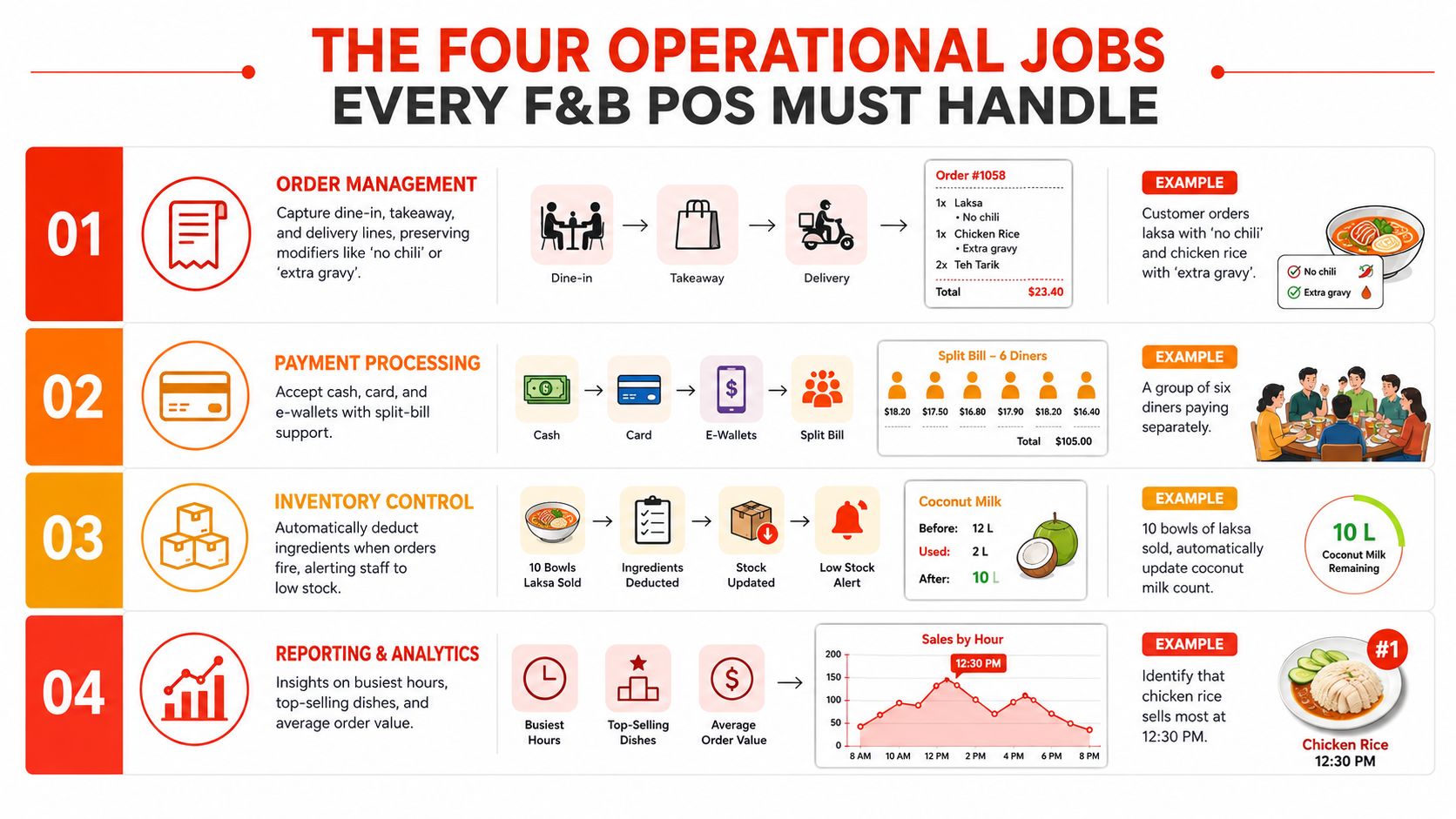
The first test is whether staff can enter a busy order without losing detail. A customer might ask for no ice, less sugar, extra chilli, a takeaway container or separate packing for several dishes. The POS should preserve those choices from the first tap through the kitchen ticket and final receipt.
For a Singapore operator, order management also means distinguishing dine-in, takeaway and delivery orders. Those channels may share the same menu and stock, but they often require different preparation instructions, packaging and fulfilment steps. A single item record reduces the chance that a delivery menu and an in-store menu drift apart.
Table management matters as soon as a venue handles groups, transfers or partial payments. Staff need to know which tables are open, which items belong to each order and whether a table has moved from one section to another.
A group of six diners paying separately is a useful stress test. The system should let staff split items or amounts without closing the original table incorrectly. It should also keep the outstanding balance visible, so a partial payment doesn't look like a completed sale.
Kitchen routing turns order data into production flow. Drinks should reach the bar, dim sum should reach the steamer and desserts should reach the pass. The kitchen needs to see the sequence and modifiers without waiting for a server to repeat them.
The best setup gives staff a clear status path, from received to preparing to ready. That visibility helps the floor team answer customers accurately and reduces duplicate preparation when a ticket is delayed or reprinted.
A fast cashier screen is useful. A coordinated ticket stream is what protects the whole service.
Payment needs to handle more than a single card tap. A suitable setup should accommodate cash, NETS, contactless cards, PayNow, QR payments, wallets, split bills, vouchers and partial payments where the business uses them. The cashier should see one amount due, one order record and a clear payment result.
Singapore's cashless environment makes this essential. Singapore's in-person POS transactions were estimated to be 13% cash in 2024, with cash projected to fall to 8% by 2030. The same APAC payment methods analysis reported digital wallets at 29% of POS sales and credit cards at 34%. The POS must therefore keep tender choice quick instead of making customers and staff manage separate processes.
A delivery order should enter the same operational stream as an in-store order. When a customer places an order through GrabFood, Foodpanda or Deliveroo, the details should flow into the POS, map to the correct menu items and produce a kitchen ticket without manual re-entry.
That flow depends on more than a logo displayed on an integration page. The operator should check how the connection handles menu changes, modifiers, taxes, packaging instructions, item availability and order status. If “extra gravy” exists in the aggregator but not in the POS, the kitchen may receive an incomplete instruction.
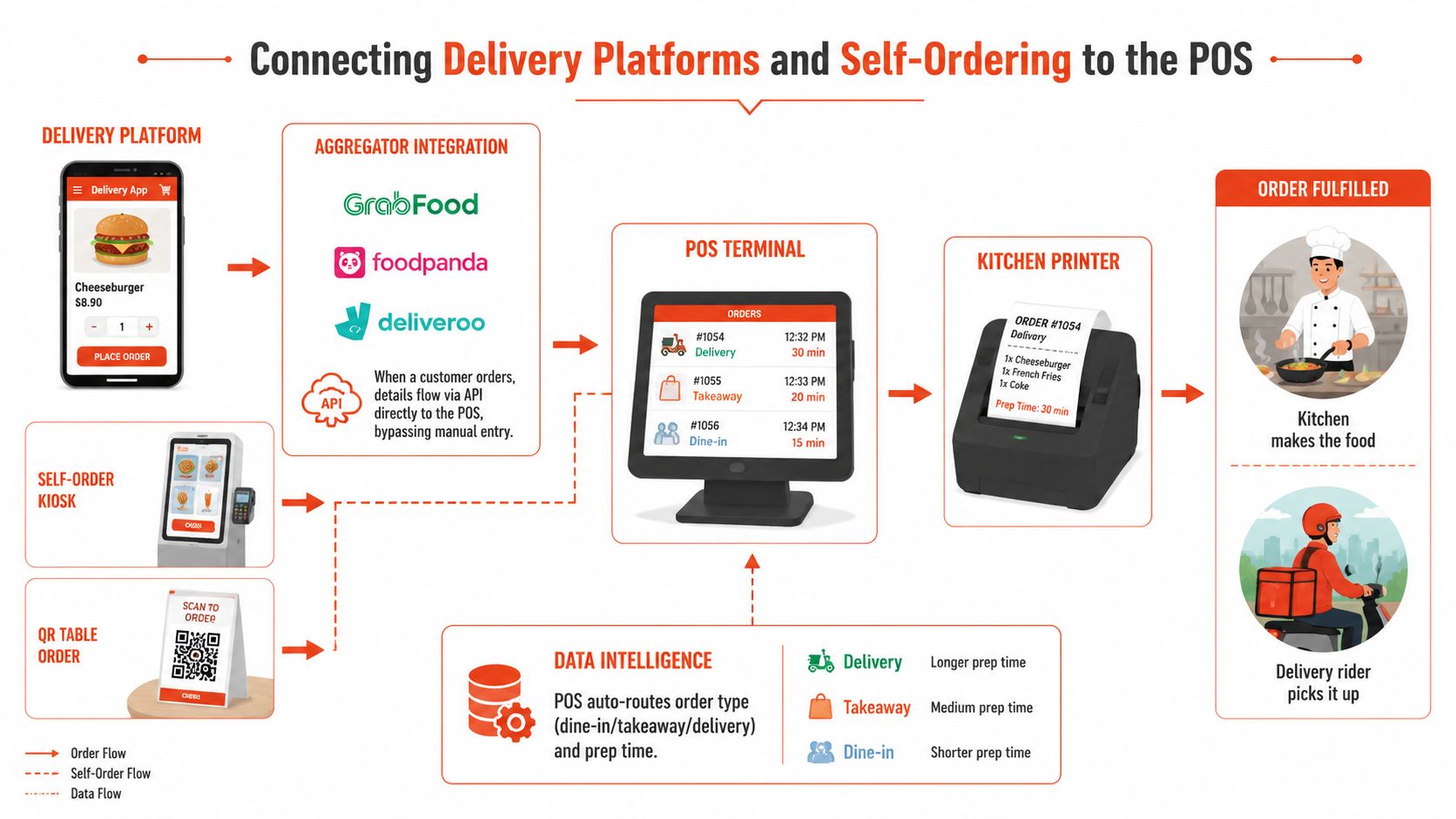
The practical flow should look like this:
The critical control is a single source of truth for availability. If the last portion of a dish is sold in the dining room, the system should help prevent delivery channels from continuing to sell it. Otherwise, staff have to cancel orders, explain substitutions and absorb avoidable service friction.
Self-order kiosks suit quick-service venues where counter queues form quickly. QR table ordering can help casual restaurants capture orders without requiring a server to return to the table for every addition. Neither channel removes the need for a good POS. Both channels increase the importance of accurate menus, modifiers and kitchen routing.
The operator should test order acceptance latency, stock deduction and cancellation handling during peak load. A connection that works in a quiet demonstration but delays tickets when several channels send orders together isn't suitable for service.
F&B payment operations become difficult after the customer leaves. A table may involve split bills, a transfer between tables, a voucher, a tip, several cards and a partial payment. Delivery platforms, QR orders, kiosks and the main counter may also settle on different schedules.
The operator needs to distinguish three events: the sale recorded in the POS, the payment approved by the tender system and the money received in the bank account. Those events should reconcile cleanly. If they don't, staff must match receipts, terminal records, aggregator reports and bank entries manually.
The BankStatementWizard statement guide is useful background for understanding how statement information supports account checking. In an F&B setting, that discipline needs to connect directly to daily POS reports, payout references and refund records.
| Payment Scenario | Operational Risk | Reconciliation Impact |
|---|---|---|
| Split bill across several cards | Staff may close the table before the full balance is collected | The POS can show an incomplete or incorrectly closed sale |
| Card approval without a matched POS ticket | The customer sees a successful payment while staff can't locate the order | The operator must investigate terminal and POS records |
| PayNow, wallet or QR payment | Staff may rely on a separate confirmation screen | Payment references may not match the day's sales report |
| Delivery aggregator payout | Fees, refunds and adjustments may be applied outside the restaurant POS | The bank deposit won't equal gross sales |
| Voucher or discount | The tender and the promotional deduction may be recorded differently | Gross revenue and collected funds can be confused |
| Refund or chargeback | The original sale may be difficult to identify later | Month-end review takes longer and disputes become harder to evidence |
The cost is not limited to administration. Thin-margin operators need to know whether an apparent sales increase produced usable cash after payment fees, refunds and channel deductions. Settlement timing also affects purchasing, wages and replenishment, so clear payout visibility matters.
A credit-card payment workflow for merchants should be assessed alongside the POS, not separately from it. The operator should ask whether the payment result is pushed back into the order record, whether refunds can be traced to the original transaction and whether the reporting view separates gross sales, fees and net settlement.
Good reconciliation lets one person review the previous day's activity without opening multiple unrelated systems. It shows transaction status, tender type, refunds, settlement date and payout amount in a format that matches the bank statement. F&B needs that level of control because the business handles many small transactions, multiple service channels and frequent exceptions in the same operating day.
A modern Android terminal isn't automatically a reliable restaurant POS. F&B hardware faces spills, heat, grease, constant handling and rushed staff. The software also needs to protect pricing, refunds, discounts and payment data across multiple shifts.
Singapore's card-security baseline has moved beyond magnetic stripe acceptance. From 1 July 2012, magnetic stripe use for Singapore-issued credit, charge and debit cards at point-of-sale transactions ceased, pushing merchants towards chip and contactless acceptance, as explained by the Association of Banks in Singapore payment-card security guidance. A dependable setup therefore needs current EMV-capable hardware, encrypted transaction handling and PCI-aligned processes.
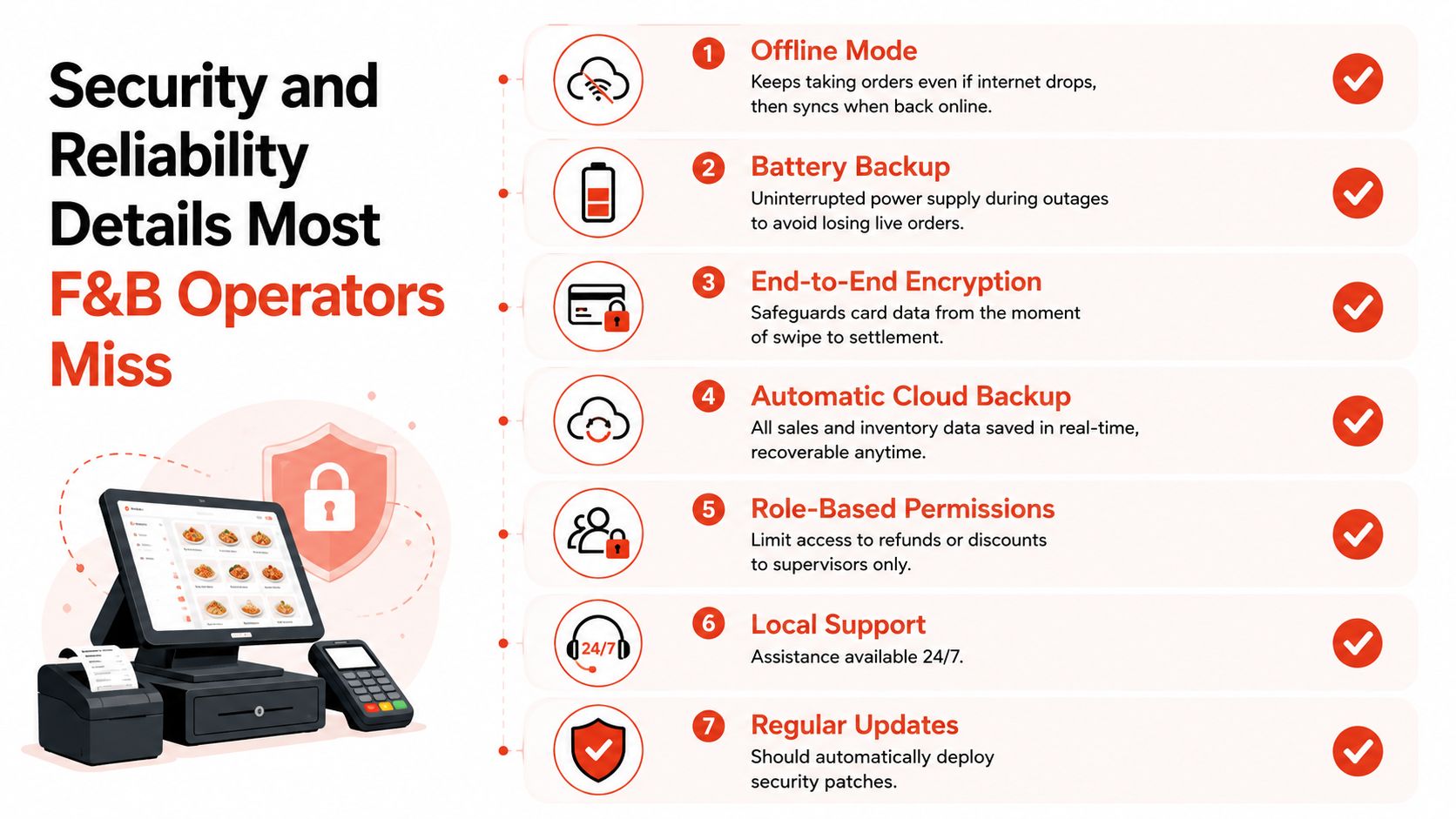
The operator should test what happens when Wi-Fi drops, power fluctuates or a terminal loses its connection to the central service. Offline capability may allow order capture and queued transactions, but the provider must explain the limits, synchronisation process and risk controls. A battery backup can preserve a live order during a short interruption, while automatic data backup supports recovery after device failure.
Support arrangements deserve the same scrutiny. A help desk that only responds during office hours may leave a restaurant exposed during a late service. Local support, device health monitoring, remote lock and centralised management are practical controls, not decorative features.
Role-based permissions should restrict refunds, discounts, voids, price changes and menu edits to authorised staff. Each employee should have an identifiable account, so managers can investigate unusual activity without blaming an entire shift.
The provider should also explain PCI scope, tokenisation and point-to-point encryption where relevant. If a tablet is stolen or an employee account is compromised, remote lock and access revocation should be available. Menu and pricing integrity matters just as much as card security, because an unauthorised discount can damage every transaction on a busy shift.
Failure test: Ask the provider to demonstrate a network outage, a refund, a lost device and a staff-permission change. A serious F&B system should have a clear answer for each one.
The cheapest terminal is rarely the cheapest POS. A low upfront price can conceal separate integration fees, payment charges, replacement hardware, manual reconciliation and support gaps. The right setup is the one that protects service and gives the operator usable control without creating another administrative job.
A Singapore F&B owner can test a shortlist against five practical questions:
A restaurant POS comparison for Singapore operators can help frame the shortlist, but demonstrations should use the venue's actual menu and service pattern. Staff should test a split bill, a modifier, a sold-out item, a refund, a delivery ticket and a failed connection before signing.
Customisation also needs discipline. A business with unusual workflows may benefit from custom software, but the operator should separate genuine operational requirements from expensive feature requests. This enterprise custom software development guide from devPulse provides useful context for assessing when a custom system is justified and when a configured platform is enough.
The total cost includes terminals, payment fees, integrations, support, training, replacement equipment and staff time spent reconciling exceptions. A POS system for F&B should reduce the number of manual handoffs in service. If it only replaces a card terminal while leaving delivery, kitchen and settlement processes disconnected, it hasn't solved the expensive problem.
Sambapay provides smart Android POS terminals for Singapore restaurants and cafés, with in-store acceptance for major card schemes and selected digital wallets, plus local onboarding and support. Operators reviewing their F&B payment infrastructure can visit Sambapay to assess terminal options, settlement arrangements and a practical migration path.