
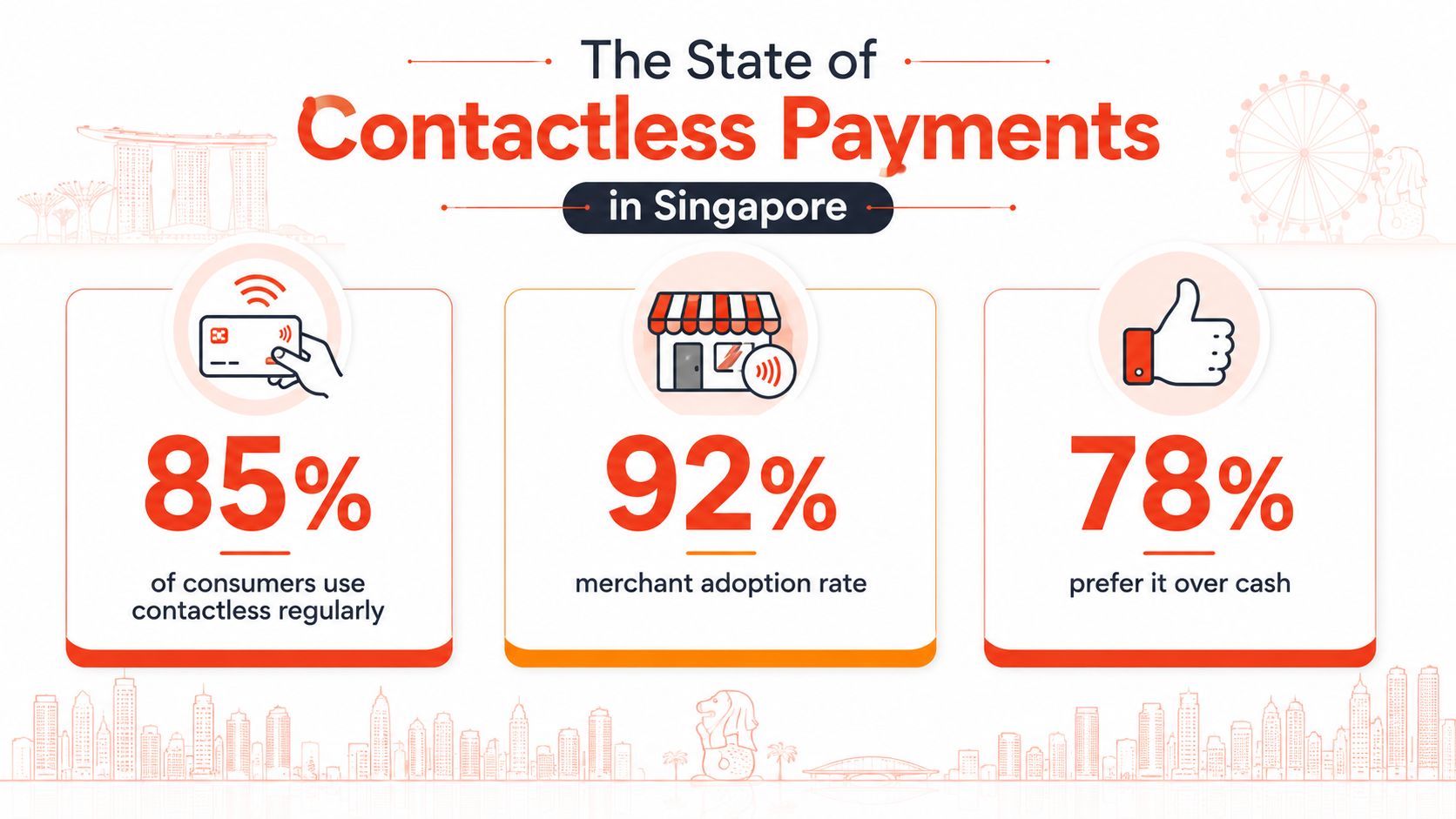
By 2025, digital-payments adoption in Singapore had reached 92.0%, while more than nine in ten Visa transactions were contactless. For merchants, that confirms contactless payment Singapore is a structural shift, not a passing trend.
A customer at a busy hawker centre taps a card, another pays with a phone, and the queue keeps moving. At a boutique, café, salon, or clinic, that smooth moment is now part of the expected service experience. Yet the merchant side is less uniform. Some SMEs still balance modern card and wallet acceptance with cash handling, ageing equipment, manual reconciliation, and uncertainty about which setup fits their daily workflow.
That operational gap matters. Consumer behaviour has moved quickly, but payment infrastructure, staff habits, settlement processes, and fallback procedures still need deliberate attention. A contactless terminal can remove friction at checkout, but it won't by itself solve weak connectivity, unclear fee structures, poor transaction records, or a cash drawer that staff haven't been trained to manage.
A customer can tap a card or phone at a Singapore retailer and finish a purchase without inserting a card, entering a PIN for many everyday transactions, or handling notes and coins. That experience is common across convenience stores, retail shops, supermarkets, public transport, and taxis. It has become part of the baseline that customers bring to the counter.
PwC reported 92.0% digital-payments adoption in Singapore by 2025, covering routine use of tap-to-pay cards in mobile wallets, PayNow, FAST transfers, and SGQR acceptance. The same PwC payments overview records that Visa had reported more than nine in ten Visa transactions in Singapore as contactless in 2022, placing the market among the world's highest in contactless penetration.
The practical conclusion for a small business is straightforward: contactless acceptance isn't an experimental add-on. It belongs in the core checkout design, alongside reliable transaction records, sensible settlement arrangements, and a clear fallback for customers who still use cash.
Fast payment only helps when the entire counter process supports it. The terminal must be visible and easy to reach, staff need to know when a transaction has been approved, and the point-of-sale record should match the amount collected. A customer shouldn't have to ask whether Apple Pay, a contactless card, or a QR payment is accepted.
For cafés and quick-service operators, the strongest setup usually keeps payment prompts simple. For boutiques and service businesses, staff may need to handle refunds, split payments, deposits, or appointments without creating a separate manual process.
Merchants evaluating mobile-wallet acceptance can also review this practical guide to e-wallets in Singapore before deciding how broadly their checkout should support digital payment methods.
Contactless payment uses a short-range communication process between a payment instrument and an acceptance device. NFC, or Near Field Communication, acts like a brief, secure handshake. The card, phone, or watch comes close to the terminal, the two devices exchange the information needed for authorisation, and the payment processor returns an approval or decline.
The customer doesn't need to understand the underlying exchange. The merchant does need to understand which component is responsible for each part of the transaction.
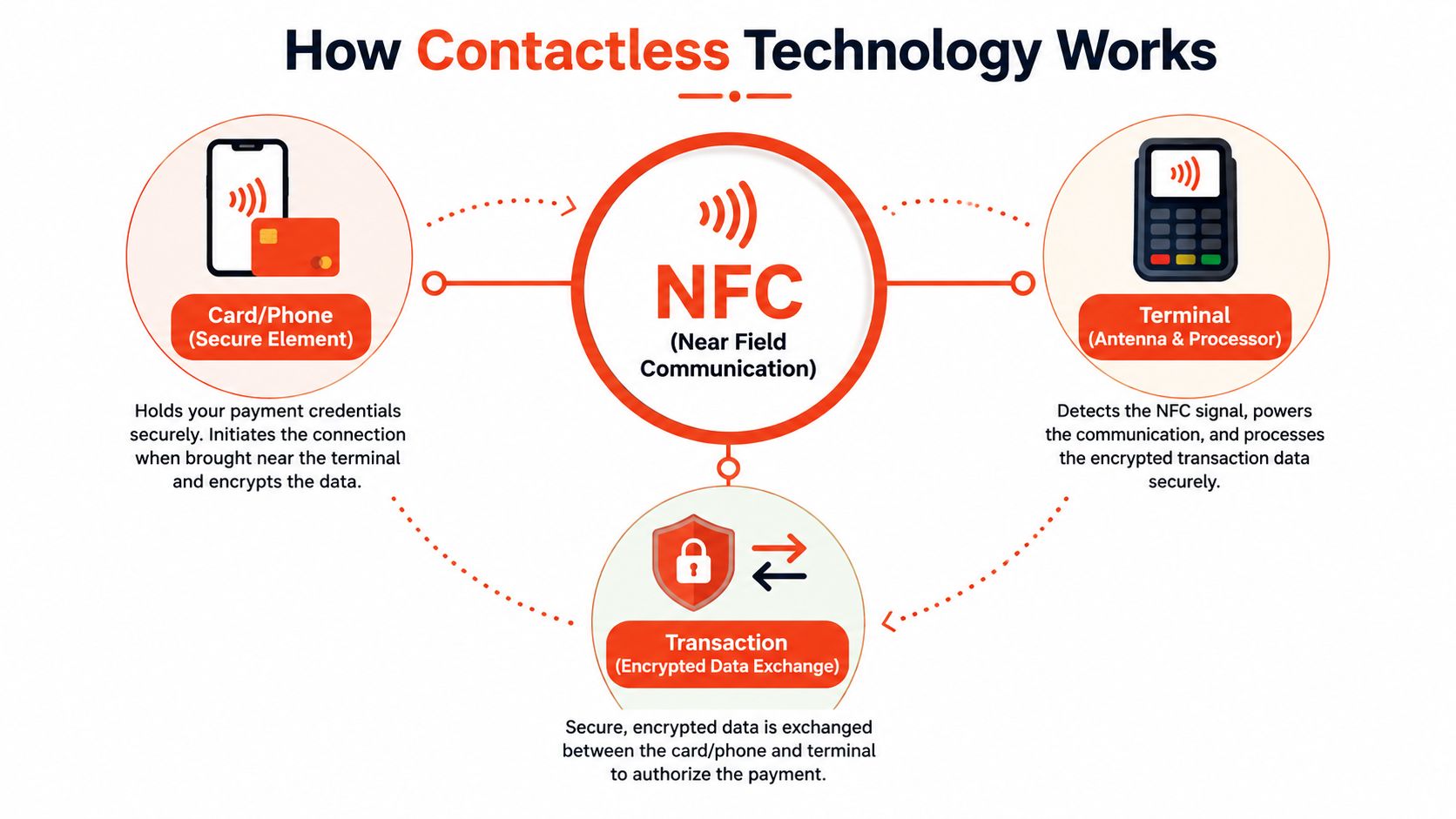
A physical contactless card contains the technology required to communicate with a compatible terminal. A mobile wallet, such as Apple Pay or Google Pay, stores a digital representation of the payment card and uses the phone's NFC capability at the point of sale. In both cases, the customer brings the payment device near the terminal rather than swiping or inserting it.
A phone wallet isn't the same as a separate payment scheme. It is a way to present a supported card or account through a device. That distinction helps merchants assess acceptance correctly. A terminal configured for contactless card payments may also support mobile wallets, but the provider should confirm the supported card networks and wallet arrangements before deployment.
Practical rule: Staff should watch the terminal's approval message or sound, not rely only on the customer's tap gesture.
QR payment starts with a visual code rather than an NFC handshake. The customer scans the merchant's QR code with a banking app or wallet, checks the amount, and authorises the payment on the phone. The merchant then needs a reliable way to confirm that the payment succeeded and that it matches the correct order.
This can work well for hawker stalls, small counters, and businesses that want a low-equipment acceptance point. It can also create reconciliation problems if staff accept a screenshot as proof or fail to match the payment reference to the sale.
The two methods serve different workflows:
For a busy Singapore store, the question isn't which technology sounds newest. It is whether the chosen combination gives staff a fast approval signal, clean records, dependable connectivity, and a workable fallback.
Singapore consumers don't treat contactless payment as a specialist option reserved for large retailers. A Visa study found that 82% of consumers used contactless cards, while 97% used contact or contactless card payments and 95% used debit and credit cards. Among contactless card users, 89% paid contactlessly at least once a week, and 41% did so at least four times a week, according to the Visa adoption report.
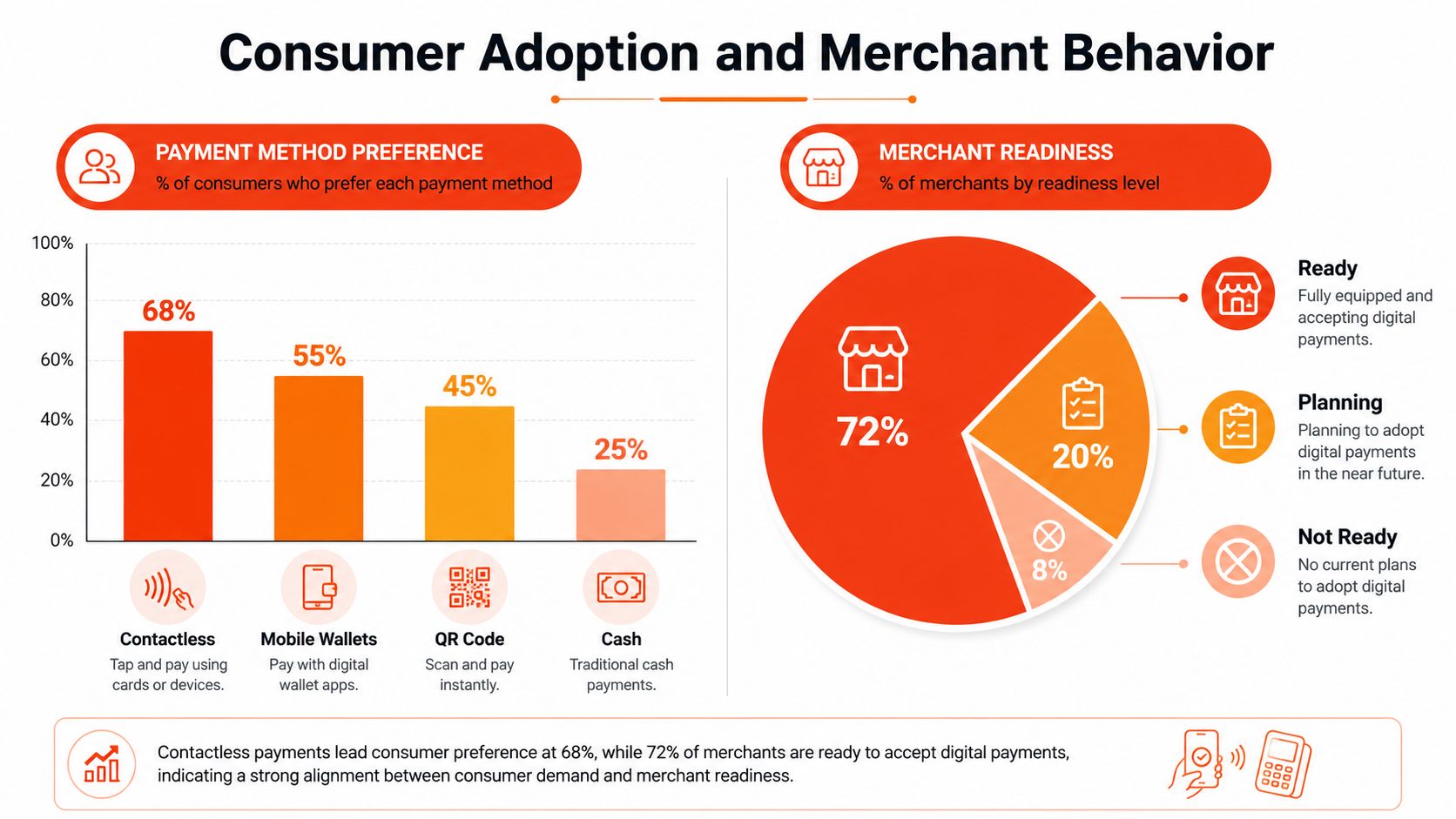
That frequency changes how SMEs should think about acceptance. A terminal isn't merely a convenience for occasional visitors. For many customers, tapping is the default action when the purchase is complete.
The Visa study identified strong contactless use across everyday categories that overlap directly with SME operations. Contactless cards were used at convenience stores by 54% of respondents, in retail shopping by 53%, and at supermarkets by 52%. Usage also appeared in public transport at 33% and taxis or ride-hailing at 28%, as reported in the same Visa market coverage.
These categories point to three practical patterns:
The 2019 evidence also showed a shift in attitudes. Visa found that 86% of Singaporeans viewed contactless payments as more convenient, while 60% expressed interest in self-checkout kiosks and only 9% chose cash in that context, as documented in the PwC payments report. Those findings support a broader operational reading: customers increasingly judge payment quality by convenience and control, not just by whether a merchant accepts cards.
A merchant shouldn't select equipment based only on the number of payment logos displayed on a brochure. The useful questions are more specific. Can the device process the payment quickly during a queue? Can staff identify an approved transaction? Can the business reconcile card, wallet, QR, and cash totals without rebuilding the day's sales manually?
For a small retailer, a compact contactless terminal may be enough. A café with an integrated till may need a device that passes the confirmed amount back to the ordering system. A clinic may value itemised records and refund controls more than the fastest possible tap.
Singapore merchants can choose between a traditional card reader, a smart Android POS terminal, a QR-led arrangement, or a mobile acceptance approach where the provider supports it. The right option depends less on the device's appearance than on how the counter operates during a rush.
Traditional readers can be effective for a straightforward card-present business. They tend to offer a focused payment workflow, which can be useful when staff need a dedicated device with minimal features. The trade-off is that older setups may require separate systems for inventory, receipts, QR payments, and reporting.
Smart Android POS terminals can combine payment acceptance with a broader application environment. They suit merchants that want one device to support card and selected wallet payments, connect with business software, or adapt the workflow as the store grows. More capability also means more configuration, so onboarding and staff training deserve attention.
SGQR addresses a different problem. It provides a single in-store Scan and Pay standard that can route payments across multiple schemes. MAS data cited by DBS SME guidance on SGQR says SGQR has been adopted by more than 210,000 merchants, representing over 90% of merchants in Singapore. The same source reports PayNow usage, including merchant and business payments, at S$46 billion in 2021.
| Option | Best For | Key Benefit | Consideration |
|---|---|---|---|
| Traditional card reader | Simple card-present sales | Focused checkout operation | May need separate tools for QR, reporting, or inventory |
| Smart Android POS terminal | Retailers and service businesses with broader workflows | Card, wallet, and business applications can sit closer together | Requires careful setup and staff training |
| SGQR acceptance | Businesses seeking broad QR coverage | One QR label can route payments across multiple schemes | Staff need a reliable way to verify completed payments |
| Mobile acceptance | Pop-ups, mobile operators, or low-footprint counters | Less dedicated hardware may be required | Device compatibility, connectivity, and provider support must be checked |
For a retailer comparing device specifications, a contactless payment terminal should be assessed against actual counter conditions, including network reliability, receipt handling, refund steps, and the distance between the customer and cashier.
The strongest arrangement may combine a smart terminal for tap-to-pay with SGQR for customers who prefer scanning. That isn't automatically better for every business. Two acceptance paths can improve coverage, but they also create more reconciliation points unless the reporting process keeps them organised.
A payment upgrade should start with the counter, not the sales brochure. The owner or operations manager should observe a busy service period and record where staff lose time: searching for the terminal, typing amounts twice, waiting for a response, checking QR screenshots, printing receipts, or manually matching settlements.
A compact shop may need one terminal, a stable connection, and clear end-of-day reporting. A café may need integration with an ordering system and a device that can sit where customers can reach it without obstructing the queue. A salon, clinic, or fitness studio may need refund controls, deposits, tips, or a payment record linked to a customer appointment.
The provider evaluation should cover:
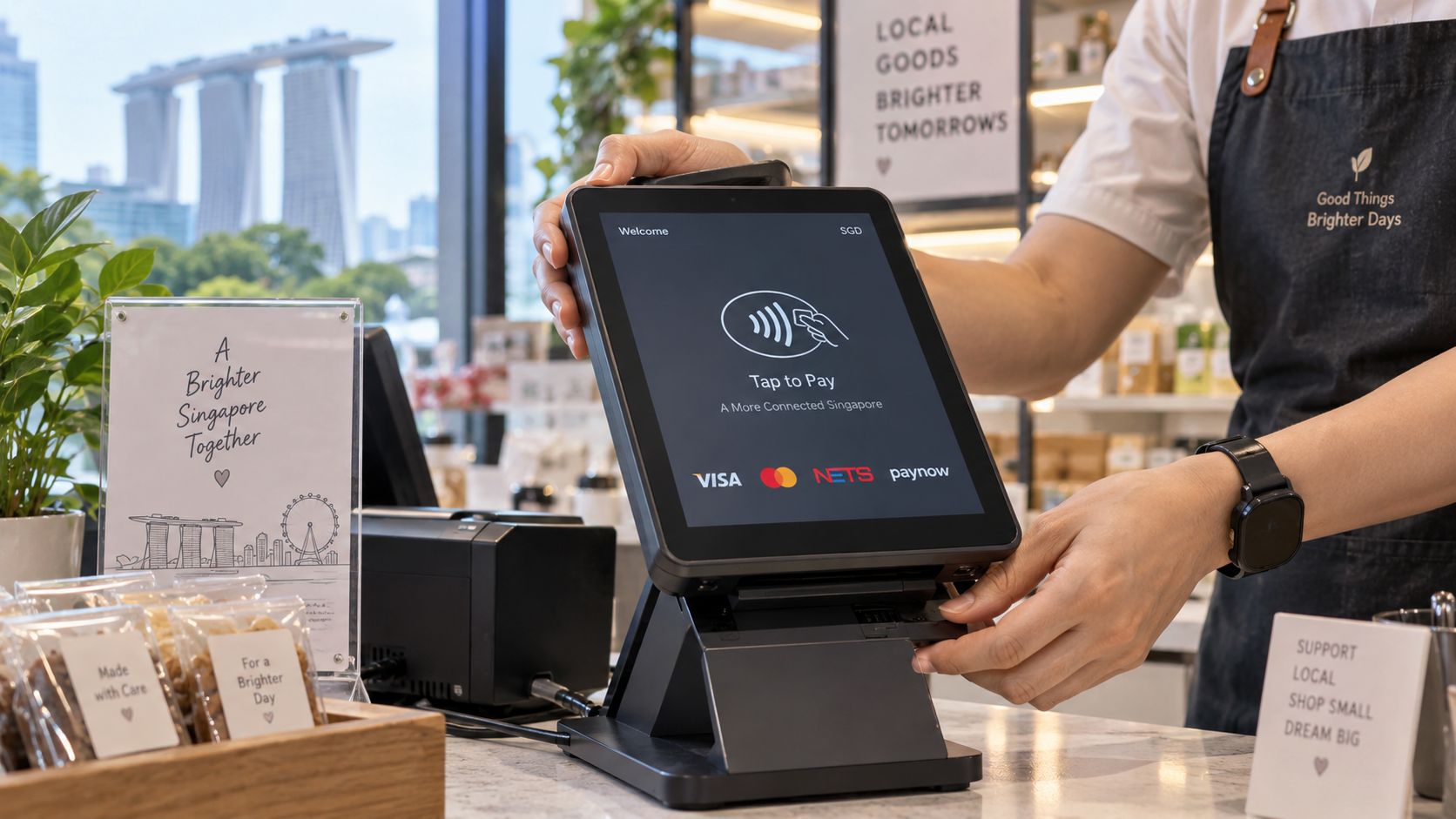
A controlled rollout reduces avoidable disruption. The merchant should test an ordinary contactless card, a phone wallet, a declined payment, a refund, a receipt, and the reporting view before removing the old device. Staff should also practise what happens when a customer taps twice, leaves before approval appears, or asks for a cash refund under the store's policy.
The modernizing store operations guide offers useful context for treating payment acceptance as part of a wider retail operating system rather than an isolated countertop purchase.
A provider such as Sambapay can supply smart Android POS terminals, card processing across major schemes and selected digital wallets, settlement from as early as T+1 depending on the merchant agreement, and Singapore-based support. These details still need to be matched against the merchant's actual agreement, transaction profile, and integration needs.
For businesses that take occasional remote or in-person card payments outside a fixed counter, this guide to paying by credit card can help clarify the customer-facing experience. The upgrade is complete only when staff can explain the payment options clearly and managers can reconcile every channel without adding hidden manual work.
A busy Singapore café can have customers tapping phones confidently while staff still manage a cash drawer, manual refunds, and end-of-day reconciliation. Contactless payment is mature for consumers, yet the infrastructure and cash-transition work can remain difficult for small businesses. 33% of Singapore SMEs still reported high cash usage, according to Singapore Business Review's coverage of SME cash reliance. Acceptance decisions should therefore reflect the outlet's customers and operating controls, not only the national shift toward digital payments.
Cash remains useful for customers who prefer it and for periods when connectivity fails. It may also fit businesses whose staff and accounting routines were built around a cash drawer. Small retailers, F&B operators, salons, and clinics can keep a parallel channel while they replace equipment, train employees, and establish dependable reconciliation.
A cashless rollout creates avoidable pressure if the full payment chain has not been tested. A live terminal does not provide a refund procedure, backup connection, clear handling for declined payments, or a reliable way to match QR receipts with the till.
A hybrid model gives the merchant time to set those controls. The goal is not to keep both channels unchanged indefinitely. Set rules for cash and digital payments, count cash consistently, record digital approvals, and review usage by outlet and customer type.
Keep cash available until the digital process works reliably under pressure, not only during a quiet test transaction.
The market is still moving toward digital payments. Cash represented 4% of e-commerce payments in 2024, and that share is projected to fall to 0% by 2029, according to the same Singapore Business Review report. The projection describes a changing market. It does not determine when every physical SME should stop accepting cash.
A café inside a transport hub may see different behaviour from a neighbourhood clinic. A boutique may need flexible handling for larger purchases, while a hawker stall may prioritise speed and a compact acceptance point. Review demand by outlet, customer group, and transaction type before changing the policy.
The question is whether the business has measured its cash demand, equipped staff for both paths, and chosen a digital setup that reduces work instead of shifting it from the counter to the back office.
Sambapay provides Singapore SMEs with POS terminals for contactless cards and selected digital wallets, alongside card processing, settlement options, onboarding, and local assistance. Visit Sambapay to review an acceptance setup suited to a café, retail shop, salon, clinic, or other in-store operation.