

A busy Singapore counter exposes a POS decision faster than any sales presentation. At a Hougang coffee shop during Saturday lunch, four customers wait while one terminal rejects a contactless tap and falls back to chip-and-PIN. A barista reaches for a second phone displaying a GrabPay QR code, while another customer asks to split the bill. The queue grows, staff apologise, and the owner starts calculating the cost of every delayed order.
That minute captures the job of a POS point of sale system. Hardware must withstand constant handling, software must keep the queue moving, the payment stack must match customer habits, and settlement must put funds into the business account when working capital is needed. Singapore SMEs in retail, F&B, clinics, salons and gyms aren't choosing a card reader alone. They're choosing how every sale is accepted, recorded, reconciled and refunded.
The failed tap isn't just a minor technical inconvenience. It tests whether the terminal can switch smoothly to chip-and-PIN, whether staff know the fallback process, and whether the payment is recorded without creating a duplicate transaction. If the terminal needs a restart, the problem becomes a queue-management issue. If the payment succeeds but the POS software fails to record it, the same sale becomes a reconciliation problem later.
A second phone for GrabPay QR introduces another weakness. Staff now need to watch two screens, confirm the customer has completed payment, and enter or remember the transaction manually. That may work during a quiet afternoon, but it creates avoidable steps when the counter is handling takeaway orders, dine-in bills and refunds at the same time.
A practical POS point of sale setup has to manage four pressures:
Practical rule: A POS should be judged at the busiest counter moment, not during a quiet product demonstration.
For a coffee shop, speed and split bills may dominate. A clinic may care more about itemised receipts, refunds and appointment records. A gym may prioritise recurring membership payments and check-ins. The right decision therefore starts with the actual customer journey, then works backwards into hardware, software, processing fees and provider support.
A POS point of sale system combines the equipment, applications and payment processing that capture a transaction when a customer pays. It can include a countertop terminal, a smart Android device, a barcode scanner, a receipt printer, a cash drawer and the software that turns a completed payment into a sale record.
A simple restaurant analogy helps. The terminal is the waiter taking the customer's payment. The POS software is the kitchen ticket system, recording what was sold and sending the information to inventory, reports or an order workflow. The payment rails are the cashier, authorising the card, wallet or account-to-account transaction and returning the result.
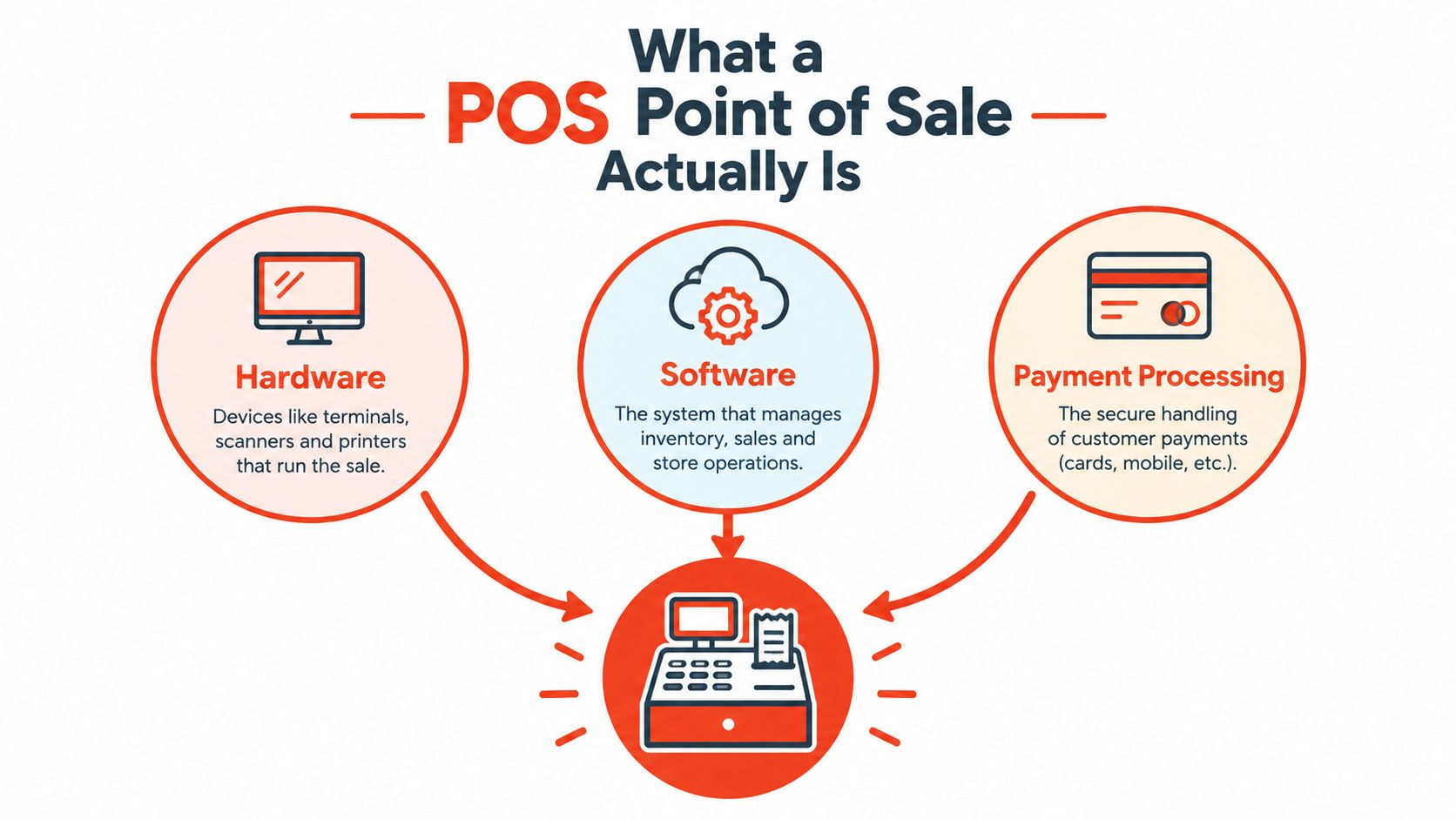
Hardware is the part staff touch. It may be a traditional countertop terminal with a connected PIN pad, a mobile Android terminal for table-side ordering, or a complete till with a display, printer, scanner and cash drawer. Retailers often need fast barcode scanning, while cafés may prefer a compact device that leaves counter space for cups, trays and collection shelves.
Durability matters as much as appearance. A device exposed to spills, repeated tapping and constant charging needs a practical placement plan, accessible power and a replacement process. A larger screen may help with product selection, but a smaller mobile unit may suit a salon or clinic where staff move between rooms.
Software determines what happens before and after payment. It may handle product lookup, inventory, sales reporting, table management, appointment records, package redemptions, member check-ins and back-office dashboards. A card transaction can be authorised successfully, yet still create operational work if the POS doesn't update stock, close the correct table or attach the payment to the right customer record.
Payment processing covers contactless cards, chip cards, mobile wallets, QR schemes and refund flows. The terminal connects through a merchant acquiring bank or payment processor, which routes the authorisation and later settles funds to the merchant. That connection is why a POS point of sale isn't just a card reader. It is the front end of a broader transaction and record-keeping system.
At a busy bakery counter, a customer taps a card, collects the order and leaves while staff serve the next person. The same expectation applies at salons, clinics, retail shops, cafés and gyms. Card acceptance now affects queue speed, reconciliation and the records available after each sale.
Singapore's in-store payment environment is strongly cashless. MAS retail payment statistics for H1 2025 record 682 million POS transactions worth SGD 54.540 billion for credit and charge cards, alongside 853 million debit-card POS transactions worth SGD 28.516 billion. Together, these represented 1.535 billion transactions valued at SGD 83.056 billion in half a year (MAS retail payment statistics for H1 2025).
The same MAS tables show average POS ticket sizes of about SGD 80 for credit and charge cards and SGD 35 for debit cards. A neighbourhood clinic or salon may process smaller individual payments than a retailer, yet the terminal still needs to authorise transactions quickly and consistently throughout a long trading day.
PwC's Singapore payments outlook reports that around 97% of retail point-of-sale transactions were cashless in 2022. It also reports projected growth in Singapore digital payments from USD 39.37 billion in 2023 to USD 113.65 billion by 2030, while cash usage at POS is forecast to fall from 15% of transaction value in 2023 to 7% by 2027. These are historical figures and projections reported in the Singapore payments outlook.
Visa's Singapore research, included in that outlook, reports that 97% of consumers used card payments, 82% used cash, and contactless penetration among Visa cards exceeded 95%. Cash remains part of the operating mix, so SMEs need acceptance across cards, wallets and cash rather than a card-only assumption.
The hidden cost sits behind each tap. MDR varies by payment method and scheme mix, while settlement timing affects daily cash flow. A POS point of sale setup should therefore be assessed by its counter workflow, transaction records and settlement terms, not only by whether the terminal accepts cards. A slow device creates queues, and unclear reporting makes reconciliation harder after closing.
A Tiong Bahru bakery and a Bukit Timah dental clinic may both need card acceptance, but their staff don't perform the same work. The bakery needs fast product selection and stock accuracy. The clinic needs the correct patient, practitioner and invoice details attached to the payment.
| Vertical | Core workflow | Must-have features | Typical peripherals |
|---|---|---|---|
| Retail | Walk-in product sales and returns | SKU lookup, barcode speed, inventory sync, receipt options | Barcode scanner, receipt printer, cash drawer |
| F&B | Counter or table orders, amendments and bill settlement | Modifiers, kitchen workflow, split bills, refunds and tip handling | Kitchen printer or display, customer-facing screen, cash drawer |
| Clinics | Appointment-linked services and product charges | Patient or client records, practitioner allocation, itemised invoices, refund control | Receipt printer, document printer, payment terminal |
| Salons | Appointments, staff services and package use | Therapist allocation, package redemption, deposits, service and product sales | Receipt printer, tablet or mobile terminal |
| Gyms | Membership, access and recurring payment administration | Member check-in, recurring billing, freeze rules, no-show fees | Tablet, scanner or access integration, receipt printer |
Retail teams should test barcode search under pressure, not just browse a sample catalogue. F&B operators should test a split bill after modifiers have been added, because the payment screen is only useful if it reflects the kitchen and table workflow. Clinics and salons need to see whether staff can issue an itemised receipt and correct a refund without creating a second customer record.
Gyms and studios face a different challenge. A card terminal may handle an in-person purchase well, but the wider system needs to distinguish membership renewals, class bookings, freeze periods and failed recurring payments. A generic feature list won't reveal whether those rules are supported cleanly.
Payment choice still matters across all five verticals. MAS-cited data reports that more than 210,000 merchants had adopted SGQR, while PayNow merchant and business payments reached about S$46 billion in 2021 (MAS parliamentary reply on e-payment adoption). Recent reporting also describes approximately 350,000 business entities registered for PayNow and about 280,000 merchant locations using SGQR, so a blended card and QR workflow is increasingly relevant (Singapore QR and PayNow market coverage).
For owners planning broader customer acquisition, practical advice on how to grow your restaurant business locally can complement the POS decision. More traffic only helps if the counter can process the resulting demand accurately.
A quoted terminal rate rarely shows the full cost of running a POS point of sale. Singapore SMEs should separate hardware, software, merchant discount rate, processing charges, support, settlement timing and contract obligations before comparing providers.
A terminal may be purchased, rented or bundled into a wider agreement. Software can carry a recurring subscription, while gateway or processor charges may sit alongside the MDR. A low headline rate can therefore hide minimum commitments, refund charges, chargeback fees or paid accessories.
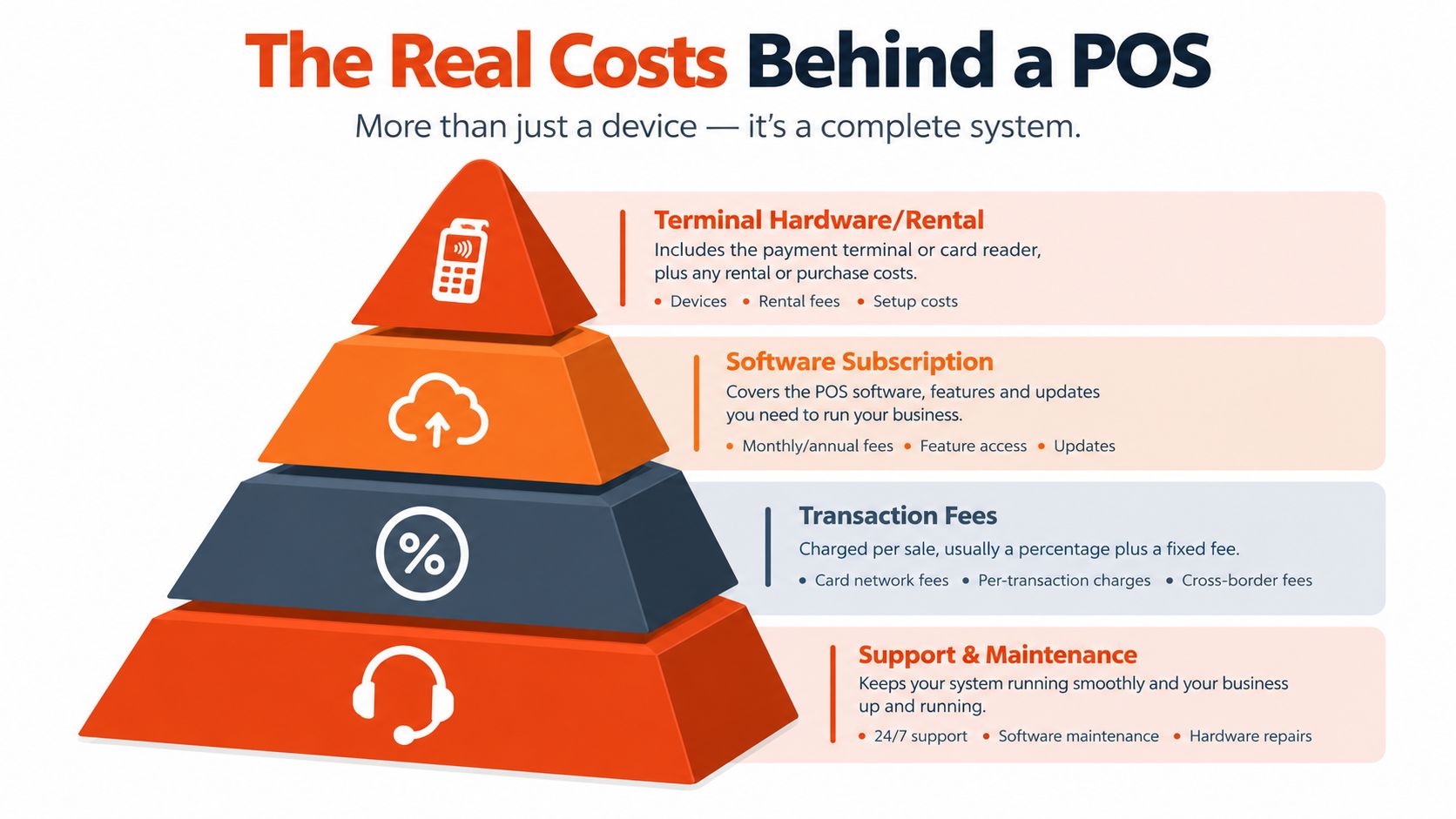
MDR is the percentage or fee deducted from a merchant transaction for payment acceptance. It can cover elements of the acquiring arrangement, card scheme and processing model. For many SMEs, the decision is no longer whether to accept cashless payments, but whether the pricing structure matches the business's transaction profile. The distinction is explained in this guide to merchant discount rates in Singapore.
With interchange-plus pricing, scheme and bank costs pass through separately. This gives clearer visibility, but invoices become less predictable and staff or owners need to understand the card categories involved. With blended pricing, the provider applies one rate across an agreed mix of schemes. Reconciliation is simpler, although the merchant should ask how that rate was calculated and whether premium cards, corporate cards or particular wallet flows are treated differently.
The right comparison depends on the counter. A retail shop with a predictable card mix may value a simple blended invoice. An F&B outlet with varied payment methods may need clearer treatment of scheme and wallet charges.
Settlement timing affects working capital. A business buying ingredients, paying staff or meeting daily supplier obligations may value predictable access to funds more than a small difference in terminal price.
Before signing, request written answers on:
A low quoted rate can cost more when it does not match the merchant's card mix. A slightly higher rate may be easier to manage if settlement and support terms are transparent.
The following video gives additional context on POS cost considerations:
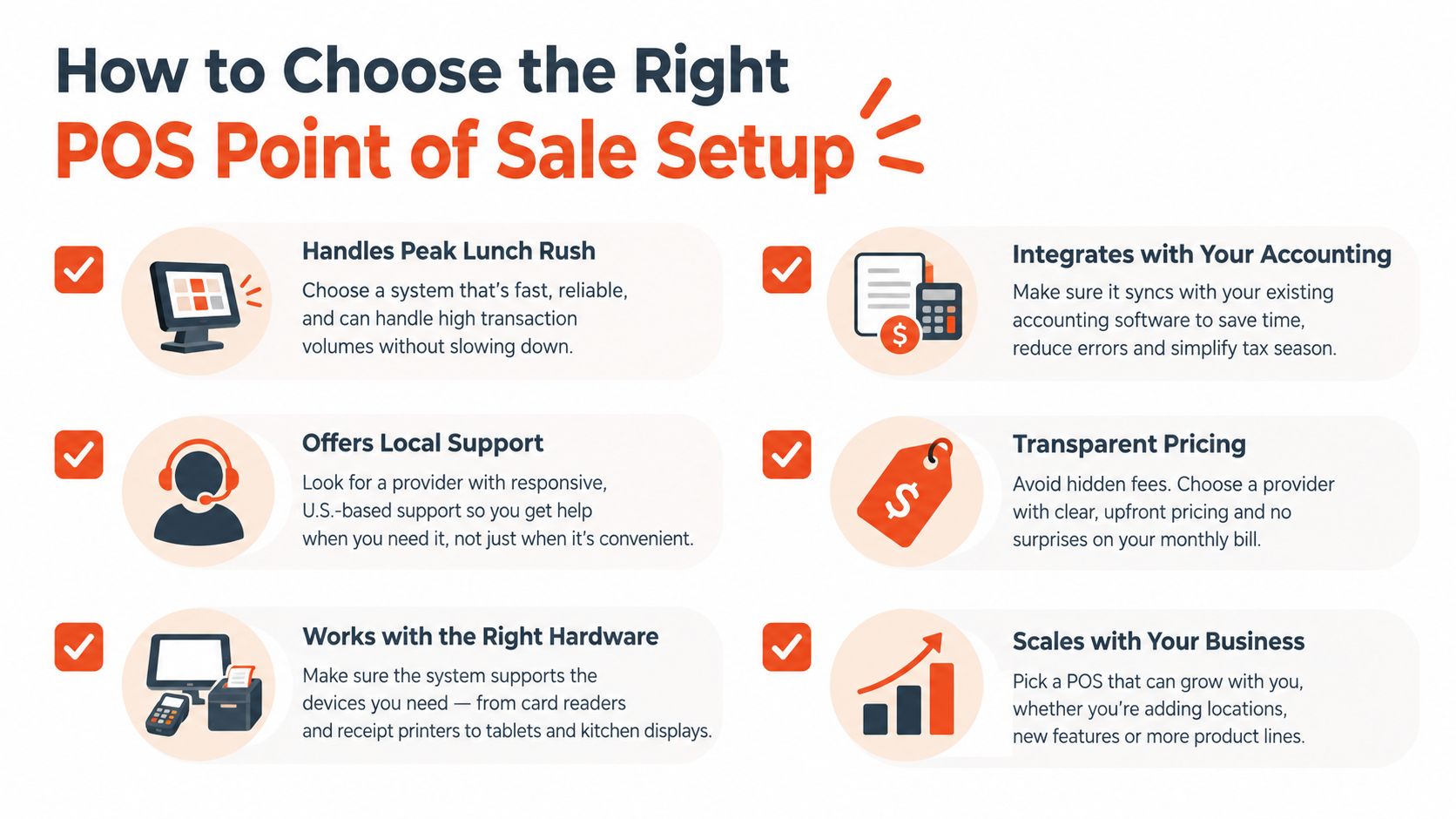
A shortlist should survive two tests. First, staff must be able to complete ordinary transactions without hesitation. Second, the owner must understand what each transaction costs and when the funds arrive.
Choose hardware around the physical workflow. A fixed Android or traditional countertop terminal may suit a retail till, while a battery-powered mobile device can help with table-side ordering, treatment rooms or fitting-room selling. Screen size, charging location, printer access and customer visibility all matter more than a polished demonstration.
Test the exact fallback sequence. Disconnect the network in a controlled demonstration, attempt a contactless payment, perform a chip-and-PIN transaction, issue a refund and check whether the sale remains visible in reports. A provider that can't explain the failure path clearly creates operational risk.
Use actual products, service packages, modifiers and appointment scenarios. Retail staff should scan several SKUs and process a return. F&B staff should split a changed bill. A salon should redeem a package and allocate revenue to the correct therapist. A gym should check a member in and review how recurring payment issues appear.
The system should support the required payment mix without forcing staff to switch between unrelated screens. A useful POS point of sale setup also exports data cleanly for accounting and provides reports that match the merchant's reconciliation routine.
Request the effective MDR after the provider considers the merchant's card and wallet mix. Confirm settlement timing, cut-off rules, refund handling and any gateway or support charge. Singapore coverage continues to identify a gap between consumer wallet behaviour and merchant readiness, with one market summary reporting physical-POS digital-wallet usage rising from 1% to 29% over the period it examined, while another report notes that only 24% of retailers accept digital wallets (Singapore payments market coverage). Those figures point to a practical need to ask which wallet flows the terminal supports, rather than assuming that a long logo list means a smooth workflow.
A structured comparison of local options can help with this Singapore POS system selection guide.
The strongest demo is a live rehearsal of the merchant's busiest and messiest transaction, not a slide deck of accepted logos.
Sambapay fits the shortlist where an SME wants a smart Android terminal, card and selected wallet acceptance, blended pricing and local operational support. Its terminals are supplied by PAX and are designed for in-store use across retail, F&B, clinics, salons and fitness studios. The stated acceptance mix includes Visa, Mastercard, American Express, JCB, CUP and selected wallets such as Apple Pay, Google Pay, Alipay, GrabPay and PayNow.
The practical attraction of an Android terminal is consolidation. A merchant can evaluate whether contactless card and QR flows can run through one device instead of requiring a card terminal plus a separate phone. That can reduce counter clutter, but the business should still test the exact QR confirmation and refund workflow before deployment.
Sambapay uses blended transaction pricing, which can make reconciliation easier than a detailed interchange-plus invoice. The trade-off is that the merchant must understand what the blended quote includes, how the card mix was assessed and which payment types fall outside the agreed arrangement. Settlement is available from as early as T+1, depending on the merchant agreement and operational requirements, so the timing should be confirmed in writing rather than assumed.
| Decision criterion | Sambapay approach |
|---|---|
| Hardware fit | Smart Android terminals, with countertop and mobile configurations |
| Payment reach | Major card schemes plus selected digital wallets and PayNow |
| Pricing | Blended transaction pricing tailored to industry, ticket size and volume |
| Settlement | Options from as early as T+1, subject to the merchant agreement |
| Support | Singapore-based assistance for onboarding, troubleshooting and servicing |
| Migration | Coordinated installation and transition support for legacy providers |
| Integration trade-off | May offer fewer third-party application integrations than some legacy or specialist platforms |
That last point matters. A merchant with complex appointment, inventory or membership software should test integration depth before choosing a payment-led setup. The provider can be a practical fit for straightforward in-store acceptance, but specialist vertical software may still be necessary where business rules extend beyond payment collection.
A controlled POS migration starts with documents and workflow mapping. The merchant should prepare business registration and director information, decide how many terminals are needed, identify counter or table-side locations, and list the transaction types staff must perform.
A short demo or sandbox test should use real products, services and refund scenarios. Training needs to fit around trading hours, and a soft launch with the existing system available as a fallback gives staff time to practise without putting the entire day's revenue at risk.
Common handover problems include old terminals that haven't been returned, transactions still unsettled at the cutover date and staff who have never processed a refund. The migration plan should assign responsibility for each item and record the final transaction date for the outgoing provider.
For merchants considering a change, this practical guide to switching POS solutions for a store provides a useful checklist. The final provider comparison should include two live demonstrations, written settlement terms, a clear MDR explanation and a review of the contract exit clause.
The action list is straightforward:
Sambapay provides Singapore SMEs with smart Android POS terminals, card and selected wallet acceptance, blended pricing, settlement from as early as T+1 subject to agreement, and local onboarding support. Visit Sambapay to request a practical discussion based on the payment mix and workflow at the business's counter.