
The lunchtime queue is growing at a Singapore café. A customer taps a phone, the terminal pauses, and the cashier isn't sure whether to try again. Meanwhile, the owner is comparing payment quotes that all seem affordable until terminal charges, different payment methods and settlement conditions enter the conversation.
Choosing a payment gateway in Singapore means understanding more than the advertised transaction rate. For a physical business, the practical questions are straightforward: who handles the payment, what does acceptance really cost, when does the money arrive, and what happens when checkout goes wrong?
A customer taps a card at a boutique counter. The terminal displays a response, the cashier issues a receipt, and the customer leaves with a purchase. Behind that familiar interaction, several organisations exchange payment instructions.
A payment gateway provides the communication connection between the merchant's checkout and the systems that process the payment. Think of it as a secure dispatcher: it sends the transaction request along the appropriate route and brings the response back to the merchant.
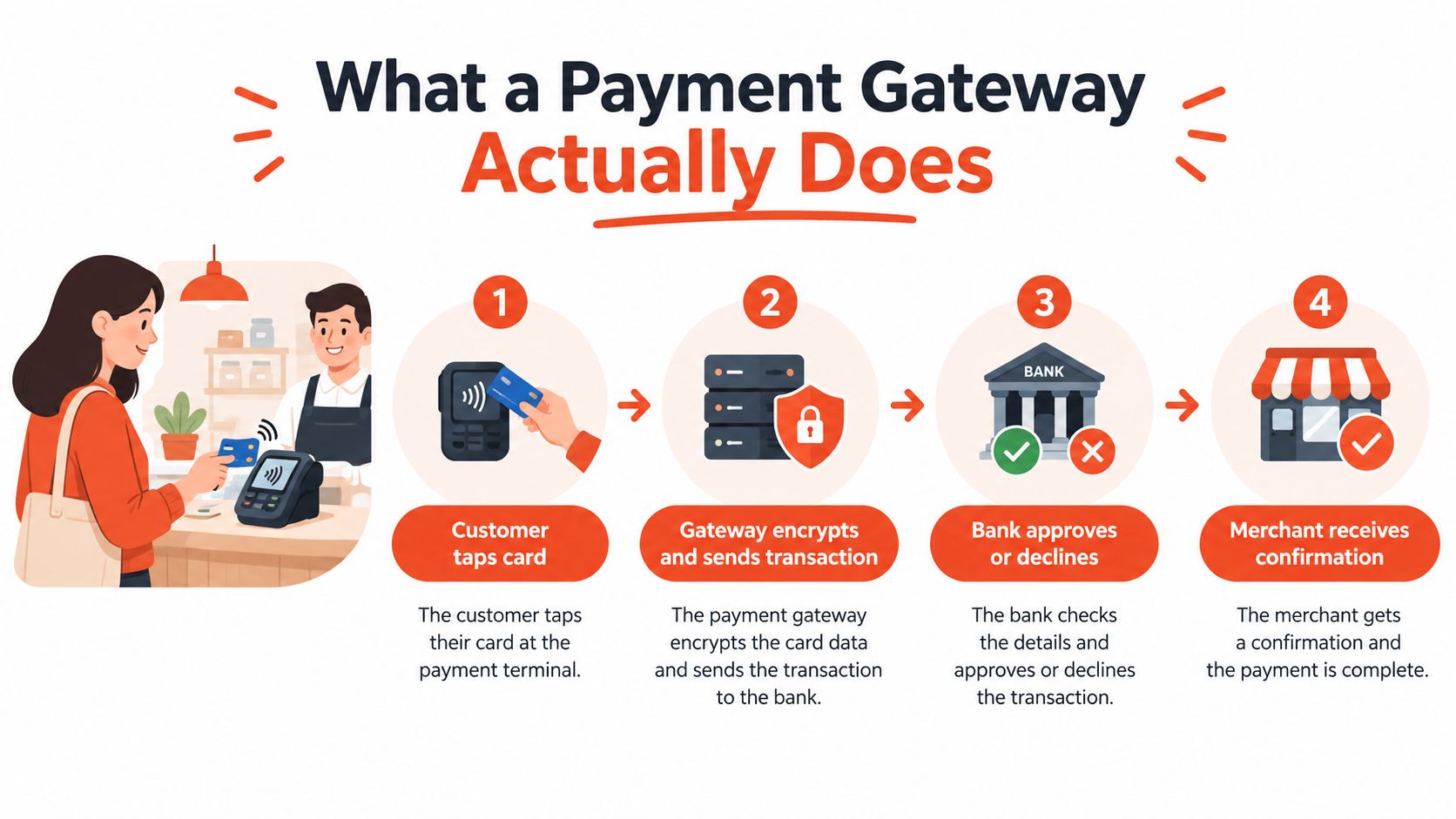
The device on the counter is the customer-facing equipment. The gateway connection, processing arrangements and acquiring infrastructure sit behind it. A modern-looking terminal doesn't, by itself, explain how reliably those arrangements work together.
The terms can become confusing because a provider may package several functions under a single agreement. The distinction between a payment processor and its role in acceptance helps merchants separate the company selling the service from the organisations carrying out the processing.
For a café owner, the useful questions concern responsibility rather than labels:
Practical rule: A merchant should be able to identify who owns each payment problem before signing the agreement.
The gateway matters because staff depend on clear responses at the counter. A delayed or ambiguous result creates a different problem from an ordinary decline: the cashier must determine what happened without charging the customer unnecessarily. Good selection therefore starts with understanding the whole service, not merely choosing a terminal.
A card payment resembles a registered parcel. Acceptance at the counter, processing through the network and final delivery are related events, but they aren't the same event. Likewise, an approved payment isn't identical to money arriving in the merchant's bank account.
The gateway handles payment communication, while the acquirer provides the merchant-side card acceptance arrangement. A merchant may encounter both through the same commercial package, but their responsibilities shouldn't be assumed to be interchangeable.
A salon might finish trading with approved transactions on its terminal, then receive a bank deposit that doesn't match that sales total exactly. Before treating the difference as missing revenue, the owner should compare the reporting period, processing deductions, refunds and any adjustments.
Useful settlement questions include:
A sample settlement report is more useful than a verbal promise of fast payouts. The provider should demonstrate how a transaction reference connects the customer receipt, merchant report and bank deposit. That connection gives the business a practical route for investigating discrepancies instead of comparing totals without context.
Electronic payment acceptance is an everyday operating decision, not merely an upgrade for technology-focused businesses. Singapore's household spending data provides a useful starting point.
In 2023, 100.0% of resident households made an e-payment, while electronic methods accounted for 60.4% of average monthly household expenditure, compared with 39.3% in 2017/18, according to the Singapore Department of Statistics' household e-payment analysis. That definition extends beyond cards to include mobile payments, e-wallets, PayNow, GIRO and buy-now-pay-later arrangements.
For merchants, the important distinction is between the way a customer initiates payment and the underlying payment route. A phone payment, for example, shouldn't automatically be treated as a separate commercial category from every card payment.
The following visual is illustrative only. Its category percentages aren't verified market shares, and the categories can overlap, so it shouldn't be used to forecast customer demand.
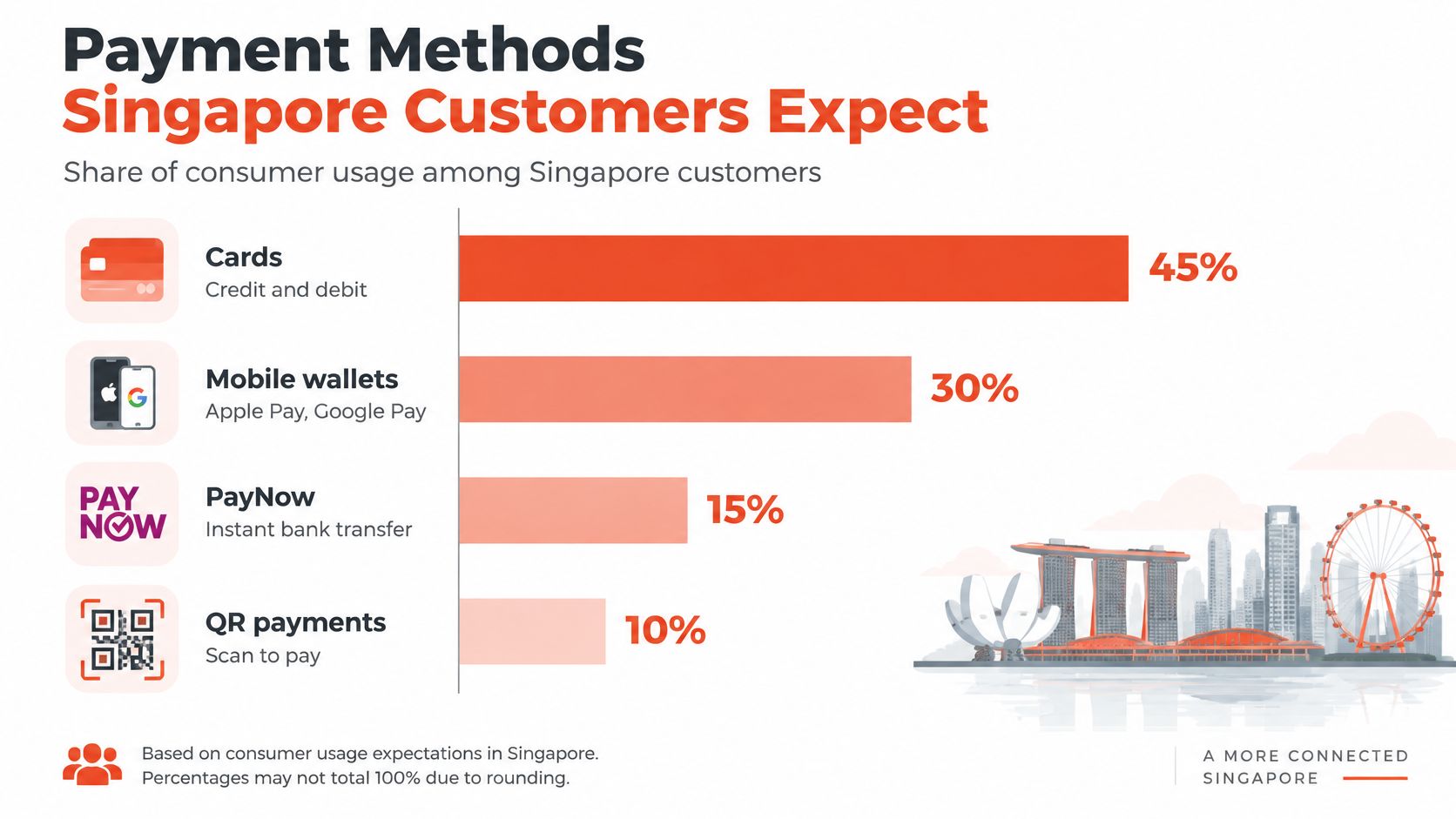
A neighbourhood café should examine its own payment records and customer requests rather than copy a tourist-facing boutique's setup. A clinic may place greater emphasis on clear receipts and invoice matching, while a busy takeaway counter may prioritise simple staff confirmation.
Multi-rail acceptance means supporting different underlying payment routes, rather than merely displaying more logos. Each proposed method should earn its place through customer relevance, manageable costs and workable administration. Merchants don't need every available option, but they should understand which customers an acceptance gap could inconvenience.
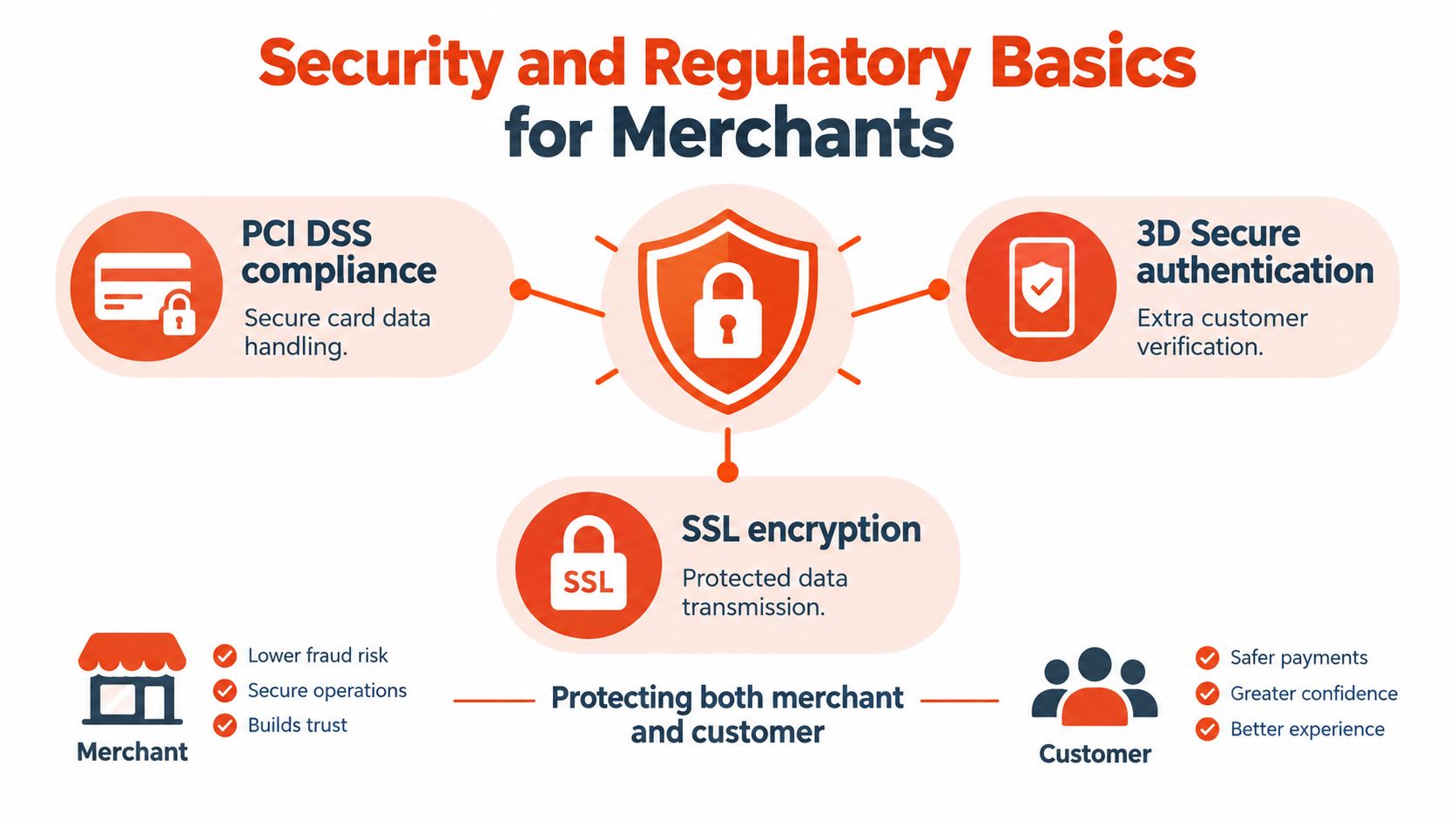
Security terminology can make a payment proposal sound reassuring without explaining the merchant's responsibilities. A more useful approach separates card-data protection, customer authentication, protected communication and regulatory accountability.
PCI DSS concerns secure handling of card data. Merchants should ask which parts of the payment environment fall within their responsibilities and what documentation the provider supplies.
3D Secure concerns additional cardholder authentication in relevant online card-payment flows. It shouldn't be presented as the safeguard that governs every in-store tap. Likewise, SSL, a term still used in payment materials for protected connections, shouldn't replace a clear explanation of the provider's current transmission-security arrangements.
As a reference for assessing how a technology platform communicates its controls, merchants can review NAS Ledger's platform security details. That resource isn't evidence of a payment provider's compliance; the provider under consideration must supply its own documentation.
Under Singapore's Payment Services Act, relevant categories include domestic money transfer and merchant acquisition. MAS explains that merchant acquisition usually includes a POS terminal or online gateway, while the treatment of a technology-only provider depends on what it does, as outlined in its payment-service classification guidance.
A blanket claim that every company described as a gateway must hold the same licence misses this distinction. The practical checks are more specific:
Documented answers give the merchant a clearer escalation route. A security badge or sales description alone doesn't establish who is accountable.
The cheapest headline rate isn't necessarily the cheapest arrangement for a café, clinic or boutique. Effective payment cost depends on the merchant's payment mix, transaction sizes, recurring charges and exception costs.
A useful comparison applies every provider's quote to the same trading records. Otherwise, a provider quoting a narrow card category may appear cheaper than another quoting a broader mix.
| Criterion | What to Look For | Why It Matters |
|---|---|---|
| Pricing model | A clear blended rate or fully explained tiered categories | The merchant needs to know which transactions attract which charges |
| Fixed charges | Per-transaction, platform, minimum-usage and other recurring fees | Small-ticket sales and quiet periods can change the economics |
| Settlement speed | Written payout conditions, cut-offs and hold provisions | The business needs a usable cash-flow schedule |
| Terminal hardware | Purchase or rental terms, connectivity, accessories and replacement arrangements | Hardware suitability affects checkout and ongoing expense |
| Refunds and disputes | Administrative charges and treatment of original processing fees | Reversals can cost more than the returned sale amount |
| Support | Contact channels, operating hours and escalation ownership | Staff need an actionable route when service fails |
| Contract terms | Cancellation, notice, renewal and equipment-return requirements | An attractive quote may carry an inconvenient exit process |
Blended pricing groups the agreed transaction categories under a simplified rate. Tiered pricing applies different rates to specified categories. Neither label proves better value: the merchant needs the actual inclusions, exclusions and assumptions.
For a consistent comparison, calculate:
Effective acceptance cost = total payment-related charges ÷ total processed sales value.
The numerator should include transaction fees, fixed charges, terminal expenses and relevant refund or dispute costs. Staff time spent matching payments can be assessed separately as an operating burden, rather than hidden inside a misleadingly precise rate.
PayNow needs particular care. The Association of Banks in Singapore states that providers may charge merchants for PayNow services, but merchants cannot pass those costs to consumers as a surcharge, according to its merchant surcharge prohibition FAQ. A merchant must therefore budget for that expense rather than assume it can be recovered at checkout.
A low advertised rate is useful only when the merchant knows which transactions qualify and which charges remain outside it.
Settlement also deserves a separate cash-flow assessment. The guide to card payment settlement can help merchants prepare questions, but the signed agreement should govern expectations. A quote comparison should show both the expected cost and the funding conditions, not collapse them into a single ranking.
A fitness studio and a takeaway café may both need card terminals, but their daily payment problems can be quite different. Selection should begin with the business workflow rather than a provider's longest feature list.
For retail shops, test the relationship between payment confirmation, the sales record and returns. A boutique should check whether staff can locate the original transaction without searching through unrelated reports.
For restaurants and cafés, demonstrate counter, table-side and shift-handover workflows where relevant. For clinics, assess invoice references, receipt clarity and staff access to payment information.
Salons and spas should test deposits, final balances and refunds. Fitness studios should distinguish front-desk payments from any separate membership-billing needs, rather than assume a terminal agreement includes both.
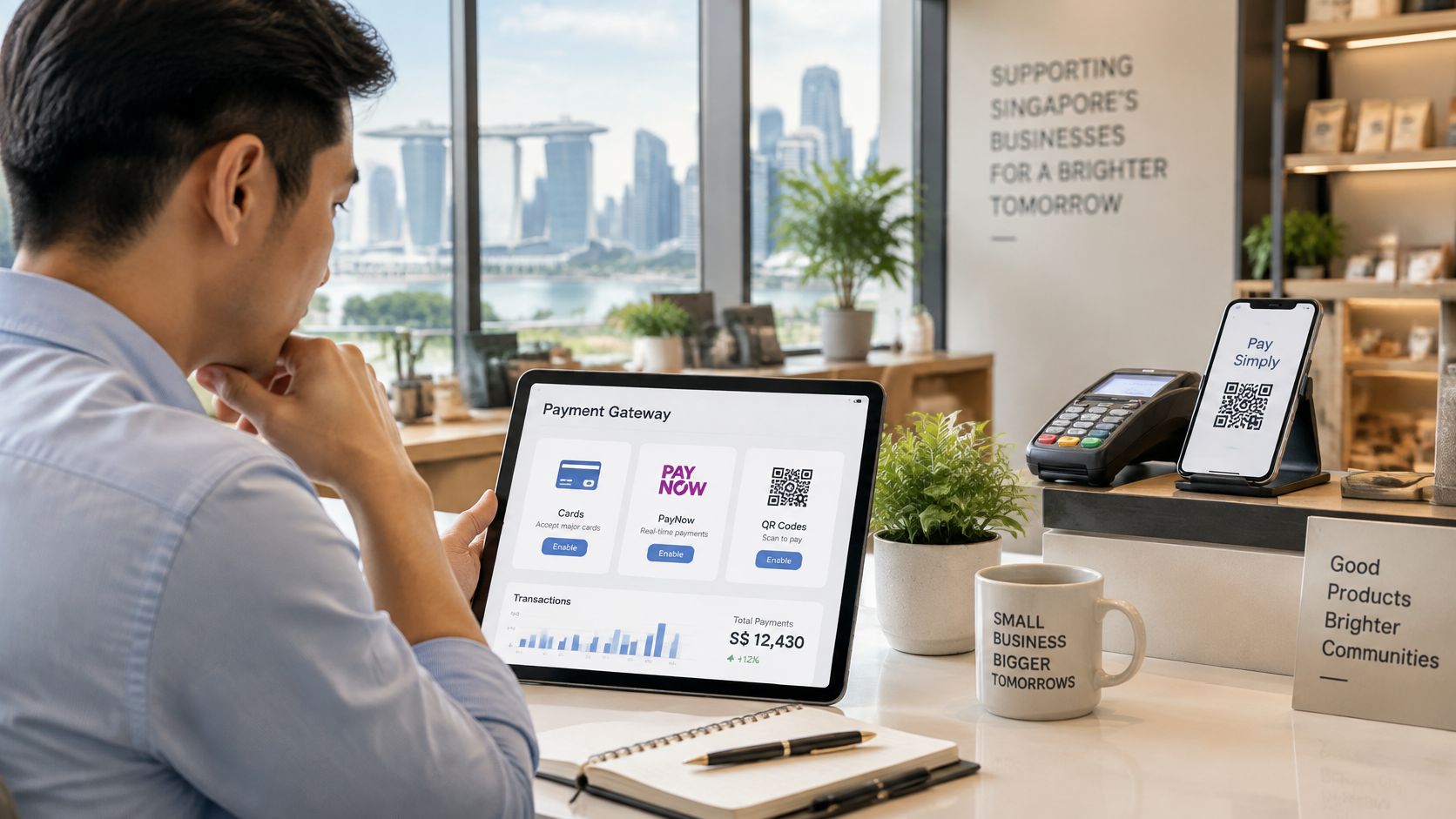
A useful provider demonstration should include an ordinary sale, a refund, a transaction search and a reporting exercise. Staff who will operate the system should participate, because an owner's purchasing priorities may differ from a cashier's practical difficulties.
The shortlist should also establish:
Local support is most useful when its responsibilities are explicit. A Singapore contact number alone doesn't explain whether the team can investigate processing problems or must pass every query elsewhere.
Before approval, the merchant should request a written summary of agreed services and compare it with the contract. Equipment ownership, optional accessories, cancellation conditions and any separately billed services should match the sales discussion.
The strongest shortlist is therefore not necessarily the shortest feature comparison. It is the set of providers that can demonstrate a workable fit for the merchant's staff, customers and administrative routines.
Accepting more payment methods doesn't automatically make a business resilient. Several methods may still depend on the same terminal, internet connection or reporting system.
Singapore's fintech-related scam losses reached S$840.3 million by November 2025, compared with S$1.1 billion across 2024, according to PwC Singapore's payments state-of-play overview. These figures aren't a measure of merchant gateway losses, but they reinforce the need to treat payment verification seriously.
A café's alternative payment route is useful only if staff can confirm it when the primary setup fails. Another method displayed on the same unavailable device may offer little practical protection.
Merchants should ask providers how the system distinguishes pending, approved, failed and settled transactions. MAS's Payment Services Act framework and interoperability FAQ provides regulatory context for interconnected payment arrangements; merchants still need provider-specific operating procedures.
Continuity check: Staff should know what to do when a customer believes payment succeeded but the merchant cannot yet confirm it.
A customer screenshot may support an investigation, but it shouldn't replace merchant-side verification. Similarly, staff shouldn't improvise a refund to settle a queue-side disagreement.
A suitable continuity plan also identifies who can authorise exceptions and who contacts affected customers. Resilience comes from controlled decisions during disruption, not from promising that disruption will never happen.
No. Under the surcharge restriction discussed earlier, merchants must absorb their PayNow service costs rather than add a PayNow surcharge. Before introducing any payment-related charge, the business should check the applicable rules and its merchant agreement instead of assuming all payment methods permit the same treatment.
There isn't a universal payout promise that applies to every gateway arrangement. Merchants should request a worked calendar showing the applicable cut-off, non-working-day treatment and any conditions that could delay a payout.
The important distinction is between a normal schedule and an unconditional guarantee. Both should be clear before the business relies on incoming funds for supplier payments.
Staff should follow the outage procedure and establish the original transaction's status before attempting another charge. If the result remains unresolved, the incident should receive a reference and an assigned follow-up owner.
This avoids leaving the next shift to reconstruct the event from a receipt and an informal message.
No, although a merchant may buy access to both through a packaged service. The agreement should identify the acquiring arrangement and explain which organisation handles transaction enquiries, settlement queries and formal complaints.
Merchants shouldn't assume so. Website checkout, payment links and recurring billing should each be confirmed as included services or separately scoped requirements.
A terminal demonstration doesn't establish how a website integration will operate.
A practical comparison pack should include:
Together, these documents make provider discussions specific. They also give the merchant a record against which to check the final offer.
Sambapay offers Singapore SMEs in-store payment terminals, card and selected digital-wallet acceptance, blended pricing and local support. Merchants can visit Sambapay with recent payment statements and checkout requirements to discuss a custom quote, settlement arrangements and a coordinated installation or migration plan.