
Electronic payments accounted for 60.4% of average monthly household expenditure in Singapore in 2023, up from 39.3% in 2017/18, according to the Department of Statistics' Household Expenditure Survey 2023. That measures money households actually spent, not payment apps they downloaded. For a shop owner comparing mobile payment solutions in Singapore, the practical question is no longer whether to accept digital payments, but how to turn each payment into a correctly recorded bank deposit.
Customers don't organise their purchases around a merchant's payment setup. They arrive with a preferred card, banking app or phone wallet and expect the cashier to recognise it.
The household expenditure category covers cards, GIRO, mobile payments such as Apple Pay and PayNow, and e-wallets such as GrabPay, ShopeePay and DBS PayLah! It spans more than purchases at physical counters, so it shouldn't be treated as a forecast of a particular shop's payment mix. Its value is simpler: electronic payments are part of ordinary household spending, not merely an online shopping habit.
Practical starting point: Payment coverage should follow customers' actual behaviour, not the number of wallet logos available on a terminal.
Say a salon customer reaches the counter carrying only a phone with a card stored in Apple Pay. A terminal that accepts the underlying card but hasn't been configured for contactless acceptance can still interrupt checkout. The customer may find another way to pay, but the cashier now has an avoidable problem.
A useful acceptance review separates what customers used from what they asked to use. Receipts reveal successful transactions; staff can identify payment requests that ended with a cash withdrawal, an alternative card or an abandoned purchase.
A short observation exercise, such as logging the last fifty customers' payment choices, gives the owner a more useful starting point than a provider's acceptance-logo sheet.
A mobile payment solution combines a portable POS terminal, often an Android device, with the acquiring services and wallet integrations behind it. The hardware captures the transaction; the services determine which methods work, how confirmation arrives and where the proceeds go.
The useful analogy is a cash drawer with several doors. Customers choose different entrances, but the merchant needs every sale recorded against the correct order and outlet.
Payment methods at a Singapore counter
| Method | How the customer pays | What the merchant needs | Settlement pattern | Dispute exposure |
|---|---|---|---|---|
| Contactless cards, including Visa, Mastercard, Amex, JCB and UnionPay | Taps a physical card | Compatible card-accepting POS and acquiring account | Batch payout under the acquiring agreement | Card chargebacks; retain transaction and fulfilment evidence |
| Mobile wallets, including Apple Pay and Google Pay | Taps a phone or watch containing a tokenised card | Contactless-enabled POS with the underlying card scheme enabled | Follows the underlying card arrangement | Underlying card scheme's dispute rules |
| E-wallets, including GrabPay, Alipay and WeChat Pay | Scans a merchant QR or presents a code for scanning | Supported wallet acceptance and compatible QR workflow | Provider's contracted payout schedule | Wallet-specific refund and dispute procedures |
| PayNow and SGQR | Scans a supported QR or pays using a proxy such as a UEN | Receiving bank account and suitable QR or POS integration | Near-real-time account transfer, with reporting arrangements checked separately | Verify receipt in the merchant system before releasing goods |
For a card or card-backed phone wallet, the cashier normally starts the sale by entering or retrieving the amount. The customer taps, and the terminal returns an approved, declined or unresolved result. A phone wallet doesn't automatically create a separate settlement account for the merchant.
With a QR wallet, the customer may scan the merchant's code or present a code to the cashier. The supported integration matters more than the QR reader itself: a device capable of displaying codes doesn't necessarily accept every wallet.
PayNow is a transfer service; SGQR is a standardised QR label, not a separate wallet. The Singapore FinTech Association and PwC payments report describes how SGQR brings participating payment schemes onto a common merchant-facing label.
The diagram separates the device from the services behind it.
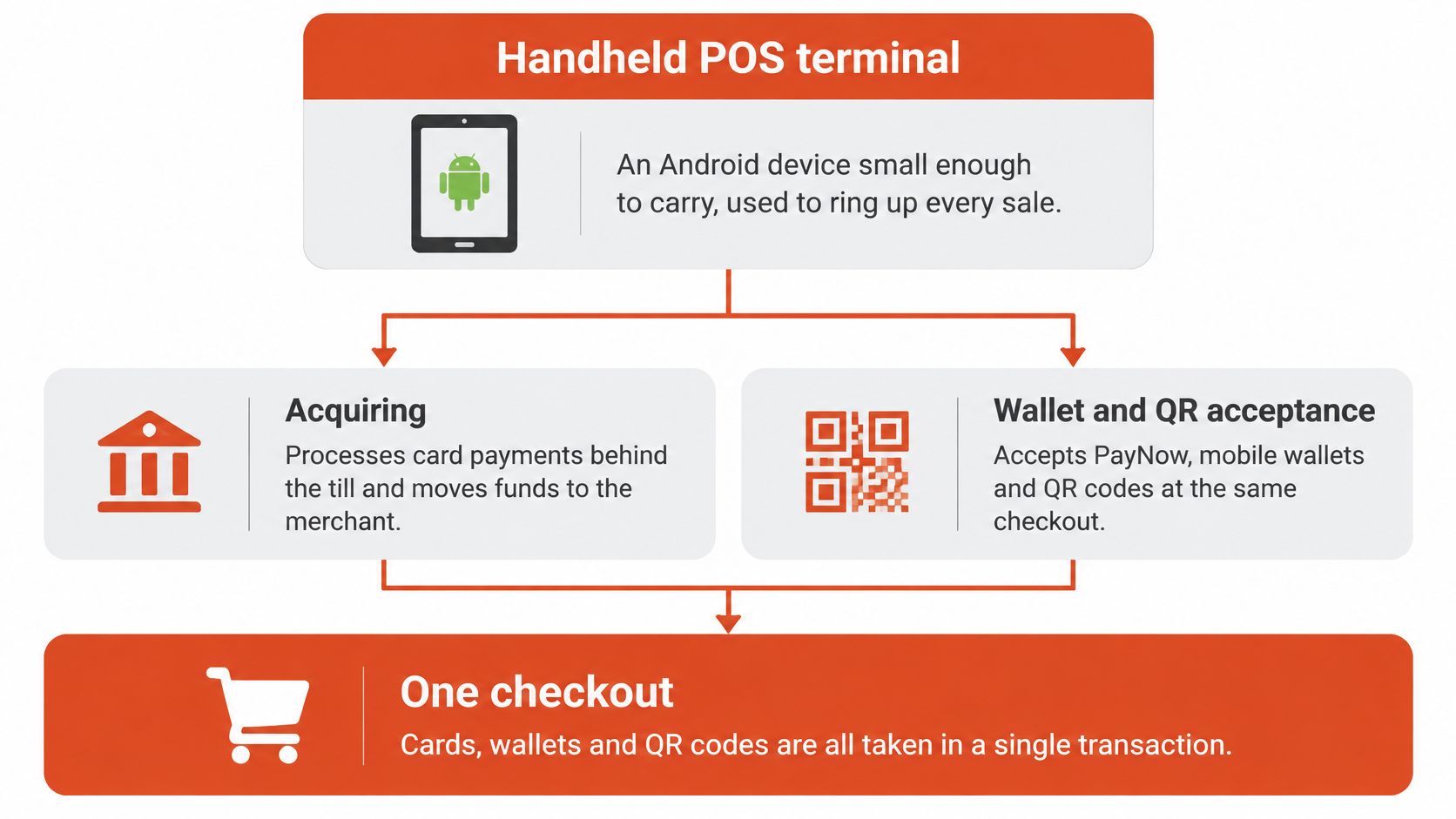
That shared checkout doesn't mean a purchase uses every payment method simultaneously. Each selected method still needs its own valid transaction result.
For owners distinguishing gateway functions from acquiring and terminal functions, payment gateway insights from Resolut provide useful context. An overview of e-wallet acceptance in Singapore can also help frame questions about supported apps, customer actions and merchant confirmation.
Consider a hypothetical café sale paid with a contactless card. The customer sees a tap and an approval message; the owner needs to understand the separate journey from that message to a bank deposit.
The familiar counter interaction is only the beginning.
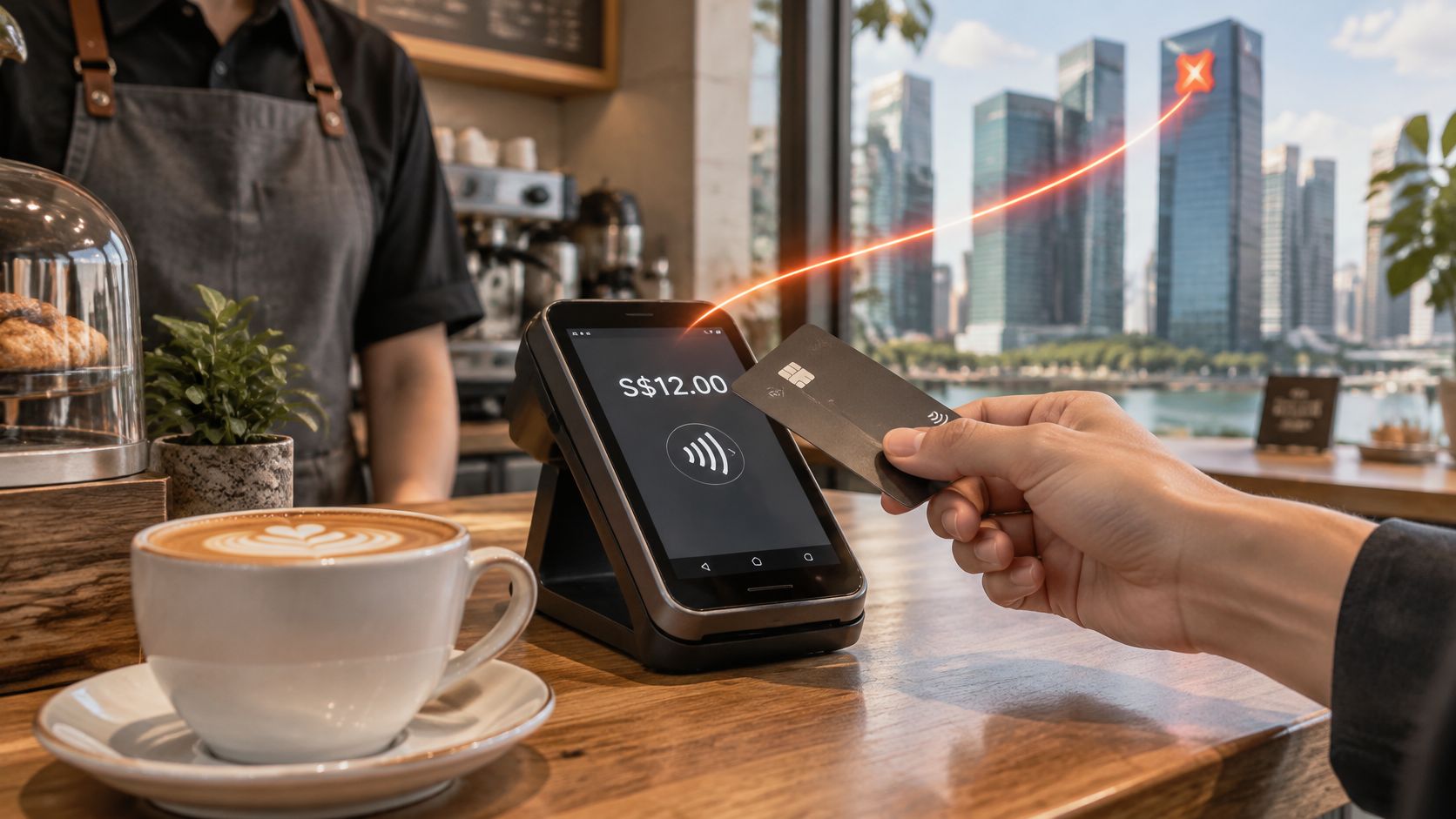
The terminal captures the transaction and sends it through the merchant's processing connection to the acquirer. The request travels through the relevant card network to the customer's issuing bank.
The issuer approves or declines, and the response returns to the terminal. In a relay-race analogy, this is the baton handover: the request has passed through the necessary participants, but the merchant hasn't necessarily received the payout.
Settlement is a later event. Captured transactions enter the provider's clearing and payout process, with fees, refunds or other adjustments handled according to the agreement.
A payment can be approved at the counter before its proceeds settle into the merchant's bank account.
A practical guide to card payment settlement helps distinguish the transaction date, batch date and bank-credit date. Those dates shouldn't be treated as interchangeable in the accounts.
PayNow operates on FAST rather than following the card authorisation route. According to MAS's retail payment statistics for the first half of 2025, FAST processed 298 million transactions worth S$389.398 billion in H1 2025.
The operational problem is often uncertainty rather than a straightforward decline. A customer may still be authorising a QR payment when the cashier sees a timeout; an immediate retry can create a duplicate.
The safe response is a status check using the original transaction reference, followed by the provider's recovery procedure. A screenshot on the customer's phone isn't a substitute for the merchant's own confirmation.
The accompanying video provides another visual reference for the payment journey.
For accounting, the useful connection is from order reference to transaction reference, payout reference and bank entry. Owners assessing that handover can explore integrated financial reporting from SIX ERP, with particular attention to outlet identifiers and adjustments rather than sales totals alone.
A headline percentage isn't the total cost of acceptance. Card mix, ticket size, transaction count and monthly volume all affect the result, while rental, refund handling and other contractual charges can change the final bill.
A merchant should compare the cost of processing the same basket of transactions, not just circle the lowest advertised rate.
Pricing and settlement models for merchants
| Model | How the fee is charged | Suits | Watch for |
|---|---|---|---|
| Blended rate | A quoted percentage across the payment categories expressly included | Merchants wanting straightforward statements | Excluded wallets, overseas cards or premium card categories |
| Interchange-plus | Interchange and scheme charges plus the provider's markup | Merchants able to review detailed processing costs | Markup, scheme fees and other charges must remain distinguishable |
| Flat per-transaction fee | A fixed charge per sale, sometimes alongside a percentage | Merchants whose ticket sizes make the fixed component economical | A fixed fee consumes a larger share of a small sale |
| Terminal rental add-on | Recurring equipment charge in addition to processing | Merchants preferring rental to equipment purchase | Fixed costs continue during quiet trading periods |
A blended quote is easy to understand only if its scope is clear. A rate covering domestic consumer cards may not cover every wallet, commercial card or overseas-issued card on the same terms.
Interchange-plus provides more visibility into components, but the owner must still check the provider's markup and additional charges. It isn't automatically cheaper just because the statement is more detailed.
Fixed transaction charges deserve particular attention at cafés and other low-ticket businesses. A fixed amount takes the same cash sum from a small sale as from a large one, so its effective percentage is higher on the smaller purchase.
A settlement label only helps when the agreement defines the starting point, cut-off time and treatment of non-business days. The owner should also check whether funds arrive gross, with fees collected separately, or net of deductions.
For a hypothetical café with steady daily card takings, receiving a payout a business day earlier releases the equivalent of that day's eligible takings sooner. That can matter before supplier payments, even when the processing rate is unchanged.
Quote-comparison rule: Every provider should price the same sample trading month and explain the resulting bank deposits.
Connectivity costs belong in the wider operating budget, but they shouldn't be confused with processing fees. Businesses considering paid wireless access for visitors from Purple should assess that guest service separately from the terminal's protected business connection.
Accepting more payment methods doesn't automatically make a shop's payment operation safer. The harder work is controlling who can refund, proving what was sold and identifying transactions that never reached a confirmed state.
The PwC payments state-of-play report reports that 92% of Singaporeans used a digital-payment method in the year to November 2025, while Singapore recorded about S$913.1 million in scam losses in 2025. Those are broad adoption and scam measures, not a shop's card-present fraud rate.
A customer deceived into transferring money elsewhere faces a different problem from a customer disputing a purchase made at the till. A fabricated transfer screenshot is another distinct risk: the merchant may release goods without receiving payment at all.
Card chargebacks also aren't interchangeable with refunds. A refund is initiated through the merchant's process; a chargeback follows a dispute procedure involving the card payment participants.
The following controls address different failure points:
Card refunds should normally use the original card transaction workflow. Wallet refunds must follow the supported wallet procedure, while PayNow returns may require a separate bank-transfer process with verified recipient details and the original reference.
A cashier shouldn't improvise by sending a card refund to an unrelated bank account. Unusual requests should go to a named manager and, where necessary, the provider.
The counter procedure should identify the support contact, information to collect and action permitted while a case remains unresolved. Owners reviewing merchant services in Singapore should ask who handles disputes and which evidence deadlines apply.
For compliance checks, request current PCI DSS documentation, terminal approval details and an explanation of the merchant's responsibilities. Customer details on receipts and loyalty records also need a documented privacy, access and retention process, with PDPA obligations reviewed for the business's actual use of that information.
What happens on a busy Saturday evening when the terminal drops offline? A useful answer names the support route, diagnostic steps and permitted fallback, rather than promising reliable service in general.
The shortlist should reflect how the shop operates when something goes wrong, not just how the terminal performs during a demonstration.
Provider selection criteria
| Criterion | What to check | Red flag |
|---|---|---|
| Payment coverage | Required cards, wallets, PayNow and SGQR within a manageable checkout | Staff must improvise between disconnected devices and records |
| Hardware and connectivity | Device model, network options and written outage procedure | No documented response to connection drops |
| Settlement timing | Payout calendar, cut-offs and deductions in the agreement | Timing offered only as a verbal promise |
| Support hours and location | Contact channels, coverage, languages and escalation ownership | No usable urgent-support route during trading hours |
| Contract and exit terms | Commitment, notice, cancellation and equipment-return terms | Charges disclosed only when cancellation begins |
| Migration help | Installation responsibilities and coordinated switch-over | Existing service must end before replacement testing |
| Reporting and reconciliation | Exportable records by transaction, method and outlet | Summaries without references needed to investigate differences |
A sales demonstration should include more than a successful tap. The owner can ask the provider to demonstrate an unresolved transaction, a permitted refund and a report showing how both affect the payout.
For a restaurant, staff should test whether the portable terminal stays connected at the tables where it will really be used. A clinic may place more weight on access permissions and receipts, while a retailer may need order references that match the stock system.
A local office isn't the same thing as available support. The agreement should clarify whether the person answering can investigate a transaction, replace hardware or escalate an acquiring issue.
When assessing a Singapore-based provider offering Android terminals and combined card and wallet acceptance, the owner should request a method-by-method coverage list. Visa, Mastercard, American Express, JCB and UnionPay acceptance shouldn't be assumed to include every wallet or configuration automatically.
The same discipline applies to claims about no terminal rental, no binding period or no cancellation fee. The written offer should identify standard equipment, optional charges, notice requirements and the conditions attached to payout timing.
Providers should quote against an identical sample month, including the same sales value, transaction count and card mix. An owner can then distinguish a genuinely suitable arrangement from one that appears inexpensive only because the quote excludes part of the shop's activity.
Support deserves especially close attention immediately after launch. That's when staff are learning unfamiliar prompts and the accountant is checking whether the reports match the agreed process.
A controlled launch has a clear finish: the merchant can trace a completed sale into the bank account and explain every deduction. Installation alone doesn't meet that standard.
The process graphic provides a visual checklist from payment mapping through reconciliation.
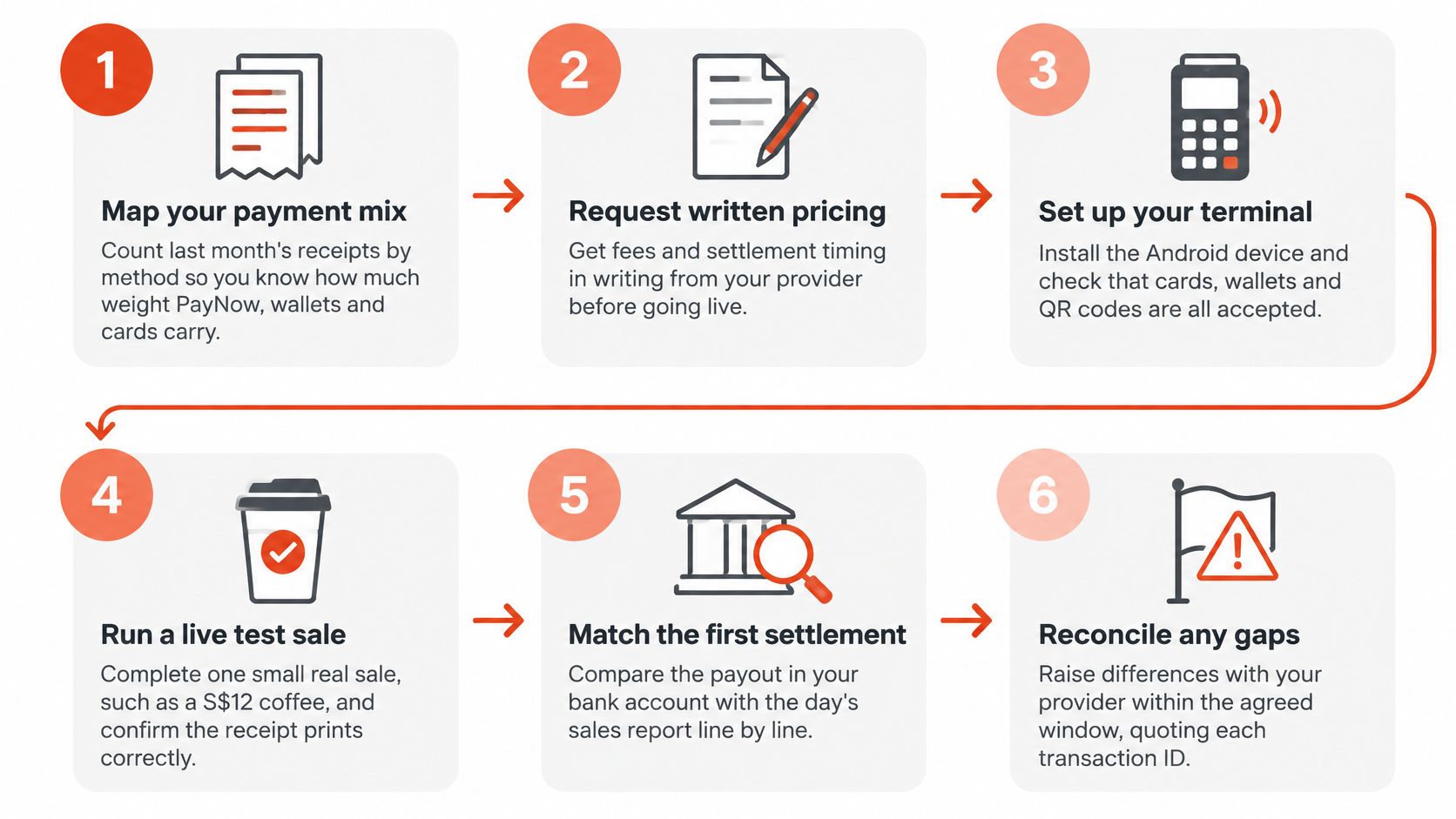
Map the payment mix. Categorise a representative month's receipts by payment method, retaining sales value and transaction count. The check is whether the sample captures quiet periods, busy trading and relevant customer groups rather than an unusually convenient day.
Request comparable written pricing. Send the same transaction profile to each shortlisted provider and ask for an itemised expected bill. Before acceptance, the owner should be able to explain equipment charges, processing charges and the payout calendar without relying on verbal clarification.
Schedule installation outside peak trading. Coordinate activation, staff training and the old-provider cut-over during a quieter period. Keep the existing arrangement available until the replacement passes its agreed acceptance tests, subject to the old contract's requirements.
Assign permissions before taking payments. Create appropriate cashier and manager access, then nominate responsibility for refunds, closing reports and incident escalation. Confirm the business's UEN and receiving-account details are correctly mapped to its PayNow and SGQR setup, so the accountant can identify the relevant transactions.
Test each enabled method and the return process. Run small live transactions across the shop's required cards, phone wallets and QR options, including PayNow, then test a supported refund. Check the amount, merchant identity, transaction status and reference in the merchant report, not only on the printed receipt.
Match the first payout to its underlying transactions. When settlement arrives under the agreed schedule, compare the bank credit with the eligible sales, refunds, fees and adjustments. Record unexplained gaps with transaction references and submit them through the agreed support route.
The launch record should remain usable after the installer leaves. Store the signed commercial terms, acceptance-test results, support contacts and first reconciliation together, with access for the people responsible for daily closing.
This week's concrete decision is to select three providers for written quotes and send each the same sample trading month. The owner can then choose on total cost, operational fit and demonstrable support rather than terminal appearance alone.
Sambapay offers Android POS terminals, in-store card and selected wallet acceptance, and Singapore-based support for merchant onboarding and ongoing assistance. Shop owners can visit Sambapay to request a written quote covering their payment mix, settlement arrangements and installation requirements, then compare it against the same trading-month sample used for other providers.