
Singapore's card market recorded S$54.2759 billion in annual credit and charge-card billings in 2017, according to MAS historical card statistics. That's an established spending habit, not a checkout novelty. For a Singapore SME comparing credit card payment options, the practical question isn't how many payment logos fit beside the till. It's which combination lets customers pay comfortably, gives cashiers a clear workflow and gets usable funds into the business account.
A café cashier has an order waiting, a customer holding a phone and another customer reaching for a physical card. Both expect the reader to work without a discussion about payment technology. The operator needs a reliable default, not a counter crowded with devices.
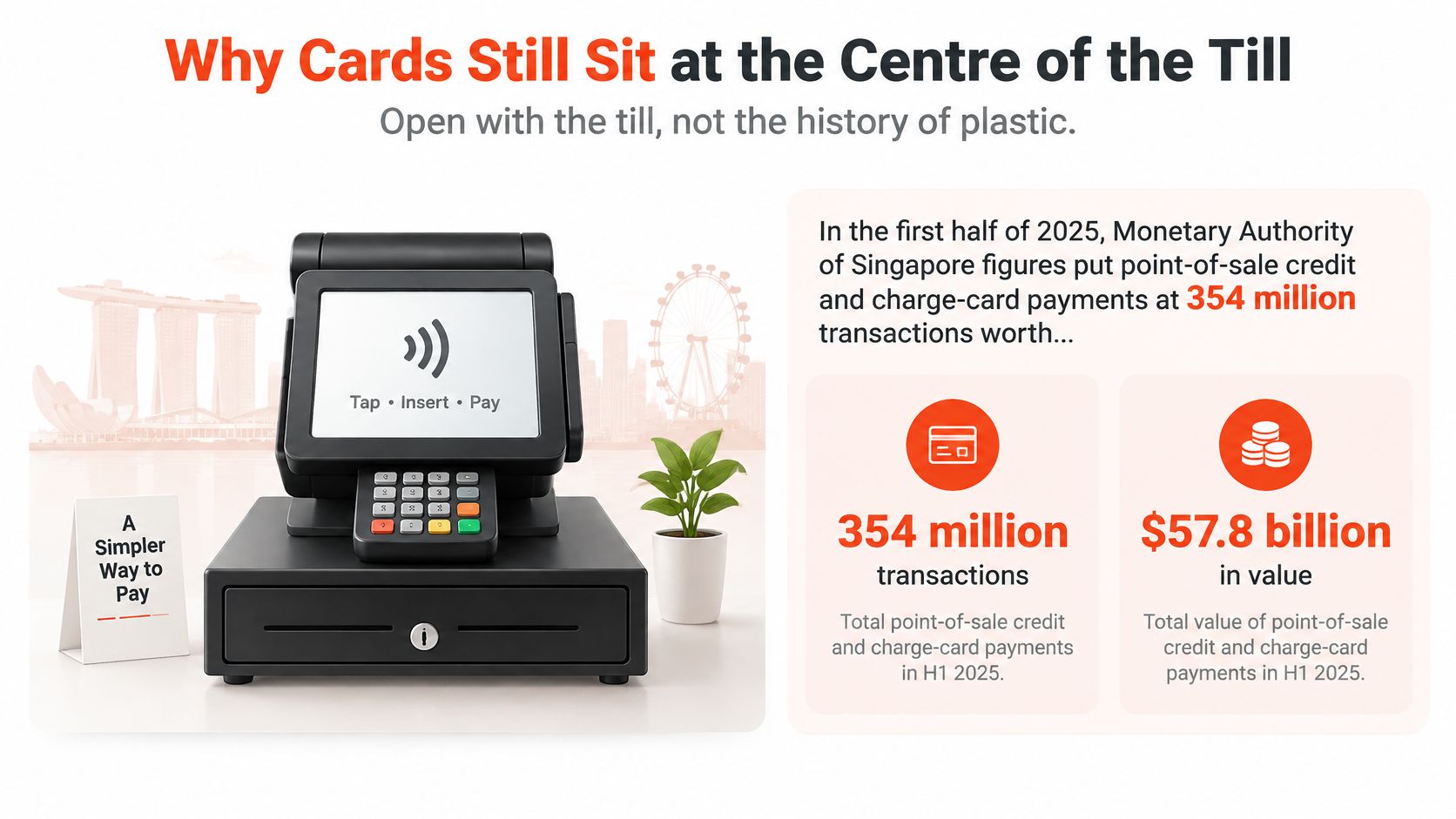
In the first half of 2025, Singapore recorded 354 million point-of-sale credit and charge-card transactions worth S$28.247 billion, averaging about S$80 per transaction, according to MAS retail-payment statistics. That average puts card acceptance firmly within everyday commerce, not just expensive purchases.
The till-level picture is illustrated below.
A boutique customer may prefer a credit card for a purchase, while a café regular taps a debit card without thinking about the distinction. A clinic patient may present a phone instead of plastic. The cashier's task should stay simple: enter or confirm the amount, present the reader and wait for a definite result before closing the sale.
For merchants, credit card payment options cover several different families:
Those distinctions matter when selecting hardware and organising reports. A reader that accepts the main card schemes can provide a common checkout point, but an additional wallet may introduce a different confirmation screen or reporting route.
Counter principle: A payment method earns its place when customers use it and staff can complete it confidently.
A useful acceptance mix starts with actual demand. Staff should note requests for unavailable methods, rather than treating every unfamiliar logo as a missing feature. A terminal demonstration should also include an awkward transaction, such as a failed read or an abandoned payment, not just a successful tap.
The strongest checkout isn't necessarily the one with the broadest acceptance list. It's the one where the customer knows what to do and the cashier knows when the sale is complete.
| Method | How the customer pays | Best suited to | Funds timing | Staff load |
|---|---|---|---|---|
| Visa and Mastercard | Chip insert, tap or permitted swipe fallback | Everyday local spend and visitors | Acquirer's contracted card-settlement schedule | Low after terminal training |
| American Express, JCB, UnionPay | Chip insert or tap on an enabled terminal | Visitors, premium-card holders and cross-border shoppers | Scheme and acquiring agreement determine payout | Low once acceptance is enabled |
| Apple Pay and Google Pay | Phone or watch tap | Customers using a card-based mobile wallet | Follows the underlying card's settlement arrangement | Low; follow the terminal result |
| Alipay | Supported in-app or merchant QR flow | Visitors already using Alipay | Wallet provider's merchant payout schedule | Medium; separate refund workflow |
| GrabPay | Supported Grab app QR or in-app flow | Regulars who already use GrabPay | Wallet payout schedule, separate from card reporting | Medium |
| PayNow | Banking-app scan of a PayNow-enabled merchant QR or SGQR | Local customers preferring bank transfers | Bank receipt, checked through merchant-side confirmation | Medium; match references and amounts |
| Cash | Notes and coins | Fallback and customers preferring cash | Immediately in the drawer, not yet in the bank | High; change, counting and banking |
This is a working list for a Singapore counter, not a recommendation to activate every row. Funds timing means usable money, not the moment a customer sees a success message. The table deliberately uses the agreement or confirmation rule rather than promising a universal payout date.
Visa and Mastercard provide a sensible starting point for a general-purpose card reader. American Express, JCB and UnionPay should be assessed as scheme additions to that setup, rather than reasons to buy separate gadgets. The merchant still needs confirmation that each requested scheme is activated.
Apple Pay and Google Pay belong beside the card rows operationally. Alipay and GrabPay need a closer look at the supported merchant flow, because a wallet logo alone doesn't explain whether staff scan a customer code or the customer scans a displayed code.
PayNow needs a clear merchant identity and a reliable way to verify receipt. An SGQR display can consolidate supported payment labels, but it doesn't mean every banking app or wallet can use every displayed method.
Cash avoids a processor payout wait, but it creates work that a transaction-rate comparison can overlook. Someone has to prepare change, count the drawer, investigate differences and arrange banking.
Selection rule: Enable the methods customers already use, then stop until another method solves a demonstrated problem.
A standalone terminal requires staff to enter the amount carefully. An integrated POS can reduce that handoff, but only if cancelled sales, split payments and refunds remain understandable to the cashier.
For a wider view of acceptance methods, the Singapore cashless-payment guide provides useful context. GetBill's explanation of how to reduce payment processing costs is also useful for preparing commercial questions, although an online-processing discussion shouldn't substitute for an in-store quote.
The merchant's shortlist should record more than the rate: the payout rule, refund procedure, reporting location and person responsible for resolving exceptions. A cheap method that repeatedly sends cashiers searching through apps can be an expensive operational choice.
Singapore customers don't divide neatly into card users, transfer users and cash users. A Straits Times payment-method survey reported regular use of credit or debit cards by 87% of respondents, PayNow by 83% and cash by 82%, with multiple selections allowed. The practical implication is choice within a controlled mix, not a winner-takes-all payment policy.
| Business | Lead with | Add when it earns its place | Limit |
|---|---|---|---|
| Retail or boutique | Visa and Mastercard tap or chip | Amex, JCB and UnionPay for visitors; a PayNow QR for locals | Extra wallet apps with no regular requests |
| Café or restaurant | Contactless cards at counter or table | PayNow for smaller, less rushed bills | A QR-only flow in a peak queue |
| Salon, spa or clinic | Cards for treatments and higher tickets | PayNow for local deposits | Cash-only acceptance that excludes card-preferring customers |
| Gym or studio | Cards at the front desk for fees and retail | PayNow when members already transfer | An additional wallet members don't use |
| Mobile repair or consultant | A mobile card terminal off-site | PayNow when the card fails and the customer has connectivity | Hardware that works only on shop Wi-Fi |
Retail and boutiques should judge scheme additions by the customer mix. A shop serving visitors has a different acceptance requirement from a neighbourhood retailer whose regulars already use the same familiar methods. Staff can record declined scheme requests separately from ordinary card declines, because the remedies aren't the same.
For cafés and restaurants, queue conditions matter as much as ticket size. During a lunch rush, the payment device should be ready when the order total is ready. PayNow can remain available without becoming the compulsory route for every customer balancing a tray and searching for a banking app.
Salons, spas and clinics need payment records that connect deposits to appointments. The booking record should identify the amount already paid, the remaining balance and the cancellation terms accepted before the visit. A deposit shouldn't become an unexplained credit that only the receptionist who took it can recognise.
A gym or studio can take a membership purchase at the desk without assuming that the same transaction establishes recurring billing. Staff should distinguish a paid membership period from permission to collect future fees. Retail purchases, joining fees and other desk payments should also have recognisable descriptions.
For mobile repair businesses and consultants, a portable reader is useful only if it works where the service takes place. PayNow can help when a particular card fails, but it isn't a complete answer to a connectivity outage. The customer still needs access to the banking service, and the merchant still needs confirmation.
A payment mix should reflect how that business sells, not how a neighbouring shop decorated its door.
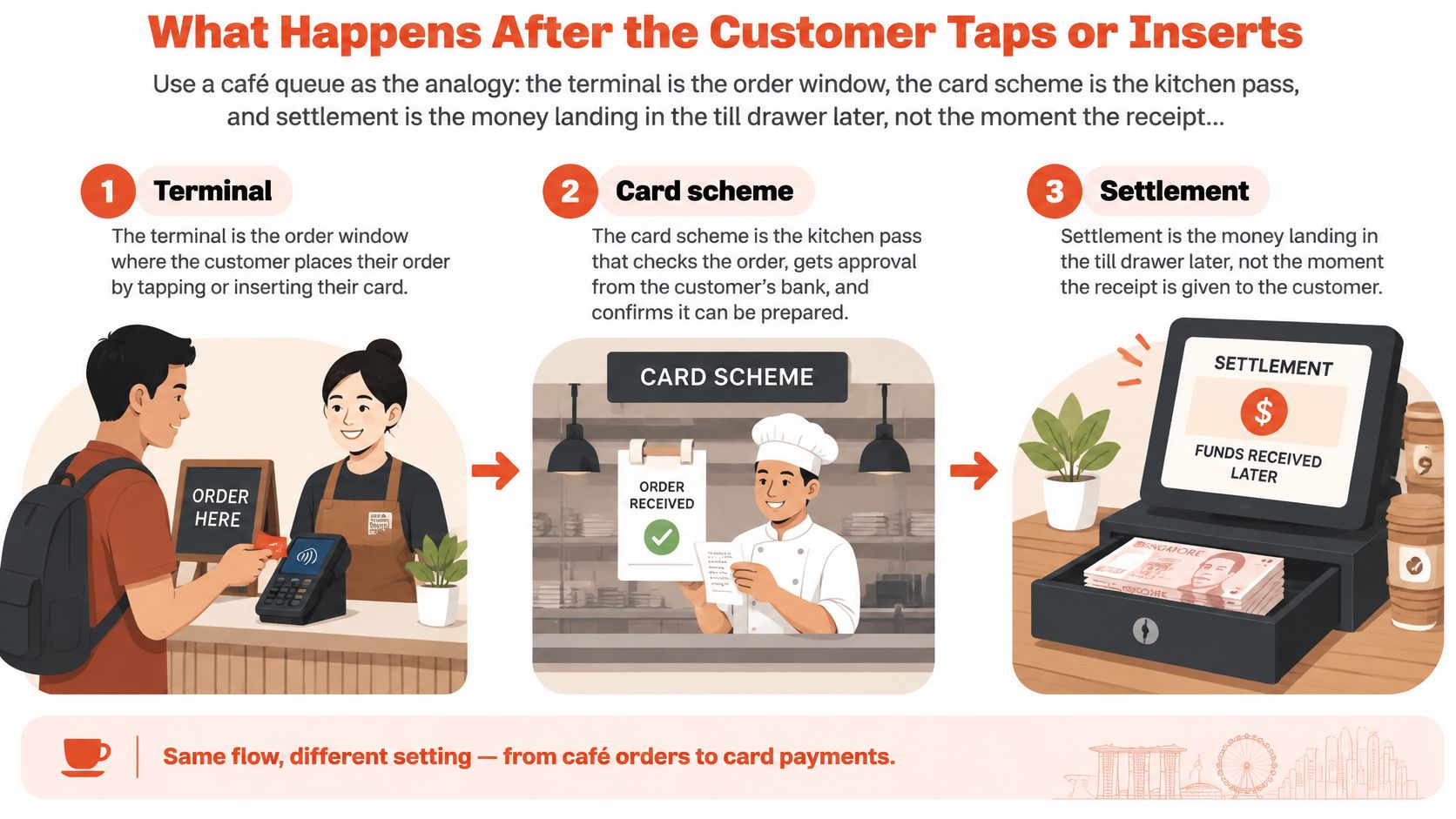
A café provides a useful analogy. The terminal is the order window, the card scheme is the kitchen pass through which instructions travel, and settlement is the money reaching the drawer later. A printed receipt isn't the same as money arriving in the business account.
The processing path separates the customer-facing result from the later movement of funds.
The terminal reads the payment credential. A chip, contactless card or supported wallet presents the information needed for an authorisation request. The amount and merchant details travel through the acquiring and card-network infrastructure towards the issuer.
The issuer returns a decision. Approval allows the transaction to proceed; a decline means staff need to resolve payment at the counter. A communications error or pending response isn't an approval and shouldn't be treated as one.
Approved transactions enter capture and batch processing. The system prepares completed sales for financial processing. Merchants need to understand whether the setup closes batches automatically or requires a staff action.
The acquirer settles under the merchant agreement. The payout follows the agreed processing schedule and deductions. This is the stage that produces a bank credit the merchant can reconcile.
Visa, Mastercard, American Express, JCB and UnionPay identify card networks, not whether every customer is borrowing. Debit cards can carry those brands too, so a cashier should follow the reader's instructions rather than infer the funding source from a customer saying card.
Apple Pay and Google Pay don't create another card scheme. They present a token representing a supported card, and the transaction follows that card's processing arrangement. 3-D Secure, by contrast, is an online authentication control, not a procedure a cashier runs for an ordinary card-present tap.
The POS should close a bill only when the payment status supports it. If the terminal approves but the POS remains open, staff should check the transaction record before attempting another charge.
Restaurant operators connecting orders, tills and payment records can use OrderOut's restaurant payment integration guide to frame integration checks. The useful test isn't just whether a sale succeeds, but whether the order and payment retain matching references when something interrupts the flow.
The accompanying video provides another way to follow the payment-processing journey.
Each morning, the owner or bookkeeper should be able to connect completed transactions to expected settlement and then to the bank credit. Unexplained differences belong in an exception list, not in an assumed processing adjustment.
The checkout should be a deliberate mix of tenders chosen for the customer base. A tap-to-pay card or an authenticated Apple Pay or Google Pay wallet moves straight to the reader. A merchant-presented PayNow, Alipay or GrabPay QR asks the customer to open the right app, scan the code and confirm the amount. Judge each route by queue speed, customer familiarity and how clearly the transaction can be matched to the payment record and funds received.
The extra interaction can work well at a quiet counter. It becomes a problem when the cashier introduces an unfamiliar app flow after the bill is ready and other customers are waiting. Put the accepted routes on display before payment, and have staff state the available options in the same order every time.
For a card-heavy mix, Sambapay provides daily summaries and settlement reporting that help match card transactions with funds received in the business account. Any QR or wallet route added beside those cards should produce an equally clear merchant-side record.
Contactless limits depend on the card issuer and card network, not a number chosen by the shop. Most everyday transactions can complete instantly without a PIN, although the reader may request additional verification or a different presentation method. Staff should explain the prompt that appears rather than promise that every customer will see the same one.
Tokenisation replaces the underlying card number with a payment credential used for the wallet transaction. It reduces exposure of the actual account number at checkout, but it cannot establish that the person who added the card to the wallet was legitimate.
A joint release by MAS, the Singapore Police Force and the Cyber Security Agency reported at least 656 cases between 1 October and 31 December 2024 involving phished card credentials provisioned to mobile wallets, with at least S$1.2 million in losses. For the merchant, that risk argues for disciplined verification and exception handling while contactless remains a normal tender.
Tokenisation protects the card credential at checkout. It cannot repair a phishing compromise that happened before checkout.
Build the routine into opening procedures and staff training:
Keep customer-facing QR codes visually distinct from payment codes. For menus or service information, branded mobile pages from HolaQR can keep that content separate from the payment flow. The page can support the visit; confirmation still needs to come from the merchant's own payment record.
Continuity needs its own test. Some terminals may keep limited contactless capability during bank or network disruptions, so confirm exactly what each device can do before activation. Ask what appears on-screen during an outage, which transactions can proceed and who carries the risk. A lost connection does not automatically authorise offline acceptance. Staff need an explicit stop rule telling them when to switch tenders and when to pause the sale.
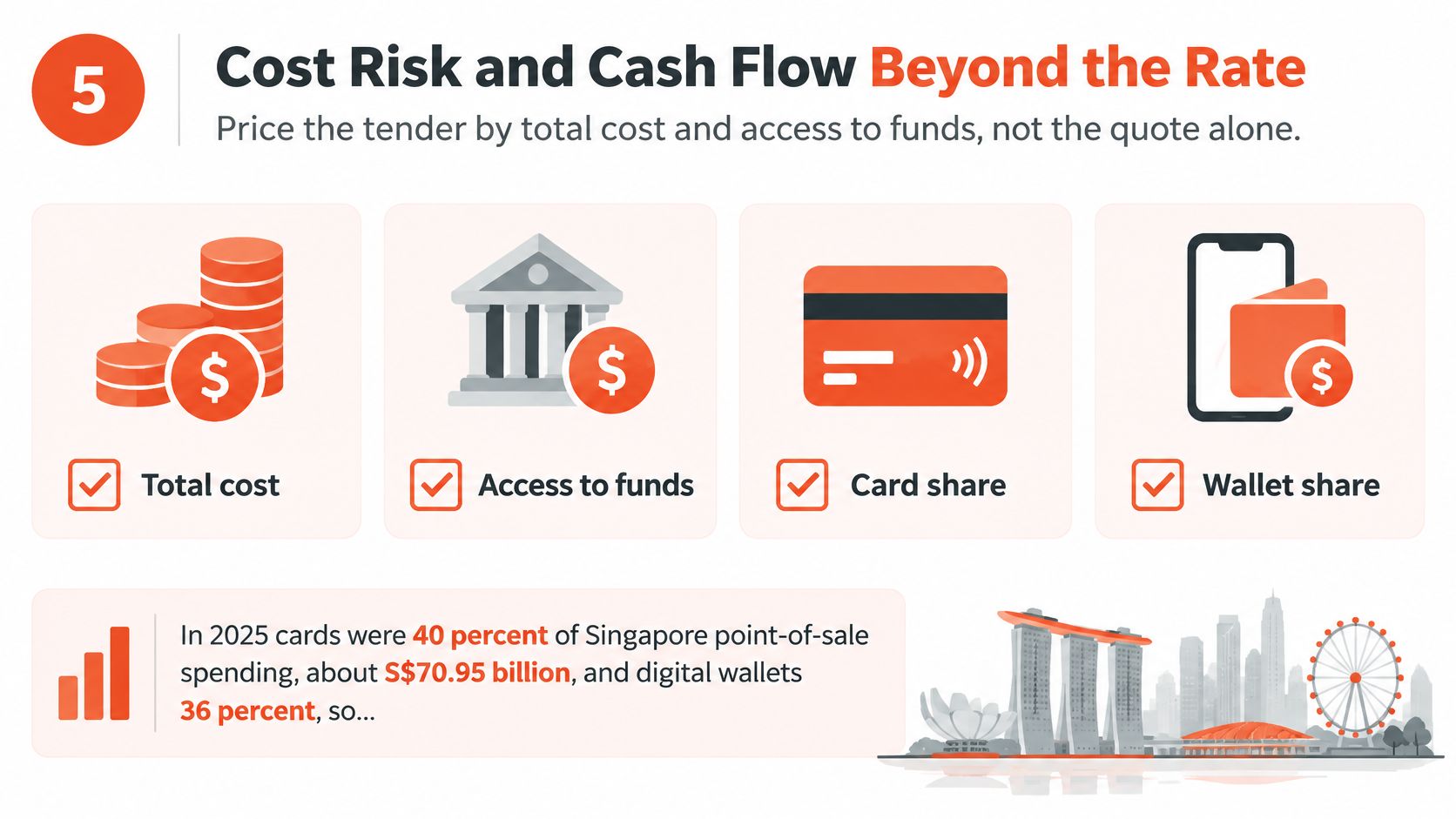
A merchant can receive an attractive transaction quote and still face an expensive payment setup. Device charges, cross-border treatment, refund costs, dispute administration and delayed access to funds all affect the commercial result. The useful comparison is total cost plus access to cash, not the headline percentage alone.
Cards represented 40% of Singapore point-of-sale spending in 2025, valued at S$70.95 billion, while digital wallets represented 36%, according to Singapore Business Review's payments-market report. Both deserve serious consideration, but a spending share doesn't establish that their payout and dispute arrangements are interchangeable.
The cost review should cover both visible charges and the work left with the merchant.
A decline needs a counter decision: follow a legitimate retry prompt or switch tender. A partial approval, where supported, needs careful handling because the cashier must collect the outstanding amount rather than close the entire bill as paid.
A refund is different. Staff should locate the original transaction, confirm the refundable amount and follow the original payment route's procedure. A card refund and a PayNow repayment aren't the same action, and refund funding can affect the merchant's balance before the original sale's payout arrives.
A chargeback requires evidence, not just an assertion that the customer attended. The merchant should retain the transaction reference, date, amount, receipt and a clear description of the goods or service supplied. Appointment confirmations, delivery acknowledgements and accepted cancellation terms can help explain the transaction when relevant.
Blended pricing is easier to forecast only when its coverage is clear. A useful merchant discount rate guide for Singapore helps merchants distinguish the quoted rate from the full acceptance arrangement.
Higher processing volume can support a better commercial negotiation, but it doesn't remove operational liabilities. The owner should leave the pricing discussion knowing what the business pays, when it receives funds and what happens when a customer wants money back.
Before onboarding, the owner should write down the lead tender, the justified add-on and the refund procedure staff will follow. That short specification keeps a provider discussion centred on the business rather than a catalogue of available logos.
Sambapay supplies modern in-store terminals accepting Visa, Mastercard, American Express, JCB and other major schemes, alongside selected methods such as Alipay, GrabPay or PayNow. Card authorisations take seconds; card transaction rates can be as low as 1.8%, depending on industry, business structure, average ticket size and monthly processing volume. Settlement timing remains subject to banking schedules and card-network processing.
A contactless payment terminal setup should match the counter's physical layout and staff routine. Sambapay can coordinate installation outside peak hours so the changeover doesn't interrupt card acceptance.
The handover should include a completed sale, an unsuccessful attempt and the agreed refund workflow. Staff should also know where to find the transaction record and whom to contact when the screen result is uncertain.
Sambapay offers Singapore SMEs modern terminals, major-card acceptance and selected wallet options with transparent pricing and local support. Visit Sambapay with the business's preferred payment mix, average ticket size and monthly card volume to discuss a setup matched to its counter and settlement needs.