
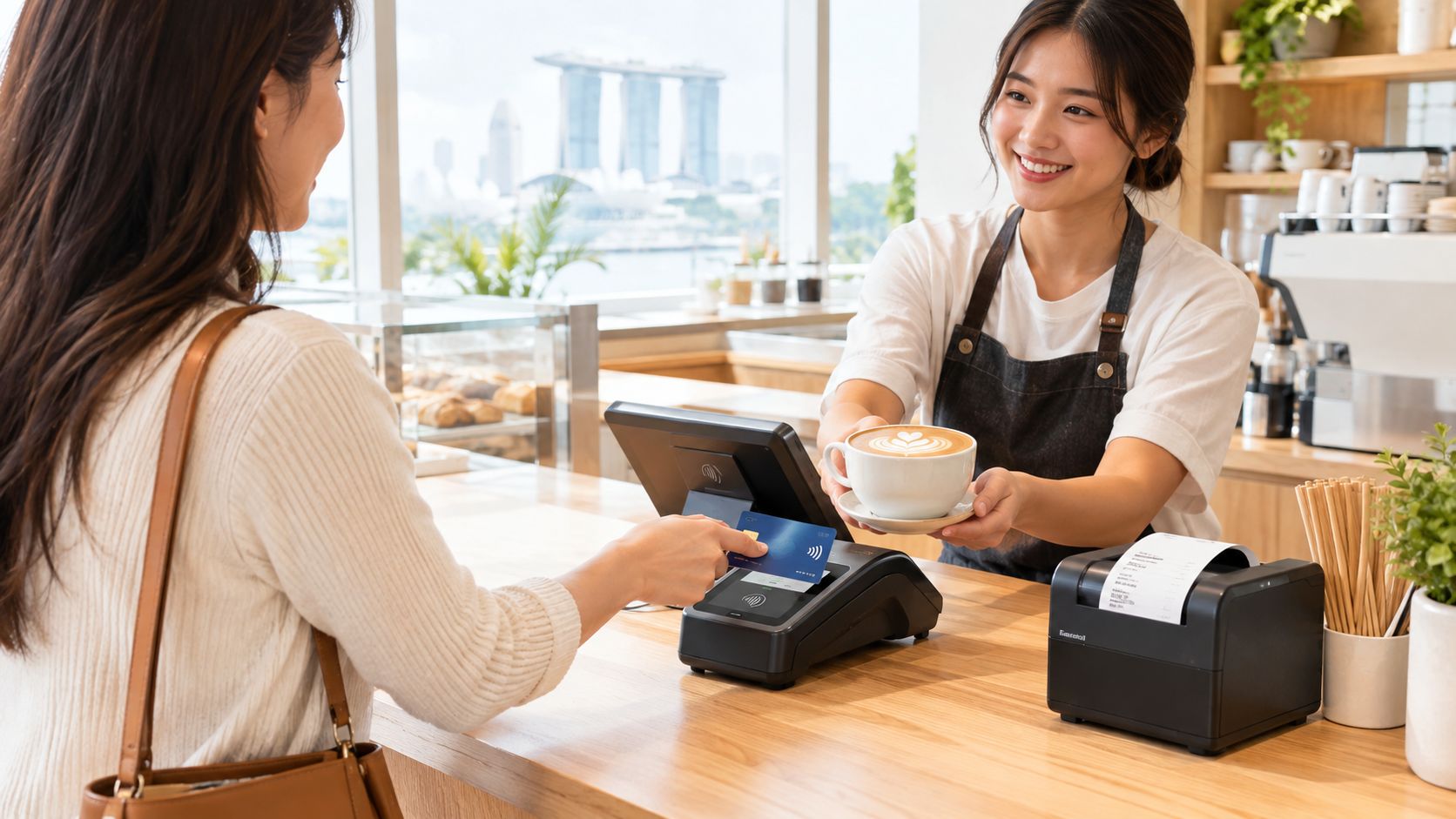
A customer taps a card at the counter, the terminal chirps, and a receipt prints before the drink is even ready. To a shop owner, that moment looks simple. To everyone behind the counter, it is a fast handoff across several systems that have to agree in seconds, then settle the money later.
Singapore merchants feel this every day. The country's point-of-sale credit and charge-card spending reached SGD54.54 billion in 2024 across 682 million transactions, with an average ticket of about SGD80 and roughly SGD4.5 billion a month flowing through in-store card acceptance, according to the Monetary Authority of Singapore (MAS retail payment statistics). That scale matters because it shows card acceptance is not a side channel for Singapore retailers, restaurants, clinics, or salons, it is part of the daily operating system.
A card tap feels instant because the customer only sees the visible part. The staff member hears the beep, hands over the coffee, and moves to the next customer. Behind that tap, the terminal asks for approval, the cardholder's bank checks the account, a network carries the message, and the merchant's provider records what happened for later payout.
That is why a “successful” tap is only the start of the story. The counter has already done the quick job, but the money still has to be verified, grouped with other sales, and moved into the merchant's bank account. If any part of that chain slows down, the customer still walks away with the latte, yet the merchant feels it later in queue time, reconciliation work, or delayed cash flow.
A useful way to think about it is this, the tap is like ordering food at a busy hawker stall. The order is taken immediately, but the kitchen still has to confirm stock, prepare the dish, and close the bill properly. Card payments work the same way, only the “kitchen” includes banks and payment rails that most customers never see.
Practical rule: if the tap feels effortless, someone else has already handled the complexity well.
A merchant does not need to memorise the machinery at first. What matters is knowing that the counter experience is only one moment in a longer payment lifecycle, and that the design of the workflow determines how smooth the day feels when the lunch crowd arrives.
A single card payment is a handoff, not a single event. One person starts it, one shop accepts it, a bank on the customer side approves it, a network carries the message, and a bank on the merchant side eventually receives the money. If a wallet is used, there may be an extra layer that stores the card safely on a phone.
A package-delivery analogy helps. The customer hands the parcel to the first courier, the retailer is the receiving desk, the network is the route map, and the issuing bank is the checkpoint that decides whether the parcel can move forward. The merchant's acquiring bank is the office that receives the final delivery and credits the shop's account.
A Singapore retailer usually contracts with the acquiring side or an acquiring partner, not directly with the issuing bank. That matters because the merchant's support line, settlement timing, and device setup usually sit with the local provider, while the customer's approval decision stays on the bank side. For a clear technical overview of this middle layer, a useful starting point is the payment processor explanation.
The merchant rarely sees the issuing bank directly. That is why local support matters so much in Singapore, the shop owner needs help at the terminal, not a generic explanation of how banking works in the abstract.
A card payment moves through three separate moments, and each one answers a different question. Authorization is the quick yes or no at the counter. Clearing is the record of what was sold. Settlement is when the money reaches the merchant's account.
A shop owner can see this in daily work. The tap may be approved in seconds, the sales record is matched later, and the payout arrives after the provider's processing cycle. That split explains why a sale can feel complete to the customer while the funds are still moving behind the scenes.
The customer usually notices only the first moment. The terminal needs to respond fast so the queue keeps moving, especially for high-frequency, small-ticket sales. MAS recorded 321 million point-of-sale credit and charge-card transactions worth S$26.716 billion in the first half of 2025 and 706 million POS card transactions worth S$41.085 billion across all card types (MAS H1 2025 retail payment statistics). That scale fits the way many Singapore stores work, a quick tap at lunch, a short queue at opening time, a steady stream at the counter.
For a merchant, the timing gap shows up in operations. A café with a lunch rush, a clinic with morning appointments, or a salon on a busy weekend feels every delay at the terminal. The front-end approval needs to stay fast even though the back-end record matching and payout happen later.
Authorisation can complete in under two seconds, clearing usually happens overnight, and settlement may land on T+1 or later depending on the agreement.
A provider's settlement promise matters because working capital shows up in daily life, not in theory. The merchant still has to pay suppliers, wages, and rent on schedule, so the gap between “approved” and “paid out” affects how the business runs. For a deeper look at how funds land, see this guide to card payment settlement.
A merchant fee often looks like one number on a quote, yet three different layers usually sit behind it, interchange, scheme fees, and the processor or acquirer margin. The easiest way to read that quote is to break it apart first, because each layer follows a different rule and goes to a different party.
| Component | Who earns it | What it depends on |
|---|---|---|
| Interchange | The issuing bank | Card type, transaction profile, and risk |
| Scheme fees | The card network | Network rules and the payment route |
| Processor or acquirer margin | The merchant's payment provider | Commercial pricing and service bundle |
A small ticket makes the fee structure easier to feel. MAS retail payment statistics show the average in-store card ticket sits around S$80 in the 2024 data, so a fixed fee takes up more of a café sale, salon bill, or clinic visit than it would on a larger purchase. For that reason, merchants in those sectors usually notice pricing changes faster than a furniture store or wholesaler.
A blended quote can still suit a merchant, but the business owner should know what sits inside it. Refunds, chargebacks, and card mix can all change the effective cost, even when the headline rate looks simple. A merchant discount rate guide helps because it shows the pricing question in layers, not just as a single sticker number.
Pricing opacity is not unique to payments. Even adjacent categories such as the price guide for guest WiFi tools show the same pattern, one visible fee can hide service layers underneath. The point is not that the products are the same, only that merchants should read past the front number.
Two providers can both advertise low rates and still produce different outcomes at the counter. One may include more support, another may leave the merchant to handle more exceptions, and a third may price international or wallet-heavy traffic differently. A quote should be compared as a full commercial package, not only by the top-line percentage.
A staff member does not need to become a banker to spot the difference at the counter. What matters is how the card behaves for the merchant, because that affects funding, reversals, and customer service later. A credit card, debit card, and charge card can all look like a tap, but they do not always create the same operational result.
A credit card usually means the issuer is extending credit to the cardholder. For the merchant, the immediate checkout experience is often similar to other cards, but the customer's repayment happens later on the cardholder side.
A debit card draws from the customer's bank balance more directly. For the merchant, that can feel like a normal card acceptance flow, yet the funds come from a different consumer-side mechanism.
A charge card is different again, because the cardholder is expected to pay the balance in full under that product's rules. The merchant still focuses on acceptance and settlement, but the cardholder's billing behaviour differs from a standard revolving credit card.
For businesses that want a practical checkout system and need to train staff on these differences, a POS for repair shops illustrates how the counter workflow can be organised around service notes, payment completion, and simple handoff steps rather than payment jargon.
Contactless and mobile-wallet payments change the path the data travels, but not the merchant's basic job. A wallet like Apple Pay or Google Pay can use tokenised card details, so the merchant sees a smooth tap while the device keeps the card number out of plain view during payment. That improves convenience, but it doesn't remove the need to reconcile refunds and disputes properly.
A tap is not the end of responsibility. It just moves some of the risk and some of the convenience to different parts of the chain.
For a cashier, the training point is simple, the payment method may look identical on the screen, yet the refund process, the customer expectation, and the back-office records still need to line up.
A terminal that approves a payment is doing one job. Security depends on several layers working together, because fraud can enter through the device, the payment app, the wallet, or the merchant's own workflow. That's the part many small businesses miss, they assume the tap itself settles the risk.
Singapore's fraud picture shows why that assumption is too narrow. The Monetary Authority of Singapore said Singapore reported an average of 790 credit-card-fraud cases annually from 2021 through 2023, with average yearly losses of S$2.1 million (MAS parliamentary reply on credit card fraud). A separate Singapore advisory said there were at least 656 cases between October and December 2024 involving phished card credentials provisioned to mobile wallets, with at least S$1.2 million in losses and at least 502 reports involving Apple Pay (Singapore payment-fraud advisory coverage).
The key lesson is that a fraud problem is not only a terminal problem. A merchant should think in layers, hardware, software, tokenisation, issuer controls, and evidence kept by staff. Chip and contactless payment help at the point of sale, but they don't fix every upstream problem, especially when stolen credentials were already used to provision a wallet before the tap happened.
Merchant workflow matters just as much. Receipts, service records, refund logs, and daily reconciliation become evidence when a customer later disputes a charge or claims the wrong amount was taken. That's especially important for salons, clinics, and restaurants, where service completion matters as much as the tap itself.
The right mindset is not “reject anything suspicious.” Too much friction can frustrate genuine customers, while a valid card tap can still be followed by refund abuse, duplicate charges, or a service dispute later. The merchant's job is to collect enough clean evidence that the transaction can be explained if someone asks questions later.
A merchant choosing a provider should look at the counter experience first. Terminals need to be reliable, connected, and quick to respond, because the lunch rush or dinner queue is where bad hardware becomes visible. A local shop also needs clear settlement timing, so the business knows when sales will land in the bank.
The second question is what the provider accepts. A merchant serving Singapore customers should check scheme coverage and wallet compatibility, because payment choice affects conversion at the counter. A provider such as Sambapay offers in-store card acceptance across major schemes and selected wallets, plus settlement options as early as T+1, which matters when cash flow planning is part of daily operations.
For businesses that also run digital campaigns, a connect Stripe to guest marketing resource shows how payments can sit inside a wider operating stack, where checkout, customer data, and back-office systems still need to line up cleanly.
The final test is simple. If the provider cannot explain the tap, the settlement timeline, and the support process in plain language, the merchant will probably spend too much time chasing problems later.
A card payment is easiest to remember as tap, confirm, settle. The customer starts the tap, the network and banks decide whether it can go through, and the merchant's account receives the money later through settlement. That process is protected by layers, not by one magic safeguard.
For a consumer, the tap confirms that the payment was accepted, not that every future dispute disappears. For a merchant, the better questions are more practical, who supports the terminal, how fast funds settle, what the pricing really contains, and what records exist if a charge gets challenged. Those answers turn payments from a black box into an operating system the shop can manage.
If a Singapore merchant wants to make payments with credit card acceptance easier to run day to day, Sambapay provides in-store terminals, card scheme acceptance, settlement options, and local support built for SMEs. Visit Sambapay to review how the setup fits a salon, café, clinic, restaurant, or retail counter.