
The most popular advice about mobile POS Singapore is also the least useful: accept cards, add a QR code, and assume the checkout is solved. Singapore's retail environment is highly cashless, with 97% of retail point-of-sale transactions reported as cashless in 2022 by PwC Singapore's payments analysis. That figure describes customer behaviour, not operational readiness.
A terminal can support contactless payments and still fail a café during the lunch rush, leave a salon unable to match transfers to appointments, or create confusion when a customer presents a PayNow screenshot. The practical question for an SME owner is therefore not whether a device accepts cards and wallets. It's whether staff can keep trading, verify every payment, reconcile exceptions, and recover quickly when connectivity or hardware breaks.
A high cashless adoption rate raises the cost of failure. When customers routinely expect to tap a card or phone, a dead terminal doesn't merely inconvenience them. It can stop the sale, create a queue, force staff into manual checks, and damage confidence in the business.
PwC reported that 97% of Singapore retail POS transactions were cashless in 2022, while 92.0% of Singapore residents had used a digital-payment method through November 2025 in its later analysis. The latter also found that approximately 30% of consumers used their phones exclusively for payments, compared with a reported global average of 21%. These figures show why a merchant needs more than a contactless logo on a device. They also show why a cash fallback can't be treated as the complete continuity plan.
A Wi-Fi interruption creates one set of problems. A mobile-network blind spot, a frozen Android application, a drained battery, or a payment that appears to fail after authorisation creates others. Staff need to know whether to retry, wait, use another terminal, or record the transaction for later reconciliation.
A retry without checking the transaction status can create a duplicate charge. A sale recorded in the till but missing from the acquirer report can produce an end-of-day discrepancy. In a restaurant, a delayed confirmation may hold up table turnover. In a clinic, the staff member may need to reconcile payment against a patient appointment without interrupting the next consultation.
Practical rule: A provider should explain the recovery process for an interrupted transaction in plain language before the terminal is deployed.
Merchants evaluating infrastructure can use the true cost of 99.9 uptime as useful background on why availability percentages don't tell the whole operational story. The relevant question for an SME isn't a headline uptime promise. It's what happens during the specific minutes when the terminal is unavailable.
A serious continuity review should cover:
Offline processing also needs careful scrutiny. Some card arrangements may support controlled fallback workflows, but PayNow confirmation isn't equivalent to card authorisation. A provider that uses the phrase “offline support” without defining the exact payment types and risk controls hasn't answered the question.
A Singapore checkout must accommodate more than a physical credit card. In 2025, cards represented approximately 40% of point-of-sale transaction value and digital wallets represented 36%, according to Global Payments data reported by Singapore Business Review. That mix makes multi-rail acceptance a baseline requirement for a modern terminal, not a premium add-on.
The hardware must handle NFC contactless payments from physical cards and tokenised cards used through services such as Apple Pay and Google Pay. The software and merchant workflow must also support QR or app-based payment journeys for PayNow and other wallets. A device that accepts only physical cards forces customers to change tender, and staff may need to direct them to a separate QR stand or another application.
Consider a boutique where one staff member handles fitting-room assistance and checkout. If the terminal accepts Visa and Mastercard but the customer wants to pay through a wallet or PayNow, the employee may need to open a separate QR workflow, verify the incoming transfer, and then mark the sale complete in the POS. Each additional step increases training needs and creates more opportunities for a mismatch.
A unified device doesn't remove every risk, but it can reduce tender switching. The merchant should see a clear transaction status, the employee should know which payment method was used, and the back office should receive a report that preserves the tender identifier.
That last point matters. Blended settlement can conceal the underlying payment mix if the merchant only receives a total payout. Useful reporting should distinguish card, wallet, and QR proceeds, alongside transaction references, refunds, reversals, and settlement status.
PayNow has reached a scale that makes account-to-account acceptance central to Singapore checkout planning. MAS and ABS data on PayNow show approximately S$154 billion in consumer payment value and S$147 billion in business payment value during 2025, plus S$371 million in cross-border value across three live corridors. MAS also reported that more than 90% of businesses, including heartland shops and hawker centres, had adopted PayNow or SGQR.
The operational preference should be for dynamic QR or a POS-generated reference rather than relying solely on static QR. A transaction-specific reference gives staff a better way to match the transfer with the correct invoice, especially during busy service. The terminal should show confirmation before goods or services are released, and the payment should enter the same reconciliation process as card transactions.
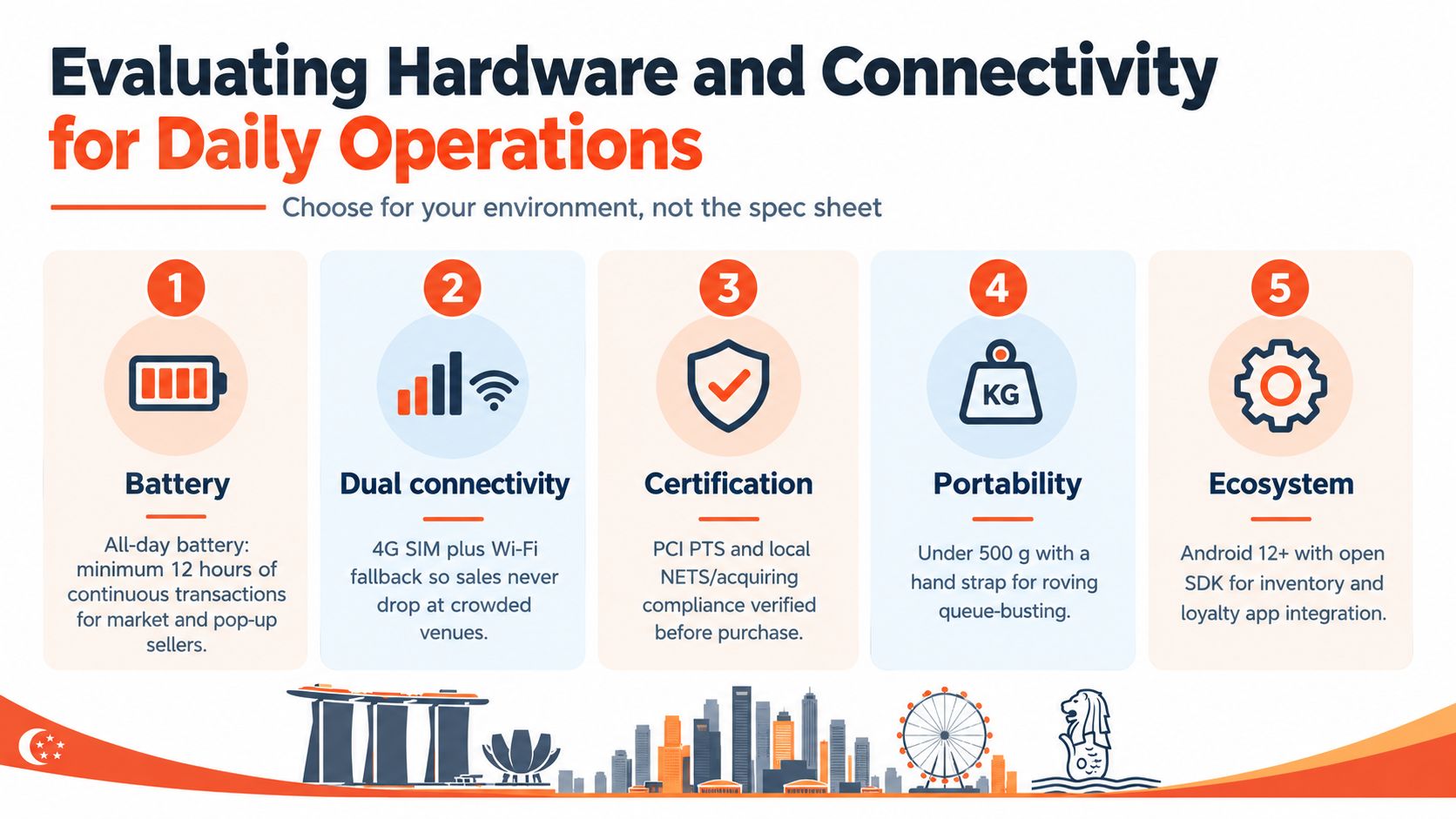
A modern Android terminal is useful when its design matches the physical workflow. A restaurant needs tableside mobility and dependable battery performance. A clinic may prioritise a clear receipt process and controlled staff access. A pop-up seller needs dependable connectivity in a crowded venue, while a basement retailer may need a tested mobile-data fallback.
The right comparison isn't Android versus an older push-button terminal in the abstract. It's whether staff can complete a sale quickly, recover from an interrupted transaction, and understand the screen without repeatedly calling a manager.
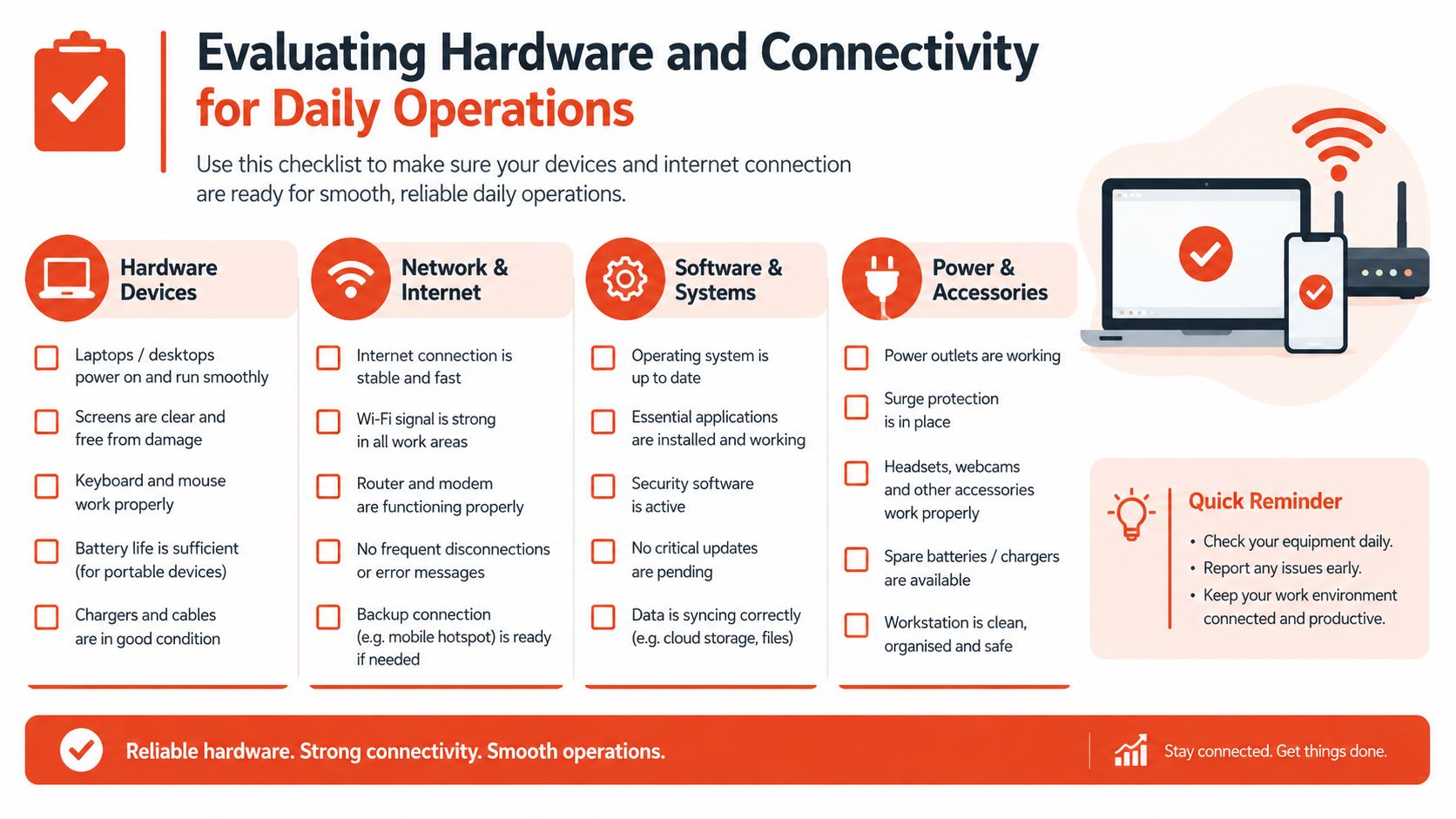
A supplier demonstration in an office doesn't reproduce a crowded café or a mobile stall. Merchants should test the terminal where it will be used.
For broader selection criteria, a practical guide to the best POS for small business can help merchants compare device usability with wider sales-management needs. Payment acceptance alone isn't enough if product lookup, refunds, receipts, and reporting remain awkward.
Wi-Fi-only terminals can work in a stable shop with a well-positioned access point. They become less attractive when the checkout sits in a basement, near thick walls, or in a venue where the network becomes congested. A terminal with mobile-data capability can provide a second route, but only if the provider explains coverage, switching behaviour, data costs, and support boundaries.
A retailer considering an Android POS system from Sambapay should assess the complete operating setup, including acquiring, reporting, support, and the physical location where staff will take payment. Hardware portability matters less than dependable completion of the sale.
Field test: Ask staff to use the terminal after a short briefing, then observe where they hesitate. Every hesitation is a training, interface, or workflow issue that should be resolved before launch.
A card authorisation and an instant account-to-account transfer aren't the same event. A card transaction produces an authorisation decision through the card and acquiring flow. PayNow sends funds through an account-to-account route, and the transfer is generally immediate and irrevocable. Staff must therefore use different evidence before releasing goods or closing a service order.
The security exposure deserves direct attention. Singapore lost approximately S$913.1 million to scams in 2025, while reported scam cases fell 27.6% to 37,308, and card-not-present fraud reached 16.2 basis points, compared with an Asia-Pacific average of 11.7 basis points, according to the Visa Singapore security road map. Those figures don't describe every in-store payment, but they reinforce why payment security must become a staff procedure rather than a technical claim.
For card and wallet transactions, the employee should wait for the terminal's approved status and confirm that the merchant-side record has captured the transaction. A printed receipt can support the workflow, but it shouldn't replace the terminal status or merchant record.
For PayNow and QR payments, the employee should:
A customer screenshot can be altered, delayed, or associated with another transaction. A visible banking-app screen isn't proof that the merchant has received the intended payment. The employee needs a confirmation generated by the merchant's own payment workflow.
Refund access should reflect staff responsibilities. Front-line employees may need to start a refund request, while a supervisor approves unusual amounts, repeated refunds, or refunds issued without a corresponding sale. The merchant should retain transaction references and preserve the evidence required for the payment method involved.
PayNow QR acceptance guidance for Singapore merchants should be assessed alongside card procedures, not treated as a substitute for them. The central lesson is simple: adding payment methods expands convenience, but it also expands the number of ways staff must verify completion and handle exceptions.
A low advertised transaction rate can be misleading if the merchant later discovers terminal rental, scheme charges, separate wallet fees, cancellation costs, or a binding contract. SMEs should compare the commercial package, not just the percentage or per-transaction figure placed on a sales sheet.
Traditional acquiring arrangements may expose merchants to several layers of pricing, including interchange, scheme, processing, and service components. A modern SME model may instead quote a blended rate shaped by the business category, average ticket, and monthly volume. Neither model should be accepted blindly. The merchant needs a written explanation of what is included and how settlement is calculated.
| Feature | Traditional Provider | Modern SME Model |
|---|---|---|
| Pricing presentation | Several cost layers may require reconciliation | A blended rate is easier to forecast when inclusions are explicit |
| Terminal costs | Rental or equipment charges may apply | Standard setups may avoid monthly terminal rental |
| Settlement | Timing can vary by contract and risk review | Options can include earlier settlement, subject to agreement |
| Contract terms | Cancellation fees or binding periods may apply | Merchants can seek clear exit terms before signing |
| Reporting | Detail depends on the provider's dashboard | Transaction-level tender and settlement reporting should be requested |
A merchant should ask for the net amount received after all applicable deductions, then compare it with the settlement date. A slightly different processing rate may matter less than delayed access to funds when the business must pay suppliers, replenish inventory, or manage payroll.
The quote should answer these questions:
Sambapay's card payment settlement information is a useful reference point for merchants comparing settlement mechanics and working-capital implications. Its published business model includes blended pricing, settlement options from as early as T+1 depending on the agreement, and standard setups without monthly terminal rental. Those terms still need to be confirmed in the merchant's own contract.
Commercial test: The best quote is the one an owner can reconcile against a bank payout without needing a spreadsheet of unexplained deductions.
Settlement speed also needs a risk and operations discussion. Earlier access to funds can support cash flow, but the provider may apply conditions based on business type, transaction profile, and onboarding review. A merchant should prioritise predictability over an attractive promise that isn't defined in writing.
Provider changes fail less often on price than on checkout disruption. If the first week brings confused staff, missing references, or fallback problems when connectivity dips, the business pays for the switch in slower queues, avoidable refunds, and manual reconciliation.
A proper migration starts with a baseline review of the current setup: terminals, contract obligations, fees, payment methods, settlement timing, refund handling, and the reporting gaps that already waste time. That review matters because many merchants replace the device but keep the same operational weakness, especially around payout matching or exception handling.
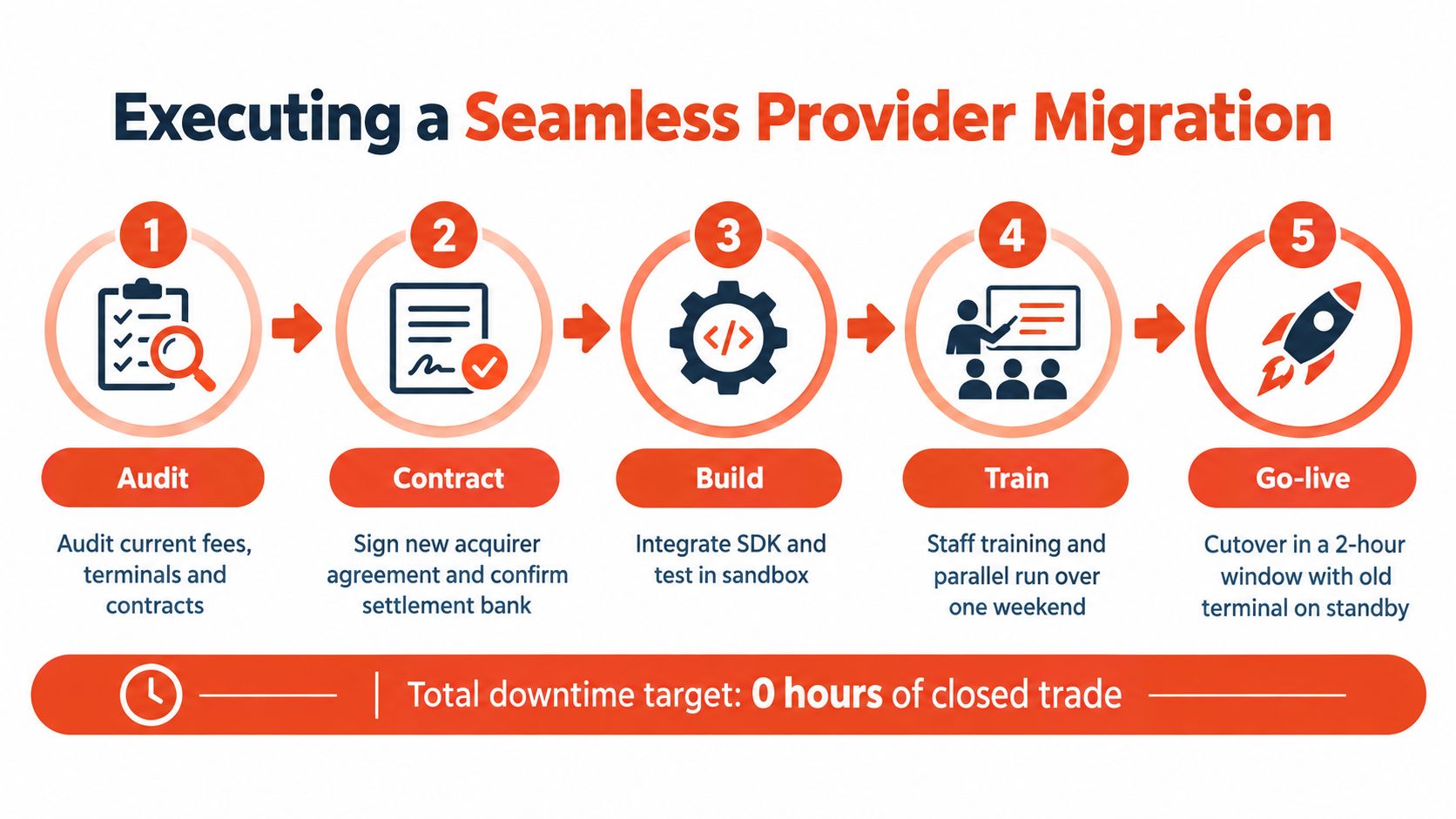
The cleanest migrations are staged, owned, and tested under realistic conditions.
Different businesses need different test cases. A retailer should check SKU and receipt formatting. A clinic should pay closer attention to appointment references and refund controls. A restaurant should test table-side payments during an actual service period, not a quiet counter demo. A gym may need to keep recurring membership billing separate from walk-in payments.
Migration is only complete when the first settlement and exception cases reconcile properly. Owners should review declines, duplicate attempts, unmatched QR payments, refund requests, staff support calls, and the first payout report. Those early signals usually show where the fault sits: terminal setup, network handling, staff process, or the provider's back office.
Sambapay supports structured cutover planning with local human assistance, consolidated reporting, and settlement from T+1 subject to agreement. Merchants considering a switch should ask for a written cutover plan that assigns responsibility for each step and keeps the old payment route available until the new reconciliation process is proven.
Sambapay provides mobile payment terminals, multi-rail in-store acceptance, transparent blended pricing, settlement options from as early as T+1 subject to agreement, and Singapore-based support for SMEs. Visit Sambapay to discuss a resilient mobile POS setup that fits the business's checkout workflow, connectivity needs, and migration timetable.