
D2Pay is DBS Bank's online bank-account payment method in Singapore, historically delivered through the eNETS payment infrastructure, so customers can pay directly from their DBS account at checkout without entering card details. Singapore's shift to real-time payments is illustrated by PayNow, which recorded approximately 150,000 transactions worth S$24 million in its first month in 2017.
A merchant reviewing payment options can easily mistake D2Pay for a card terminal, QR payment product, or general-purpose mobile wallet. It isn't any of those. D2Pay is a specific online checkout rail that connects an eligible merchant, an eNETS integration, and a customer with a DBS banking relationship.
That distinction matters for Singapore SMEs. An online retailer may use D2Pay alongside cards and wallets, while a café, clinic, or boutique needs dependable in-store acceptance at the counter. The right question isn't whether D2Pay is “good” in isolation. It's whether the rail matches the merchant's sales channel, customer base, and payment setup.
D2Pay is DBS's online account-to-merchant payment method in Singapore. Instead of typing a card number into a merchant's checkout page, the customer selects D2Pay and authorises a debit from a DBS account. The customer remains within an authenticated DBS banking journey, while the merchant receives the payment through the connected electronic payment infrastructure.
The service has historically been delivered through eNETS, an established payment gateway environment used to connect online merchants with electronic payment methods. A merchant therefore can't display a D2Pay logo and expect payments to work. The merchant website needs the relevant eNETS connection and the operational setup required to offer the method at checkout. The DBS explanation of D2Pay and electronic collections describes this relationship between the bank payment option, the customer's DBS authentication, and merchant integration.
The arrangement has three practical participants:
D2Pay is therefore narrower than a general payment acceptance product. It isn't a universal consumer app, a standalone POS terminal, or a replacement for every card and wallet option. Its natural audience is an online merchant serving DBS customers who prefer a direct bank payment.
Practical rule: Treat D2Pay as one checkout method within an online payment mix, not as the entire merchant acceptance stack.
That framing prevents a common implementation mistake. A business that mainly sells from a physical counter may gain more from card, contactless, wallet, and QR acceptance than from prioritising an online bank-payment rail.
A D2Pay payment starts on the merchant's website, not at a countertop terminal. The customer adds an item or service, reaches the payment page, and selects D2Pay from the available methods. The customer then chooses DBS Bank Ltd as the debiting bank.
The checkout hands the customer into the relevant DBS banking flow. The customer signs in with a DBS digibank User ID and PIN, then completes transaction signing with a digital token or secure device. This is different from card checkout, where the customer normally provides card details and completes a card-authentication step.
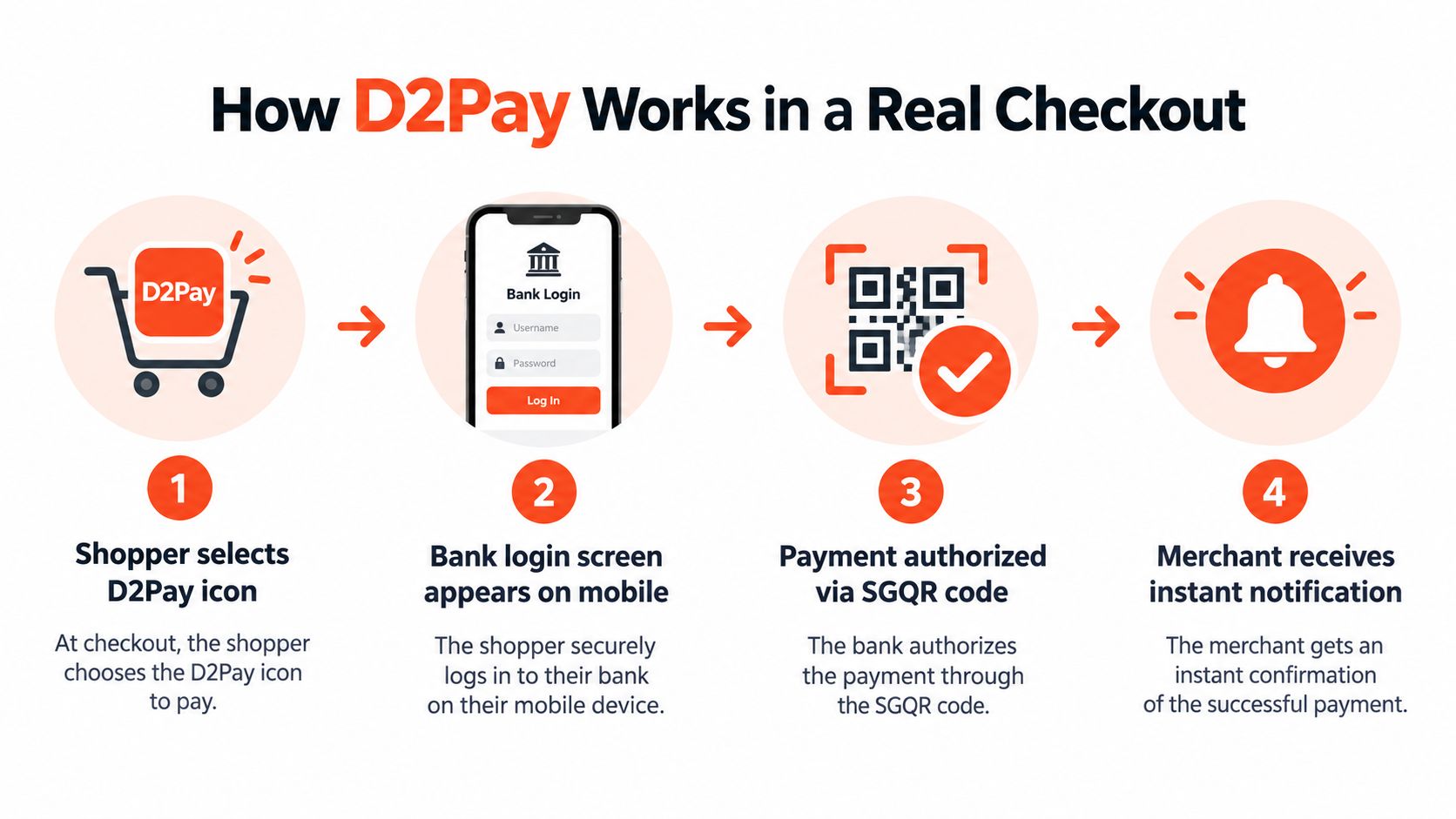
The merchant website must be connected to eNETS before D2Pay can be offered. That requirement affects project planning, testing, reconciliation, and customer support. The merchant needs to confirm that its ecommerce platform, payment gateway, order-management process, and notification flow can recognise a successful bank debit and update the order correctly.
The flow can be summarised as follows:
This account-to-merchant debit model reduces dependence on card-number entry, but it doesn't remove all checkout friction. A customer may abandon the payment if the banking session fails, the authentication device isn't available, or the merchant's return flow doesn't clearly confirm the order. Merchants should also explain what happens after a failed or interrupted payment, rather than leaving customers unsure whether a second attempt could create a duplicate order.
For businesses assessing QR and account-based payment options more broadly, a practical guide to PayNow QR code payments can help separate online checkout flows from in-person QR acceptance. D2Pay remains primarily an online payment rail, even though Singapore's wider payment ecosystem includes QR and mobile experiences.
D2Pay and a card terminal solve different operational problems. D2Pay helps an online shopper pay from a DBS account through an integrated bank-payment checkout. A card terminal lets a customer tap, insert, or swipe a card at a physical location. A digital wallet usually uses a mobile device or wallet account to complete payment through a supported merchant acceptance channel.
| Payment option | Best fit | Customer action | Merchant requirement |
|---|---|---|---|
| D2Pay | Online checkout | Sign in to DBS digibank and approve a bank debit | Website connected to the relevant eNETS infrastructure |
| Card terminal | Shops, restaurants, clinics, and other physical counters | Tap, insert, or swipe a card or supported device | Terminal, acquiring arrangement, connectivity, and settlement setup |
| Digital wallet | Online or in-store payments, depending on the wallet and acceptance method | Approve payment in a wallet or mobile interface | Compatible gateway, terminal, QR, or wallet integration |
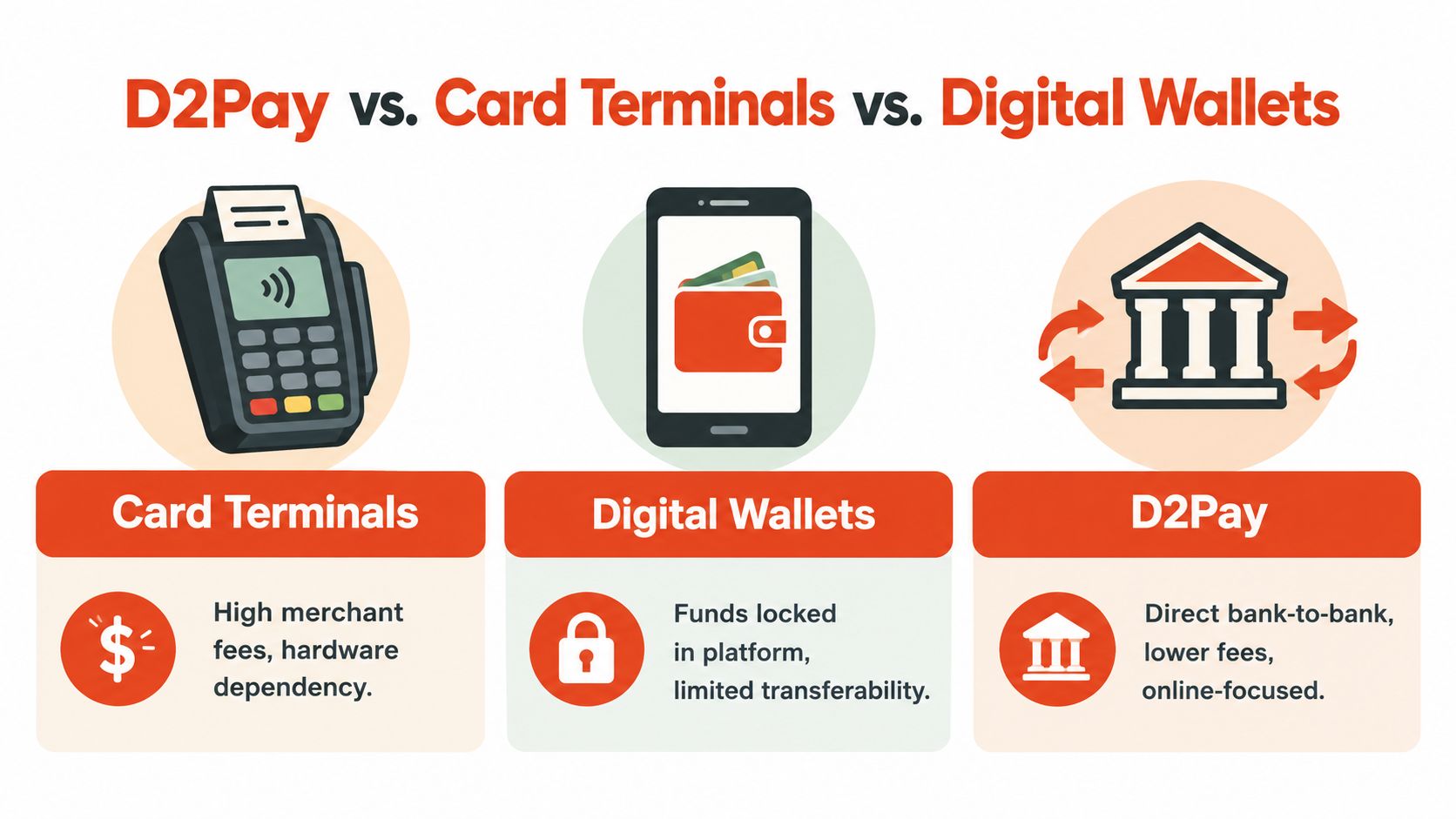
A merchant selling mainly through an ecommerce site may value D2Pay because it offers customers a direct bank-account route. A physical retailer needs a fast face-to-face flow, where a shopper can tap a contactless card or phone without opening a bank login journey. A business operating across both channels may use D2Pay online and terminals or QR acceptance in-store.
That's why merchants comparing POS and EPOS systems should first map the checkout environment. The issue isn't just hardware versus software. It's whether the system captures the payment type, records the sale, manages refunds, and gives staff a clear confirmation at the point where the customer pays.
D2Pay also shouldn't be treated as identical to PayNow. Both relate to bank-directed digital payments, but the customer journey, merchant integration, and acceptance context can differ. The difference between digital wallets and mobile wallets provides further context for separating account-based payments from wallet-led experiences.
A business with a busy physical counter shouldn't replace its terminal strategy with an online-only bank-payment option.
An online retailer offers D2Pay beside card payments at checkout. A DBS customer reaches the payment page, selects the bank option, signs in through digibank, and authorises the purchase without entering card details. For that retailer, D2Pay can serve customers who prefer a direct relationship with their bank and who are comfortable completing payment in an authenticated banking session.
The merchant still needs the correct eNETS connection, order-status handling, and reconciliation process. D2Pay makes sense when those foundations already exist or when the ecommerce project has a clear reason to add a bank-direct option.
A physical SME shouldn't select D2Pay only because it is a bank-connected method. The business should ask where customers complete most transactions, whether those customers use the relevant bank, and whether the team can support the integration.
PayNow and PayLah are also not interchangeable concepts. A merchant assessing those options can use this explanation of the difference between PayNow and PayLah to keep bank-transfer services and wallet experiences distinct.
The practical conclusion is simple. D2Pay has a defined role for online-focused merchants with the required integration and a relevant DBS customer base. It isn't a universal answer for every Singapore SME.
Singapore's payment environment gives merchants a strong reason to support more than cash and traditional cheque-based commerce. The Monetary Authority of Singapore reported approximately 11 million PayNow proxy registrations by December 2025, including 6.3 million mobile-number registrations and 4.5 million NRIC or FIN registrations. The same PayNow Gen 2 report from the Monetary Authority of Singapore recorded approximately S$154 billion in consumer payment value and S$147 billion in business payment value through PayNow in 2025.
PayNow's earlier development shows the direction of travel. It launched in 2017, reached more than 5 million monthly transactions exceeding S$1 billion in value by July 2019, and processed S$371 million in cross-border transactions across three live corridors in 2025, according to the same MAS source. These figures describe PayNow, not D2Pay, but they establish the broader setting in which bank-directed digital payments have become familiar to Singapore users.
PwC Singapore reported that 92.0% of Singaporeans used a digital payment method during the year ending November 2025. Its cited 2024 payment-value figures recorded S$99.39 billion in credit-card transactions, S$49.52 billion in debit-card transactions, and S$2.52 billion in e-money transactions. These figures are reported in the PwC Singapore payment data shared by Nischau.
D2Pay fits this environment as one specific route among several. It represents authenticated, bank-direct online payment, while cards, wallets, PayNow, and terminals cover other customer habits and physical contexts. The important merchant lesson isn't to force every transaction through one rail. It's to provide dependable choices that match how customers buy.
D2Pay is a sensible option when a business meets three conditions. It sells through an online checkout, it can support the required eNETS integration, and a meaningful part of its customer base is comfortable paying from a DBS account. Under those conditions, D2Pay can sit alongside cards rather than compete with them.
The method is less suitable as the main acceptance solution for a physical-first merchant. A shop, café, clinic, salon, or fitness studio needs staff to take payment quickly at the counter, confirm the transaction clearly, and continue serving the next customer. An online banking authentication journey doesn't replace the convenience of a contactless terminal or a suitable QR setup in that setting.
| Business question | If the answer is yes | Likely implication |
|---|---|---|
| Are most transactions completed online? | D2Pay may fit the checkout | Assess gateway and eNETS readiness |
| Do customers ask for direct bank payment? | A bank-account rail may add value | Offer D2Pay beside cards and other methods |
| Are most payments made at a physical counter? | In-store speed matters more | Prioritise terminals, wallets, and QR acceptance |
| Does the business lack payment integration support? | Setup could create operational risk | Confirm gateway, testing, refunds, and reconciliation first |
A merchant shouldn't choose D2Pay because the name sounds like a complete payment system. The method is valuable precisely because it has a clear purpose. It serves an online, bank-authenticated payment moment, while modern POS and digital-wallet tools serve different moments.
The strongest setup may combine several rails, with each assigned to the channel where it works best. Online businesses can evaluate D2Pay as part of their checkout mix. Physical SMEs should start with reliable in-store acceptance and add online methods only when those channels justify the integration.
Sambapay helps Singapore SMEs accept in-store card payments and selected digital wallets through modern POS terminals, with transparent blended pricing, settlement options from as early as T+1 depending on the merchant agreement, and local onboarding support. Merchants can explore the available payment solutions by visiting Sambapay.