
A café owner checks the bank account after a busy weekend and finds that the card receipts aren't available yet. The terminals approved the transactions, staff completed the sales, and customers left with their purchases, but the money still has to pass through clearing and settlement before it becomes usable working capital. That gap can affect supplier payments, payroll planning, stock replenishment, and the decision to accept another large order.
Card payment settlement isn't the same as a successful authorisation. It's the point at which the acquiring side completes the payment process and credits the merchant's bank account, usually after deductions required by the provider agreement. For Singapore SMEs, the important question isn't only whether funds arrive on the next business day. It's whether the net amount is usable when the business needs it, and whether fee deductions, cut-off times, weekends, public holidays, and reconciliation create a longer practical delay.
A customer taps a card at a retail counter. The terminal sends the transaction for approval, the customer's issuing bank checks the payment, and the card network routes the information between the relevant parties. The merchant receives an approval message almost immediately, but that message confirms permission to proceed. It doesn't mean the merchant's bank account has already received the money.
The transaction then moves through several operational stages. The merchant captures the sale, the acquirer groups or submits the transaction, the card network helps route clearing information, and the issuing bank transfers the funds through the payment chain. The acquirer eventually credits the merchant, normally after subtracting the agreed processing charges.
A useful analogy is a restaurant order. Authorisation is the kitchen accepting the order. Clearing is the kitchen preparing and checking it. Settlement is the meal reaching the customer's table. A terminal receipt proves that the transaction was accepted, not that the merchant has received final funds.
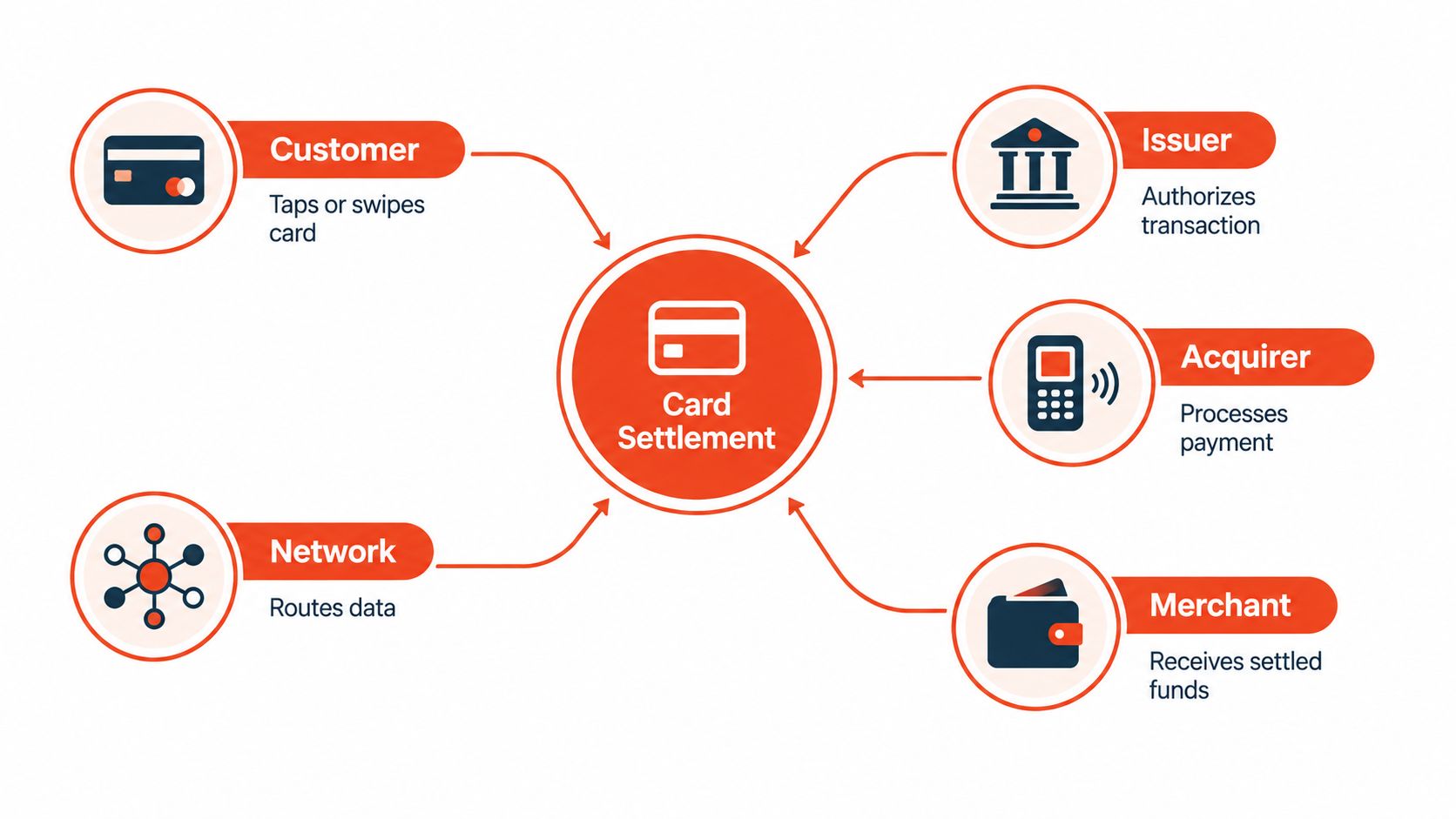
The merchant sells the goods or services and initiates capture through the point-of-sale terminal. The issuer is the customer's bank or card provider, while the acquirer handles payment acceptance for the merchant. The card network connects the parties and carries the transaction instructions between them.
Each party has a different role, so the phrase “the payment went through” can describe only one stage. A customer may see a pending or completed card transaction while the merchant is still waiting for the acquirer's settlement run. A reversal or dispute can also alter the final amount after the initial approval.
Singapore's payment environment handles substantial activity. MAS payment and settlement information records 1,204 million card payment transactions worth SGD 76,894 million in H1 2025, with an average transaction size of SGD 72. POS credit and charge transactions reached 682 million transactions worth SGD 54,540 million in the same dataset. MAS describes Singapore's infrastructure as a high-throughput system built around speed and finality rather than prolonged batching.
A terminal, POS system, acquirer, accounting platform, and bank account must exchange reliable records. Poor integration can leave the merchant with approved transactions that are difficult to match against deposits, especially when refunds, tips, offline transactions, or multiple payment methods appear in the same daily report. Businesses assessing their setup can also review this payment processing integration guide for practical context on how payment systems connect.
Merchants should check the provider's settlement information for the stated crediting schedule, reporting process, and conditions that may apply. The agreement should identify the settlement day, the destination account, the fee treatment, and the process for handling exceptions.
Settlement notation starts with the transaction date, marked as T. The number after the plus sign indicates the expected business-day interval before funds are credited, subject to the provider's cut-off rules and operating calendar.
| Timeline | Definition | Best For |
|---|---|---|
| T+0 | Funds are credited on the transaction day, where the provider and payment method support same-day settlement | Businesses with immediate cash requirements and suitable transaction volumes |
| T+1 | Funds are credited on the next business day | SMEs that need predictable working capital for regular operating expenses |
| T+2 | Funds are credited after two business days | Businesses that can tolerate a longer cycle or receive other commercial benefits |
“T+1” doesn't always mean the merchant sees money the morning after every purchase. A transaction captured after the provider's cut-off may be treated as part of the next processing day. A Friday evening sale may therefore follow a different practical path from a weekday morning sale, particularly when a weekend or public holiday intervenes.
The merchant agreement should answer five questions:
A café with daily ingredient purchases has a different need from a business that invoices customers on a predictable cycle. Retailers, salons, clinics, and gyms often benefit from a settlement schedule that matches payroll, supplier, and replenishment routines. The right question isn't “Which provider is fastest?” It's “Which schedule gives the business usable funds with the least uncertainty?”
Practical rule: Treat a provider's settlement statement as an operating promise with conditions, not as a universal guarantee for every transaction.
A provider may advertise next-business-day settlement while crediting funds after fees, adjustments, and reconciliation items. A different provider may offer a faster route but require separate reporting or more complicated accounting. The headline timeline is only one input into the decision.
Businesses should test the timeline using actual trading patterns. Review a weekday sale, a late-day sale, a weekend sale, a refund, and a payment taken near a public holiday. This exercise reveals the effective cash-flow pattern more accurately than a single T-plus label.
Settlement becomes difficult when merchants treat the deposited amount as a simple copy of terminal sales. The bank credit usually reflects gross transactions less processing charges, refunds, reversals, and other agreed adjustments. A clean process separates the sale date, capture date, settlement date, fee date, and bank-credit date.
Pricing can appear in different structures. Blended pricing combines relevant processing costs into a single merchant rate, making forecasting easier. Interchange-plus pricing separates components, which can provide more detail but demands stronger reporting and accounting discipline. Neither structure is automatically cheaper for every business. A merchant should compare the total effective cost against transaction mix, average ticket size, payment methods, support, and settlement terms.
Singapore SME guidance illustrates why a T-plus label can be misleading. DBS-related Singapore SME processing guidance states that cards and PayLah! are credited on the next working day net of fees, while PayNow fees are deducted separately on the 10th calendar day. This means settlement timing, fee timing, and net-versus-gross crediting are separate accounting events.
A merchant receiving net card proceeds may have less money available at the point of deposit but fewer later deductions. A merchant whose fees are deducted separately may see a larger initial credit followed by a later cash outflow. The second arrangement can look better on the settlement date while creating a less obvious working-capital requirement later.
Merchants comparing offers should request a sample settlement report and clarify:
Reconciliation should happen against the provider's settlement report, not only against the POS sales total.
A merchant that uses a merchant discount rate guide for Singapore can use the terminology as a starting point, but the signed commercial schedule remains decisive. The operational test is simple: staff should be able to explain why a bank credit differs from the day's sales without rebuilding the entire payment history manually.
Fast settlement solves a cash-timing problem, but it can create a cost, reporting, or operational problem if selected without examining the full payment mix. A merchant accepting cards, PayNow, GrabPay, ShopeePay, and cross-border wallets may receive different settlement behaviours across the same POS environment.
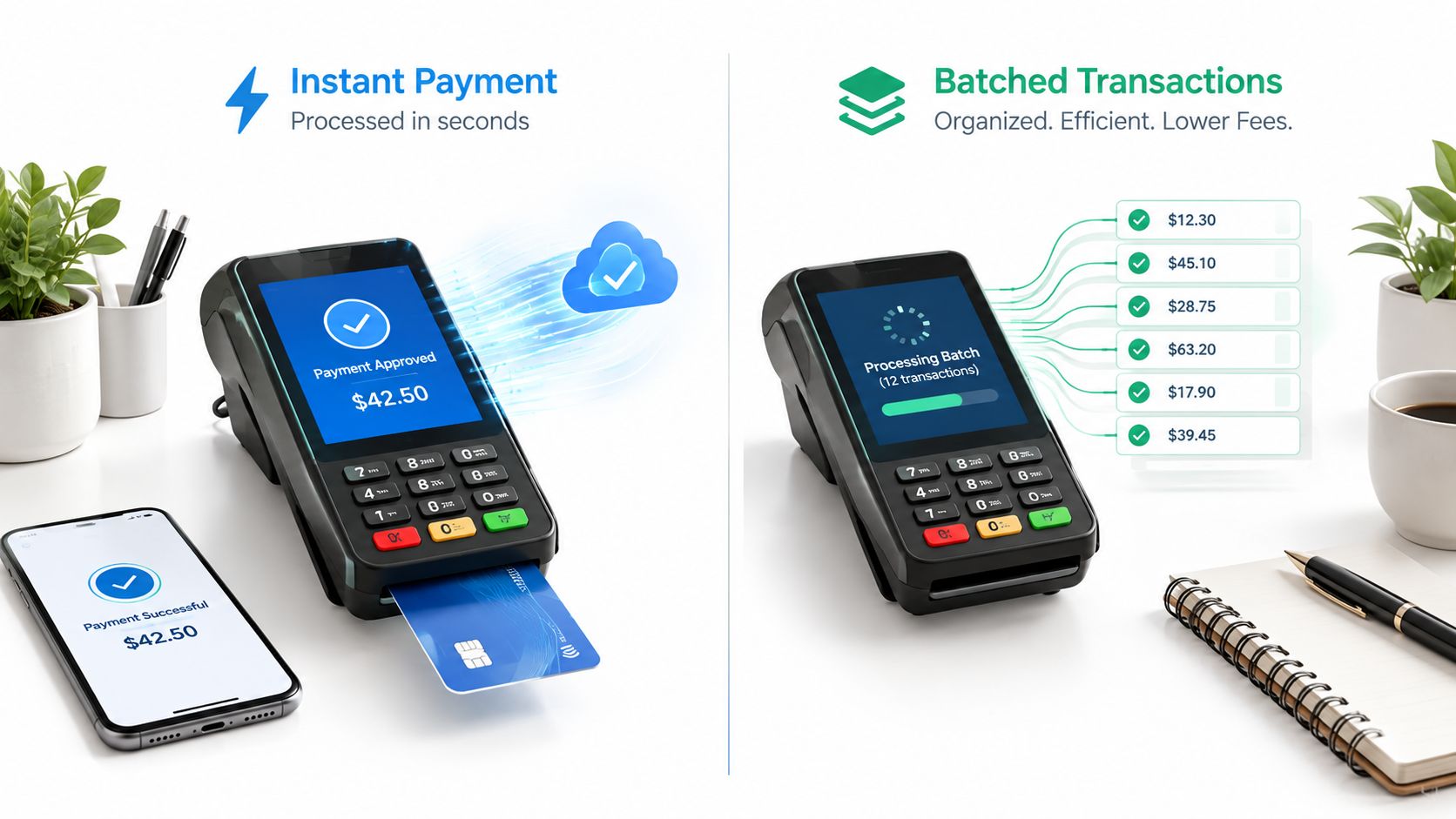
Immediate or accelerated settlement can help a small retailer replenish popular products without using a short-term facility. It can also support an F&B operator managing frequent supplier payments. The benefit is strongest when cash arrives early enough to change a real operating decision.
Batched settlement can be easier to reconcile because transactions are grouped into a predictable cycle. A business with stable cash reserves may prefer a consistent batch structure over a faster option that produces more frequent deposits, more fee entries, or fragmented reports.
The choice also depends on the payment method. Bank-transfer-style payments may reach a merchant faster than traditional card flows, while card and wallet methods can vary by provider and agreement. Singapore payment acceptance guidance describes growing expectations for bundled acceptance across Visa, Mastercard, Amex, PayNow, GrabPay, ShopeePay, and cross-border wallets. It also highlights the practical trade-off: faster settlement isn't automatically better if the setup brings fragmented rails, higher fees, or weaker in-store support.
A useful comparison asks three questions:
A single POS stack can be valuable when it standardises transaction records across payment types. It may reduce the effort required to compare deposits, identify refunds, and trace settlement exceptions, even when the underlying rails still follow different schedules.
The following video gives merchants a visual overview of payment processing flows and can help non-finance teams understand why an approved transaction and a settled deposit aren't identical events.
A practical policy is to choose the fastest settlement that solves a defined cash-flow need without undermining acceptance or reconciliation. Merchants should trial the reporting process before committing. If staff can't identify which batch produced a deposit, speed has not improved control.
A chargeback can remove money from a later settlement even when the original transaction was approved. A reversal can also return funds when a transaction is cancelled, duplicated, expired, or otherwise fails to complete as expected. Merchants need a process that treats these events as part of settlement management, not as isolated customer-service issues.
The first control is evidence. Staff should retain the receipt, order or appointment record, refund history, customer communication, and proof of delivery or service where relevant. The business name shown on the customer's statement should also be recognisable, because an unfamiliar descriptor can lead to a dispute that the merchant could have prevented through clearer transaction identification.
| Strategy | Implementation | Expected Impact |
|---|---|---|
| Clear transaction descriptor | Use a business name customers recognise on statements and receipts | Reduces confusion-driven disputes |
| Consistent refund process | Record the original transaction reference and refund approval | Makes refunds traceable and prevents duplicate handling |
| Proof of fulfilment | Keep delivery, collection, appointment, or service records | Supports evidence submission when a customer disputes receipt |
| Staff verification | Train staff to follow terminal prompts and check unusual transactions | Limits avoidable processing errors |
| Secure acceptance | Use supported terminal security controls and follow provider procedures | Helps reduce unauthorised-use exposure |
When a dispute arrives, the merchant should note the response deadline immediately. The business should then map the disputed amount to the original transaction, check whether a refund or reversal already occurred, and submit only relevant evidence in the format requested by the acquirer.
Dispute discipline matters: A fast response with organised evidence is more useful than a long explanation assembled after the deadline.
Merchants should also separate genuine customer refunds from chargebacks in the ledger. Combining them can make the settlement report appear inconsistent and can hide repeated operational problems, such as unclear cancellation terms or staff entering the wrong transaction amount.
Settlement optimisation starts with the business model, not the terminal. A retailer may need funds for replenishment, while a clinic may care more about appointment completion, refunds, and clean records. A salon may face deposits, cancellations, and repeat customers. A gym may collect recurring membership payments and need reliable exception handling.
Retail shops and boutiques should compare settlement timing with stock purchasing and peak trading periods. The key checks are batch visibility, refund handling, and whether card and wallet deposits can be matched without separate spreadsheets.
Restaurants and cafés need fast checkout and simple end-of-day controls. Managers should confirm that staff can close batches correctly, trace tips or adjustments where applicable, and identify whether a late service period moves into the next settlement run.
Clinics and dental practices should prioritise transaction references, refund controls, and evidence retention. A payment linked clearly to an appointment or treatment record is easier to investigate than an isolated terminal entry.
Beauty salons and spas should document deposits, cancellations, and service completion. The settlement schedule should be tested against no-shows and partial refunds, not only successful appointments.
Gyms and fitness studios should review recurring payment exceptions and account matching. A reliable report is especially important when a customer changes membership status or disputes a charge after a service period.
A provider assessment should include the commercial and operational questions that standard rate comparisons often miss:
Sambapay provides in-store POS acceptance for Singapore SMEs, with major card schemes and selected digital wallets, settlement options from as early as T+1 subject to the merchant agreement, transparent blended pricing, settlement reporting, and local support. Businesses evaluating providers can review its merchant services in Singapore alongside competing offers and compare the actual agreement rather than relying on headline claims.
Security and operational controls belong in the same review. Teams preparing their compliance work can use this 2026 PCI DSS checklist as a reference point, then confirm the provider's responsibilities and the merchant's own obligations.
The strongest settlement setup gives the business predictable usable cash, clear deductions, broad enough acceptance, and reports that staff can reconcile without guesswork. Speed matters, but control determines whether that speed supports growth or moves confusion earlier in the day.
Sambapay helps Singapore SMEs accept in-store card and selected wallet payments, with settlement options from as early as T+1, transparent blended pricing, settlement reporting, and local support. Visit Sambapay to compare a settlement setup that fits the business's payment mix and working-capital needs.