
A customer taps a card. The receipt prints. Staff move to the next person in line.
For many SME owners in Singapore, that looks like the end of the sale. It isn't. Between the customer's tap and the money reaching the business account, a small charge is deducted. That charge is often treated as just “the card fee”, but that shortcut hides an important business question: what does payment acceptance really cost each month?
That's where Merchant Discount Rate, or MDR, matters. For a retail shop, café, clinic, salon, or gym, MDR affects margin on every card transaction. It also affects pricing decisions, cash flow planning, and whether a payment setup still makes sense as customer habits change.
Many merchants start by asking for the lowest percentage. That's understandable. But in Singapore, that headline number doesn't always tell the full story. Fixed fees, blended pricing, card mix, and newer payment options like PayNow can change the actual cost more than expected.
A common Singapore shop-floor moment goes like this. A customer buys a low-ticket item, pays by card, and leaves happy. Later, when the owner reviews settlements, the payout is lower than gross sales. Nothing is wrong. The system has taken the payment acceptance cost before settlement.
That quiet deduction matters more than many SMEs realise.
For a business with healthy margins and larger tickets, card fees may feel manageable. For a business with smaller baskets, frequent transactions, or tight operating costs, the same fee structure can bite harder. That's why the phrase merchant discount rate Singapore shouldn't be treated as banking jargon. It's a daily operating cost.
A merchant may see a quoted rate and think the comparison is done. In practice, the posted rate is only part of the decision. A Singapore SME can face fixed charges as well. One DBS merchant example shows an annual fee of S$240, a terminal subscription of S$38 per month, a one-time setup fee of S$340, and MDR of 2.50% for Visa/Mastercard in that package, as stated in the DBS card payments terms.
That changes the conversation.
A bakery with many small purchases, for example, may feel those fixed fees more sharply than a clinic with fewer but larger transactions. The card rate may be identical on paper, but the total acceptance cost can be very different.
Practical rule: A lower MDR doesn't always mean a lower monthly payment cost.
Part of the confusion comes from how pricing is presented. In Singapore, merchants often receive a single blended MDR rather than itemised pass-through fees. That makes quoting simple, but it can make cost drivers less visible in day-to-day operations.
Busy owners usually aren't asking for a breakdown of network economics. They want clear answers to practical questions:
Those are the questions that shape profitability, not just the headline rate on a brochure.
A customer taps a card for a S$12 lunch set. Your POS records S$12, but the amount that reaches your bank account is slightly lower.
That gap is the merchant discount rate, or MDR.
MDR is the percentage charged on a card transaction for accepting that payment. It is usually taken out before settlement, so the net amount you receive is lower than the sale value. The Monetary Authority of Singapore explains card payments through the roles of the issuer, acquirer, and card network in its e-payments user protection and payment system materials.
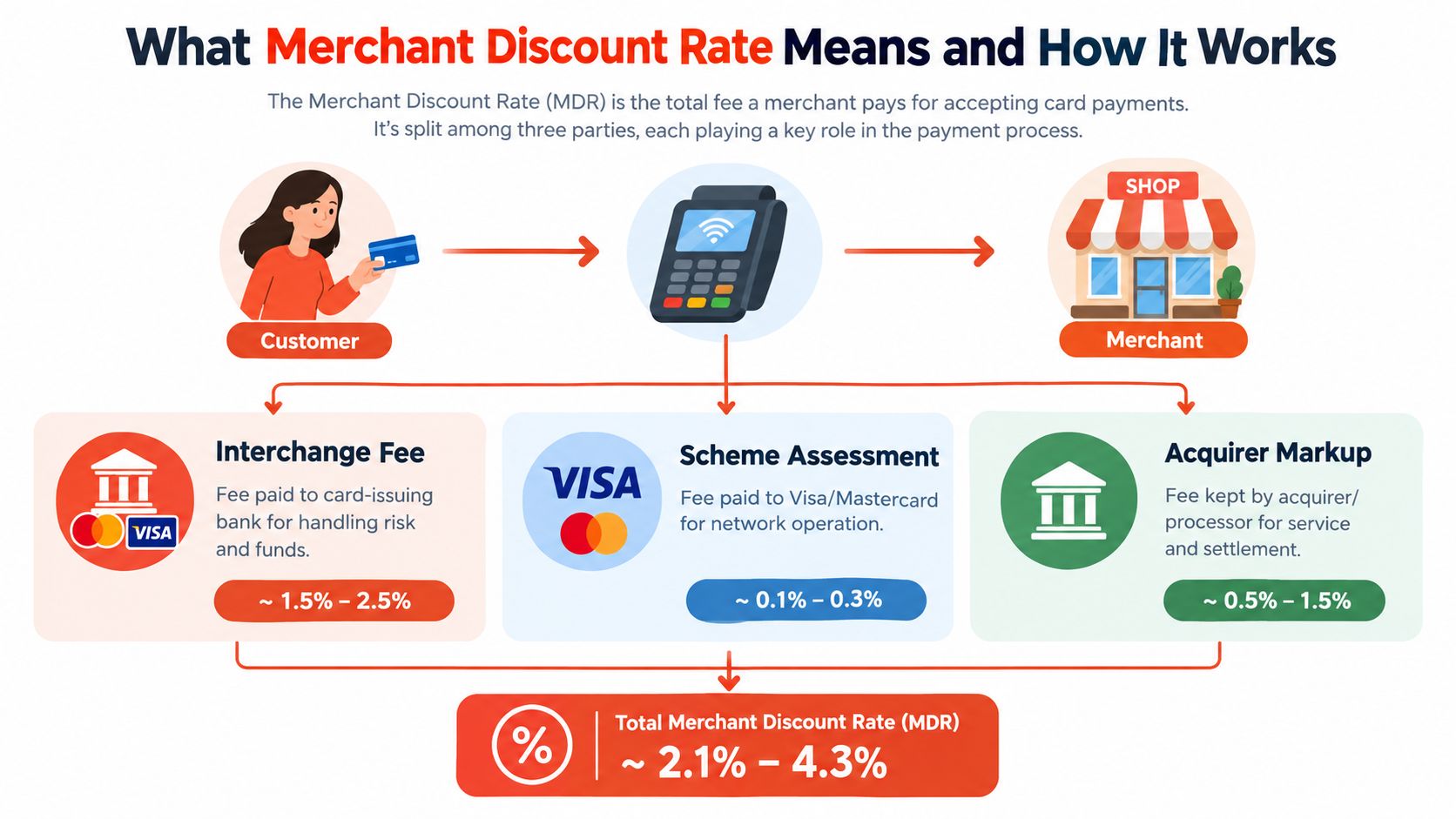
A card payment has a few cost layers behind it. Even if your provider shows one bundled MDR on the quote, that percentage is usually built from three parts commonly described by card acquirers and schemes such as Visa's explanation of merchant and acquiring roles.
Interchange fee
This portion goes to the bank that issued your customer's card. In many card transactions, it is the largest underlying cost.
Card scheme fee
This goes to the card network, such as Visa or Mastercard, for operating the network that routes and authorises the payment.
Acquirer or provider margin
This goes to the acquirer or payment provider that processes the transaction, settles funds to you, and supports the merchant account.
A simple way to read this is: one customer payment, three cost buckets.
Say a minimart processes a S$50 card sale at a 2.5% MDR. The MDR on that transaction is S$1.25, so the merchant receives S$48.75 before any other fixed charges outside MDR.
This is why many owners feel a difference between sales volume and cash received. The POS shows gross sales. The bank payout shows net settlement.
That difference matters more when ticket sizes are small. A bubble tea shop with many low-value card payments can feel payment costs differently from a renovation firm collecting larger deposits, even before monthly terminal or platform fees enter the picture.
Many SME owners stop at the headline percentage. That is understandable, but it can hide the decision.
What matters in practice is total acceptance cost. That includes the MDR structure, any fixed monthly charges, and the mix of payment methods your customers use. A 2.2% blended card rate may look simple, but the monthly outcome can still be higher than a setup with clearer pass-through pricing or more PayNow usage on smaller tickets.
That is also why it helps to review your credit card payment acceptance options with actual transaction patterns in hand, especially average ticket size and the share of domestic versus overseas cards.
Two merchants can both hear “your MDR is around 2%” and still pay different effective costs.
One reason is the pricing model. In a blended model, the provider wraps different underlying card costs into one easier-to-read rate. In an interchange-plus model, the underlying interchange and scheme costs are passed through, with the provider adding its own markup separately. The first is simpler to read. The second can make cost drivers easier to spot on statements.
For a Singapore SME, the practical question is not only “What is my MDR?” It is also “Which customers are paying by which method, at what ticket size, and how does that change my total cost after settlement?”
That question becomes even more useful when you compare cards with lower-cost account-to-account options such as PayNow for smaller everyday transactions.
A neighbourhood bubble tea shop and a clinic near Orchard can both hear “around 2%” and still end the month with very different payment costs.
The reason is simple. MDR is not one flat market price. It changes with the card used, where the card was issued, and the channel the customer pays through. In practice, domestic debit usually sits at the lower end, while international credit cards are often at the higher end. For an SME owner, that difference matters more than the headline quote because your actual bill comes from the mix of transactions passing through your counter.
| Card Type and Channel | Illustrative MDR Range | Why It Varies |
|---|---|---|
| Domestic debit, in-store | Lower end of common market ranges | Lower underlying card cost in many cases |
| Domestic consumer card, mixed acceptance | Mid-range in many SME quotes | Depends on provider pricing method and merchant profile |
| International credit card | Higher end of common market ranges | Cross-border and card-type costs usually raise the fee |
| Mixed card portfolio across one shop | Depends on actual customer usage | Final outcome follows your card mix, not the brochure headline |
A merchant does not process “card sales” as one bucket. A merchant processes many small buckets that are priced differently.
Here is a simple shop-floor example. A minimart may see lots of low-value local tap payments. A dental clinic may see fewer transactions, but some are larger and more likely to be paid with credit cards. The quoted MDR can look similar at the start. The monthly cost can still come out differently because one business is carrying more higher-cost card transactions.
This is also why card acceptance should be compared alongside other payment methods. Many SMEs review cards together with digital wallet and e-wallet payment options in Singapore because customer choice at checkout changes the total cost of acceptance, especially for smaller tickets.
The same card can cost differently depending on how the payment happens.
In-store tap payments are usually the easiest reference point for retailers and F&B operators. Once a business accepts payments through other channels, the provider may price them differently based on risk, processing setup, and how the transaction is handled operationally. The practical lesson is straightforward. A printed rate range is only a starting point.
What SME owners should watch is effective cost by transaction type. If many purchases are small, a lower-cost method such as PayNow can make more sense than pushing every payment onto cards. If ticket sizes are larger, card acceptance may remain perfectly reasonable even at a higher percentage because customer preference and conversion still matter.
A useful way to read any MDR table is to ask two questions. Which customers are paying by debit, local credit, or overseas cards? And for each group, is the average ticket size large enough that the convenience of card acceptance justifies the cost?
A cafe owner in Singapore might hear two offers for card acceptance and assume the lower headline rate is automatically cheaper. It often is not. What matters is the total cost of taking payment across the mix of cards and order sizes you see each day.
Most SMEs will be offered one of two pricing models. Blended pricing gives you one all-in percentage. Interchange-plus separates the underlying card costs from the provider's own markup.
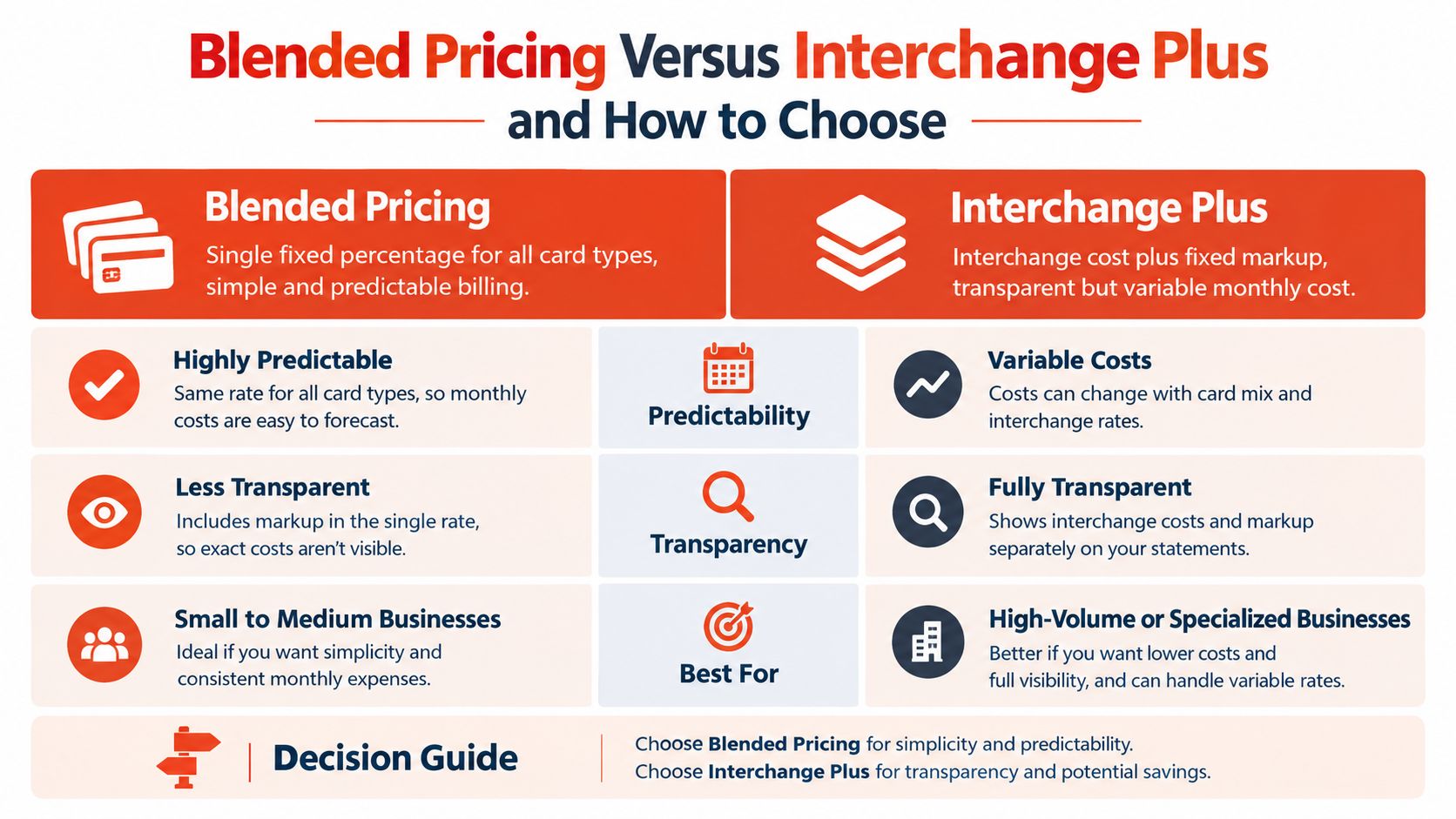
Blended pricing works like a buffet price. You do not see the cost of each item on the plate. You just know the final price is simple.
That simplicity helps busy shop owners. You can estimate payment costs quickly, train staff without explaining fee layers, and read statements without sorting through technical line items. For many retail and F&B businesses, that is a practical benefit.
The trade-off is less visibility. If more customers start paying with higher-cost cards, your all-in rate may still look neat on paper, but you may not know whether the quote still fits your business well.
Interchange-plus is closer to an itemised bill. You can see the card-related cost components, then the processor's margin on top.
That makes it easier to spot what is driving costs. A merchant with a changing card mix, growing volume, or a finance team that reviews statements closely may prefer that detail. The downside is that monthly cost can move around more, because the final percentage depends on the actual cards used during that period.
A short explainer can help visualise that trade-off:
This is the part many SME owners miss.
A blended rate can look fair if your customers mostly use local debit or local consumer credit cards. The same blended rate can feel expensive if your average basket is small and many customers could have used PayNow instead. On the other hand, interchange-plus can look more attractive for a business with larger tickets, because a clearer view of underlying costs makes it easier to judge whether card acceptance is still worth it for conversion and customer convenience.
A simple shop-floor example helps. A neighbourhood bakery selling low-value items all day may care more about total acceptance cost per transaction and may compare cards against PayNow more closely. A furniture store with fewer but higher-value sales may accept a higher card cost more comfortably, because the sale size gives more room for that percentage-based fee.
The better choice depends on how you want to control payment costs, not just how low the quoted percentage looks.
A useful question to ask providers is: “Based on my average transaction size and customer payment mix, what does my total acceptance cost look like under each model?” That question usually leads to a better decision than comparing headline MDR alone.
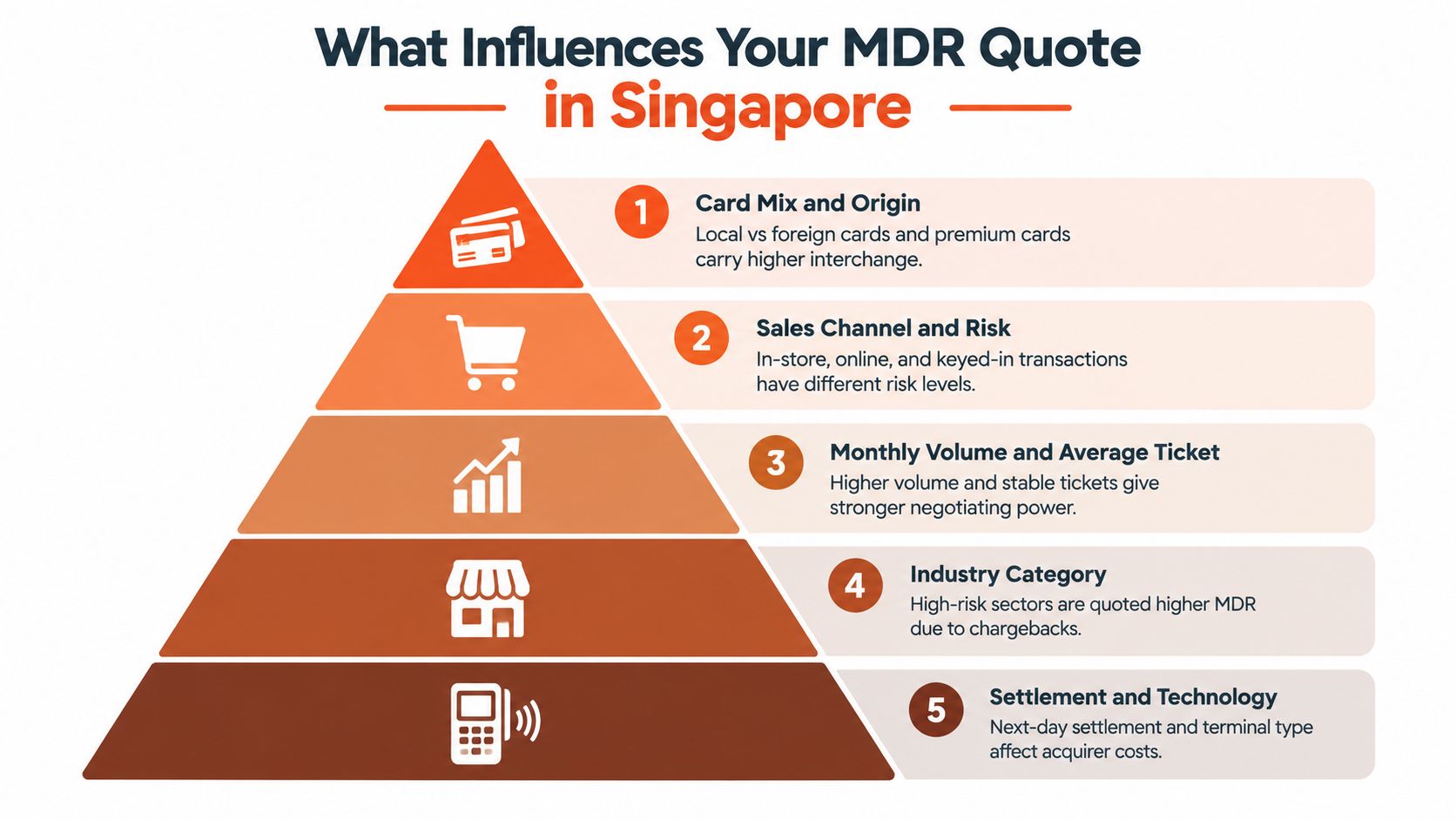
Two businesses can stand on the same street, use similar terminals, and still receive different MDR quotes. That's because providers aren't pricing only the machine on the counter. They're pricing the payment pattern behind it.
This is often the biggest practical driver.
A merchant that mostly accepts local debit and domestic consumer cards will usually look different from one that regularly serves overseas customers using international credit cards. The terminal may be the same. The cost base isn't.
A tourist-facing beauty business and a neighbourhood provision shop can therefore land on different effective outcomes even if both were first shown the same headline pitch.
How the payment is taken also matters.
A straightforward in-store tap tends to be easier operationally than setups that involve more manual handling or more dispute exposure. Providers look at the full transaction environment, not just the merchant name.
Providers also care about scale and pattern.
A business with steady volume and a stable average basket is easier to price than one with irregular sales swings. Volume can improve negotiating position, but average ticket matters too. A merchant with many small sales may feel fixed fees more strongly, while a merchant with larger tickets may focus more on percentage-based charges.
The same payment provider may quote a salon, dental clinic, gym, and restaurant differently because each business behaves differently at the point of sale and in post-sale servicing.
A clinic may process fewer but larger transactions. A café may process many quick taps with smaller values. A gym may have different billing and cancellation patterns. The provider is evaluating workflow as much as category.
Settlement speed, hardware setup, and support model can also shape the quote.
Some merchants prioritise faster access to funds. Others care more about minimal hardware complexity, integrated reporting, or local support when terminals fail during peak hours. Those preferences may affect the commercial package even if the MDR headline looks similar.
The quote reflects a merchant's payment behaviour, not just the merchant's industry label.
The strongest cost-saving move usually isn't chasing the lowest advertised MDR. It's managing the total acceptance cost with a clearer view of customer behaviour, fixed charges, and payment mix.
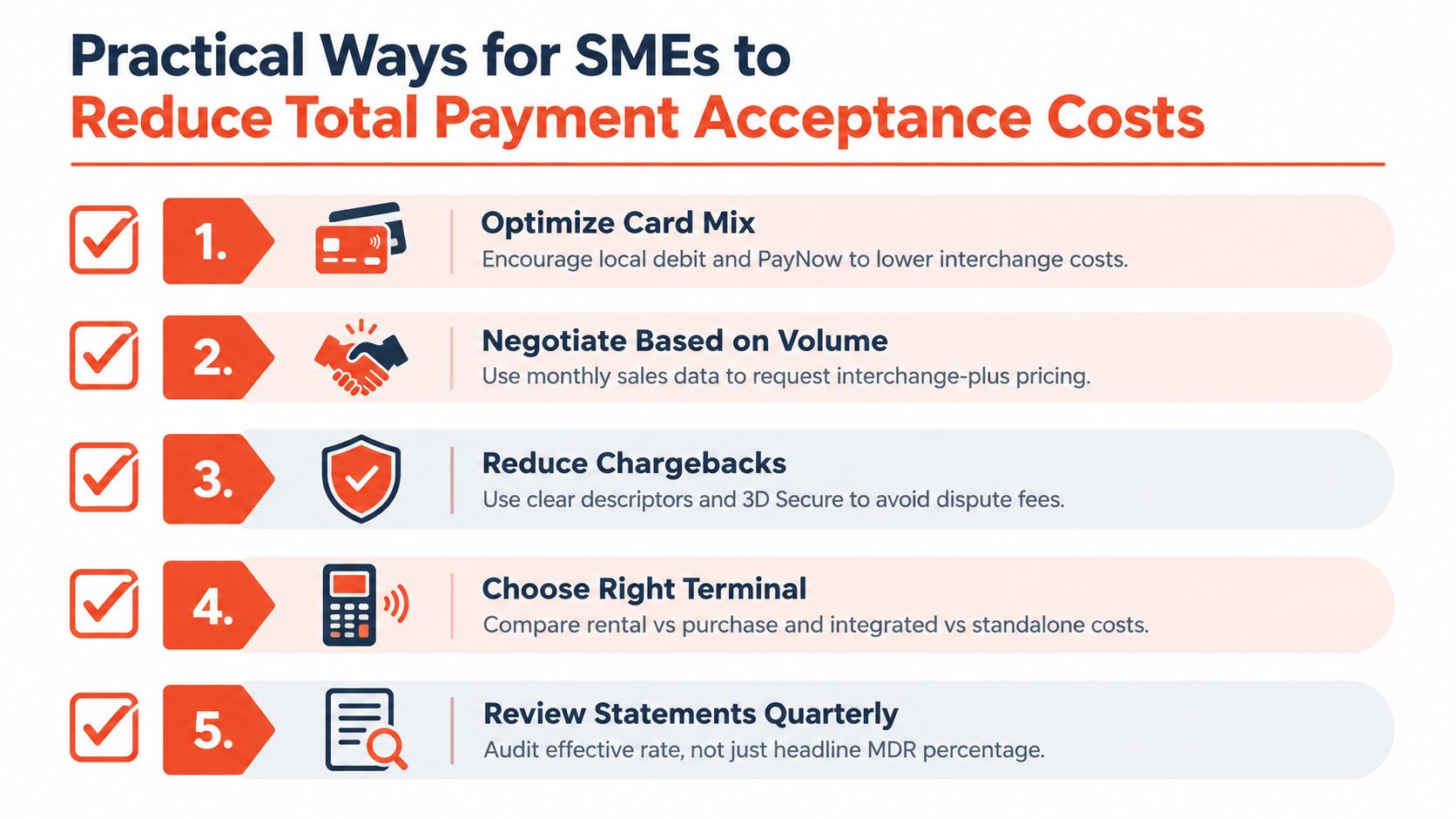
A merchant should ask for the full commercial picture in writing.
That means MDR, setup charges, annual fees, terminal-related charges, and any subscription components. Fixed costs can outweigh a “cheaper” rate for lower-volume businesses.
A practical review checklist helps:
Some merchants assume steering customers is awkward. In reality, many Singapore businesses already guide payment behaviour through counter signage, queue design, and payment prompts.
Cards are still important because customers expect convenience. But SMEs should also compare card acceptance against bank-transfer-style methods where appropriate. This has become more relevant in Singapore because policy changes are shifting the economics of non-card rails too.
Singapore's Hawkers Go Digital programme was extended in 2024 with a stated MDR subsidy of 0.5% for stallholders on up to the first S$20,000 of e-payment transactions per month, according to Enterprise Singapore's announcement. The same source notes that a government post in 2025 flagged that from 2026 onwards some businesses will have to pay S$0.20 per PayNow transaction.
That creates a more practical comparison than many merchants have seen before. The question isn't “cards or PayNow?” The question is which method costs less at the business's typical basket size.
Merchants often negotiate too early and with too little detail.
A provider can only quote accurately when it understands volume, average ticket, business type, and customer mix. A merchant that brings actual payment data into the discussion is in a stronger position than one asking only for “best rate”.
One market option in Singapore is Sambapay, which offers in-store card acceptance with transparent blended pricing and no monthly terminal rental for standard setups, alongside local support and settlement options from as early as T+1 depending on the agreement.
By the time a merchant compares quotes seriously, the MDR percentage is only one part of the decision. The better question is what that quote feels like after a full month of trading.
A provider with a simple statement format can save admin time. A provider with clear onboarding can reduce disruption during switching. A provider with predictable settlement can support stock purchases, payroll timing, and supplier planning.
That's why the final assessment should include:
For merchants reviewing merchant services in Singapore, the most useful comparison is usually side by side: quoted MDR, fixed fees, hardware terms, settlement timing, payment methods accepted, and support model.
Singapore's payment mix is still evolving. Cards remain important for customer convenience, but businesses are also weighing PayNow and other low-cost rails differently as subsidy and transaction-fee conditions change.
A hawker, boutique, salon, and dental clinic may all accept digital payments, yet the most economical mix won't be the same across all four. Ticket size, customer profile, and operational needs shape the answer more than any single advertised rate.
The practical takeaway is simple. A merchant shouldn't ask only, “What's the MDR?” The merchant should ask, “What will this whole setup cost each month, how quickly are funds settled, and which payment mix suits this business best?”
Sambapay provides in-store card payment acceptance for Singapore SMEs, with modern PAX Android POS terminals, transparent blended pricing, and settlement options from as early as T+1 depending on the merchant agreement. For merchants reviewing merchant discount rate Singapore options, that makes it easier to compare headline MDR against the total acceptance cost that affects margin and cash flow. To see whether the setup fits a shop, clinic, salon, café, or gym, visit Sambapay.