

A shop owner in Singapore usually spends more time arguing over rent than over the payment contract sitting in the same signing pile. That's backwards. The lease decides occupancy. The card acceptance agreement decides how money arrives, when it arrives, what gets clawed back, and how painful it is to leave.
Take a familiar scenario. A café owner signs because the sales pitch sounds simple: fast payouts, one terminal, easy setup. Later, the contract starts doing the work. A chargeback lands. A monthly minimum appears. A notice period suddenly matters because the business wants to switch providers before the next festive rush.
That's why terms and conditions deserve a hard read, especially for SMEs using POS terminals, card acquiring, PayNow, and digital wallets. For owners reviewing contracts and trying to improve cash flow with payment terms, the right place to start isn't a marketing brochure. It's the merchant agreement and the clauses that control settlement, fees, liability, refunds, and exit.
A lease mostly tells a merchant what happens to the premises. A payment contract tells that merchant what happens to daily revenue. That difference is easy to miss because card acceptance paperwork often arrives as standard template noise, bundled with onboarding forms and terminal setup instructions.
For a retail shop, clinic, salon, or café, that contract controls several operational realities:
Practical rule: If the contract affects daily takings, it deserves more attention than the fit-out quotation.
Owners often treat payment terms as admin. That's a mistake. A processor can hold back funds, deduct fees, reject a chargeback defence, or enforce a notice period while the business is trying to migrate to a new terminal setup. None of that shows up in the glossy pitch deck.
The smart approach is blunt. Read the parts that move money and create liability. Ignore decorative legal padding unless it changes an operational outcome. The useful review lens is simple: what gets paid, when it gets paid, what can be deducted, what can be disputed, and how the relationship ends.
Terms and conditions are the written rules of the commercial relationship. They set out what each side must do, what each side can restrict, and what happens when something goes wrong. That's all. No mystery, no legal theatre.
A practical way to think about them is as a rulebook. The merchant doesn't need a lecture on contract theory. The merchant needs to know which rulebook is binding when a payment fails, a refund is delayed, or a provider claims a fee is standard.
A Singapore SME usually runs into three different sets of terms:
Customer-facing terms and conditions
These appear at checkout, on invoices, booking pages, or refund notices. They govern the merchant's relationship with its own customers.
Merchant agreement with the acquirer or payment processor
This is the big one. It controls onboarding, processing, settlement, fees, reserves, chargebacks, terminal use, and termination.
Card scheme rules
Visa, Mastercard, and other scheme rules sit above the merchant agreement in practical effect. The processor usually passes those obligations down to the merchant through the contract.
For readers who want a simple plain-English baseline, this short guide on legal terms explained is useful as a vocabulary refresher. But for a Singapore merchant signing a POS or acquiring contract, the second and third documents are the ones that deserve scrutiny because they determine how money moves and where liability lands.
The customer refund sign at the till matters less than the acquiring clause that says a processor can debit the merchant for a chargeback. The checkout wording matters less than the settlement clause that says payouts are subject to verification, batching rules, or reserve rights.
Most merchants don't lose money because a contract looked scary. They lose money because a routine clause was treated as harmless boilerplate.
That's the mindset shift. Terms and conditions aren't there to decorate the file. They allocate control.
The easiest way to review a payment agreement is by commercial purpose, not by legal label. Some clauses tell the merchant how money is earned and paid. Others shift risk. The rest govern the ongoing relationship and the exit.
These clauses decide whether the agreement works for the business day to day.
| Clause | Commercial Purpose | Typical SME Negotiation |
|---|---|---|
| Fees | Sets transaction pricing and non-transaction charges | Ask for fully itemised pricing and removal of vague ancillary fees |
| Settlement timing | States when processed funds are paid out | Confirm whether settlement can be as early as T+1 or whether longer cycles apply |
| Chargeback responsibility | Allocates who bears losses and response duties on disputed transactions | Narrow merchant liability to cases tied to actual merchant conduct or missing evidence |
| Refund mechanics | Controls how refunds are initiated, timed, and charged | Ask for simple refund workflows and clarity on whether refund fees apply |
| Minimum monthly volumes | Protects provider economics where merchants process little | Remove volume commitments if turnover fluctuates seasonally |
On fees, owners should always ask whether pricing is blended or based on a layered structure. A blended model is easier to audit. A layered model can still be fair, but it needs sharper review because cost often hides inside categories, pass-through items, or scheme conditions.
Settlement timing matters because stock suppliers, payroll, and rent don't wait. For merchants comparing providers, merchant services in Singapore are easier to compare when the quote clearly states settlement timing, processing rates, and any conditions tied to the payout schedule.
These clauses decide who absorbs the pain when something goes wrong.
A clause can be standard and still be bad for the merchant. “Standard” only means it appears often.
These clauses become important when the relationship strains or ends.
| Clause | Commercial Purpose | Typical SME Negotiation |
|---|---|---|
| Termination notice | Sets the notice required to end the agreement | Push for shorter notice and no early exit cost |
| Data ownership | Clarifies who controls transaction records and exports | Require access to usable transaction history on exit |
| Governing law | Determines which law applies and where disputes are handled | For Singapore SMEs, local law and local dispute handling are usually cleaner |
For many merchants, termination gets ignored until the business wants to switch. That's when the hidden pain starts. Mastercard's Singapore merchant terms state that an agreement may continue for six months after termination or expiry of participation in enrolled programmes in that context, which shows why a “termination” date doesn't always mean obligations end immediately (Mastercard Singapore merchant terms).
A payment contract in Singapore isn't enforceable just because someone signed it. Local law puts limits around misleading conduct, unfair terms, data handling, and the way exclusion clauses are drafted.
| Statute | What it regulates | Practical consequence for the merchant |
|---|---|---|
| Payment Services Act 2019 | Payment service licensing and regulated payment activity | Merchants should confirm the provider's role, fund flow structure, and operational responsibilities before signing |
| Personal Data Protection Act 2012 | Collection, use, disclosure, and retention of personal data | Merchants need clear notices, limited retention, and a defined process for transaction records |
| Unfair Contract Terms Act | Limits exclusion and limitation clauses in certain contracts | Merchants shouldn't assume a broad liability exclusion will automatically stand |
| Consumer Protection Fair Trading Act | Prohibits misleading or exploitative unfair practices toward consumers | Refund, fee, and service wording shown to customers must be plain and non-misleading |
The key statutory guardrail on exclusion clauses is the Unfair Contract Terms Act. It was enacted to limit how far liability for breach of contract, negligence, or other breach of duty can be excluded through contract wording. The current revised edition on Singapore Statutes Online shows amendments incorporated up to 1 December 2021 and an operative date of 31 December 2021, and section 3 focuses on situations where one party deals on the other party's written standard terms of business, while section 11 applies a reasonableness test (Singapore UCTA).
That matters because SME payment contracts are usually standard form. The provider drafts. The merchant signs. A clause that tries to wipe out too much liability isn't automatically safe just because it sits in small print.
Singapore's consumer-protection regime also reaches beyond classic consumer sales. The unfair-contract framework described in this summary captures certain small-business agreements entered into, renewed, or varied after 12 November 2016, where at least one party employs fewer than 20 people and the upfront price is no more than S$300,000, or S$1 million for contracts running longer than 12 months. The same framework says an unfair term must create a significant imbalance, not be reasonably necessary to protect legitimate interests, and cause detriment if relied on (Singapore unfair-contract summary).
Separately, the Consumer Protection (Fair Trading) Act makes it an unfair practice for a supplier to do or say anything that may mislead a consumer, make a false claim, or exploit a consumer's inability to understand the transaction, and any contract term inconsistent with the Act is void to that extent (Consumer Protection Fair Trading Act).
That has a direct takeaway. If a merchant's terms say “no refunds” or “surcharges may apply” but the actual practice is inconsistent, unclear, or misleading, the problem isn't just customer frustration. It's enforceability.
Two contracts can look similar on first read and behave very differently in real trade. That's why merchants should compare draft against draft, not headline against headline.
A flat merchant discount rate is easier to understand. A layered structure may be cheaper for some baskets, but only if the merchant checks how the transaction mix behaves in real life.
For a S$12 lunch set, a flat 1.7 percent MDR and a 1.45 percent plus 10 cent rate don't land the same way. The first produces a simple variable fee. The second combines a lower percentage with a fixed component, which can feel lighter on larger tickets but heavier on small ones. That's exactly why cafés and bakeries should model likely basket sizes before accepting a “lower rate” claim.
One termination clause can allow a clean exit. Another can trap a merchant just when the business needs flexibility.
A short notice period with no exit fee gives the owner room to move if service degrades or pricing changes. A long lock-in with an exit charge turns switching into a budget event, not an operational choice.
Refund terms affect reputation as much as administration. A quick refund route keeps the front line calm. A slow manual process creates customer friction, then increases the odds of a cardholder escalating to a formal dispute.
| Clause type | Provider A standard | Provider B favourable to merchant |
|---|---|---|
| Fees | Flat MDR across schemes. Easy to reconcile, less flexible on mixed ticket sizes | Lower percentage plus fixed charge. Can suit higher tickets but needs basket-size review |
| Termination | Long lock-in, early exit charge, narrow notice window | Short notice, no early termination fee, cleaner switch path |
| Refunds | Manual refund handling, more staff steps, slower customer resolution | Fast operational process, clearer responsibility, easier evidence trail for disputes |
A lower headline rate isn't better if the ticket profile, refund flow, and exit terms make the contract more expensive in practice.
The point isn't that one structure is always right. The point is that merchants should test each clause against actual business behaviour. A salon with larger average tickets may tolerate a different fee structure from a kopi stall. A clinic may prioritise record-keeping and dispute evidence over marginal pricing differences. The same printed clause can produce very different commercial results.
Payment data, privacy compliance, and dispute handling shouldn't be reviewed as separate checklists. In real operations, they form one workflow. The till captures information. The provider processes it. The merchant stores some records. A dispute later depends on whether the right data was collected and kept properly.
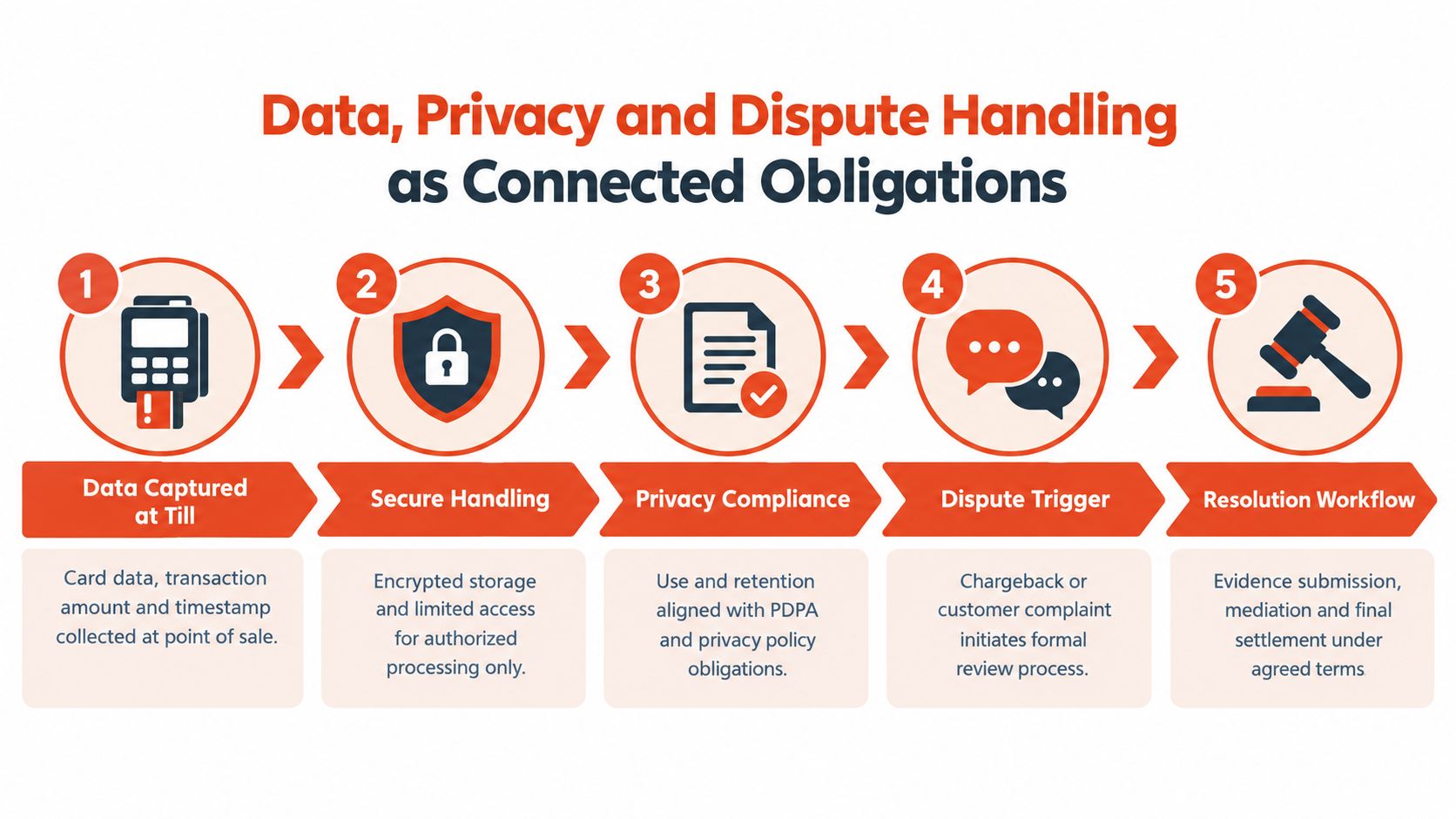
A POS environment usually records transaction details such as amount, time, approval outcome, and reference information tied to the sale. Depending on the setup, the merchant may also hold invoice data, customer contact details, booking records, or internal notes. The payment provider and scheme then process the transaction along their own rails.
Where tokenisation and provider-side controls reduce direct merchant exposure, that's useful. But it doesn't remove the merchant's responsibility to understand what its own systems still collect and retain. A merchant privacy notice and internal process should match reality, not assumptions. A useful reference point for the kind of disclosures businesses should review sits in a sample privacy policy framework.
A chargeback doesn't begin as a legal debate. It begins as an operational scramble for records. If the merchant can't produce the receipt trail, service evidence, booking confirmation, or refund history within the required response window, the defence weakens immediately.
That means retention has to be deliberate. Keep what is needed for legitimate business and dispute purposes. Don't keep broad stores of transaction-linked personal data indefinitely just because storage is cheap.
Good dispute handling starts long before the dispute. It starts with clean records and disciplined retention.
A merchant that treats privacy as a website policy and disputes as an operations issue is splitting one workflow into silos. That usually fails under pressure.
A switch sounds simple when the new terminal is already on the counter. The hard part sits in the old contract.
Consider a 20-seat kopitiam moving off a legacy card processor to a newer setup that also accepts PayNow, GrabPay, and Atome. The owner wants the new system live quickly because staff are tired of juggling separate devices and slow support responses. The migration still depends on paperwork, final settlements, old disputes, and notice timing.
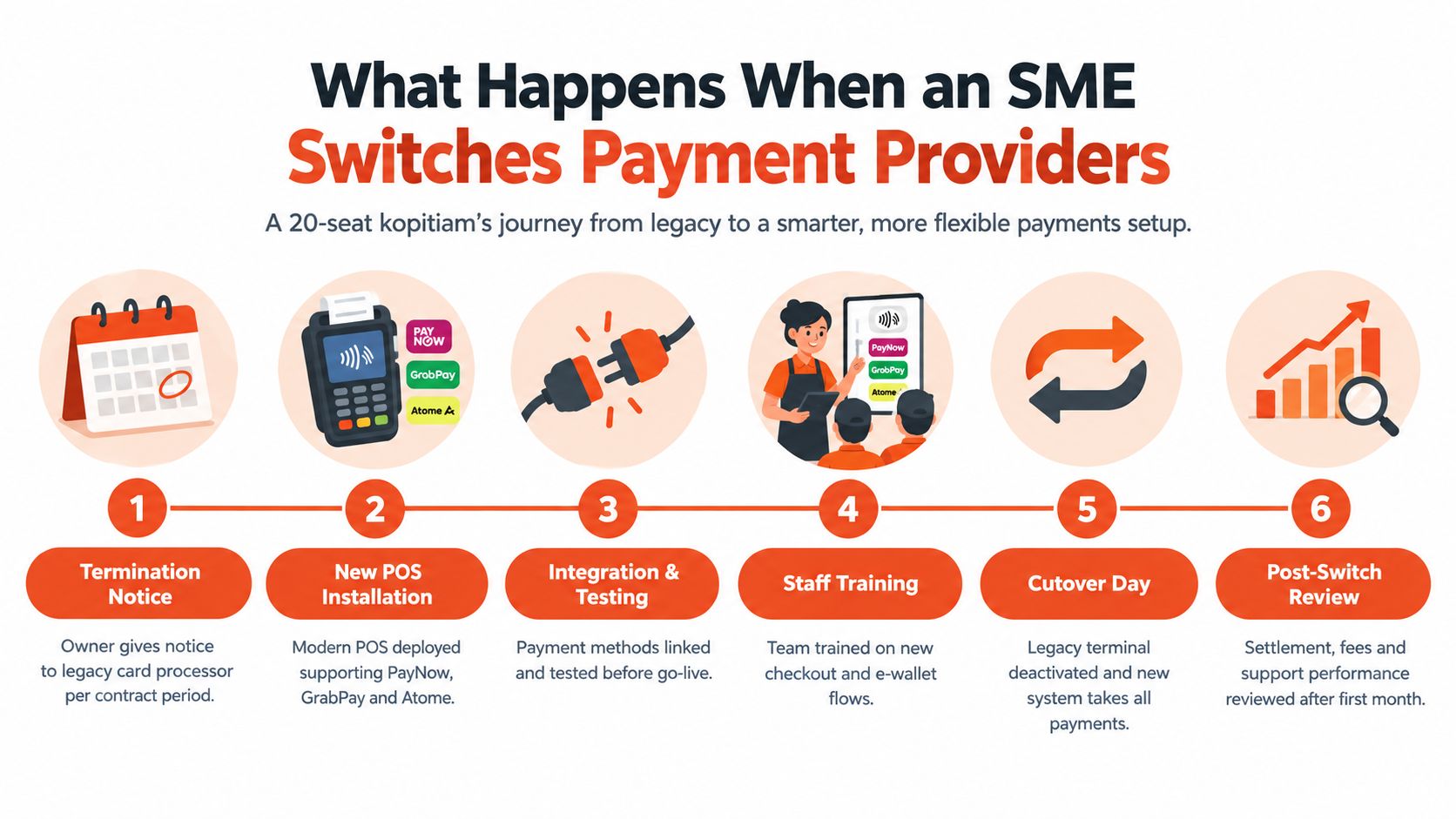
The first issue is termination notice. If the owner gives notice late, the old provider may continue billing through the notice period or enforce an exit charge. Merchants often spot this only after the deduction appears in the settlement account.
The second issue is final batching and settlement. Transactions processed on the old merchant ID may still settle after the new terminal is installed. Refunds and chargebacks linked to those earlier sales can also continue under the old arrangement. So even after the hardware swap, the old provider can remain relevant for weeks or longer.
Many merchants run both terminals briefly to avoid downtime. That's sensible operationally, but it creates admin confusion if staff don't know which sales route to use, where to pull receipts from, and which processor handles a later refund request.
A guided migration plan helps. For merchants reviewing practical cutover steps, this checklist on how to switch a POS solution for a store is useful because it frames termination, testing, training, and post-switch review as one sequence.
One contractual detail matters more than most owners expect: early termination fee versus waiver. A provider may verbally say the move is manageable, while the signed terms still allow deductions on exit. That's why the waiver, if any, should appear in writing inside the signed contract pack or an approved variation.
A clean switch depends less on the new terminal than on whether the old terms and conditions allow an orderly exit.
Most merchants don't need a lawyer for every routine review. They need a sharper checklist and the discipline to ask direct questions before signing.
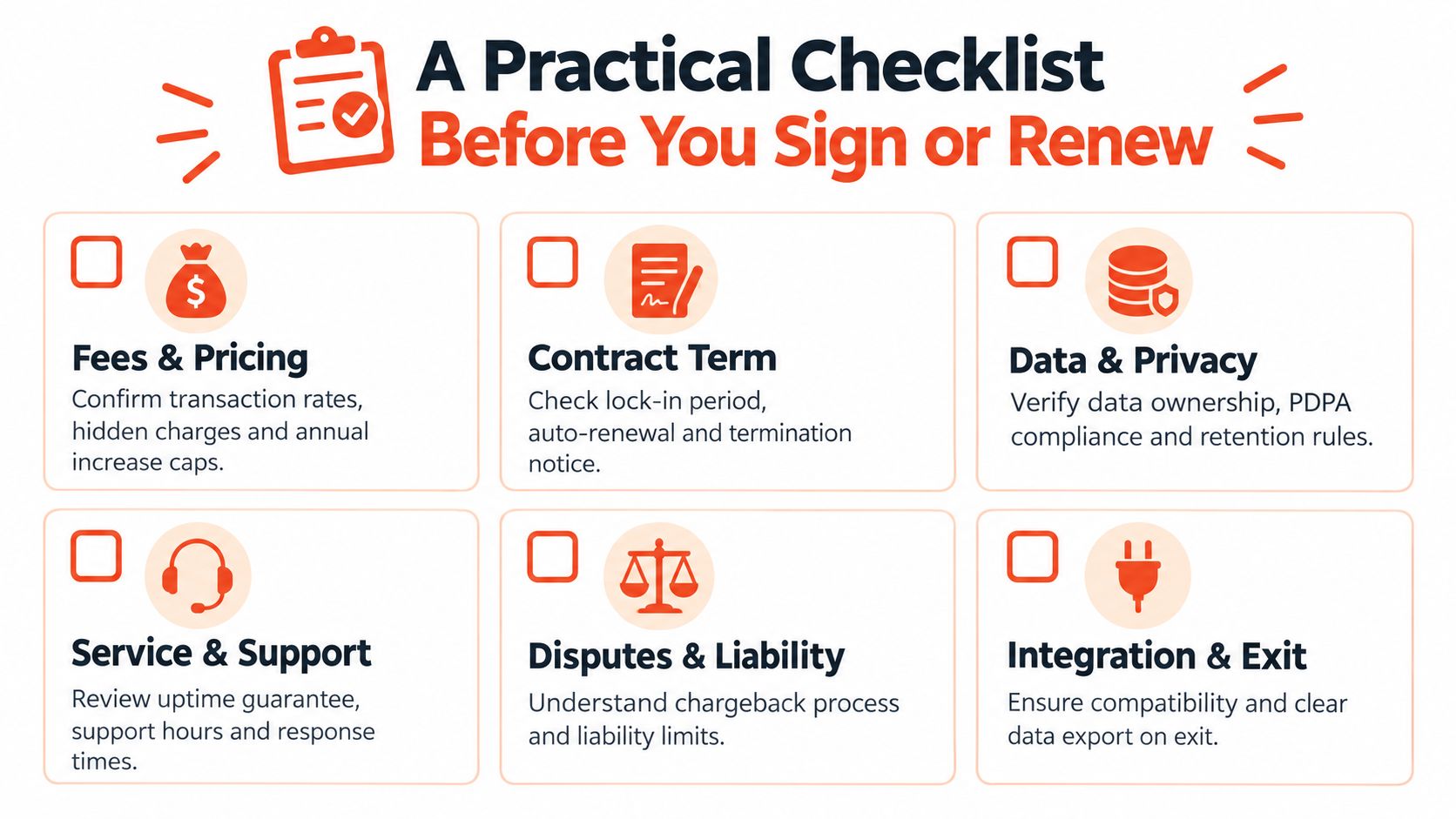
Fees and pricing
Ask: What exactly appears on the monthly statement apart from the transaction rate?
Red flag: “Other applicable charges may be imposed from time to time.”
Settlement timing
Ask: When are funds typically settled, and what events allow delay or withholding?
Red flag: “Settlement timelines are indicative only and subject to internal review.”
Chargeback liability
Ask: In which situations can the provider debit the merchant without prior agreement?
Red flag: “The merchant shall remain fully liable for all disputed transactions.”
Refund handling
Ask: How are refunds processed operationally, and are any fees charged on refunded transactions?
Red flag: “Refunds may be handled at the provider's sole discretion.”
Data and PDPA obligations
Ask: What transaction and customer data does the merchant retain, and how can it be exported on exit?
Red flag: “All data generated through the service belongs exclusively to the provider.”
Termination and exit cost
Ask: What notice applies, what survives termination, and is there any early exit fee?
Red flag: “Termination does not affect continuing obligations under related programmes.”
Dispute escalation
Ask: If reconciliation or liability is disputed, what is the escalation route and timeframe?
Red flag: “The provider's records shall be final and conclusive.”
Force majeure and service interruption
Ask: If the system fails, what support steps and workarounds apply?
Red flag: “The provider bears no responsibility for interruption of any duration.”
Store the final signed version of the terms and conditions together with the merchant application form, pricing schedule, and any later email variations that were expressly approved. Date everything. Version everything. If a sales promise matters, it should appear in the signed documents.
A merchant comparing providers should also look for straightforward commercial terms where possible. One example in the Singapore market is Sambapay, which offers in-store card acceptance, blended pricing, settlement from as early as T+1 depending on the merchant agreement, and states that its contracts have no cancellation fees and no binding period based on the publisher information provided here. That sort of clarity is easier to review than a contract built on hidden layers.
The right habit is simple. If a provider can't explain a clause in plain English before signing, that clause probably deserves harder scrutiny.
Sambapay provides Singapore SMEs with in-store card acceptance, modern Android POS terminals, selected wallet acceptance, and practical support around onboarding and migration. For merchants reviewing terms and conditions, the useful part is simple commercial clarity around pricing, settlement, and exit. Visit Sambapay if a business wants a local option to compare against its current payment contract before signing or renewing.