
A customer taps a POSB debit card at a hawker stall, buys groceries at a supermarket, or settles a clinic bill without taking out cash. The payment feels instant, but several practical questions sit behind that simple tap. Which account pays? Why might a transaction be declined? What happens when the card is used overseas, linked to a mobile wallet, or presented at a merchant with an older terminal?
POSB debit cards remain familiar tools for everyday spending in Singapore. The PAssion POSB Debit Card, launched in 2013, was described by DBS as the first partnership between a Singapore bank and the People's Association to create a community debit card with TransitLink EZ-Link functionality, retail rewards, and no income requirement. DBS says it has grown to more than 2 million cardholders, making it a notable mass-market debit-card milestone in Singapore's banking history. DBS explains the PAssion POSB Debit Card's history and features.
For consumers, the important question isn't whether a card offers rebates. It's whether the card works smoothly for common purchases, stays within a sensible spending limit, and avoids unnecessary charges. For shops, cafés, clinics, and other SMEs, the question is whether their terminal can accept the cards customers carry.
At checkout, a POSB debit card looks much like any other bank card. A customer taps, inserts, or swipes it, waits for approval, and leaves with the purchase recorded. The difference lies in where the money comes from. A debit transaction normally draws against funds in the customer's linked bank account rather than creating a monthly borrowing balance.
That distinction matters during ordinary Singapore spending. A small purchase at a neighbourhood shop, a supermarket basket, a meal at a café, or a payment at a medical centre can all depend on the card's available balance, transaction settings, terminal acceptance, and daily limits. A declined payment doesn't always mean the card is faulty. The account may have insufficient available funds, the relevant function may be disabled, or the transaction may have crossed a configured limit.
Singapore consumers use debit cards for frequent, relatively modest point-of-sale purchases. MAS retail payment data records about S$28.5 billion in POS debit card payment value during H1 2025, with average ticket sizes around S$31 to S$35. MAS publishes the retail payment statistics for H1 2025. Those figures frame POSB debit cards as practical payment instruments, not only rewards products.
Merchants see the same pattern from the other side of the counter. A terminal needs to recognise the card scheme, communicate with the acquiring network, and return a clear approval or decline message. Staff also need a simple process for handling a failed tap, a request for a PIN, or a customer who wants to use a mobile wallet instead.
The sections ahead build a working mental model of the payment flow, then separate card features from the rules that shape behaviour. They also examine daily limits, overseas fees, card alternatives, and the operational requirements for merchants accepting POSB debit cards.
The useful takeaway isn't that one payment method wins every time. It's that the right choice depends on the spending job, the level of control required, the customer's travel needs, and the merchant's acceptance setup.
A debit card transaction can be understood as a direct pipeline from the customer's account to the merchant's till. The terminal starts the conversation, the bank checks whether the payment can proceed, and the payment networks carry the messages between the merchant and the bank.
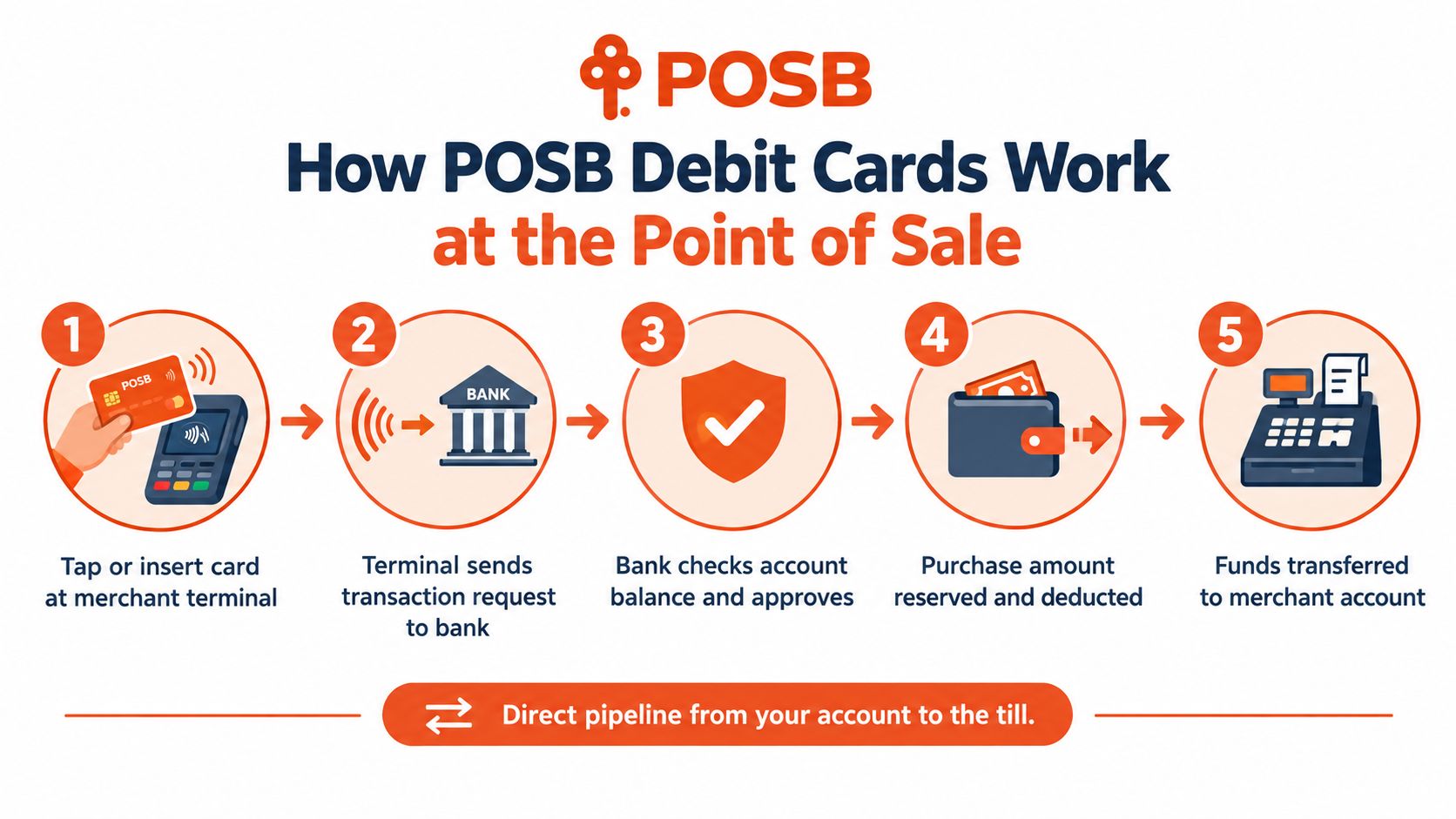
The customer presents the card. A contactless tap uses the card's chip and near-field communication capability. An inserted card reads the chip directly, while some transactions may ask the customer to enter a PIN. A linked mobile wallet can perform a similar contactless exchange through the phone or wearable.
The terminal sends an authorisation request. The merchant's POS terminal sends the purchase details through the relevant card scheme and acquiring infrastructure. The request identifies the merchant, amount, card credentials, and other security information needed for approval.
The bank checks the transaction. The issuing bank checks available funds, card status, security controls, and applicable limits. If the checks pass, the bank returns an approval. If not, the terminal shows a decline or asks for another form of verification.
Funds are reserved or deducted. The purchase amount can reduce what the customer can spend immediately. This is why the available balance may differ from the displayed account balance. A pending transaction, deposit, or pre-authorisation can temporarily reserve funds even before final settlement.
The merchant receives settlement. Authorisation confirms that the transaction can proceed. Settlement is the later movement of funds through the payment system into the merchant's acquiring account, subject to the merchant's agreement and processing arrangements.
Core idea: Debit means the customer pays from available money in a linked account, rather than relying on a revolving credit balance.
A contactless payment is therefore not just a card touching a terminal. The tap starts a secure exchange, but the bank still decides whether the transaction can be approved. Readers who want a broader explanation of tap-to-pay behaviour can review this guide to contactless payment in Singapore.
For a customer, the result feels immediate. For the merchant, the terminal needs stable connectivity and accurate transaction status. If a receipt prints but the terminal later shows an error, staff should check the transaction record rather than assuming that the payment succeeded or failed.
POSB debit cards serve different practical needs, even when several cards share core functions. The useful comparison starts with the customer's routine, not with the longest rewards list.
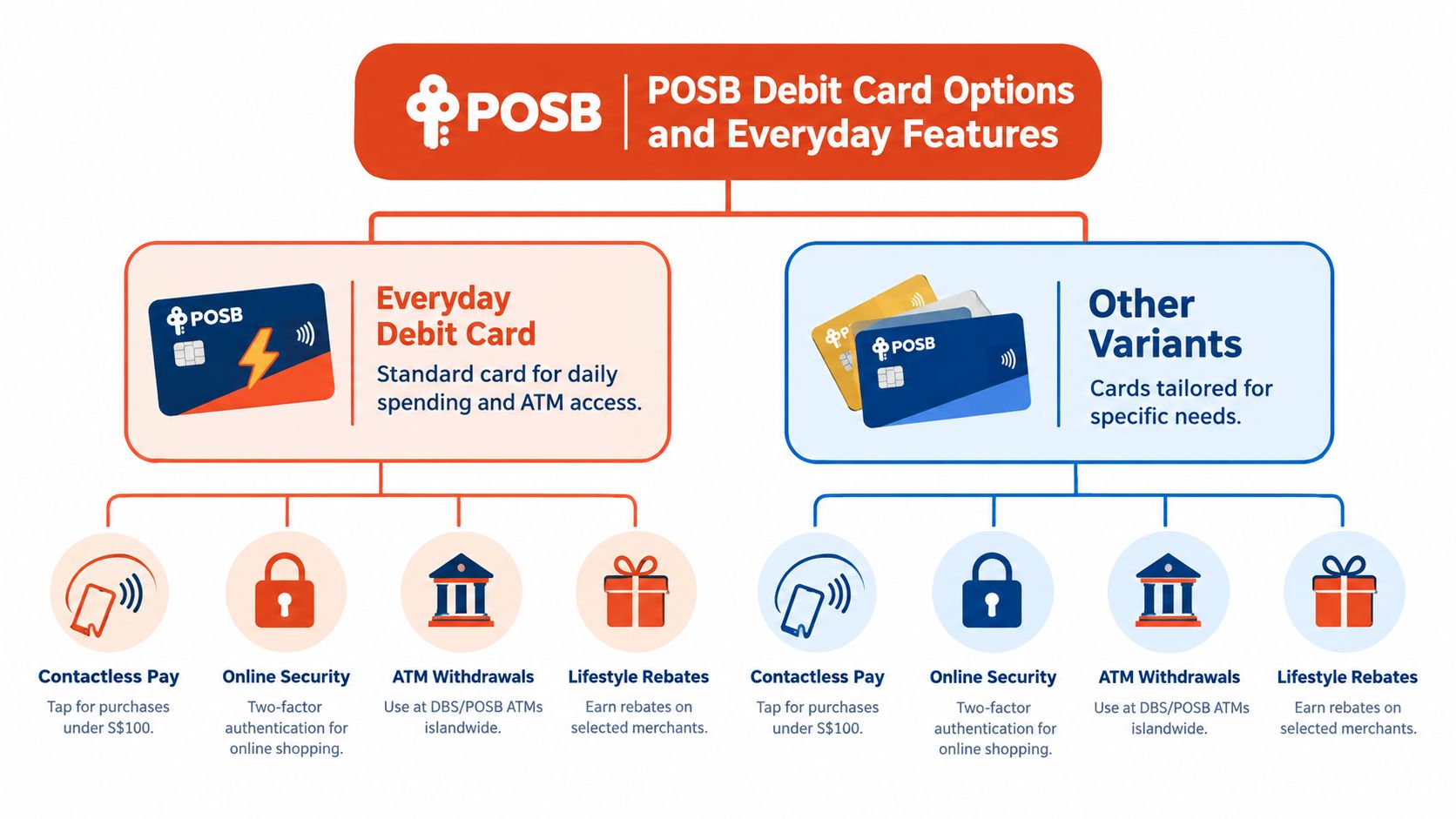
A standard POSB debit card is designed for routine spending and cash access. It can support local purchases, online transactions, ATM withdrawals, and, where enabled and accepted, overseas use. Contactless functionality reduces friction for quick purchases, while a PIN remains important for verification and certain transaction types.
The PAssion POSB Debit Card has a community-oriented role. DBS describes its combination of TransitLink EZ-Link functionality, retail rewards, and no income requirement as part of the product's design. That makes it relevant to customers who want transport functionality and everyday retail use in one card, rather than a product built around income-based credit approval. DBS lists the PAssion POSB Debit Card's functions and eligibility.
A student or young adult may value direct spending control, ATM access, and a card that works for transport and food purchases. A family may prefer a card linked to a clearly managed account, with transaction alerts and limits that make household spending easier to monitor. A community user may prioritise the PAssion card's transport and retail connection.
POSB's current card pages list the PAssion POSB Debit Card among the bank's debit-card products. The broader ecosystem includes multiple card variants and operational controls, so customers should check the specific card page rather than assume every POSB card has identical terms. POSB's current debit-card application and support information also provides the relevant account and card-management context.
The most visible features are contactless payments and ATM access, but the less visible controls often matter more:
A card's value comes from the combination of these functions. A transport-linked card may suit a commuter, while a basic debit card with straightforward account controls may be more suitable for someone focused on budgeting.
POSB debit cards, credit cards, and e-wallets can all complete a purchase, but they create different money-management outcomes. Debit cards draw from available account funds. Credit cards create a bill that must be repaid. E-wallets usually require a stored balance or a linked funding method.
The best option depends on whether the customer values immediate control, payment flexibility, rewards, or separation from a main bank account.
| Criteria | POSB Debit Card | Credit Card | E-Wallet |
|---|---|---|---|
| Spending control | Uses available funds in a linked account | Allows spending up to an approved credit limit | Uses wallet balance or linked funding source |
| Repayment | No monthly card borrowing balance for ordinary debit spending | Requires repayment of the billed amount | Usually funded before or during use |
| Interest exposure | Ordinary debit spending doesn't create revolving card interest | Unpaid balances can incur finance charges | Depends on the linked funding arrangement |
| Budgeting | Strong direct connection to the bank account | Requires tracking current spending and future repayment | Can separate a spending pot from the main account |
| Acceptance | Depends on the card scheme and terminal | Depends on the card scheme and terminal | Depends on merchant and wallet support |
| Rewards | May include card-specific rewards or rebates | Often built around rewards, subject to programme terms | May include wallet promotions or partner rewards |
| Overseas use | Requires attention to activation, fees, and ATM compatibility | Can provide flexibility, but costs and repayment rules need checking | May offer a separate balance and exchange process |
Debit suits customers who want the purchase to remain tied to money already available. It can help a household set a clear spending boundary, especially when the account and card limits are actively managed. It also avoids the temptation to treat a credit limit as extra income.
Credit may suit a customer who needs a billing cycle, wants particular rewards, or needs a payment method accepted for a transaction that requires a credit card. That flexibility carries responsibility. A customer who doesn't clear the balance can face finance charges, and the spending decision becomes a future repayment obligation.
E-wallets work well when a customer wants a separate spending balance, quick in-app payments, or access to a wallet-specific promotion. They can be convenient for transport, delivery, and selected merchants, but acceptance isn't universal. A guide to e-wallets in Singapore helps explain why a wallet is a separate layer rather than a direct substitute for every card transaction.
A practical decision matrix looks like this:
The right payment method is less about loyalty to one product and more about matching the funding source to the spending situation.
A POSB debit card can work perfectly at a local checkout and still fail in a different situation because limits, settings, and charges change the result. Customers should treat the card's controls as operating rules, not fine print to inspect only after a decline.
Daily limits can apply separately to NETS payments, ATM withdrawals, and debit card spending. POSB's support materials show default limits for these functions and provide account-management routes for changing them. A customer preparing for a large purchase should check the relevant limit before reaching the till, while a customer concerned about fraud may prefer to keep limits lower and increase them temporarily when needed.
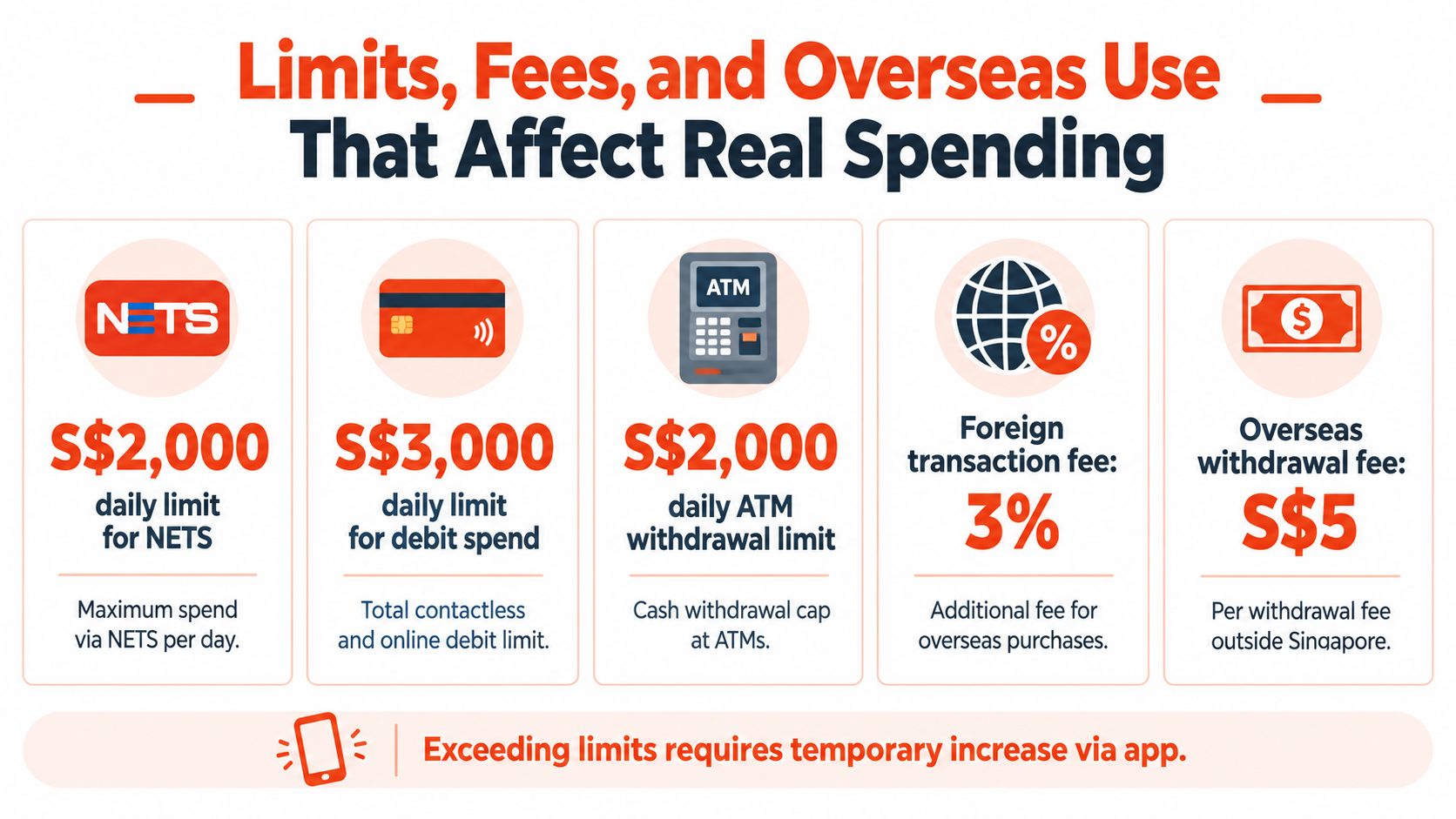
A failed payment can result from several causes:
Customers should check the card controls in the bank's app or online banking before asking a merchant to retry repeatedly. Multiple attempts can create confusion when one attempt is pending and another is declined.
POSB's rates and fees page states that overseas Visa or Mastercard ATM withdrawals carry a S$7 service charge, while cash advances can incur an 8% fee or a S$15 minimum. The same page also describes high finance charges on unpaid balances. These costs show why a customer should distinguish ordinary debit spending from cash access and credit-related transactions. POSB's rates and fees information covers overseas withdrawals, cash advances, and finance charges.
Overseas ATM compatibility also depends on the local machine and the card network. A customer should check overseas-use settings, carry a backup payment method, and consider whether cash withdrawal is necessary before accepting a fee at the machine.
DBS states that Mastercard Maestro functionality will be phased out on 15 July 2026 for several DBS and POSB card types, including the PAssion POSB Debit Card. DBS also states that cashback rules changed from 1 August 2025, including a reduced cash-withdrawal threshold of S$200 and below for qualifying cashback under the Visa Debit Cashback Programme in Singapore. POSB's card support page outlines the Maestro change and cashback-rule update.
Customers who rely on an older terminal, overseas ATM, or cashback condition should verify the current rule before spending. A card that remains active for ordinary purchases may still have a specific function that is changing.
For a merchant, accepting a POSB debit card starts with the terminal, not the customer's bank. The business needs a payment terminal and acquiring arrangement that support the relevant card scheme, contactless transactions, and the transaction types customers are likely to request.
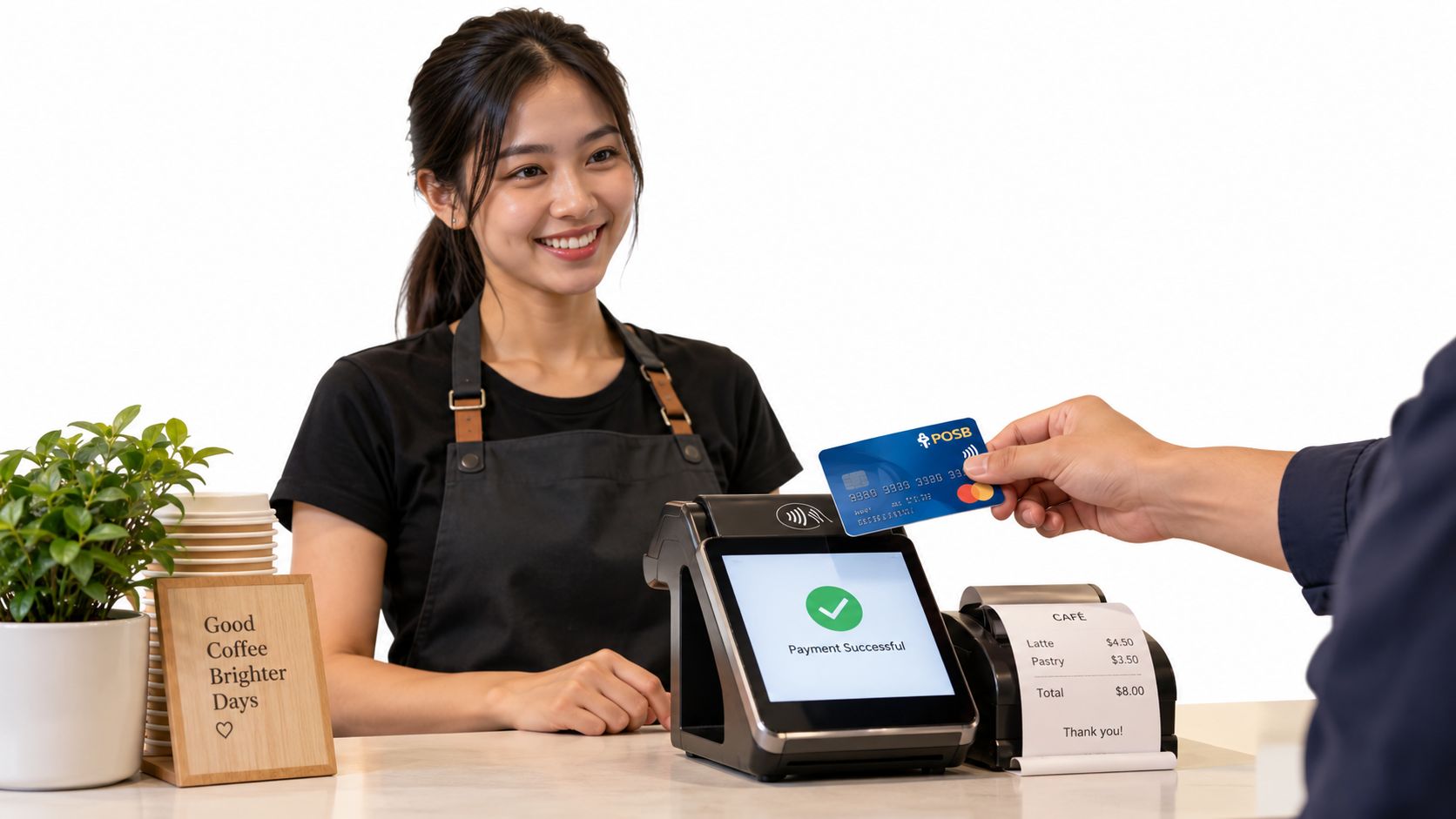
A customer may tap a physical card, insert it and enter a PIN, or use a phone-based wallet. The terminal captures the transaction details and sends an authorisation request through the acquiring and card-network rails. Once the issuing bank approves the payment, the terminal shows the result and the merchant can complete the sale.
Staff should know how to handle the common outcomes:
A clean checkout process protects both the customer and the merchant. Staff shouldn't assume that a card's bank branding guarantees acceptance, because acceptance depends on the merchant's scheme support and terminal configuration.
Merchants also need to understand when approved transactions become available in the business account. Settlement timing depends on the merchant agreement, acquiring setup, transaction type, and operational arrangements. The headline transaction rate isn't the only commercial consideration. A business should also review terminal charges, support arrangements, payout timing, contract terms, and how refunds or chargebacks are handled.
Modern Android POS terminals can combine card acceptance with selected digital wallets, which reduces the need for separate devices at a busy counter. Businesses evaluating the wider acceptance process can compare the operational differences in paying with a credit card, while remembering that the merchant's terminal must still support the specific scheme and payment method.
For cafés, salons, clinics, and retailers, the practical target is simple. Customers should see accepted payment marks clearly, staff should know the decline workflow, and the business should receive understandable records for reconciliation.
A POSB debit card is usually a strong fit when a customer wants everyday purchases to come directly from available money. It's especially useful for people who prefer visible budgeting, regular local spending, and a card that can handle contactless payments, ATM access, and selected transport or retail functions.
The choice becomes less straightforward when overseas cash withdrawals, unusual transaction sizes, or strict reward conditions enter the picture. A customer who travels should check overseas controls and charges before departure. A customer who makes occasional large payments should confirm the relevant daily limit rather than discover the restriction at checkout.
For merchants, the equivalent checklist covers card-scheme support, contactless readiness, reliable connectivity, clear receipts, staff training, and a documented response to declined or uncertain transactions. A terminal that accepts the cards customers carry protects checkout speed and reduces avoidable payment disputes.
Product communication also improves when features are connected to outcomes. Teams writing customer-facing explanations can use Bragly's messaging framework guide to distinguish a feature, such as contactless acceptance, from its practical benefit, such as a quicker checkout for a small purchase.
POSB debit cards remain useful because they fit the rhythm of Singapore spending. The strongest results come from treating the card as a controlled payment tool, checking the rules that affect real transactions, and matching the card to the customer's account habits and the merchant's acceptance setup.
Sambapay helps Singapore SMEs accept POSB debit cards, major card schemes, and selected digital wallets through modern POS terminals, transparent blended pricing, and local support. Visit Sambapay to explore practical in-store payment acceptance for retail, F&B, clinics, salons, and other businesses.