
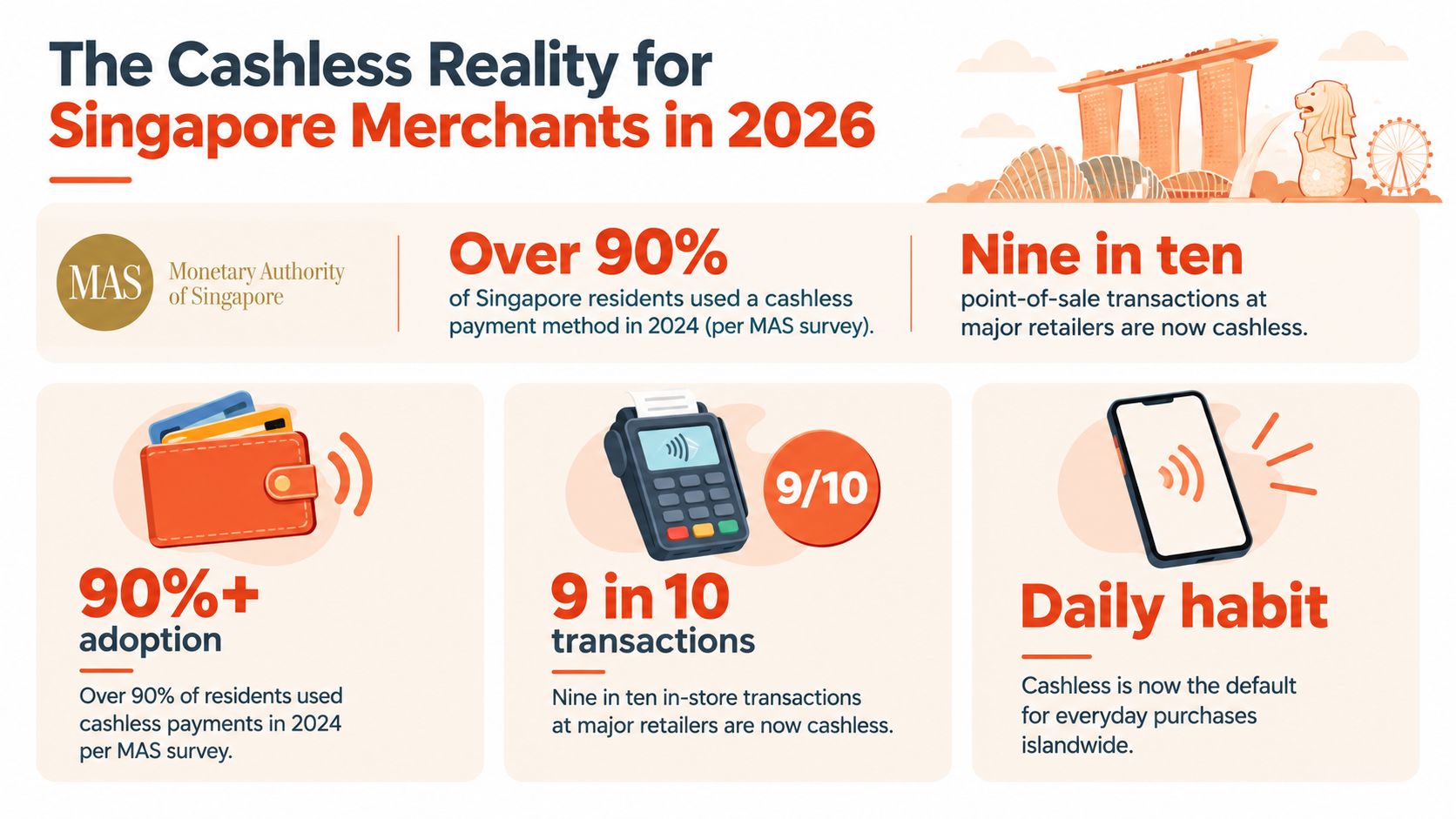
Singapore's cashless market is no longer a side option for merchants. Digital payments adoption reached 92.0% in 2025, while 97% of retail point-of-sale transactions were cashless, according to PwC's Singapore payments report. For a small retailer, café, clinic, salon, or gym, the question isn't whether customers will pay digitally. It's whether the merchant's terminal, QR setup, fees, and settlement process can keep up without creating avoidable cost or reconciliation work.
The scale of cashless adoption makes digital acceptance part of ordinary counter operations. An SME needs payment methods customers recognise, but it also needs a setup that controls fees, settlement timing, hardware failures, and reconciliation work. The right question is how those pieces fit the business, not whether it accepts cashless payments.
A coffee shop in Tiong Bahru that accepts only cash loses convenience at the point of purchase. A QR code that scans unreliably creates the same problem. In a boutique, an overseas card may fail, while a clinic can face delays when its terminal does not process a contactless mobile wallet. These are operational failures, not abstract technology issues.
The merchant-side decision has several parts:
Payment rails also show why cashless payment Singapore is a merchant operations issue. In 2024, FAST transactions totalled 500 million, with a value of S$661,748 million, according to PwC's 2026 payments analysis. An SME should therefore compare acceptance coverage with the daily realities of terminal uptime, fee deductions, settlement reports, and end-of-day matching.
Singapore's current payment habits grew from infrastructure built decades ago. Interbank GIRO was implemented in 1984, followed by NETS Electronic Funds Transfer at Point of Sale, or EFTPOS, in 1986. EFTPOS enabled cashless retail payments through ATM cards, giving merchants a local electronic alternative before smartphones and wallet apps existed. By the mid-1990s, EFTPOS had scaled beyond 110,000 transactions a day, with an aggregate daily value of S$7 million, as documented in PwC's history of Singapore's payments landscape.
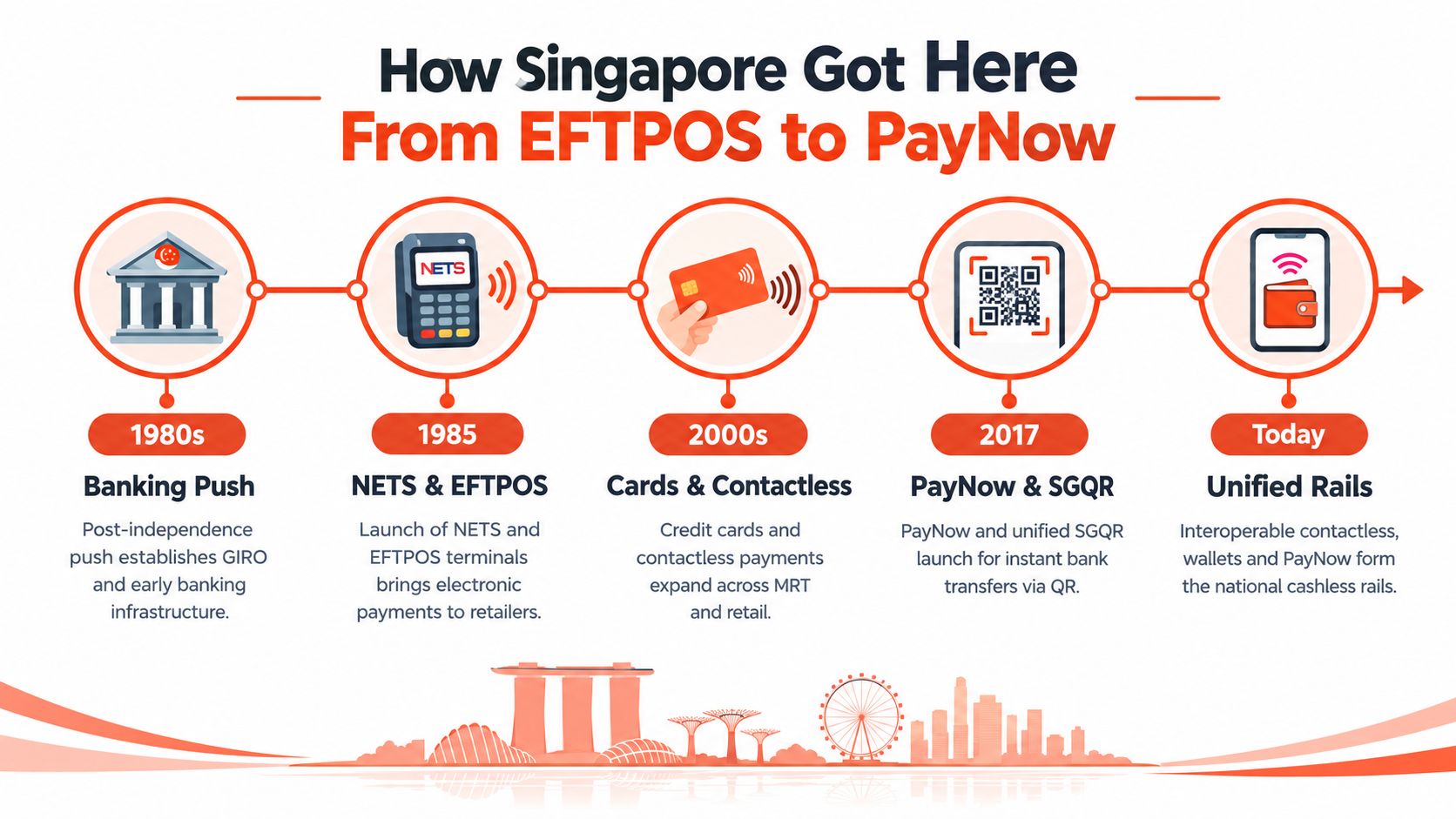
That early infrastructure shaped merchant expectations. Electronic payments became part of everyday retail operations, rather than a premium add-on reserved for large stores. A 1993 amendment to the Banking Act also restricted the issuance of multipurpose stored-value cards to banks with MAS approval, showing that regulation was involved early in the development of cashless payments.
The next stage added international card schemes and contactless capability. Visa and Mastercard expanded card acceptance, while contactless cards reduced the effort involved in low-value purchases. Mobile wallets later tokenised those cards, allowing customers to tap a phone or smartwatch at the same terminal without handing over a physical card.
PayNow changed the economics of small-ticket acceptance. Launched in 2017, it let customers send funds using identifiers such as a mobile number or UEN, reducing the need for a card terminal for businesses that mainly needed bank-transfer acceptance. SGQR then helped consolidate participating QR payment methods into a more manageable merchant display.
Practical rule: The modern SME counter isn't choosing between cash and one digital method. It's managing several rails that customers experience as one quick checkout.
The result in 2026 is layered rather than completely uniform. Cards handle many higher-value and international transactions, contactless wallets sit on top of card rails, and PayNow QR covers direct account-to-account payments. The merchant's job is to make those layers work together without forcing staff to guess where a payment went.
A payment logo only becomes useful when the merchant knows what happens after the customer taps or scans. Visa, Mastercard, and UnionPay are card schemes. The acquiring bank or payment provider connects the merchant to those schemes, obtains authorisation, and routes settlement to the merchant account.
Contactless services such as Apple Pay, Google Pay, and Samsung Pay generally represent a tokenised card stored on the customer's device. They aren't separate bank accounts that require a separate countertop terminal. A terminal that supports the relevant contactless standards can process the token through the underlying card network.
NETS remains important for local debit acceptance. A merchant may use a traditional NETS-capable terminal or a phone-based option such as NETS PayAnyone, subject to provider availability and onboarding requirements. SoftPOS products can also turn a compatible Android phone into a contactless acceptance device, but the merchant should check device compatibility, connectivity, staff workflow, and receipt options before relying on a phone as the primary terminal.
PayNow QR is the key local account-to-account method. The customer scans a merchant-presented code and authorises payment through a participating banking app. A static code requires the customer or staff member to enter the amount, while a dynamic QR can carry the transaction amount and reference, reducing entry mistakes.
Wallets such as GrabPay, Alipay+, and Fave Pay give customers branded payment experiences. Their commercial and settlement arrangements depend on the acquiring provider and the specific wallet connection. A merchant shouldn't assume that every wallet settles into the same account, on the same schedule, or with the same reporting label.
The following comparison is a starting point. Exact settlement terms must be confirmed in the merchant agreement.
| Method | Type | How It Settles | Best Use Case |
|---|---|---|---|
| Visa and Mastercard | Card scheme | Through the contracted acquirer, according to the agreed settlement cycle | Retail, F&B, clinics, salons, and higher-value purchases |
| UnionPay | Card scheme | Through the acquirer supporting the merchant's international card acceptance | Tourist-facing businesses |
| Apple Pay, Google Pay, and Samsung Pay | Tokenised contactless card payment | Through the underlying card scheme and acquirer | Fast tap payments at a modern terminal |
| NETS | Local debit rail | Through the NETS or acquiring arrangement selected during onboarding | Heartland retail and everyday local spending |
| PayNow QR | Account-to-account QR payment | To the linked merchant bank account or provider account, according to the setup | Small-ticket local payments and stalls |
| GrabPay and Alipay+ | Wallet acceptance | Through the wallet or aggregator arrangement, with provider-specific reporting | Local wallet users and selected overseas visitors |
| Fave Pay | Wallet and rewards-linked payment | Through the contracted payment provider | SMEs using wallet-led promotions or customer rewards |
For merchants comparing wallet options, this Singapore e-wallet guide helps separate consumer wallet branding from the underlying acceptance and settlement arrangement. The important question at onboarding is simple: which provider receives the transaction, what appears on the merchant report, and when does the money reach the nominated account?
Cashless acceptance has no single price. The cost depends on the payment rail, card origin, provider pricing model, hardware, settlement speed, and the merchant's ability to reconcile disputes.
The main line is the Merchant Discount Rate, or MDR. Domestic Visa and Mastercard transactions generally cost less than cross-border card transactions, but the actual rate depends on the merchant category, risk profile, card mix, contract, and monthly volume. A blended rate bundles scheme, processing, and acquiring costs into one figure. Interchange Plus separates those components, which can make the statement harder to read but may be more economical for a merchant with meaningful volume and a predictable card mix.
A simple benchmark makes the impact clear. On a S$10 sale at a 1.8% blended rate, the fee would be approximately S$0.18, leaving approximately S$9.82 before any other applicable charges. The specific rate and net amount must come from the merchant agreement, not a generic market promise.
| Payment Type | Typical MDR/Fee | Settlement | Hidden Costs |
|---|---|---|---|
| Domestic card | Contracted MDR, often quoted as a blended or interchange-plus rate | Commonly agreed as T+1 or T+2 | Terminal rental, refunds, chargebacks, scheme and compliance administration |
| Cross-border card | Usually priced above domestic card acceptance | Provider-specific, often slower than domestic settlement | Foreign-card handling, currency conversion, cross-border assessment |
| PayNow QR | The underlying rail may have no percentage MDR, but provider services can still carry charges | Frequently near real time or according to the provider arrangement | Onboarding, reporting, wrong-reference administration, refund handling |
| Digital wallet | Provider-specific MDR or transaction fee | Contracted settlement cycle | Promotions, wallet-specific reconciliation, refund processes |
| Online payment link or gateway | Gateway or transaction fee plus payment-method pricing | Depends on the gateway and method | Gateway charges, failed-payment handling, dispute administration |
Some providers add annual terminal rental, gateway charges for online payments, refund fees, or minimum monthly volume clauses. Chargeback handling can also carry a fee, and payment security obligations may create administrative or compliance costs even when the terminal itself looks inexpensive.
Settlement is a working-capital decision. Traditional acquiring arrangements may use T+1 or T+2, while newer providers can offer faster access under specific agreements. Same-day or D+0 settlement can help an SME replenish stock or manage daily cash flow, but faster access can come with a higher MDR or additional conditions.
Ask for the net settlement, not only the headline rate. A low MDR can lose its advantage if the provider adds terminal rent, delayed settlement, refund charges, and costly reconciliation.
Merchants evaluating negotiation tactics can use this guide on lowering card transaction fees before requesting a revised quote. Three months of statements, card-origin information, average ticket size, refund history, and monthly volume give an acquirer something concrete to price.
The right mix depends on who stands at the counter and how much they spend. A heartland coffee shop serving older commuters needs reliable NETS and PayNow QR, while a CBD café may see more customers reaching for Apple Pay or Google Pay. A restaurant near Orchard Road has a stronger reason to consider overseas cards and Alipay+ than a neighbourhood service business.
Small-ticket purchases often work well with PayNow QR, especially where the merchant wants to avoid terminal hardware. The customer scans, confirms the amount, and the merchant verifies the completed payment. Static QR is cheap and simple, but dynamic QR reduces amount-entry errors when the point-of-sale system supports it.
Mid-ticket retail needs contactless card acceptance. A boutique selling clothing or accessories should support Visa and Mastercard, then check whether UnionPay and relevant tourist wallets fit its customer base. Apple Pay and Google Pay generally become available through the contactless card setup rather than through separate terminals.
Tourist-heavy businesses should review foreign-issued cards and cross-border wallet demand. A merchant shouldn't activate every available logo automatically. Each extra rail adds onboarding, reporting, refund, and support considerations.
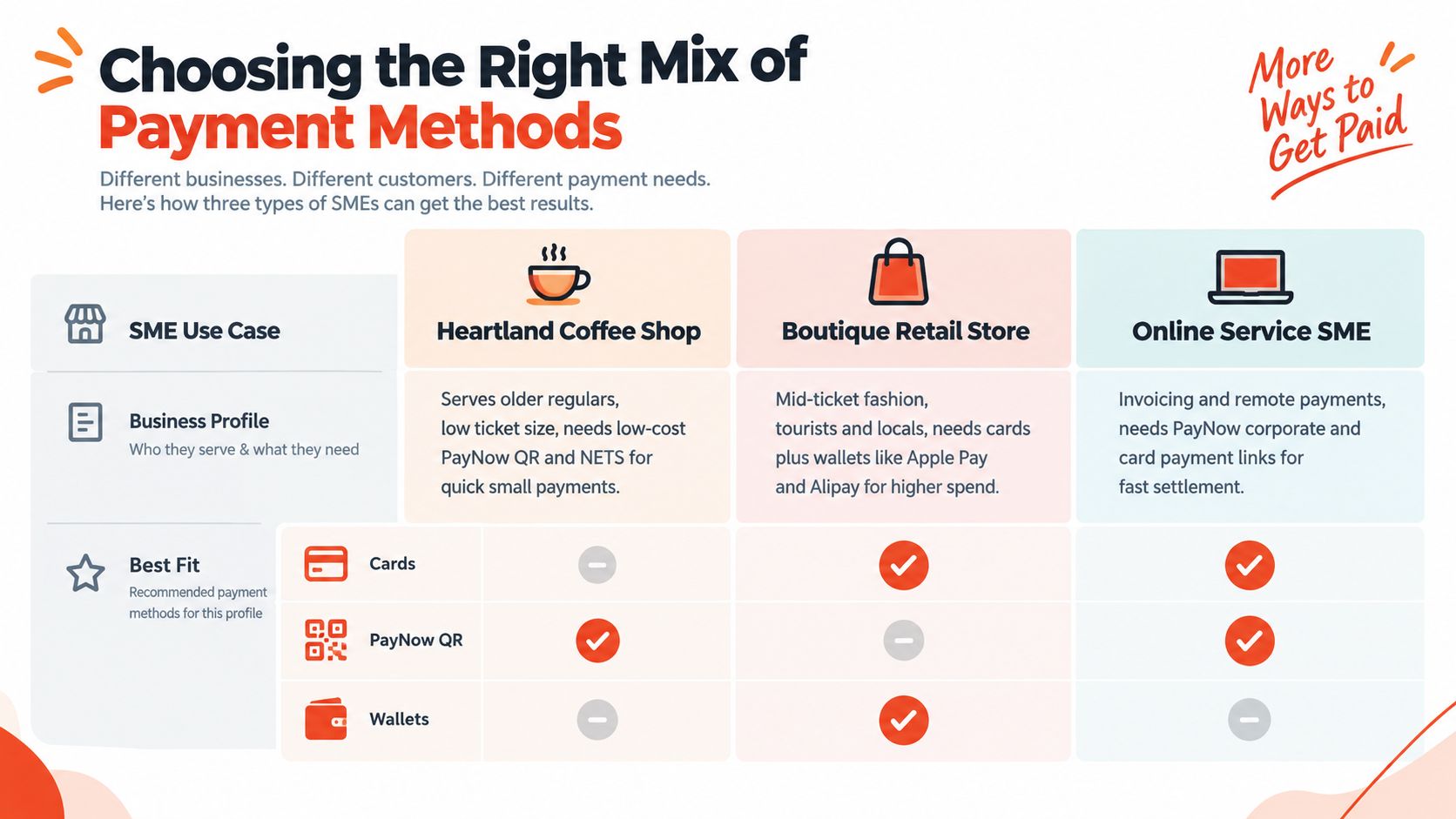
For most SMEs, a sensible sequence is to activate PayNow QR first, add card acceptance when ticket size or customer expectations justify the MDR, then add wallets based on observed demand. That avoids paying for unused integrations while still protecting the checkout experience.
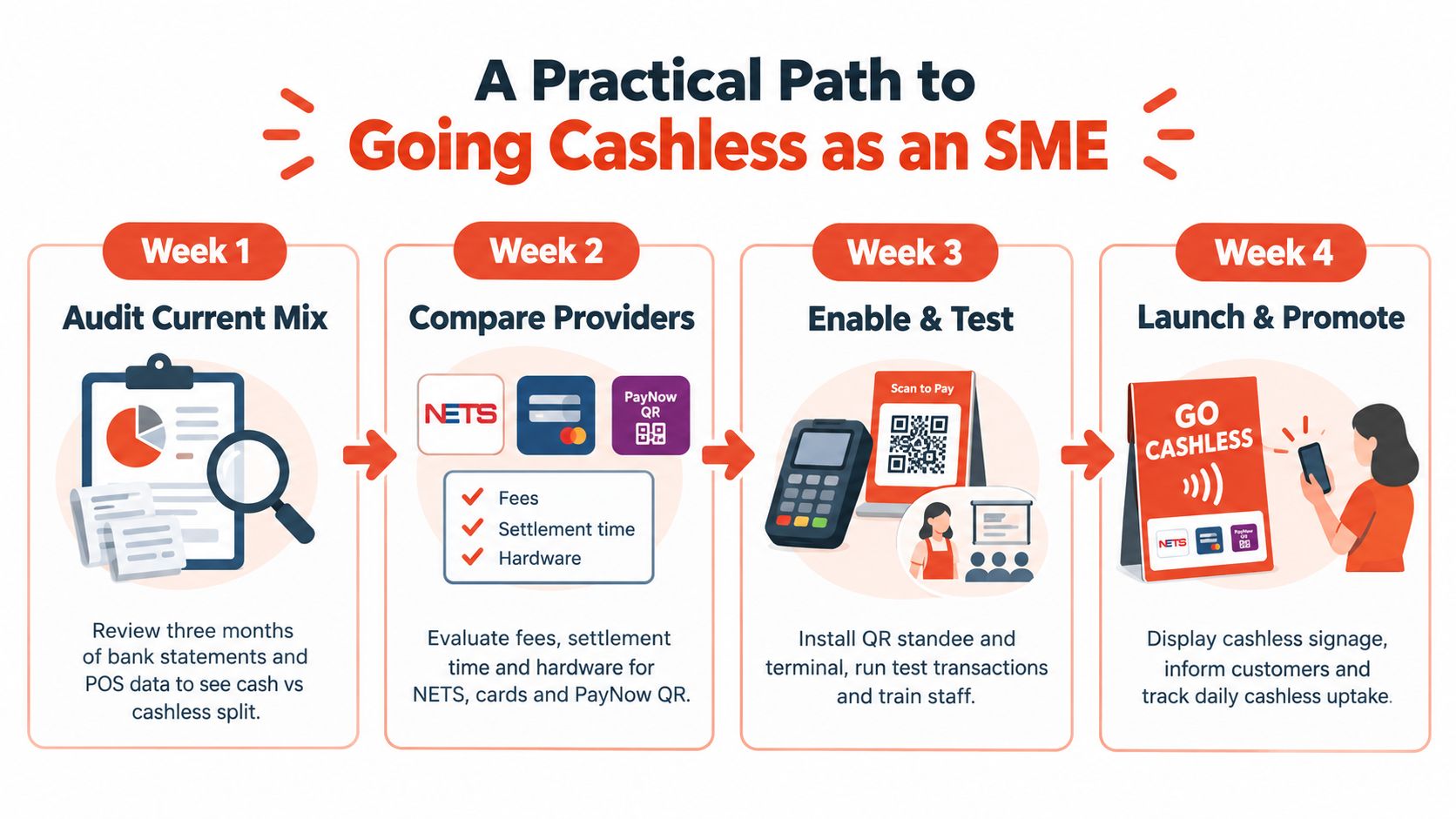
A merchant can upgrade a cashless setup without turning the project into a long technology rollout. The work becomes manageable when the owner treats it as an operational change, not just a terminal purchase.
Review three months of bank statements, POS reports, and cash-up records. Separate domestic cards, foreign cards, NETS, PayNow, wallets, refunds, and unexplained deposits. The purpose isn't to produce a perfect financial model. It's to identify which payment methods already generate demand and where settlement or reconciliation causes daily friction.
Shortlist providers that can support the required rails and confirm that the relevant payment service provider is authorised under Singapore's Payment Services Act. Check the merchant account name, settlement account, business activity, and refund process before signing.
A fixed retail counter normally suits a countertop terminal. A mobile service business may need a portable reader, while a small operator can consider a compatible softPOS application. A business considering an Android POS system should assess NFC compatibility, battery life, connectivity, receipt delivery, and whether the device can support the staff workflow.
Apply for PayNow for Business through a participating bank or provider, and confirm the expected onboarding schedule directly. Avoid printing a permanent QR standee until the merchant name and UEN have been verified.
Dynamic QR is preferable for variable-amount transactions because it reduces manual entry and makes invoice references easier to reconcile. If hardware, integration, or onboarding requires upfront spending, this resource on funding digital payments for SMBs can help owners assess the cash-flow side of the transition.
PayNow QR is inexpensive to receive through the underlying bank-transfer rail, but “free” doesn't mean administration disappears. Businesses still need to verify onboarding, match references, handle wrong amounts, and manage customer queries. A provider or gateway can also apply its own commercial charges.
All contactless terminals behave the same. They don't. Some entry-level devices may lack the contactless capability, wallet support, connectivity options, receipt flexibility, or acquirer interoperability that a busy SME needs. A merchant should test a foreign card, a local contactless card, and a mobile wallet before committing to hardware.
Settlement is always instant. A completed customer tap is an authorisation, not necessarily an immediate bank deposit. Card settlement follows the contracted cycle, often T+1 or T+2, while PayNow availability depends on the specific arrangement and banking process. The merchant must distinguish “payment accepted” from “cash received in the operating account”.
Cashless removes administration. It removes some cash counting, storage, and deposit work, but replaces it with reconciliation, refund handling, access control, dispute management, and scheme compliance. A terminal that produces unclear reports can create more accounting effort than a slightly higher MDR with a clean unified statement.
Small merchants can't negotiate. Providers may review pricing when a merchant supplies statements and demonstrates consistent card volume. The owner should ask for the full commercial schedule, including terminal charges, minimums, settlement timing, refund treatment, and chargeback fees, rather than negotiating only the MDR.
Data security also matters. Staff shouldn't photograph cards, share terminal credentials, or accept screenshots as proof of payment. The terminal, QR display, refund workflow, and merchant dashboard all need clear ownership.
A workable cashless payment Singapore strategy rests on three decisions.
First, define the counter mix. Most SMEs should assess PayNow QR, contactless cards, and at least one relevant wallet, then remove methods that customers never use or staff can't reconcile properly. A tourist-facing retailer and a neighbourhood coffee shop shouldn't carry identical acceptance setups.
Second, negotiate the operating terms. Ask whether pricing is blended or interchange-plus, whether PayNow Corporate is included, when funds settle, how refunds are charged, and what happens during a terminal outage. The cheapest headline MDR isn't automatically the lowest operating cost.
Third, prepare for changes in tokenised payments and account-to-account rails without buying every new product immediately. The sensible approach is to keep the hardware current, maintain clean transaction records, and review the provider agreement as the business grows.
This week, the owner can:
Sambapay provides Singapore SME merchants with in-store card terminals, contactless acceptance, selected wallets, PayNow support, settlement options from as early as T+1 depending on the agreement, and local onboarding assistance. Visit Sambapay to review a payment setup built around the merchant's counter layout, customer mix, ticket size, and settlement needs.