
Friday night service has a way of exposing every weakness in a restaurant's payment setup. The orders keep moving, the queue at the counter gets longer, a table asks for split payment, and the card terminal suddenly becomes the slowest thing in the room. In that moment, a POS system is no longer software in the background, it decides whether the shift feels controlled or chaotic.
| Criterion | Bundled SaaS POS | Standalone Payment Terminal | Hybrid Setup |
|---|---|---|---|
| Order handling | Strong when menus, modifiers, and kitchen routing stay inside one system | Weak for complex orders, since payments sit apart from order capture | Strong if order flow and payments are connected cleanly |
| Payment acceptance | Often broad, but depends on provider integrations | Usually reliable for core card acceptance, less flexible for local workflows | Broad if the POS and terminal support the right rails |
| Settlement predictability | Varies by provider and merchant agreement | Often clearer if the terminal provider owns the payment flow | Usually better when one partner coordinates both sides |
| Pricing clarity | Can be easy to compare, but hidden add-ons still appear | Can look simple at first, then grow through extras | Best when the commercial terms are transparent |
| Support | Often ticket-based, sometimes offshore | Can be fast for terminal faults, slower for software issues | Strongest when local support owns both layers |
| Best fit | Restaurants that want one dashboard for daily operations | Simple counters with light order complexity | Restaurants that need flexibility without splitting accountability |
The decision is not whether a system can take payment. Singapore restaurants already operate in a market where cashless checkout is the norm, and the friction shows up when a POS cannot keep up with live service, local payment rails, and settlement timing. That is why the hidden costs matter more than the glossy feature list.
The first thing that usually breaks is not the terminal. It is the handoff between the waiter, the kitchen, and the cashier when modifiers pile up and someone has to re-key an order because the screen is cluttered, slow, or badly designed.
A busy restaurant shift lives or dies on five pressure points, order accuracy, modifier handling, terminal speed, payment acceptance breadth, and settlement predictability. If one slips, the cost shows up fast in guest complaints, staff stress, or delayed takings. That is why a restaurant POS has to be judged under live-service conditions, not in a demo room.
An order screen that makes staff tap through too many layers will fail during a rush. A payment terminal that freezes for a few seconds creates a queue at the counter. A system that cannot handle table-side checkout or split bills cleanly forces staff to improvise, and improvisation is where mistakes start.
Practical rule: if the team needs to explain the POS to each other during service, the POS is already too slow for that operation.
Some problems do not show up on day one. A restaurant might like the interface, then discover that reconciliation takes too long, or that the provider's support team only replies after the shift is over. Others realise too late that payments clear on a schedule that does not fit supplier runs or payroll timing.
Singapore's restaurant environment has also shaped expectations over time. NETS was first piloted in 1985, launched island-wide in 1986, and had already crossed S$1 billion in consumer spending by 1993, which shows how early local card acceptance became part of everyday retail behaviour. That history still matters because diners now expect checkout to be quick, familiar, and broadly accepted.
The hidden cost is rarely the headline subscription fee. It is the cash flow drag from slower settlement, the staff time spent reconciling mismatched batches, and the support gap when something fails during service. Local support usually shortens that gap because the team understands Singapore payment rails, local workflows, and the urgency of a dinner rush. Offshore support may handle tickets well enough, but if it cannot resolve a terminal, settlement, or integration issue before closing time, the restaurant carries the cost into the next day.
A POS that passes a sales demo but slows down at the till is not a minor inconvenience. It affects table turnover, staff confidence, and the end-of-night cash count. That is the actual test.
Singapore's F&B spending patterns make one point very clear, the POS is now core revenue infrastructure. In 2023, 45.1% of household expenditure on Food and Beverage Serving Services was paid via e-payment, up from 23.6% in 2017/18. Within that category, Restaurants, Cafes and Pubs had the highest proportion at 69.1% in 2023, while Fast-Food restaurants rose from 24.2% to 66.1% over the same period, according to MAS retail payment statistics. The same source shows Singapore's POS card payments were valued at S$148.91 billion in 2024, with credit cards at S$54.54 billion, debit cards at S$28.52 billion, and e-money at S$2.52 billion. MAS retail payment statistics
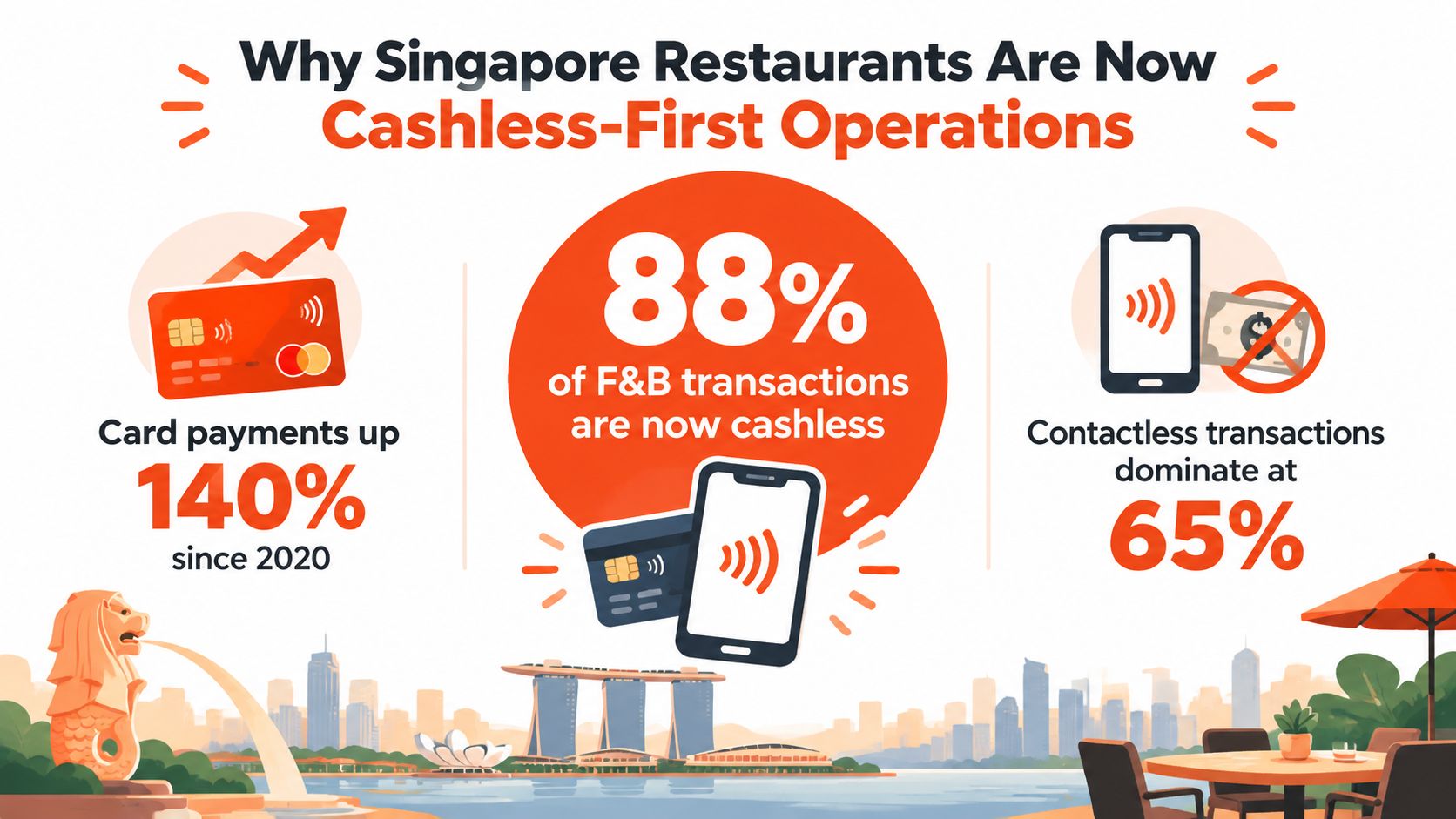
Those numbers change the buying decision. A restaurant POS is no longer just a digital cash register, it is the front end of the business's cash flow. If a system accepts cards poorly, handles local wallets awkwardly, or creates delays at settlement, the operator feels it in daily working capital, not just in convenience.
That is also why local acceptance breadth matters. Guests in Singapore expect fast card checkout, QR options, and wallet compatibility to be normal rather than premium. A payment flow that is fragmented across different devices or logins creates staff confusion and more reconciliation work at the end of service.
The historical path from NETS to today helps explain this expectation. Singapore's in-store card acceptance evolved early from a bank-led domestic network into a mature retail payment backbone. That created a market where broad acceptance became the baseline, not an upgrade. NLB on NETS's rollout history
For restaurants, that means the POS must do more than close a bill. It has to support the payment habits diners already use every day, while keeping the cashier line moving and the books clean.
For teams comparing payment flows, this guide on contactless payment in Singapore is useful background on how fast the market has standardised around tap-and-go behaviour.
A weak setup does not always fail loudly. Sometimes it just adds seconds to every transaction, or pushes one more task onto the manager after closing. In a dining room, those delays compound into staff frustration and slower seat turnover.
The right way to read the market is simple. Singapore restaurants are already cashless-first in practice, so the POS has to be designed for that reality, not for a legacy cash-heavy model.
Restaurant buyers often get distracted by feature lists that sound impressive but do little at peak service. The useful comparison is simpler, how the system behaves when the kitchen is full, the queue is building, and the accountant still needs clean reports at close.
The matrix below weighs each setup against the operational criteria that surface during peak service.
| Criterion | Bundled SaaS POS | Standalone Payment Terminal | Hybrid Setup |
|---|---|---|---|
| Terminal hardware quality and form factor | Good if the vendor uses stable Android or tablet hardware, but durability varies | Usually strong for payments, though not always built for order-taking | Strong when the hardware is selected for restaurant use, not generic retail |
| Order management and modifiers | Usually the strongest option for menus, combos, and course flow | Weak, because the terminal is not built to manage service logic | Strong if the order screen and payment flow are synced |
| Payment acceptance breadth | Depends on the vendor's local integrations and acquirer stack | Often solid for core card acceptance, but may be narrower for local rails | Strongest when the merchant agreement covers cards, QR, and wallets cleanly |
| Settlement speed and predictability | Varies widely by provider | Often clearer if the payment stack is simple | Often best when one partner owns both payment and support |
| Pricing transparency | Can look simple, but add-ons and usage layers still appear | Appears straightforward, then extras show up in support or transaction costs | Usually best if the commercial terms are bundled clearly |
| Local support responsiveness | Good only when the provider has Singapore-based help | Good for terminal faults, weaker for software workflow issues | Best when the same team handles both setup and escalation |
A bundled SaaS POS works when the operator wants menu control, modifier logic, and reporting in one place. It starts to strain when the restaurant needs local payment compatibility and fast issue resolution, because the software team and the payments team are often separate.
A standalone payment terminal can feel easy at the start. It suits a low-complexity counter, but it rarely fixes the workflow issues that show up during peak service. It handles payment, not the steps around payment.
A hybrid setup is often the most practical model for Singapore restaurants that want both operational control and local payment compatibility. The primary risk is coordination. If too many vendors share responsibility, no one wants the fault when something fails and service slows.
For operators comparing options, the point of sale marketing tag is a useful reminder to look beyond feature headlines and ask how the system behaves at the till.
Operational truth: the cheapest-looking POS can become the most expensive one if reconciliation and support are weak.
The best system matches the restaurant's service pattern. A busy café, a full-service dining room, and a chain with multiple outlets do not need the same stack, even if the brochures look similar.
The part most POS comparisons miss is not the checkout screen. It is the time spent cleaning up after checkout, especially when the restaurant is small and the same people who serve guests also close the books.
Singapore restaurants now have to think about 9% GST, SGQR, PayNow, and the InvoiceNow rollout path. Independent local guidance notes that voluntary adoption starts on 1 Nov 2025, and new voluntary GST registrants are required to use InvoiceNow from 1 Apr 2026. That means a POS decision is no longer just about taking orders or collecting payment, it is also about whether the till can support accounting handoff and e-invoicing readiness without extra middleware. Singapore retail and F&B software guidance on compliance
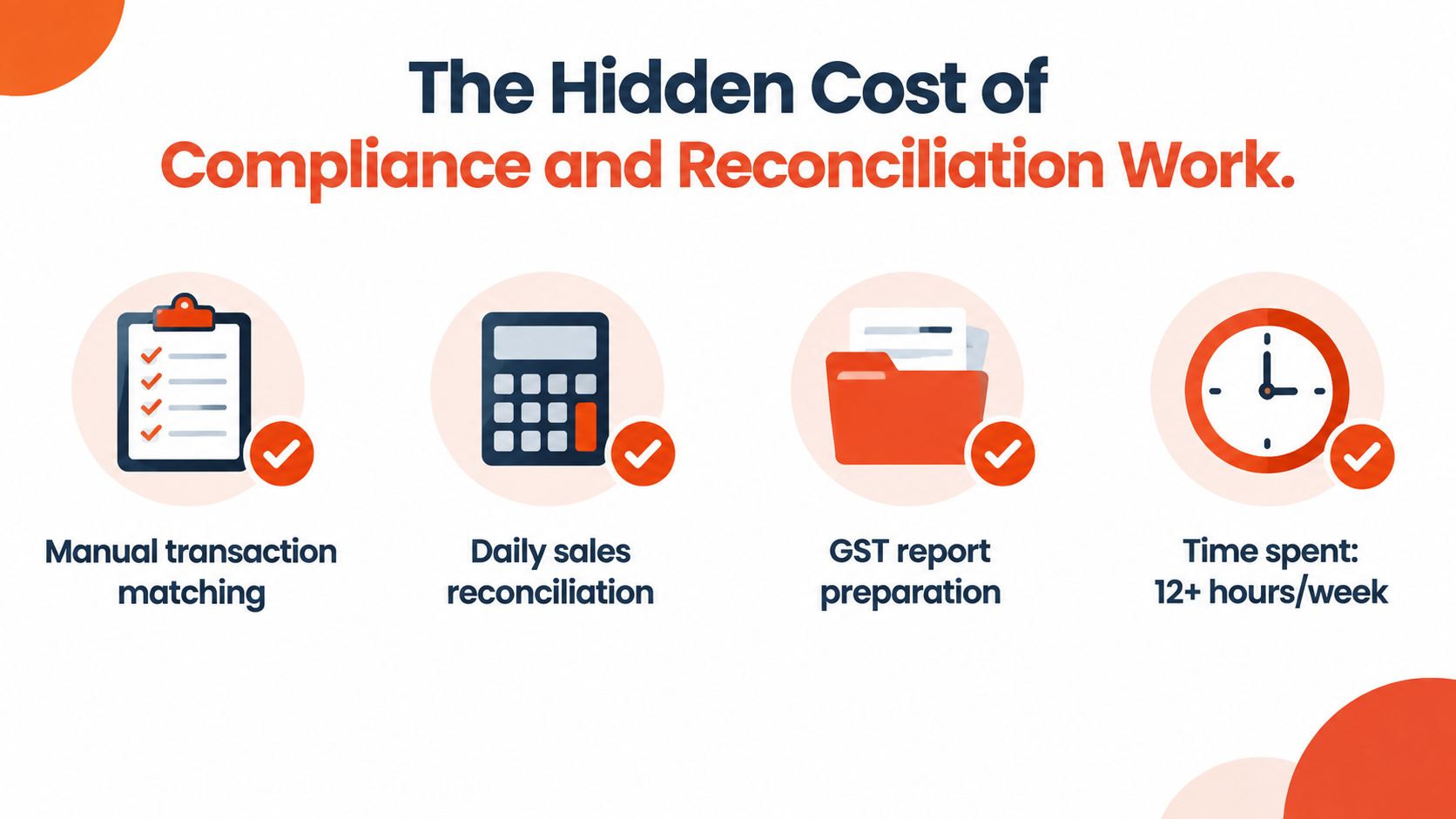
The wrong setup usually adds friction in small places first. A café with two front-of-house staff does not have time to export payment reports from one portal, sales from another, and invoices from a third system. The hidden cost is not a licence fee, it is the number of manual steps needed to produce a clean end-of-day close.
The strongest question to ask is not “What features does the POS have?” It is “How many handoffs does this POS remove?” If the answer still includes manual matching, spreadsheet fixes, or middleware just to move data into accounting, the system may be too heavy for a lean operation.
That is why a smaller team often benefits from the simpler commercial model, not the flashier one. Transparent fees, clear settlement terms, and direct reconciliation reduce the administrative load that drains late nights. For operators trying to bring down card-processing friction, lower-fee card transaction guidance is worth reviewing before contracts are signed.
A clean POS should support the basics without making the manager become an integration specialist. If daily sales, payment confirmations, and GST records do not line up quickly, the system has shifted work from the provider to the restaurant. That is the wrong direction.
The right POS does less in the background, because the restaurant already does enough during service.
For Singapore operators, compliance readiness and reconciliation speed are part of cash flow management. They are not back-office extras.
A switch should be treated like a service-critical change, not a software install. The safest migrations start with the current contract, the settlement cycle, and the actual busiest hours in the week, because that is where hidden problems surface first.
Audit the current setup. Check the contract end date, notice period, terminal ownership, and settlement timing. If the current provider is holding the business to a long cycle or awkward fee structure, that needs to be known before any move.
Plan the parallel run. Keep the old flow available while the new one is tested on a quiet day. That gives the team a fallback if menu mapping, receipts, or terminal connectivity behaves differently in live conditions.
Brief front-of-house before launch. Staff need to know where refunds, voids, and split bills sit in the new flow. A five-minute explanation before service is not enough for a switch that changes how the till works.
Go live off-peak. The best time to switch is the lowest-traffic service period, not the biggest dinner rush of the week. That reduces the chance of a queue forming while staff learn the new device.
Check settlement and closeout within the first week. If the cash flow timing is off, the switch has not really finished. The restaurant needs to see how quickly funds arrive and whether reports are readable without manual work.
The scheduling logic here is the same one that applies to any kitchen or outlet opening. Trail Star Development's opening timeline advice is useful because it treats lead times and dependencies as operational risks, not admin details.
A clean migration also depends on the handoff points being clear. That includes terminal delivery, activation timing, menu setup, receipt formatting, and who handles support if a device fails during a live shift. The point is not to make the switch feel invisible, it is to make the disruption predictable.
Singapore operators who want a structured migration path can review how to switch POS solution for your store before they schedule the cutover. The useful part is not the marketing language, it is the sequence of checks.
Useful rule: never decommission the old provider until the new settlement, reporting, and support chain have all been tested in service conditions.
A good switch preserves cash flow and staff confidence. A bad one makes both worse for a week.
Different restaurant formats break in different ways, so the right setup changes with the business model. The useful lens is ticket size, transaction volume, and how much the team can tolerate during peak hours.
Cafes live on speed, repeatability, and short queues. A compact Android terminal with clean counter flow usually fits better than a heavy software stack, especially when the team needs fast tap payments and simple modifier handling for drinks and add-ons. Settlement predictability matters here because small, frequent sales depend on steady cash flow.
Full-service dining needs stronger table-side workflow, split-bill handling, and clearer kitchen routing. A hybrid setup often makes more sense than a standalone payment device, because the order capture has to stay linked to the table while the payment side remains quick and reliable. The staff cannot afford a system that is good at payment but weak at service sequencing.
Chains need consistency more than novelty. The right setup is one that centralises menu updates, reporting, and settlement visibility while still leaving room for each outlet to run its own service patterns. Local support becomes more important here, because a problem at one outlet should not require a long back-and-forth with an offshore helpdesk.
Pop-ups and event stalls need portability, quick onboarding, and simple commercial terms. Hardware should be light, connectivity should be stable, and setup should not depend on a long implementation cycle. These operators are exposed to downtime more than permanent outlets, so the payment flow has to be easy to deploy and easy to pack down.
A practical Singapore option in this category is Sambapay, which provides smart Android POS terminals, card acceptance across major schemes, selected wallets, and settlement options as early as T+1 depending on the merchant agreement. That kind of setup suits operators who want in-store payment handling without overcomplicating the service floor.
The broad takeaway is straightforward. The right POS system is the one that matches the format's operational rhythm, not the one with the longest feature sheet. A format with fast turns needs speed, a format with complex service needs coordination, and a format with multiple outlets needs control.
The final choice usually comes down to three profiles. The cost-conscious operator should look for transparent pricing, no extra rental layers, and a settlement cycle that fits daily cash flow. The growth-focused multi-outlet owner should prioritise control, support quality, and reporting that stays consistent across sites.
The compliance-sensitive small team should inspect reconciliation load, GST handoff, and how much manual work the POS creates after closing. A provider that removes steps is usually stronger than one that adds features. If the provider operates as an authorised Independent Sales Organisation on global acquiring rails, that can also support longer-term pricing predictability and acquiring stability.
The true test is operational. If the POS helps staff finish service faster, close the day cleanly, and avoid repeated support escalations, it is doing its job. If it creates new spreadsheets, new logins, and new delays, it shifts the burden onto the restaurant.
If settlement timing and reconciliation overhead are costing you hours each week, Sambapay's local team can review your current setup and quote a custom rate. Sambapay offers restaurant-focused POS terminals, card acceptance across major schemes and selected wallets, and settlement options from as early as T+1 depending on the merchant agreement. For operators who want in-store payments with transparent pricing and local support in Singapore, a close look at Sambapay is a practical next step.