
You've opened the shop, the coffee machine works, the clinic front desk is ready, and then the question lands, how should payments run at the counter? The first terminal quote looks simple enough until the jargon starts, card schemes, settlement cycles, wallet acceptance, monthly fees, hidden charges, support contracts. For a Singapore SME, small business payment processing is not a back-office detail, it shapes queue speed, staff workload, and how fast cash reaches the bank.
A new café owner in Singapore can spend weeks choosing chairs, POS displays, and menu boards, then end up staring at payment proposals that all sound the same. One provider says “low rates”, another says “fast settlement”, a third bundles hardware and software in a way that looks neat until the monthly bill arrives. The real decision is not which logo sits on the terminal, it's which setup keeps the counter moving and the cash flow healthy.
That matters in a market where 97% of retail point-of-sale transactions are cashless and digital payments are projected to grow from USD39.37 billion in 2023 to USD113.65 billion by 2030 according to PwC Singapore's payments outlook. For a shop, salon, clinic, gym, or café, in-store card and wallet acceptance isn't a nice extra. It's a basic operating requirement.
Practical rule: if the counter is busy, the payment system has to disappear into the background. Customers should tap, pay, and leave without the staff thinking about the terminal.
That's why it helps to choose the right payment processor with the same seriousness used for rent, staffing, and suppliers. A provider that looks cheap on paper can still create more friction than it saves if the terminal is slow, the settlement is delayed, or the fee structure is hard to reconcile. In Singapore, the right system is the one that fits the business's daily rhythm, not the one with the loudest sales pitch.
A card payment moves through a simple chain, even if the jargon makes it sound complex. It is like a four-person relay race. The customer starts the run, the merchant's terminal passes the transaction onward, the banks check and confirm the details, and the payment network carries the baton between them.
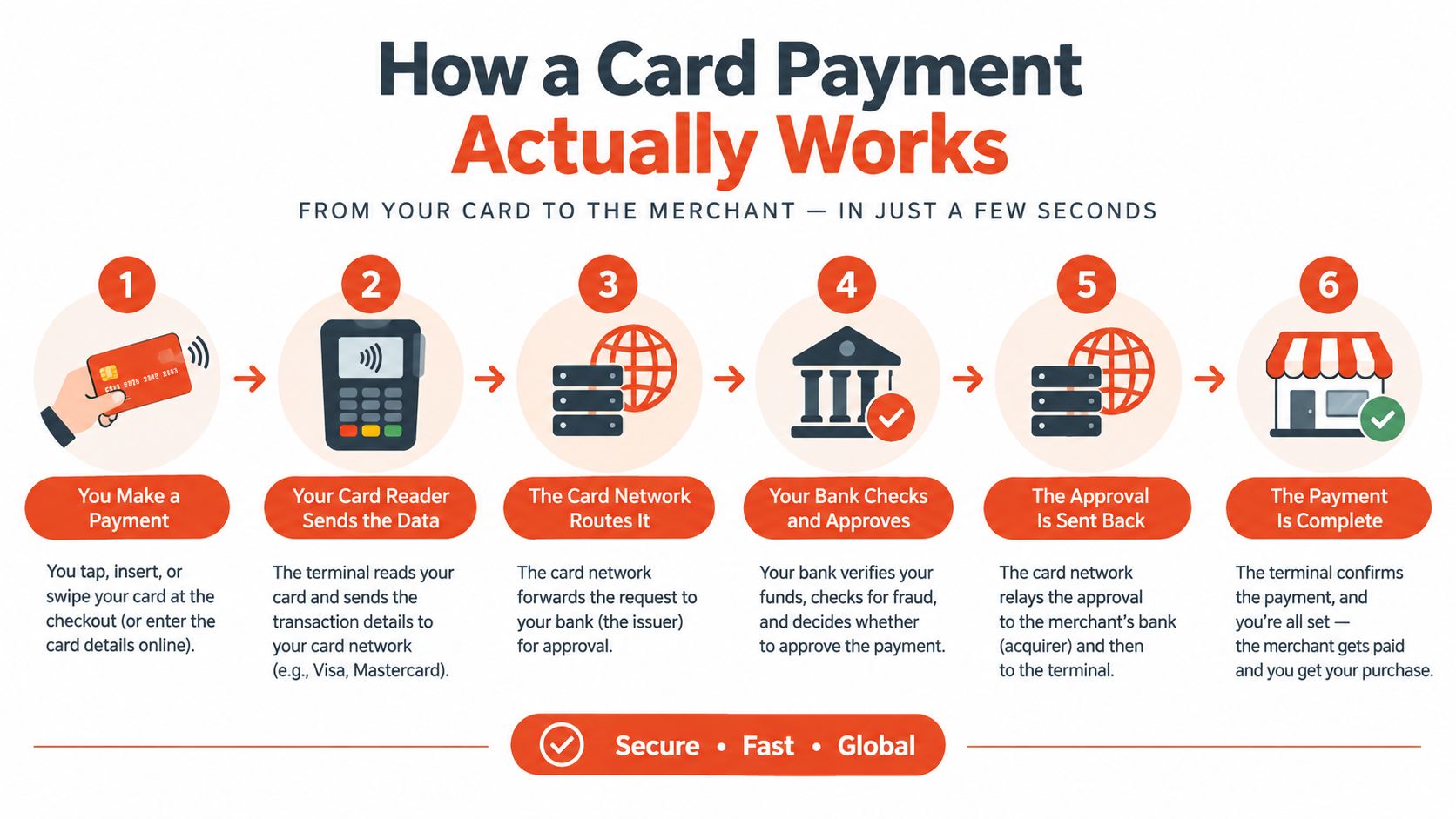
At the counter, the customer taps or inserts a card. The terminal sends the payment request for approval, the issuing bank checks whether the card is valid and whether the transaction can go through, and the authorisation comes back in seconds. After that, the transaction is batched for settlement, which is the step that moves the funds to the merchant account.
The four parties are easy to separate once the flow is clear:
That structure explains why card acceptance still sits at the centre of in-store commerce in Singapore. Digital payment adoption reached 92.0% in 2025, and card payments totalled SGD 148.91 billion in 2024 according to PwC Singapore's payments report. The terminal isn't just collecting money, it's doing the last-mile work that keeps the checkout line short.
For broader context on online and subscription-style flows, handling international SaaS payments uses a similar authorise-settle logic, even though the customer experience sits on a website rather than a counter. That's useful to know because many owners eventually add online ordering, deposits, or membership billing.
The same logic applies when comparing payment providers in store. If the processor can't explain who authorises, who settles, and where the money lands, the setup is probably too opaque for a small merchant. A clean transaction flow should be boring, predictable, and fast.
For merchants mapping the checkout journey to a local payment page, the credit card payment flow reference can help anchor the basics in a familiar sequence.
The hardest part of payment processing is usually not the technology, it's the bill. The headline rate often looks tidy, but the final cost can change once terminal rental, statement fees, premium card costs, and contract terms show up. In Singapore, where average processing charges have been estimated at about 1.5% to 3% of transaction value in one local media estimate, pricing clarity matters more than glossy marketing claims The Straits Times.
A good way to judge a quote is to identify which of these structures it uses:
| Pricing Model | How It Works | Best For |
|---|---|---|
| Interchange-plus | The provider passes through network costs and adds a markup | Merchants that want transparency and can read statements carefully |
| Tiered | Transactions are grouped into rate bands, often with less visibility into the true cost | Businesses that can tolerate complexity, but usually not ideal for smaller operators |
| Blended | One all-in rate is applied across transactions | Cafés, salons, clinics, and shops that value predictability |
A blended rate is often the easiest for a new owner to budget around. The trade-off is that it can hide the actual cost of different transaction types, so the provider's promise has to be backed by a clean statement and no surprise add-ons. Interchange-plus is more transparent, but it's harder to track if the owner doesn't have time to decode every line item.
A payment quote is only useful if the owner can tell, at a glance, what changed from last month. If the statement needs a phone call every cycle, the pricing model is already costing time.
Tiered pricing is the one that often causes frustration. A merchant may be told that the rate is low, only to find later that most sales do not qualify for the cheapest band. That is especially painful for cafés, bakeries, and clinics where ticket sizes are modest and margin leakage shows up quickly.
The simplest way to compare providers is to examine the total cost of ownership, not just the headline fee. For a clear breakdown of the local structure, the merchant discount rate guide is a useful reference point. The question to ask is not “what is the rate?”, it's “what will a normal month cost once all the moving parts are added together?”
That mindset is more useful than chasing the lowest advertised figure. For a small merchant, predictability often beats theoretical savings that only appear on the sales slide.
A payment terminal should make the counter faster, not more complicated. In a busy retail shop or café, the difference between a modern terminal and an old clunky unit shows up in staff confidence, checkout speed, and the number of times someone has to ask the customer to wait while the screen catches up. The best hardware is the piece nobody has to think about.
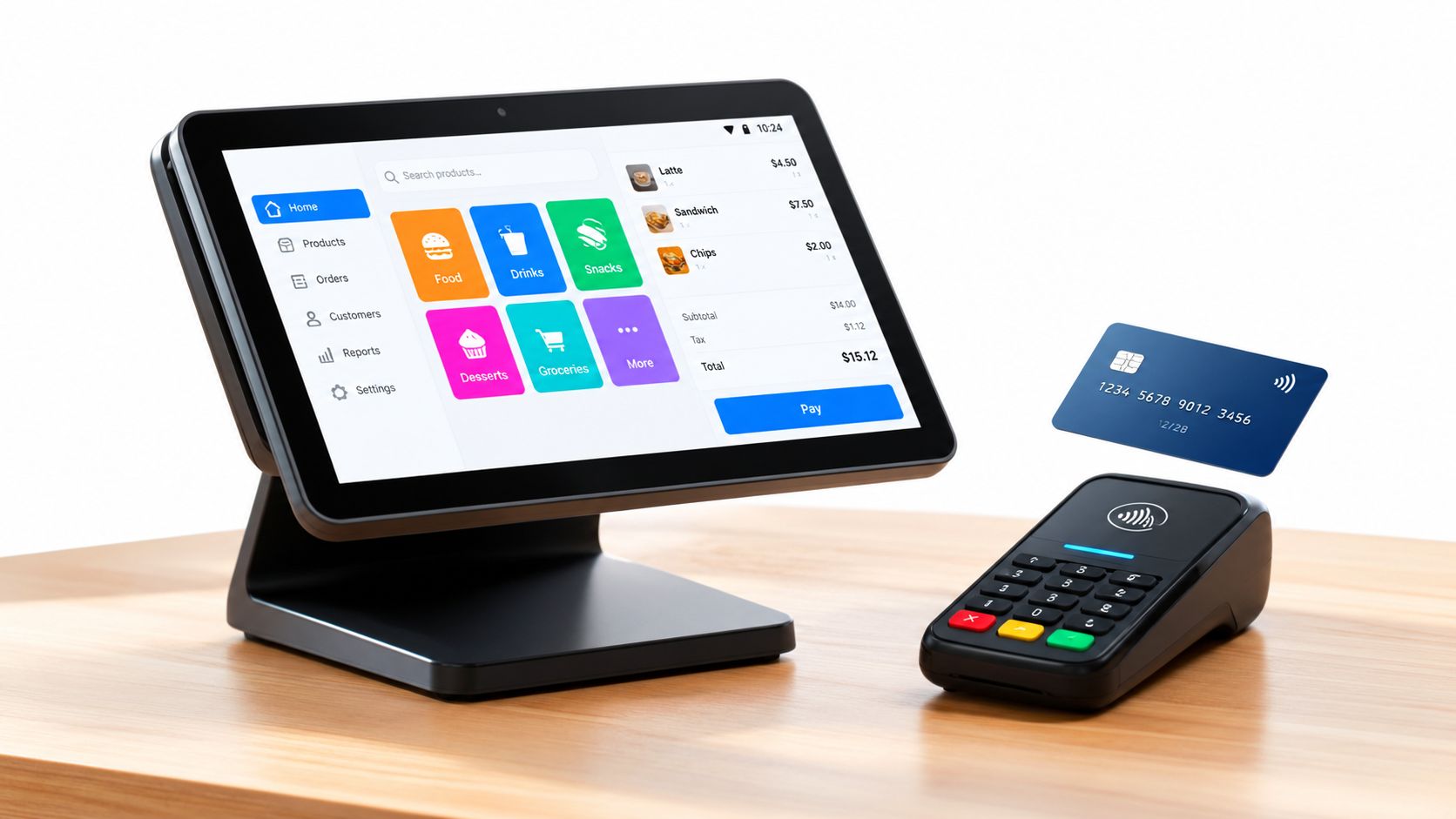
Modern Android-based POS terminals tend to be easier for new staff because the interface feels familiar, and the screen layout can be simpler to learn than older banking-style devices. That matters in businesses with turnover, shift work, or part-time staff. A terminal that takes two minutes to explain every morning becomes a drag on service.
A useful terminal review starts with practical questions:
The terminal also shapes the customer's impression of the business. A delayed tap, a frozen screen, or a rejected transaction after the card has already been presented makes the whole counter feel unreliable. That's not just inconvenient, it can undermine trust in a business that's otherwise running well.
The video below is useful for seeing how terminal usability affects day-to-day checkout flow.
For an owner weighing hardware and processor together, the right question is whether the terminal, software, and settlement setup behave like one system. If they don't, reconciliation gets messy and staff waste time on work that should have been automated. Sambapay is one option in this category, with smart Android POS terminals, card acceptance across major schemes and selected digital wallets, and local installation support for Singapore merchants.
For a café, salon, or clinic, the sale is only half the story. The other half is when that money becomes usable cash in the business account. If the terminal approves transactions quickly but the settlement arrives slowly, the owner can still face a working capital squeeze even when sales are healthy.
That's why payout timing matters as much as the fee rate for cash-sensitive businesses. Singapore's digital payment adoption reached 92.0% in 2025, and merchants increasingly expect near-real-time fund movement, with T+1 settlement becoming a meaningful benchmark for day-to-day liquidity according to Asian Banking & Finance. When stock has to be reordered, wages still need to be paid, and suppliers don't wait for month-end statements, settlement speed becomes operational, not technical.
A café may clear a strong Friday service, then wait days for the funds to land. During that gap, the owner still has to buy milk, bread, packaging, and ingredients for the next service. If the processor settles slowly, the business can end up borrowing from its own margin just to keep trading.
That's why many merchants now ask about settlement before they ask about features. A provider that offers fast access to funds reduces pressure on daily cash handling and makes bookkeeping easier. It also helps when the business is seasonal, high-volume, or dependent on same-day replenishment.
Working capital rule: if the business buys inventory every day, the payment system should return cash fast enough to support that cycle.
The right comparison is not only fee versus fee, it's fee plus settlement versus fee plus settlement. A cheaper processor that holds money longer can be more expensive in practice if it forces the owner to keep extra cash idle. For merchants that already deal with tight operating buffers, that distinction is big.
For a closer look at how funds move after authorisation, the card payment settlement overview is a useful local reference. Businesses that also receive foreign collections sometimes use tools like how to get a USD account for cross-border receipts, but in-store Singapore merchants usually feel the settlement issue first in local operating cash.
The right provider in Singapore should solve daily operational problems, not just sell payment acceptance. That means looking past the polished brochure and checking whether the offer is transparent, stable, and easy for staff to live with. A merchant is buying a working system, not a promise.
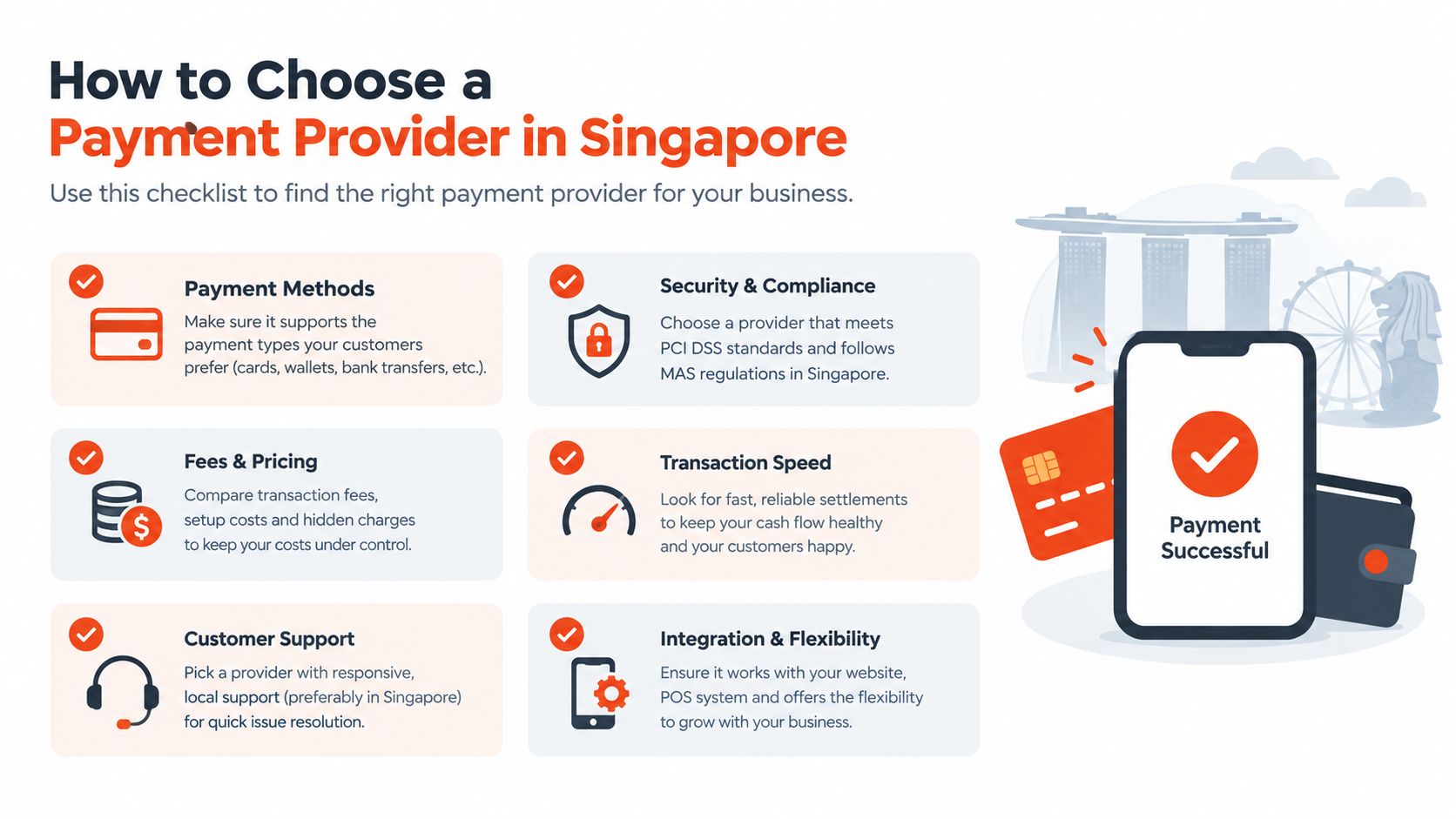
A solid provider comparison should test five areas:
Card usage still matters even in a market that talks a lot about wallets and QR. Card payments represented 34.72% of point-of-sale transaction value in 2025 in Singapore, according to Statrys' market summary. That means the provider has to handle cards well, but it also has to make room for QR codes and wallets without making reconciliation a mess.
The practical test is simple. Ask how the provider handles refunds, failed taps, settlement questions, and terminal faults on a busy Friday evening. If support only exists in a generic ticketing queue, the merchant may save a little on paper and lose a lot when the counter stalls. A local contact who understands Singapore merchant operations is worth more than a vague promise of “24/7 service”.
For brick-and-mortar SMEs, one option to evaluate is Sambapay, which combines in-store card acceptance, selected wallets, modern POS hardware, transparent blended pricing, and local support. That kind of package is easier to assess because the costs and operational pieces sit in one place instead of being scattered across separate vendors.
The final comparison should look at total business impact. The best provider is the one that keeps the checkout line moving, settles funds predictably, and gives the owner confidence that the next service won't be disrupted by a payment problem.
A payment processor is part cashier, part treasury tool, and part customer experience layer. For a Singapore SME, the right choice usually comes down to three things, transparent fees, reliable hardware, and fast settlement. Once those are in place, support and onboarding become the difference between a smooth launch and a stressful one.
The smartest owners don't chase the cheapest headline rate. They choose a system that fits the way the business earns money, serves customers, and pays suppliers. In Singapore's cashless environment, that decision has a direct effect on daily operations.
If a Singapore café, shop, salon, clinic, or gym needs a practical in-store payment setup, Sambapay offers card processing, modern POS terminals, selected digital wallet acceptance, and settlement options designed for everyday merchant cash flow. Visit Sambapay to review the setup, compare the commercial terms, and see whether it fits the way the business operates at the counter.