
The café queue is moving, the cashier has entered the amount, and a customer holds a card over the terminal. A beep sounds, but the screen still says processing. Should the customer tap again, wait, or check the banking app? Across the counter, the cashier faces the same uncertainty, with another order waiting.
To pay by credit card confidently, both sides need more than a working tap. Customers need to recognise confirmation, authentication and unfamiliar statement entries. Merchants need a dependable terminal, clear settlement records and staff who know how to handle exceptions without turning a minor interruption into a disputed payment.
At a Singapore café counter, the customer sees a terminal and a receipt. Behind that checkout, the merchant's payment provider sends an authorisation request towards the bank that issued the card. The issuing bank checks the request against the card account and returns an outcome.
A credit card payment isn't an immediate transfer of the customer's own cash. It's a request to use available credit, followed by processing that records the purchase and pays the merchant under its payment agreement. That distinction explains why an approved transaction, a pending banking-app entry and money arriving in the merchant's account aren't the same event.
The diagram below illustrates the checkout journey.
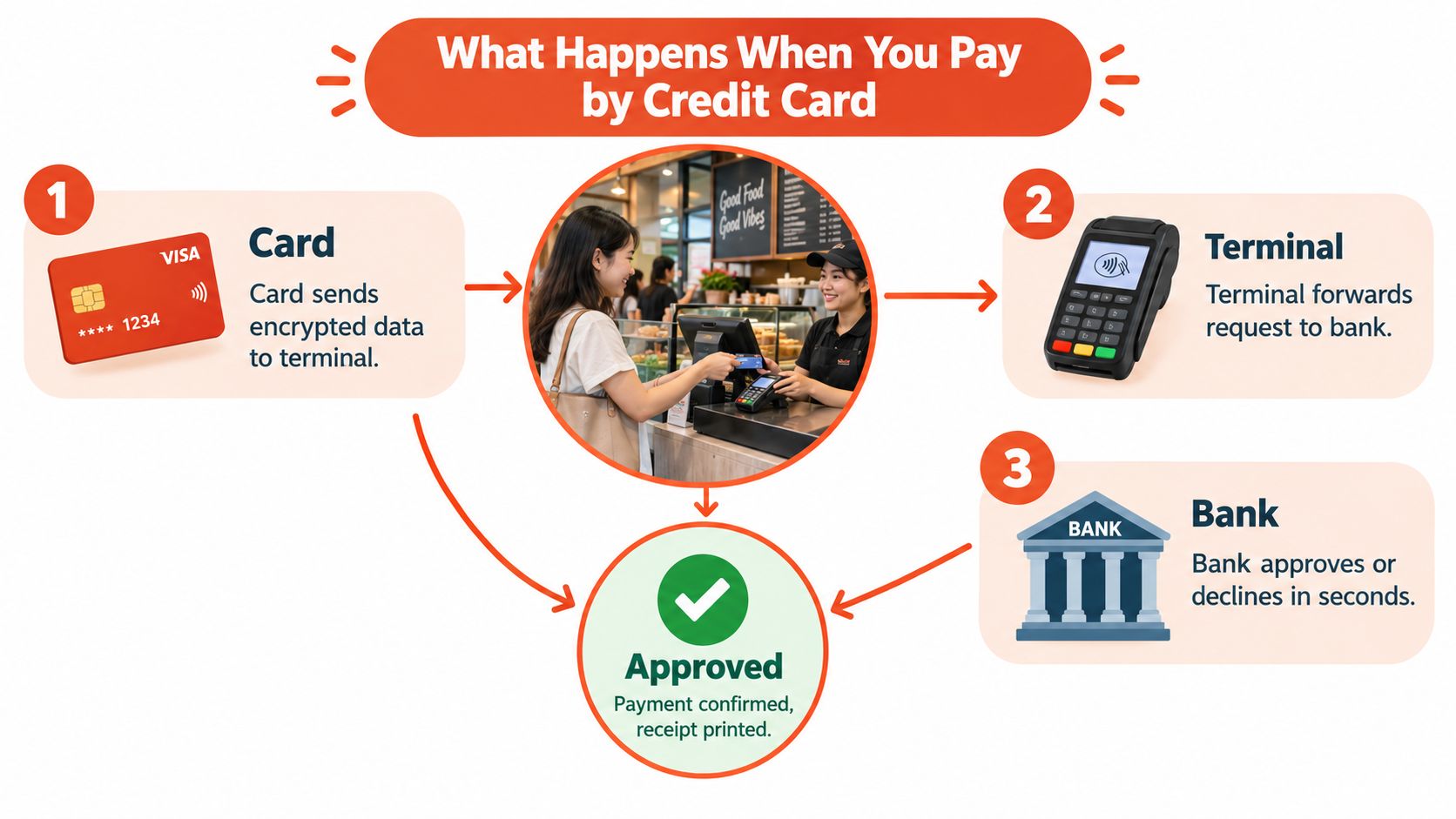
For the customer, approval means the issuer has authorised the purchase. The customer still needs to repay the card account according to its terms. For the merchant, approval is evidence that the transaction can proceed, not a substitute for checking settlement later.
Singapore's checkout activity makes these distinctions operationally important. MAS recorded 321 million POS credit and charge-card transactions worth S$26,716 million in H1 2025, with an average transaction size of approximately S$83, in its retail-payment statistics. Card acceptance belongs in everyday operating procedures, not just occasional high-value sales.
| Payment environment | What the customer encounters | What the merchant must manage |
|---|---|---|
| In-store card-present | A card or supported wallet interacts with a terminal | Terminal confirmation, connectivity and receipts |
| Online card-not-present | Checkout fields and possible bank authentication | Secure checkout, payment status and order confirmation |
Checkout principle: A beep is a cue to check the result, not permission to assume the sale succeeded.
Good staff training starts with that distinction. The cashier should confirm the amount and final status before handing over goods, while the customer should leave with a recognisable record of the purchase.
At an attended counter, the customer should check the displayed amount before presenting a card or device. The cashier should make the screen visible rather than asking the customer to approve an amount that's hidden behind the till.
Contactless cards and supported phone wallets make that interaction straightforward.
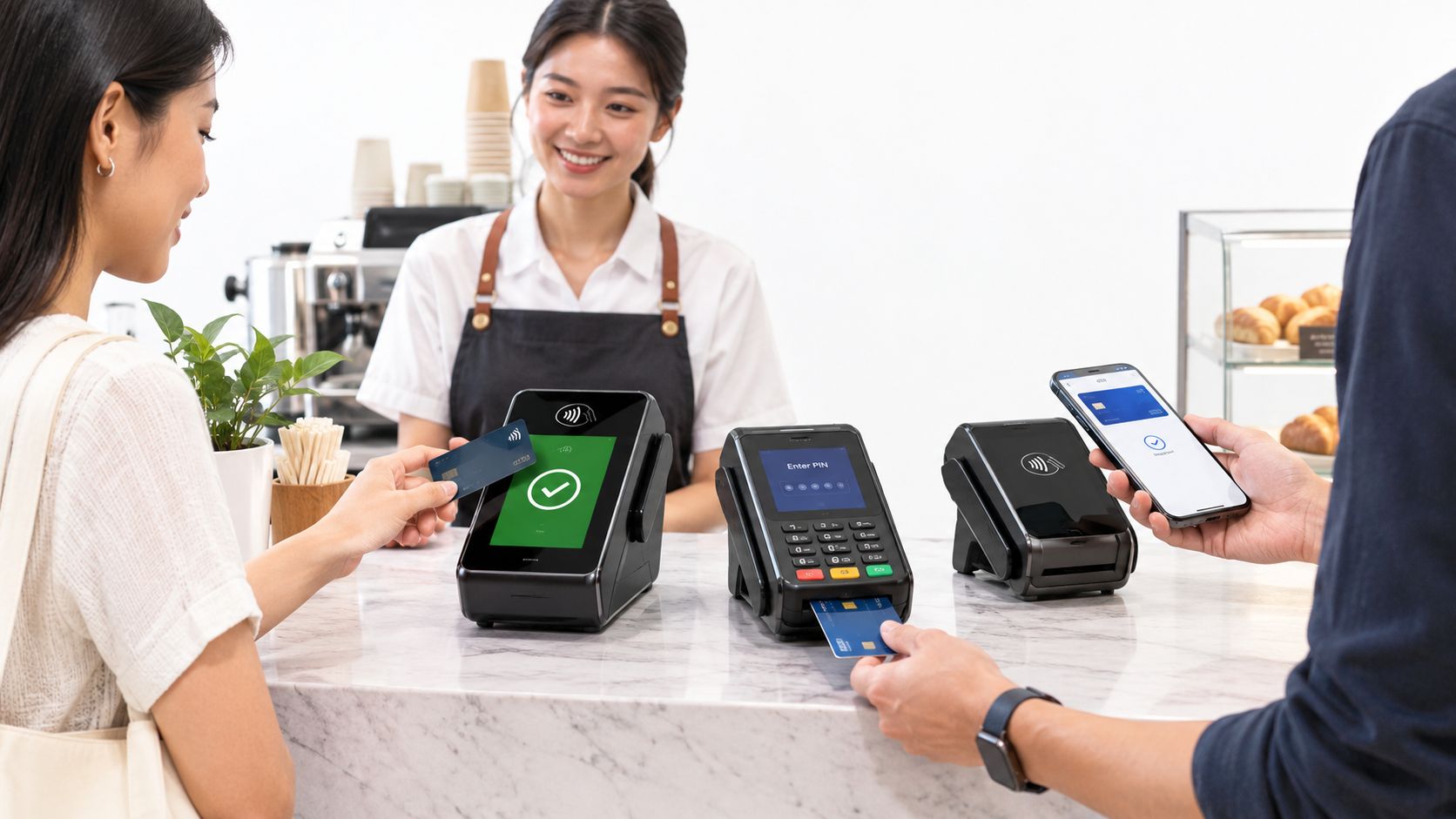
A phone or watch wallet is another way to present a supported card through contactless checkout. With Apple Pay or Google Pay, the customer selects the intended card and completes device authentication when requested. The Apple Pay Singapore guide provides further context for customers and merchants using that flow.
Not every wallet payment is necessarily a credit-card payment. A merchant accepting GrabPay or another wallet should distinguish the wallet's payment route from a card presented through a device. Acceptance logos alone don't explain which account funds the purchase.
The embedded video provides a further visual reference for the payment interaction.
A routine coffee purchase and a salon package may produce different verification prompts. There isn't a universal amount that guarantees PIN-free payment across every card, device and terminal configuration.
Processing should feel brief, but an unexplained pause deserves a status check, not another tap. Staff should read the display, and the customer should wait for the final result before putting the card away.
A customer buying supplements online may encounter card-entry fields, a bank authentication screen and an order confirmation. Those screens belong to a connected payment journey, but each confirms something different. Successfully entering an OTP doesn't, by itself, prove that the merchant has completed the order.
The payment gateway connects the website's checkout to payment processing. The issuer still decides whether to authorise the purchase, while the merchant must associate the payment result with the correct order.
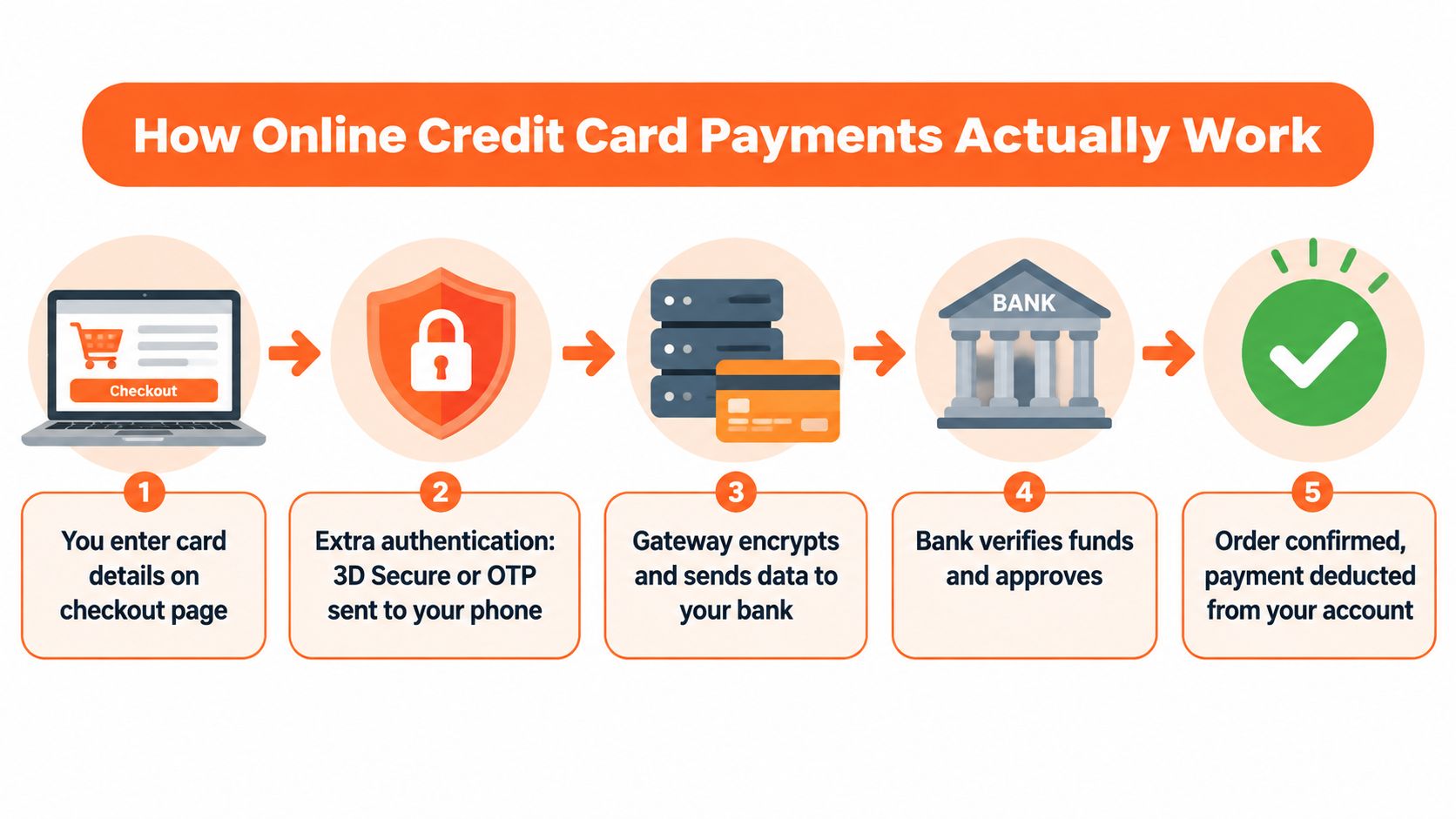
The illustration simplifies the sequence: authentication and authorisation can vary by checkout configuration. Its final account-deduction label shouldn't be read as a debit-card cash transfer. A credit purchase is recorded against the card account.
A checkout may use 3D Secure, an authentication process that can involve an OTP or approval through the bank's app. Some transactions proceed without a visible challenge; others require extra verification. The absence of an OTP isn't automatically suspicious, and an OTP prompt isn't automatically trustworthy.
The useful checks are contextual:
For merchant teams, a Singapore payment gateway comparison can help frame checkout-selection questions. In a tuition business, payment processing also needs to connect with lesson invoices and customer balances; Tutorbase billing is a relevant resource for reviewing that billing workflow.
Saved-card systems can use a token, a substitute credential, rather than retaining the card number in the merchant's own application. Customers shouldn't assume every website stores information this way merely because it offers a save-card checkbox.
For a clinic deposit requested through SMS or WhatsApp, the safer approach is to verify the request through the clinic's known contact details or official website before entering payment information. A familiar logo and urgent wording aren't sufficient checks.
A decline and a timeout need different responses. A decline means the payment request received an unsuccessful outcome. A timeout means the expected response wasn't received within the system's waiting period, leaving staff to establish what happened.
An issuer may decline a request because of available credit, a blocked card or a security decision. A terminal or processing connection can also fail independently of the customer's account. Weak connectivity is a reason to investigate a timeout, but staff shouldn't diagnose every interruption as a signal problem.
| Display or account status | Practical interpretation | Appropriate action |
|---|---|---|
| Approved | The terminal received approval | Complete the sale and retain its reference |
| Declined | The request wasn't approved | Read the message and use another permitted payment method if necessary |
| Timed out | The outcome needs investigation | Check transaction history before retrying |
| Pending account entry | The bank shows an authorisation or unresolved entry | Compare it with the merchant record rather than assuming a completed charge |
A timeout isn't a definitive decline. Repeated blind retries can turn an uncertain payment into several uncertain payments.
The customer should confirm that the intended card is selected in the wallet. Staff should check the terminal's transaction history and contact their payment provider when the outcome remains unclear. The provider managing the merchant's card acceptance is commonly called the acquirer.
Merchants should record approved, declined, reversed, timed-out and manually retried transactions separately. An approval-rate headline won't reveal how often customers wait while staff restart a payment.
MAS's national POS benchmark reports 682 million credit and charge-card transactions totalling S$54.540 billion, with an average ticket of approximately S$80, in its H2 2025 retail-payment publication. Those are national benchmarks, not promised results for any terminal.
A useful merchant test covers authorisation, receipt generation, connection recovery, refunds and end-of-day settlement under normal and busy conditions. Staff should reconcile terminal totals against the acquirer report daily and investigate differences using transaction references and response codes.
The customer's payment record starts at checkout and continues through the card statement. A merchant receipt identifies the sale, an online confirmation identifies the order, and the statement identifies what reached the card account. Keeping those records together makes an unfamiliar entry easier to investigate.
A café's trading name may differ from the description shown on the statement. That mismatch deserves checking, but it doesn't automatically mean fraud. Merchants should explain their payment descriptor clearly and ensure receipts show enough information to identify the purchase.
The founder's guide to reconciliation from Jumpstart Partners is a relevant resource for owners organising the business side of this matching process. Customers benefit from the same discipline: a clear record beats relying on memory.
A cancelled clinic appointment may leave the original purchase visible alongside a separate refund or reversal. The customer should compare the amounts and statuses rather than expect the original line to disappear. Staff should explain which action was taken and provide confirmation without promising an arrival date they can't control.
A refund should be linked to the original sale. Where tracing is needed, the merchant's payment provider may supply an acquirer reference number; the acquirer reference number explainer helps clarify its role. That reference isn't necessarily the same as an order number or the identifier printed at checkout.
Recordkeeping habit: Keep refund evidence until the credit appears and matches the agreed amount.
Statement review should also include applicable foreign transaction charges and the total amount due. Unrecognised purchases should be flagged promptly, with attention to the issuer's dispute requirements rather than an assumed universal deadline.
Security depends on ordinary routines: checking the merchant, following verification prompts and keeping control of the card account. A convenient payment method doesn't remove the need for those checks.
Visa's Singapore security roadmap reports a 2025 card-not-present fraud rate of 16.2 basis points, compared with 11.7 basis points across Asia-Pacific, and identifies cross-border fraud as a major source of losses in its Singapore security roadmap. These figures aren't an in-store fraud rate or a performance measure for a particular provider.
The checklist provides a visual reminder of these habits.
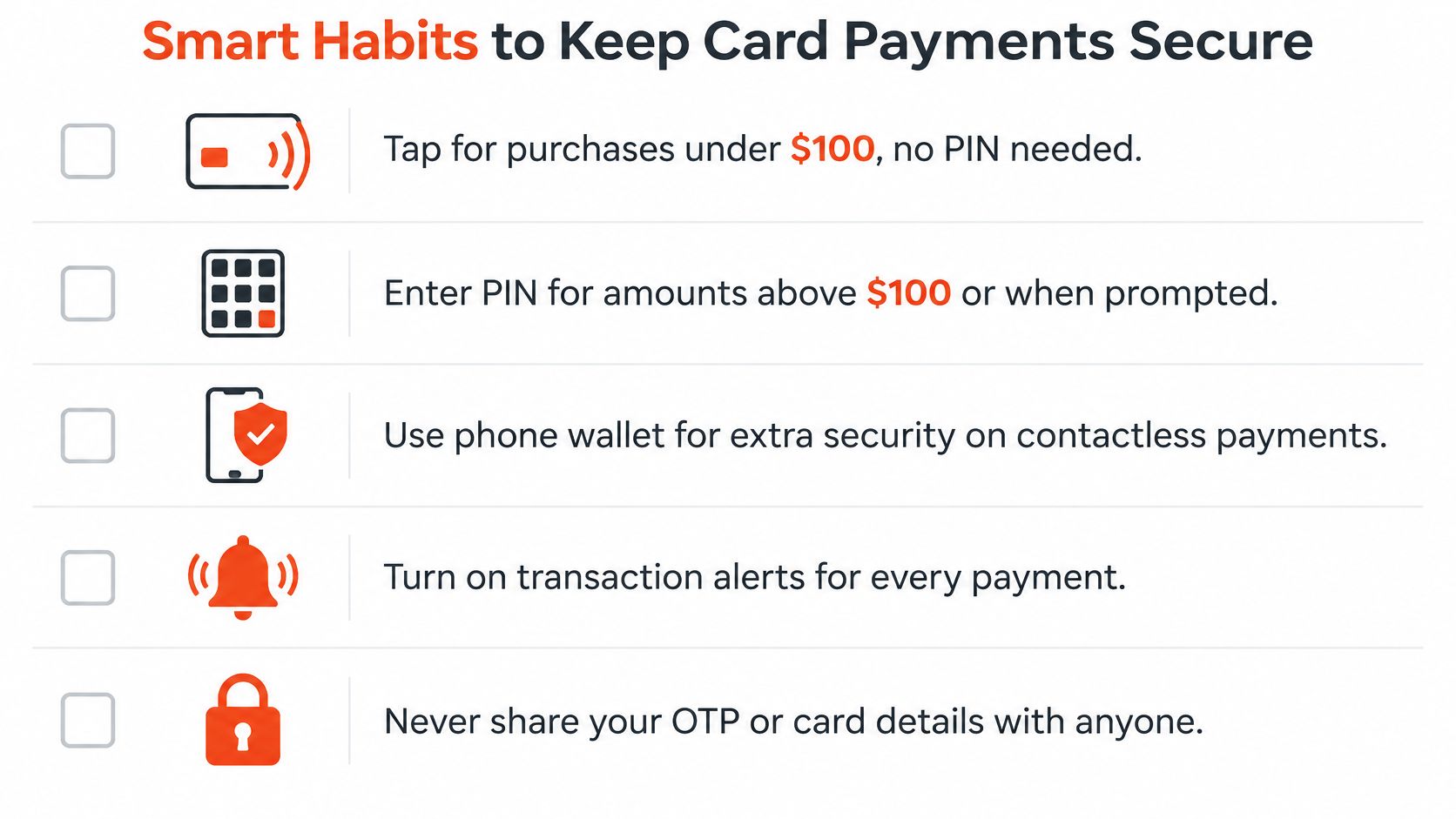
Any fixed contactless threshold shown in a visual should not be treated as a universal rule. The applicable card, wallet and terminal requirements govern the transaction.
Singapore's credit-card rollover balances reached S$9.64 billion in Q2 2026, up from S$9.4 billion at the end of 2025, according to the figures discussed in PwC's Singapore payments overview. Broad acceptance doesn't remove the risk of accumulating debt.
Paying the statement in full differs from carrying a balance or agreeing to an instalment plan. Customers should check their card's interest, fees and repayment conditions before choosing among them. Cashback doesn't automatically offset borrowing costs.
Merchant security should be equally routine: supervisor approval for sensitive exceptions, refunds tied to original sales, and no informal storage of card details. Quiet consistency is more useful than dramatic reactions after something goes wrong.
The immediate priority is to preserve evidence and establish the payment status. A customer should capture the terminal reference or order number and, where relevant, a screenshot showing a pending entry or apparent duplicate. Staff should record the displayed outcome without copying sensitive card details.
A chargeback is a dispute handled through the issuer and card-payment process, not another name for a merchant refund. Customers should give accurate evidence; merchants should preserve the sale record, relevant terms and correspondence.
Owners dealing with broader repayment pressure can consult the guide to business debt recovery for owners from MyOfficeOps. Business debt planning is a separate task from tracing an individual card transaction.
Good card payments feel invisible because staff, terminals, payment networks and banks complete their respective tasks. When a transaction stops feeling routine, a clear status check and usable records provide the way forward.
Sambapay offers Singapore SMEs in-store POS terminals, card processing, transparent blended pricing and local payment support. Merchants reviewing their checkout setup can visit Sambapay to discuss accepted payment methods, settlement terms and a practical installation plan for their business.