
A customer is waiting at the counter, phone already open, while the shop owner checks the terminal and asks whether Alipay is supported. For a Singapore SME, the answer usually isn't a separate Alipay merchant account sitting beside NETS, cards, and PayNow. Alipay or Alipay+ is more often enabled as one wallet within an existing acquiring relationship, with the provider handling much of the payment connection while the merchant handles documents, staff readiness, signage, refunds, and reconciliation.
That distinction changes the buying decision. The practical questions are who contracts with the business, which wallets are covered, how funds reach the Singapore bank account, and whether the outlet serves enough cross-border customers to justify another payment method. Singapore's Alipay story has moved from tourist-facing acceptance to wider retail and everyday merchant coverage, but broader availability doesn't mean every outlet will see worthwhile demand.
A Tampines beverage shop owner may hear the Alipay question from a visitor, glance at the existing card terminal, and assume a new standalone product is required. In many Singapore setups, that assumption leads to unnecessary work. The merchant normally approaches a licensed acquirer or payment aggregator, signs its commercial agreement with that provider, and enables Alipay+ alongside other supported payment methods. Singapore-focused payment guidance describes this as the usual route rather than a direct in-store Alipay merchant sign-up flow. Singapore Alipay merchant guidance
The physical experience can be simple. A customer scans a QR code or uses a compatible terminal, the provider routes the transaction through the relevant wallet network, and the merchant receives settlement according to the acquiring agreement. The merchant statement may show Alipay transactions beside card and local payment activity, rather than requiring a separate operational ledger.
The provider generally manages the network connection, merchant account configuration, transaction routing, settlement file, and technical activation. Depending on the chosen setup, it may also supply or configure the terminal, create the SGQR arrangement, and provide access to transaction reporting.
The merchant still needs to ask what “Alipay supported” means. One activation may cover only a subset of cross-border wallets unless the provider explicitly supports Alipay+ in Singapore, so the coverage list belongs in the proposal and contract, not just in a sales conversation.
The owner must submit accurate business information, nominate the settlement bank account, train staff to identify successful payment prompts, explain refunds, and place acceptance signage where customers can see it. A technically enabled wallet can still produce few completed transactions if shoppers don't know it is accepted. Singapore merchant guidance highlights cashier training and visible acceptance marks as part of a workable go-live process. NETS merchant guidance
Singapore's early rollout shows why the channel matters. Alipay expanded into Singapore in 2015, and by August 2017 had reached about 20,000 acceptance points, after a ComfortDelGro tie-up added acceptance across 17,000 taxis, while more than 600 merchants had been onboarded through CC Financial Services. The Straits Times report on Alipay acceptance The lesson for a new merchant isn't that every shop needs Alipay. It is that acceptance has historically scaled through local partners and merchant infrastructure, not only through individual direct sign-ups.
A provider can't assess an application properly if the business profile, bank details, and operating information are incomplete. Most delays occur during verification, so the owner should assemble a clean onboarding pack before comparing commercial terms.
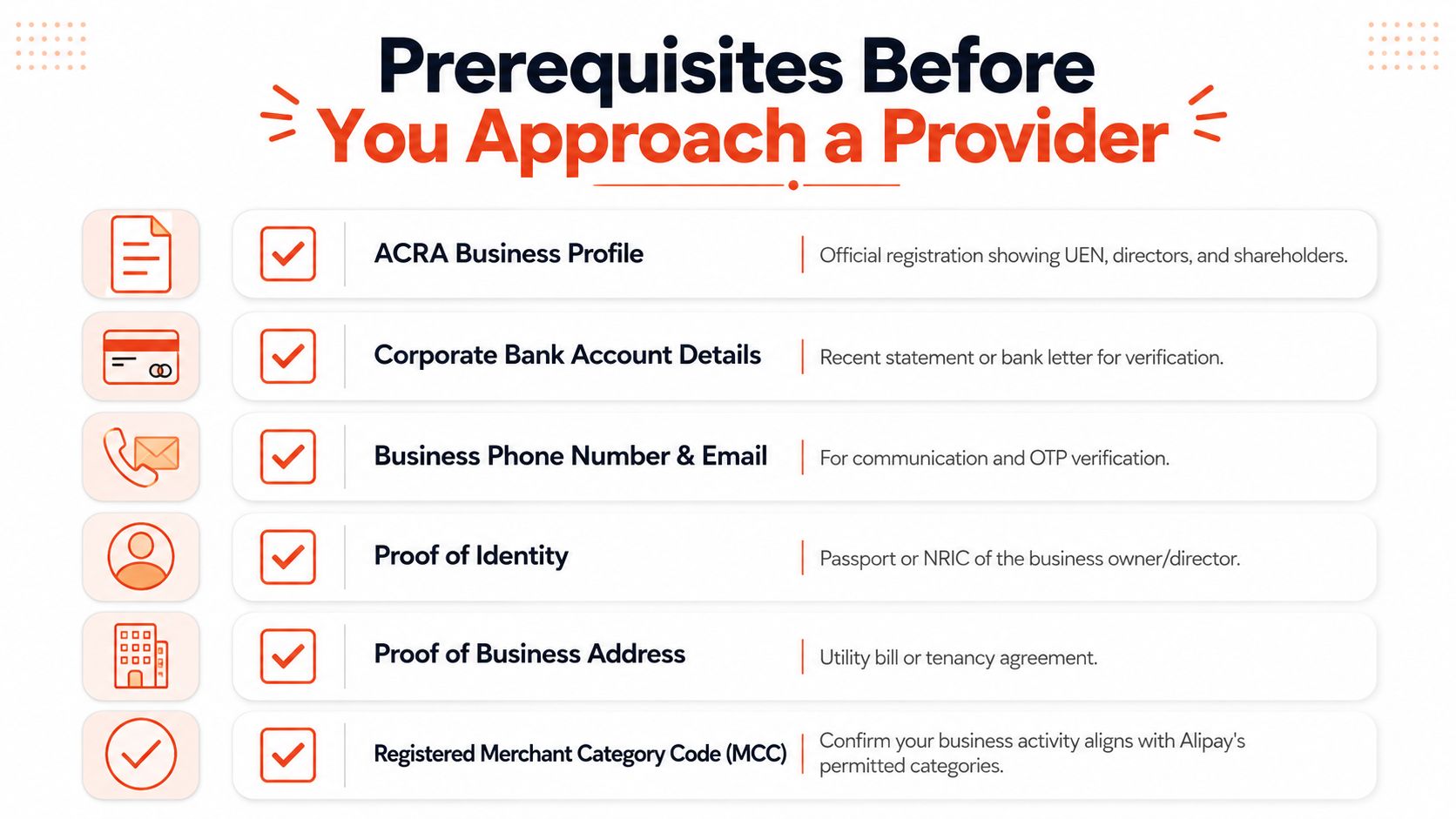
The business should also keep sector-specific approvals current. A food outlet may need relevant food-related permissions, while a shop in a managed commercial premises may need supporting tenancy or landlord documentation. The provider's exact list takes priority, but early preparation reduces repeated uploads and conflicting versions.
A merchant can review the wider Singapore merchant account setup before contacting providers. The useful question isn't whether every document exists. It is whether the legal name, address, bank account, business activity, and beneficial ownership information tell the same story across the application.
The owner should record the existing POS provider, preferred payment route, outlet locations, average basket description, refund process, and whether sales happen only in-store or also online. Exact forecasts aren't necessary at the first conversation, but a sensible monthly volume range helps the provider assess the account.
Practical rule: If a document has changed recently, submit the current version rather than relying on a previously approved file.
The right Alipay route depends on how customers pay at the counter, not on which logo appears most prominently in a sales deck. A busy restaurant with an existing card terminal has different needs from a market stall that already relies on a printed QR display.
POS terminal enablement suits merchants that already take card payments on a countertop or Android terminal. The provider may activate the wallet scheme on the existing device, allowing staff to keep one checkout flow for cards and supported wallets. This is usually the cleanest option for shops that need a customer-facing confirmation on the terminal and a familiar end-of-day report.
SGQR or equivalent multi-scheme QR works well for hawker counters, coffee shops, wet-market stalls, and small retailers that don't need a card terminal for every transaction. In April 2023, Alipay+ was added to SGQR and made available at about 11,000 hawker centre stalls, coffee shops, wet markets, and industrial canteens. The Straits Times coverage of Alipay+ and SGQR The value is breadth at the point of acceptance, but staff need a reliable way to confirm payment before handing over goods.
A direct Alipay QR can suit a highly tourist-oriented business that wants a dedicated Alipay presentation or a specialised aggregator relationship. It may offer a focused reporting experience, but it can create another device, another reconciliation view, or a narrower wallet footprint. The provider must explain whether the QR supports Alipay only or a wider Alipay+ partner set.
| Integration Path | Best Suited For | Typical Settlement | Main Trade-Off |
|---|---|---|---|
| POS terminal enablement | Existing card-led shops and restaurants | Provider payout cycle in SGD | Lowest counter clutter, but depends on terminal and acquirer support |
| SGQR or equivalent QR | Hawker stalls, small retailers, and compact counters | Provider payout cycle in SGD | Broad QR convenience, but payment confirmation and signage need discipline |
| Direct Alipay QR | Strongly tourist-facing outlets | Provider payout cycle in SGD | Focused wallet experience, but may create separate reporting or coverage limits |
The merchant should compare cut-off times, refund handling, reporting detail, and all-in pricing rather than choosing on transaction rate alone. A neutral overview such as OneSafe compares Alipay offerings can help clarify the distinction between Alipay and Alipay+ before the provider call.
For merchants reviewing a wider wallet mix, Singapore e-wallet acceptance options are useful context. The key test is whether one acquiring relationship can support the customer wallets the outlet encounters.
Once the provider is selected, onboarding becomes a controlled sequence. The merchant should assign one person to own documents, bank verification, terminal access, and staff readiness, because applications often stall when different people submit inconsistent information.
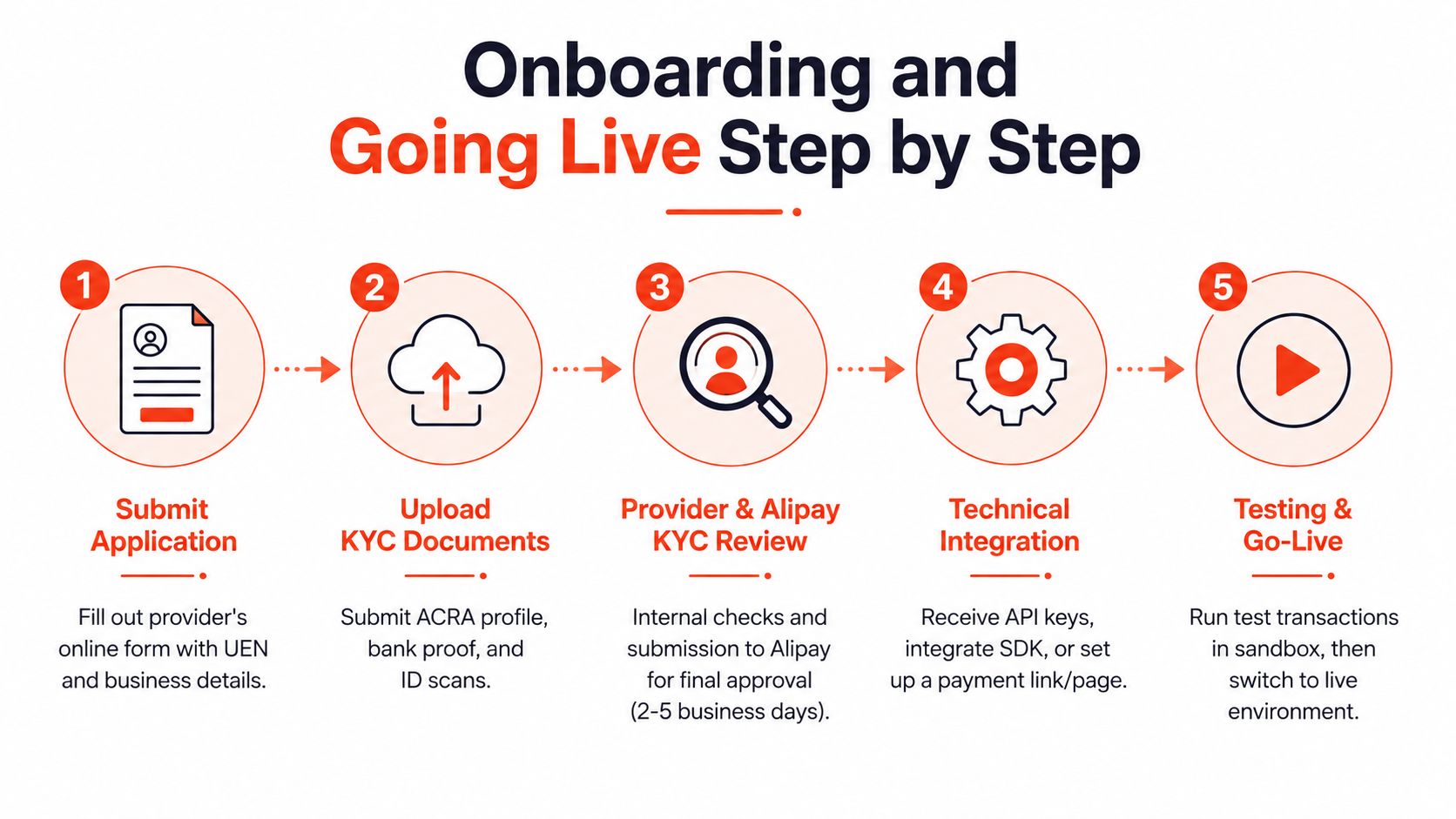
After approval, the provider assigns the merchant ID and configures the chosen terminal or QR asset. A static QR may require staff to check the amount and payment confirmation manually. A dynamic QR or integrated terminal can carry more transaction context, but the provider must explain how refunds, voids, and failed payments appear to staff.
The merchant should run controlled tests before public launch. Staff need to recognise a successful confirmation, know what to do when a customer shows a pending screen, and understand that a screenshot alone isn't reliable proof of settlement. The refund path deserves a short role-play, including who can approve it and where the refund reference is recorded.
A soft launch with limited counter exposure allows the owner to check the full loop, from customer scan to settlement report. Common causes of delay include an incorrect beneficial owner declaration, a trading address that differs across documents, and bank verification that remains incomplete.
A short training video can support the terminal briefing, but it shouldn't replace provider-specific instructions:
The amount that matters to the owner is the net SGD credit, not the wallet label shown at the counter. In the usual Singapore model, the acquirer or aggregator receives and processes the cross-border payment, converts or accounts for it under the agreed arrangement, and pays the merchant in SGD on its payout cycle. The merchant should confirm the exact timing, cut-off, exchange treatment, and statement format before signing.
The provider may quote a blended rate or separate components. Rather than accepting a headline MDR, the owner should request an example settlement statement showing the gross transaction, each deduction, refund treatment, and final bank credit.
| Fee Component | Typical Range | Charged By |
|---|---|---|
| Transaction MDR | Provider-specific | Acquirer, aggregator, or payment processor |
| Terminal or gateway fee | Contract-specific | Acquirer, terminal provider, or aggregator |
| Minimum commitment | Contract-specific | Provider where included in the agreement |
| Refund or reversal handling | Contract-specific | Provider and relevant payment network |
| Currency conversion treatment | Contract-specific | Provider and processing arrangement |
The brief provides no verified Singapore fee range, so a provider quote should be treated as the source of truth. The owner should ask whether the quoted rate applies to every supported wallet, whether Alipay+ partner wallets carry different pricing, and whether a refund reverses the original MDR or creates a separate charge.
The settlement workflow itself is often easier to understand through a provider's Singapore merchant settlement guide. The commercial contract still governs, so the owner shouldn't rely on a generic webpage instead of the signed schedule.
More wallet logos don't automatically produce more sales. Acceptance tends to make more commercial sense where the outlet regularly serves Chinese visitors or other cross-border wallet users, especially in tourism-linked retail, hotels, restaurants, attractions, transport-related businesses, and busy visitor corridors.
Singapore's network has broadened beyond tourist-heavy locations. By 2025, more than 500 FairPrice Group outlets reportedly accepted Alipay+ from 18 Alipay+ partners, while Singapore's SGQR transactions had risen more than 1.7 times year-on-year and represented about one-third of cross-border payments in Singapore. Coverage of Alipay+ and Singapore retail acceptance These figures show infrastructure growth, not a guaranteed return for every merchant.
The owner should assess:
A neighbourhood service business with mostly resident customers may gain little from another wallet, even if activation is inexpensive. A visitor-oriented boutique or hotel restaurant may value the familiarity and speed more because the payment method matches the customer's existing habit.
The sensible approach is a measured trial, followed by a review of actual transaction count, value, refunds, staff questions, and reconciliation time. The business should reassess at regular intervals as customer profiles and nearby visitor flows change, rather than treating activation as a permanent sign of modernity.
A provider call should end with clear answers, not just a promise that “Alipay is supported”. The merchant needs to know which entity signs the agreement, what is activated, how money settles, and what the outlet must do at the counter.
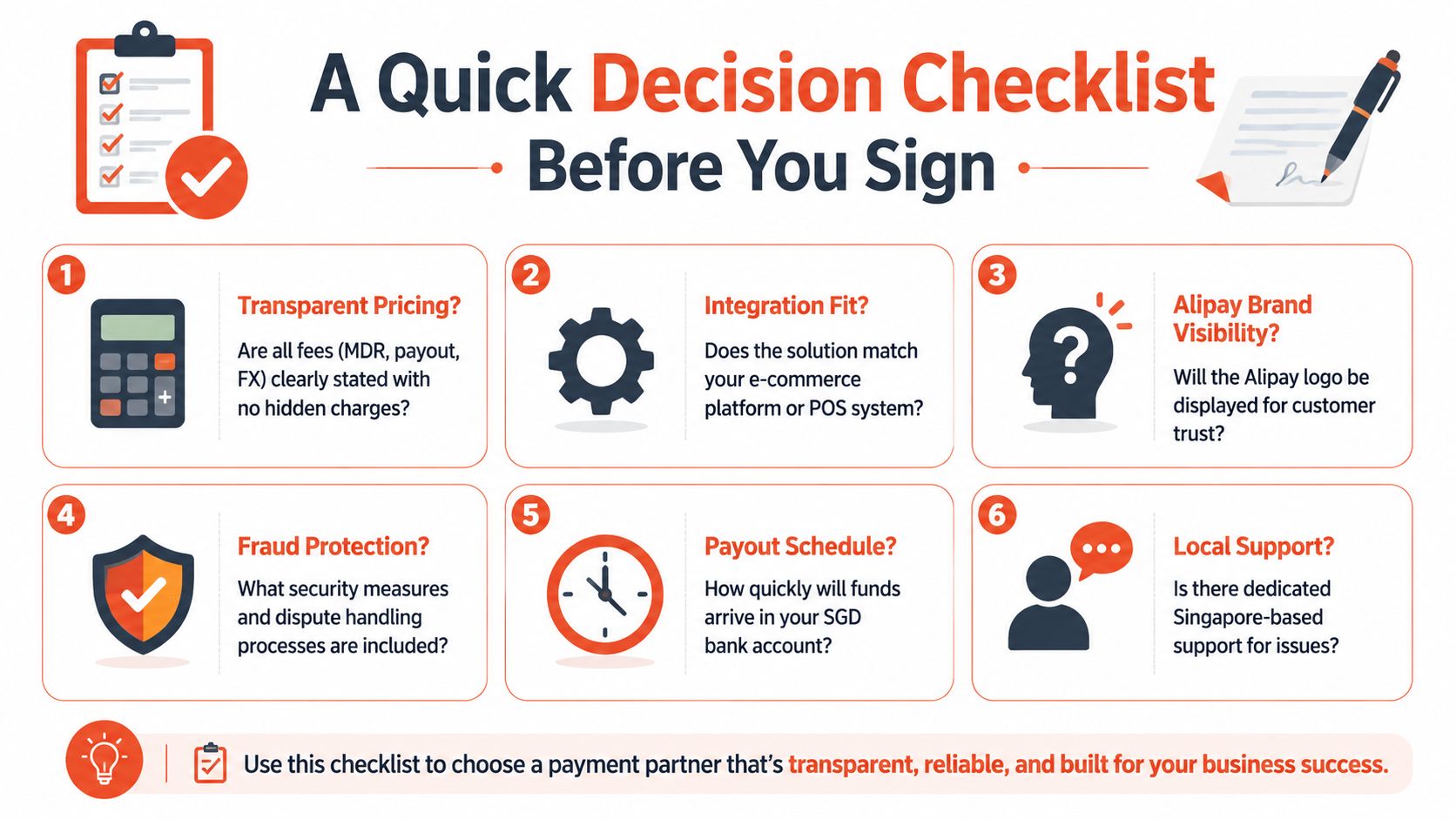
The useful decision is not “Can the merchant accept Alipay?” It is “Can this outlet accept the right wallets, settle them clearly, and serve enough relevant customers to justify the operating work?”
Sambapay provides Singapore SMEs with POS terminals and card processing alongside selected digital wallets, including Alipay, with onboarding, installation, settlement arrangements, and local support handled as part of the payment relationship. Merchants comparing an in-store setup can visit Sambapay to discuss whether its terminal and acquiring options fit the outlet's customer mix and reconciliation needs.