

PAX A930: A Handheld Payment Terminal Built for Long Days
The PAX A930 stores more battery energy than the A920 Pro and takes two SIM cards. Here is when that matters, and when the A920 Pro fits better.
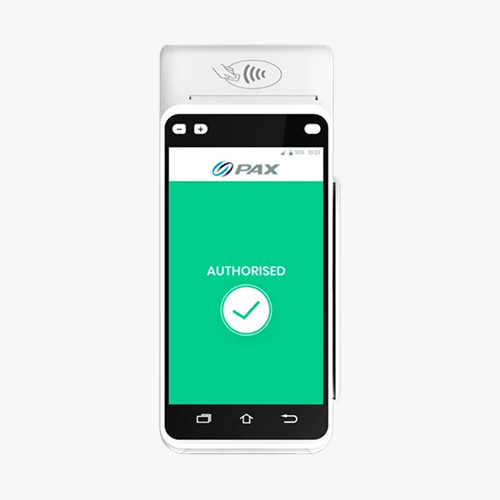
The PAX A930 is a handheld card payment terminal that runs on Android, prints its own receipts and connects over 4G or Wi-Fi. It suits businesses that take payments at the counter and away from it in the same day, such as restaurants with table service, market and event stalls, and delivery teams.
Compared with the PAX A920 Pro, the A930 stores more battery energy and has room for two SIM cards. The A920 Pro is the newer device, runs a more recent version of Android and has a dedicated scanner for QR codes. The sections below explain what that means in practice, so you can decide which one fits the way your business takes payments.
What can the PAX A930 do?
The A930 takes chip, contactless and magnetic stripe payments, prints receipts and runs business apps on a 5.5 inch touchscreen. The table below lists the main specifications in plain terms.
| Feature | PAX A930 | What it means for you |
|---|---|---|
| Screen | 5.5 inch touchscreen, 720 x 1280 pixels | Customers can enter their PIN directly on the screen, which PAX calls PIN on Glass |
| Card readers | Chip, contactless (NFC) and magnetic stripe | Covers every common way a card, phone or watch is presented |
| Connection | 4G, Wi-Fi and Bluetooth, with two SIM slots | Takes payments without the shop’s internet when a SIM card is inserted |
| Printer | Built-in 2 inch thermal printer | Prints receipts on the spot, with no separate printer to buy |
| Battery | 7.2 V, 3,350 mAh | About 24 watt-hours of stored energy, explained in the next section |
| Cameras | 5 MP rear, 0.3 MP front | The rear camera can read QR codes and barcodes |
| Memory | 1 GB RAM, 8 GB storage, micro SD slot up to 128 GB | Enough room for the payment app and a few business apps |
| Weight | About 490 g with the battery | Worth holding one before you decide if staff will carry it all shift |
| Security | PCI PTS with SRED, EMV Level 1 and 2 | Card data is encrypted inside the terminal the moment it is read |
PCI PTS is the security standard for devices where customers enter a PIN, set by the PCI Security Standards Council. SRED means the terminal encrypts card data as soon as it reads it, so the data never travels in readable form. EMV is the global standard for chip and contactless card payments.
Specifications from the PAX A930 datasheet (February 2021) and the PAX A930 product page, checked 13 November 2026.
Want to use the PAX A930 for your business? Get in touch with us.
Does the PAX A930 have a bigger battery than the A920 Pro?
Yes, in stored energy, even though its mAh number is smaller. The A930 battery is rated 7.2 volts and 3,350 mAh, while the A920 Pro battery is rated 3.7 volts and 5,150 mAh.
The mAh figure (milliamp hours) only compares two batteries fairly when they run at the same voltage. When the voltages differ, multiply the voltage by the capacity in amp hours to get watt-hours (Wh), which is the actual energy the battery holds.
| Terminal | Voltage | Capacity | Stored energy |
|---|---|---|---|
| PAX A930 | 7.2 V | 3,350 mAh | About 24.1 Wh |
| PAX A920 Pro | 3.7 V | 5,150 mAh | About 19.1 Wh |
On these figures, the A930 battery holds about a quarter more energy than the A920 Pro battery.
Stored energy is not the same as hours of use. Screen brightness, 4G compared with Wi-Fi, and the number of receipts you print all change how fast a terminal drains. Treat the difference as an advantage on paper, and check it on your own busiest day before you rely on it.
Battery ratings from the PAX A930 datasheet and the PAX A920Pro product page, checked 13 November 2026.
Can the PAX A930 work as a counter terminal?
Yes. PAX makes a docking base for the A930, called the B930, that holds the terminal at the counter and charges it at the same time. Staff lift the terminal off the base to take payment at a table or at the door, then put it back to charge.
The B930 comes in two main versions. The multifunctional base adds a wired internet (Ethernet) port and a USB port, and the wireless base charges the terminal and connects it over Wi-Fi and Bluetooth. Both use magnets to line the terminal up on the base.
A wired connection does not depend on Wi-Fi or mobile signal. That helps shop units inside malls and basements, where both can be weak, and counters where a failed payment means a queue.
The PAX A920 Pro also has its own charging base, so a base is not a reason on its own to pick one terminal over the other. Ask your provider whether the base is included with the terminal or charged separately.
Base details from the PAX A930 product page, checked 13 November 2026.
Which payments can the PAX A930 accept?
The A930 reads chip cards, magnetic stripe cards and contactless payments from cards, phones and watches. Apple Pay and Google Pay work through the same contactless (NFC) reader as a tap of a physical card, so staff follow the same steps whichever one the customer uses.
The card networks, wallets and QR payments you can actually accept are set by your payment provider and the payment app it installs on the terminal, not by the hardware. Two shops with the same A930 can accept different payment methods.
The rear camera can read QR codes, but QR payments such as PayNow only work if your provider supports them on the terminal. If QR payments matter to your customers, ask about this before you sign.
Want to use the PAX A930 for your business? Get in touch with us.
PAX A930 or PAX A920 Pro: which one should you choose?
Choose the A930 if battery and mobile signal are your main worries. Choose the A920 Pro if staff hold the terminal all day, you scan a lot of QR codes, or you want the newer device. Neither one is better for every business.
| PAX A930 | PAX A920 Pro | |
|---|---|---|
| Screen | 5.5 inch | 5.5 inch, with a 6.56 inch version on newer models |
| Battery | 7.2 V, 3,350 mAh, about 24 Wh | 3.7 V, 5,150 mAh, about 19 Wh |
| Weight | About 490 g | About 390 g |
| SIM slots | Two | One |
| QR and barcode scanning | Rear camera | Dedicated barcode scanner and a side scan button |
| Android version | Android 7.1 | Android 8.1 or later, depending on the model year |
| Receipt printer | Built-in | Built-in |
The A930 is usually the better fit when:
-
- The terminal spends long hours away from a charger, for example at markets, pop-up events or on deliveries.
-
- Mobile signal is unreliable where you work, and you want a second SIM from another mobile network in the terminal.
The A920 Pro is usually the better fit when:
-
- Staff carry the terminal in their hand for most of the shift, where about 100 g less weight makes a difference.
-
- Customers often pay by QR code, or staff scan vouchers and barcodes during the day.
-
- You plan to run other business apps on the terminal and want a more recent version of Android.
Sources: PAX A930 product page, PAX A930 datasheet, PAX A920Pro product page, and A920 Pro weight and SIM details from a PAX reseller listing, checked 13 November 2026.
What should you check besides the terminal?
Your payment provider decides most of what a terminal costs you, so two businesses with the same A930 can pay very different amounts each month. Before you sign, ask these five questions.
-
- What is my rate for each card network? The MDR (merchant discount rate) is the percentage of each card payment the provider keeps as its fee. Ask whether Visa, Mastercard, American Express, JCB, UnionPay and e-wallets each have their own rate, and what you pay on foreign cards.
-
- Is there a monthly rental or a monthly minimum? Some providers charge a fixed monthly fee for the terminal, or a minimum fee in months when your card sales are low. Over a three year contract, these fees can add up to more than the terminal is worth.
-
- When does the money reach my bank account? Settlement is the time between a customer paying and the money landing in your account. T+1 means one business day after the transaction, and T+2 means two.
-
- How long is the contract, and what does it cost to leave early? Read the early termination clause before you sign, not when you want to switch.
-
- Who fixes the terminal when it stops working? Ask whether support is local, what hours it covers, and how fast a replacement terminal arrives.
Why Sambapay offers the PAX A930
We offer the A930 next to the PAX A920 Pro so merchants can pick the terminal that matches how they take payments, instead of fitting their business around one device.
With Sambapay, the A930 accepts Visa, Mastercard, American Express, JCB and UnionPay, as well as contactless wallets such as Apple Pay and Google Pay. Our rates are set per card network, so each of these has its own rate, and e-wallets and international cards are priced separately.
Merchants in their first year of operation, or accepting Visa and Mastercard for the first time, qualify for our SMB program, with rates starting from 1.8 percent. There are no recurring monthly fees, and setup and terminal costs can be waived for qualifying merchants.
Payments settle T+1, one business day after the transaction, and onboarding and support are handled by our team in Singapore.
If you already accept cards, our free Payment Cost Review compares what you pay today with our terms, with no commitment.
PAX A930 FAQ
Does the PAX A930 print receipts?
Yes. The PAX A930 has a built-in 2 inch thermal printer, so it does not need a separate receipt printer, only rolls of thermal paper.
Can the PAX A930 take payments without Wi-Fi?
Yes. With a SIM card inserted, the PAX A930 takes payments over 4G, and it has two SIM slots so a second mobile network can be added as a backup.
Does the PAX A930 accept Apple Pay and Google Pay?
Yes. The PAX A930 accepts Apple Pay and Google Pay through its contactless (NFC) reader, as long as your payment provider has turned on contactless wallets for your terminal.
How long does the PAX A930 battery last?
It depends on screen brightness, the type of connection and how many receipts you print. The PAX A930 battery stores about 24 watt-hours, which is about a quarter more than the PAX A920 Pro battery. Typically will last you for a full day of work.
Is the PAX A930 secure?
The PAX A930 is certified under PCI PTS, the security standard for devices where customers enter a PIN, and it encrypts card data inside the terminal as soon as it is read. It is also EMV certified for chip and contactless payments.
Can I use a PAX A930 from my previous payment provider?
Usually not without setting it up again. A terminal is loaded with one provider’s payment app and security keys, so ask your new provider whether your current unit can be reprogrammed or whether they will supply a new one.
Is the PAX A930 better than the PAX A920 Pro?
Not for every business. The PAX A930 stores more battery energy and has two SIM slots, while the PAX A920 Pro runs a newer version of Android and has a dedicated QR code scanner.
This article is general information, not financial or legal advice. Confirm current rates and terms directly with Sambapay. Terminal specifications come from PAX Technology’s published documents and can change without notice.
Sources
-
- PAX A930 product page, PAX Technology, checked 13 November 2026
-
- PAX A930 datasheet, PAX Technology, February 2021
-
- PAX A920Pro product page, PAX Technology, checked 13 November 2026
-
- PAX A920 Pro listing, Pos-Hardware Ltd, checked 13 November 2026