
SEO is the practice of making a website easy for search engines to find, understand and rank for relevant unpaid searches. Its three parts are on-page SEO, off-page SEO and technical SEO.
A shop owner might search for the business's own services and find nearby competitors instead. The website looks polished, the shop is open, and customers leave happy, yet someone searching nearby still struggles to find it.
The useful starting question isn't how to impress an algorithm. It's whether the website gives a search engine and a potential customer enough clear, consistent information to verify what the business offers.
Say a boutique in Tiong Bahru publishes beautiful product photographs but leaves out its street address and accepted payment methods. Someone searching for a nearby boutique that accepts contactless payment has little reason to choose that website. A search engine also lacks explicit evidence connecting the shop with that need.
Think of a search engine as a librarian managing an enormous bookshop. Before recommending a book, the librarian must locate it, understand its contents and decide whether it answers the reader's question.
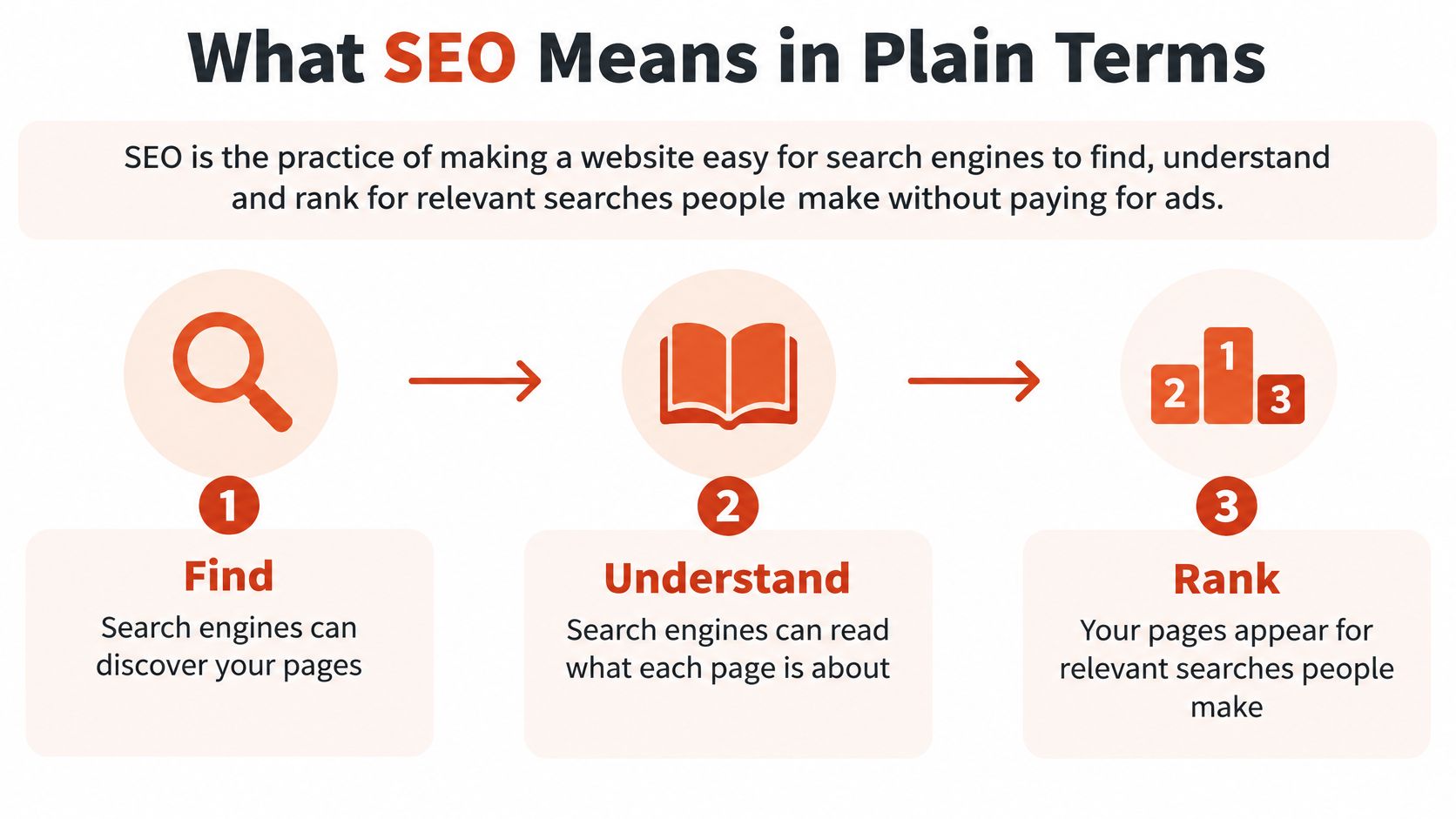
SEO improves the equivalent of the book's cover, contents and shelf access. It doesn't give the business control over the librarian.
For the boutique, practical improvements include a visible address, directions, product descriptions and accurate payment information. These details don't guarantee inclusion for a particular search, but they remove unnecessary ambiguity.
Practical rule: A fact that customers need shouldn't depend on a search engine guessing correctly.
An owner seeking a hands-on starting resource can use Outrank's guide to manage your own SEO with Outrank as an implementation checklist.
SEO doesn't buy advertising placement or guarantee first position. The plain answer to what is SEO is clarity about a business and its pages, made accessible to machines and useful to people.
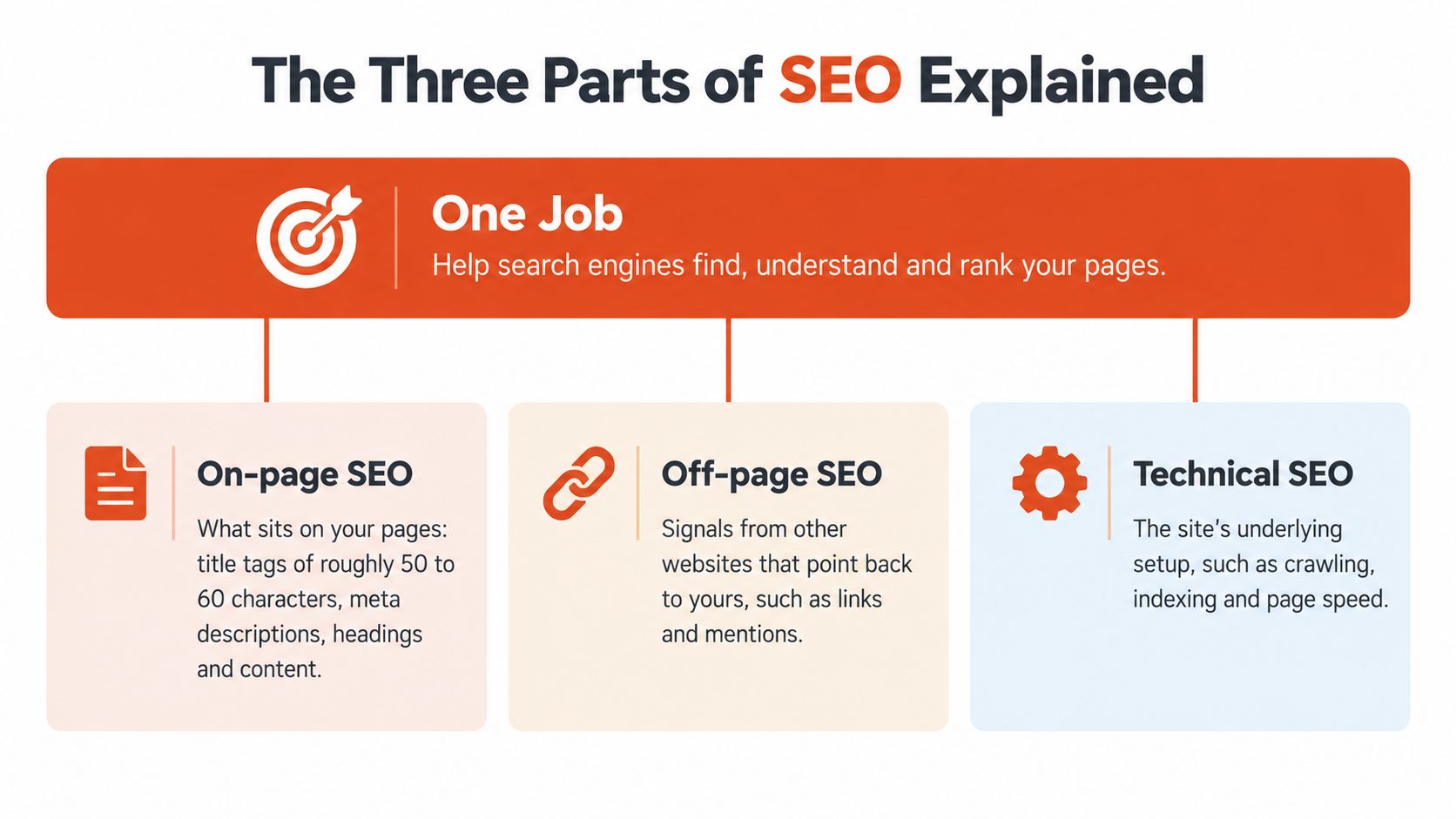
A beginner often meets SEO as three separate checklists. The clearer view is one job seen from three sides: the page has to say what the business offers, the wider web has to corroborate it, and the site has to let machines reach those facts.
The three SEO components compared
| Component | What It Covers | Singapore SME Example | Usual Owner |
|---|---|---|---|
| On-page | Titles, headings, page copy, images and internal links | Barber's services page titled for men's haircut Tanjong Pagar | Content or marketing team |
| Off-page | Links, brand mentions, directory listings and reviews from other sites | Clinic with matching name, address and phone details across directories | Marketing lead or business owner |
| Technical | Crawling, indexing, page speed, mobile layout, HTTPS and structured data | Salon booking page returning an error that keeps it out of search | Web developer or hosting provider |
On-page SEO starts with the page's purpose. A Tanjong Pagar barber needs a descriptive title, service headings and copy explaining haircut options, prices and booking arrangements. A vague slogan can remain part of the branding, but it should not replace a clear service description.
The title tag helps identify the page in search results. The meta description summarises its appeal, while headings organise the visible content. Descriptive image alt text supports accessibility, and internal links help visitors reach related services.
Off-page SEO concerns information beyond the website. Relevant partner links, accurate directory listings and genuine customer reviews give people outside the site a way to check the same facts. A clinic should correct conflicting contact details rather than create more listings carrying the same mistakes.
Technical SEO covers whether important pages are blocked from crawling, whether preferred URLs appear in an XML sitemap, and whether duplicate versions point to the intended canonical page. HTTPS, mobile layouts and accurate structured data belong here too.
Structured data is machine-readable information describing visible facts, such as the organisation or location. It works best when it matches what a customer can see on the page, because AI answers and search features tend to reuse facts that are stated plainly and consistently.
Descriptive titles, internal links, preferred URLs and locally relevant content all sit more securely on a sound setup. A salon can publish excellent booking instructions, but an erroring booking page still prevents customers from completing the task. Strong wording cannot repair broken access.
Google accounted for 92.16% of Singapore's search-engine market share in September 2026, compared with 4.53% for Bing, according to StatCounter figures reported by Aemorph's Singapore SEO overview. A local business that ignores Google is ignoring the front door most customers walk through.
The potential audience is substantial: Singapore had 5.78 million internet users, representing 98.4% of the population, as of October 2025, according to DataReportal's Digital 2026: Singapore report. Nearly every customer a business wants is already online. The key question is whether they can verify that business there.
A café whose menu exists only inside an unreadable photograph, with no useful location page, asks customers to trust what they cannot check. A competing café publishes its lunch menu as text, explains how to reach the entrance and states its opening hours. Both a search engine and a hungry customer can confirm those facts before anyone commits.
A useful local page answers the questions someone needs resolved before leaving home or making a booking.
Retail shops, restaurants, cafés, beauty salons, medical and dental clinics, and gyms can connect search visibility with concrete actions. Relevant searches might concern product availability, appointment types, class schedules or nearby services.
AI-generated answers raise the same requirement. When a tool summarises lunch options nearby, it can only repeat facts a business has stated clearly on its own site. A café that never wrote down its weekend hours gives that summary nothing accurate to pass on.
SEO also works as an ongoing channel rather than a finished website project. The StatCounter Singapore historical series provides a long-running view of the search market; individual businesses also need their own continuing performance records.
Search demand changes, competitors update their pages and search engines revise their systems. Falling clicks therefore need investigation before any rewrite.
The useful question stays specific: Which searches would a customer make before choosing this business, and does the website answer them?
A ranking report alone can't show whether SEO helps the business. Measurement needs to connect visibility, visits, page usability and completed customer actions.
Impressions show how often a page appeared in search results. Average position summarises its position across recorded appearances, so comparisons are more meaningful within the same query than across unrelated searches.
Clicks record clicks from results, while click-through rate, or CTR, divides clicks by impressions. CTR needs context: a business-name search and a broad informational search shouldn't be judged against the same expectation.
Core SEO metrics and where to check them
| Metric | What It Tells You | Where to Check | Good Benchmark |
|---|---|---|---|
| Impressions | How often pages appeared in search results | Google Search Console, Performance report | Rising relevant visibility; no fixed target |
| Clicks | Clicks from search results | Google Search Console, Performance report | Read alongside impressions and enquiries |
| Click-through rate (CTR) | Clicks divided by impressions | Google Search Console | Compare pages serving similar queries |
| Average position | Average recorded search position | Google Search Console | Lower is generally better within the same query |
| Largest Contentful Paint (LCP) | How quickly the main content becomes visible | PageSpeed Insights, field data | Meet the good-experience threshold |
| Interaction to Next Paint (INP) | How quickly the page responds to interaction | PageSpeed Insights, field data | Meet the good-experience threshold |
| Cumulative Layout Shift (CLS) | How much content moves unexpectedly | PageSpeed Insights, field data | Meet the good-experience threshold |
| Organic enquiries or bookings | Actions associated with organic-search visitors | Google Analytics 4 key events | Compare against the business's starting baseline |
The Google thresholds cited by SingRank's Singapore performance benchmarks define a good experience at the 75th percentile as LCP below 2.5 seconds, INP below 200 milliseconds and CLS below 0.1. These describe loading, responsiveness and visual stability respectively.
Real-user field data matters because a fast test on an office connection doesn't necessarily represent a customer's phone. When PageSpeed Insights lacks sufficient field data, lab diagnostics can still help identify problems, but they shouldn't be presented as measured customer experience.
Measurement safeguard: A booking-button click isn't a completed booking. Reports should distinguish intent from a confirmed outcome.
A useful reporting companion is Silver Spoon Agency's explanation of SEO reporting metrics that guide optimization. The practical task is to pair search metrics with clearly defined enquiries or bookings, including any hand-off to an external booking platform.
An initial reporting period establishes the baseline. Later comparisons should use matching periods and account for holidays, promotions and changes in demand.
Consider a hypothetical hair salon in Tiong Bahru. Its owner doesn't need to begin with a publishing calendar full of articles. The first priority is making the existing service and booking information dependable.
Complete the Google Business Profile. The salon records its actual name, address, opening hours, service categories and booking destination. A common mistake is updating holiday hours on social media while leaving the listing unchanged.
Give the services page a descriptive title. A title built around women's haircut in Tiong Bahru communicates more than a slogan about transformation. Repeating the same search phrase in every heading makes the page awkward without adding useful detail.
Separate meaningfully different services. Haircuts, colouring and treatments can each explain suitability, the actual price or pricing approach, expected appointment duration and booking requirements. The opening should answer the main customer question, rather than delay it behind a long brand story.
Make those pages easy to reach. The homepage and service menu should link to the relevant service pages using descriptive wording. A page accessible only through an old social post is unnecessarily difficult for visitors to discover.
Request honest reviews and reply helpfully. Recent clients can describe their actual experience without being coached to insert keywords. Replies should address the feedback naturally, not force the neighbourhood and service name into every response.
Prepare photographs for the web. Compress images, choose suitable dimensions and provide descriptive alt text where appropriate, such as a stylist colouring a client's hair in the studio. Uploading original camera files wastes bandwidth, while keyword lists aren't useful image descriptions.
Keep a preferred URL for each service. Slight wording changes don't justify duplicate pages. Separate location pages make sense when real branches have distinct addresses and customer information, not when the salon only wants to target neighbouring streets.
The salon should also explain practical checkout details, including the payment methods it accepts. Sambapay's information about a POS system for a salon is relevant when reviewing how payment arrangements fit the appointment workflow.
The same service-page logic applies beyond beauty businesses. Dekodi's guide to plumber service page optimization offers a useful comparison: customers need to understand the service, where it's available and what action follows.
The salon's task is not to sound optimised. It's to remove the questions that prevent a suitable customer from booking.
SEO guarantees a ranking. It doesn't. A business controls its website and information, but it doesn't control competing pages or search-engine decisions.
That difference matters when assessing SEO advice. An agency can improve how clearly a site states its services, location, prices and booking steps. It cannot promise where Google will place that page, or that an AI answer will cite it.

More pages mean more visibility. Generic articles can add little that helps customers choose. Google's guidance on AI features and websites recommends distinctive, non-commodity content and states that existing SEO fundamentals remain relevant, with no special AI markup required.
The practical alternative is specific evidence: actual service details, original photographs, clear eligibility information and answers based on how the business operates. Meta-keyword lists, repetitive copy and purchased links aren't substitutes for that work.
An appearance doesn't always produce a visit. AI Overviews and AI Mode can summarise information before someone opens a website. A business therefore needs useful customer outcomes, not merely a count of pages appearing in results.
The embedded video provides another format for considering search visibility.
A hypothetical physiotherapy clinic in Bishan should state its location, accessibility, booking methods and accepted payment arrangements. If patients ask about a particular insurer or payment programme, the clinic should publish its actual policy rather than leave the answer implicit.
That is what AI answers change. A search engine can only repeat what a site states clearly, and a customer can only trust what they can check. Vague claims such as “conveniently located” or “affordable rates” give both of them less to verify than an address, an opening time and a real fee range.
SEO is a quick fix. It's safer to plan for sustained work than promise immediate results. Owners can complete many foundational tasks with staff time, while development, photography and specialist help may require a budget.
Progress should be judged through relevant impressions, genuine enquiries and completed actions. Neither an AI citation nor a prominent ranking guarantees a customer.
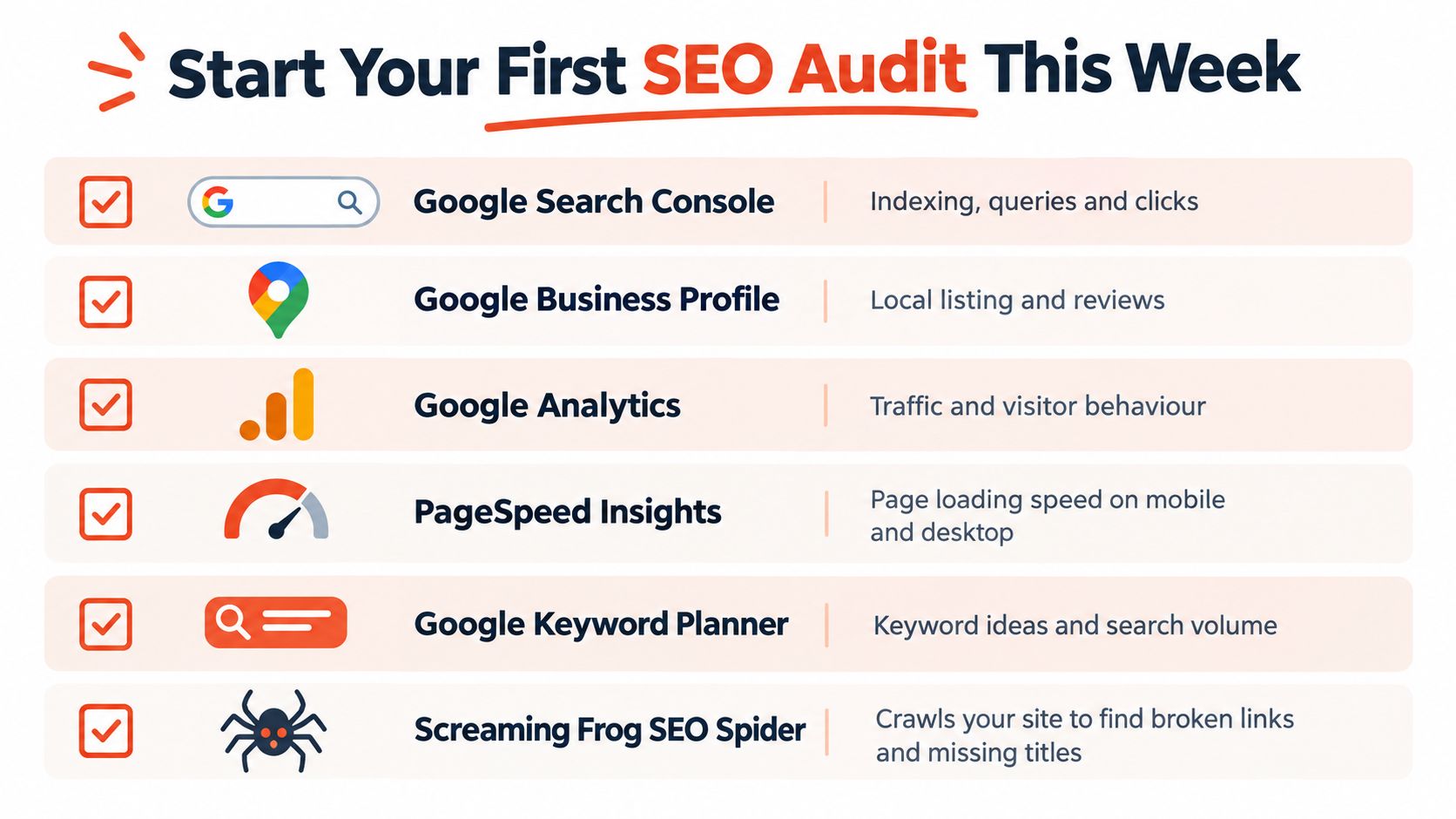
Free SEO tools for a first audit
| Tool | Use It To | Cost |
|---|---|---|
| Google Search Console | Check indexing, queries, clicks and average position | Free |
| Google Business Profile | Manage the local listing, hours, photos and reviews | Free |
| Google Analytics 4 | Track visits, enquiries and bookings from organic search | Free |
| PageSpeed Insights | Inspect field performance and lab diagnostics | Free |
| Rich Results Test | Check supported structured data and eligibility | Free |
| Screaming Frog SEO Spider | Find broken links, duplicate titles and redirect chains | Free limited crawl; paid licence for expanded use |
The visual checklist helps keep the audit focused on practical checks.
Payment information deserves the same accuracy as opening hours. Customer-facing pages should identify accepted payment methods; merchant-facing payment pages should explain applicable settlement arrangements clearly.
Sambapay operates as an Independent Sales Organisation (ISO), facilitating merchant onboarding and payment services for businesses in Singapore. That role should be described accurately wherever a business evaluates its payment arrangements.
Sambapay helps Singapore businesses with merchant onboarding and in-store payment services, supported by a local team. Businesses reviewing the payment details published on their websites can visit Sambapay to discuss card acceptance, onboarding and the arrangements relevant to their operations.