

Small Business Payment Processing: A Singapore Guide
You've opened the shop, the coffee machine works, the clinic front desk is ready, and then the question lands: how should payments run at the counter? The first terminal quote looks simple enough until the jargon starts. Card schemes, settlement cycles, wallet acceptance, monthly fees, hidden charges, support contracts. For a Singapore SME, small business payment processing is not a back-office detail. It shapes queue speed, staff workload, and how fast cash reaches the bank. The choice of a payment solution for small business owners decides which customers you can serve at all. Digital merchant payments were used by 42% of adults in low- and middle-income economies in 2024, up from 35% in 2021, according to the World Bank's Global Findex 2025 report. This overview offers a working decision framework: provider comparisons, fee math for a typical café, a settlement-speed table, and the features that separate a good setup from an expensive one.
Table of Contents
- Why Your Payment System Is a Foundational Choice
- How a Card Payment Actually Works
- Decoding Payment Processing Fees
- Essential Hardware for Your Countertop
- How and When You Get Your Money
- How I Tested and Selected These Payment Solutions
- How to Choose a Payment Provider in Singapore
- Making the Right Choice for Your Business
- Frequently Asked Questions
If you are also planning the physical side of a food business, see Creventa for restaurant floor plans that pair well with the counter-readiness checks below.
Why Your Payment System Is a Foundational Choice
A new café owner in Singapore can spend weeks choosing chairs, POS displays, and menu boards, then end up staring at payment proposals that all sound the same. One provider says "low rates", another says "fast settlement", a third bundles hardware and software in a way that looks neat until the monthly bill arrives. The decision is not which logo sits on the terminal. It is which setup keeps the counter moving and the cash flow healthy.
That matters in a market where 97% of retail point-of-sale transactions are cashless and digital payments are projected to grow from USD39.37 billion in 2023 to USD113.65 billion by 2030 according to PwC Singapore's payments outlook. For a shop, salon, clinic, gym, or café, in-store card and wallet acceptance is a basic operating requirement.
Practical rule: if the counter is busy, the payment system has to disappear into the background. Customers should tap, pay, and leave without the staff thinking about the terminal.
That is why it helps to choose the right payment processor with the same seriousness used for rent, staffing, and suppliers. A provider that looks cheap on paper can still create more friction than it saves if the terminal is slow, the settlement is delayed, or the fee structure is hard to reconcile. In Singapore, the right system is the one that fits the daily rhythm of the business.
How a Card Payment Actually Works
A card payment moves through a simple chain, even if the jargon makes it sound complex. It is like a four-person relay race. The customer starts the run, the merchant's terminal passes the transaction onward, the banks check and confirm the details, and the payment network carries the baton between them.
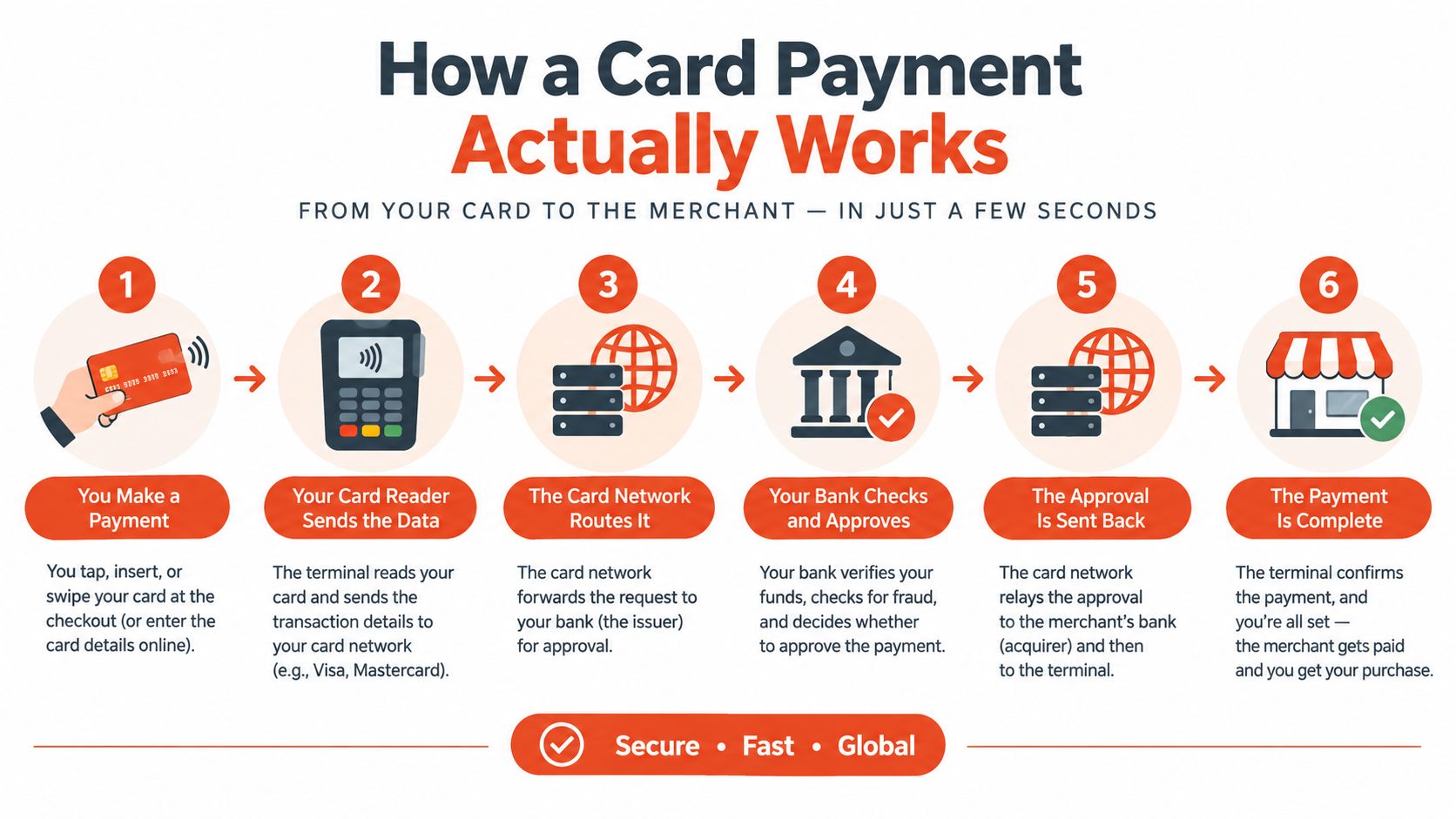
At the counter, the customer taps or inserts a card. The terminal sends the payment request for approval, the issuing bank checks whether the card is valid and whether the transaction can go through, and the authorisation comes back in seconds. After that, the transaction is batched for settlement, which is the step that moves the funds to the merchant account.
The roles that matter
The four parties are easy to separate once the flow is clear:
- The customer's bank, which decides whether the payment is approved.
- The card network, which carries the request and response between banks.
- The merchant's bank or acquirer, which receives the transaction and later settles the funds.
- The business, which needs the sale to be approved quickly and deposited predictably.
That structure explains why card acceptance still sits at the centre of in-store commerce in Singapore. Digital payment adoption reached 92.0% in 2025, and card payments totalled SGD 148.91 billion in 2024 according to PwC Singapore's payments report. The terminal is doing the last-mile work that keeps the checkout line short.
For broader context on online and subscription-style flows, handling international SaaS payments uses a similar authorise-settle logic, even though the customer experience sits on a website rather than a counter. That is useful to know because many owners eventually add online ordering, deposits, or membership billing.
The same logic applies when comparing payment providers in store. If the processor cannot explain who authorises, who settles, and where the money lands, the setup is probably too opaque for a small merchant. A clean transaction flow should be boring, predictable, and fast.
For merchants mapping the checkout journey to a local payment page, the credit card payment flow reference can help anchor the basics in a familiar sequence.
Decoding Payment Processing Fees
The hardest part of payment processing is usually not the technology. It is the bill. The headline rate often looks tidy, but the final cost can change once terminal rental, statement fees, premium card costs, and contract terms show up. In Singapore, where average processing charges have been estimated at about 1.5% to 3% of transaction value in one local media estimate, pricing clarity matters more than glossy marketing claims The Straits Times.
The three pricing models
A good way to judge a quote is to identify which of these structures it uses:
| Pricing Model | How It Works | Best For |
|---|---|---|
| Interchange-plus | The provider passes through network costs and adds a markup | Merchants that want transparency and can read statements carefully |
| Tiered | Transactions are grouped into rate bands, often with less visibility into the true cost | Businesses that can tolerate complexity, but usually not ideal for smaller operators |
| Blended | One all-in rate is applied across transactions | Cafés, salons, clinics, and shops that value predictability |
A blended rate is often the easiest for a new owner to budget around. The trade-off is that it can hide the actual cost of different transaction types, so the provider's promise has to be backed by a clean statement and no surprise add-ons. Interchange-plus is more transparent, but it is harder to track if the owner does not have time to decode every line item.
A payment quote is only useful if the owner can tell, at a glance, what changed from last month. If the statement needs a phone call every cycle, the pricing model is already costing time.
What usually goes wrong
Tiered pricing is the one that often causes frustration. A merchant may be told that the rate is low, only to find later that most sales do not qualify for the cheapest band. That is especially painful for cafés, bakeries, and clinics where ticket sizes are modest and margin leakage shows up quickly.
The simplest way to compare providers is to examine the total cost of ownership, not just the headline fee. For a clear breakdown of the local structure, the merchant discount rate guide is a useful reference point. The question to ask is not "what is the rate?" It is "what will a normal month cost once all the moving parts are added together?"
That mindset is more useful than chasing the lowest advertised figure. For a small merchant, predictability often beats theoretical savings that only appear on the sales slide.
Essential Hardware for Your Countertop
Buying a terminal and choosing a payment solution are two different decisions. A standalone terminal processes cards. A full solution ties the terminal, software, reporting, and settlement into one system. The difference shows up in three places: total cost of ownership, reconciliation effort, and how long it takes to train staff.
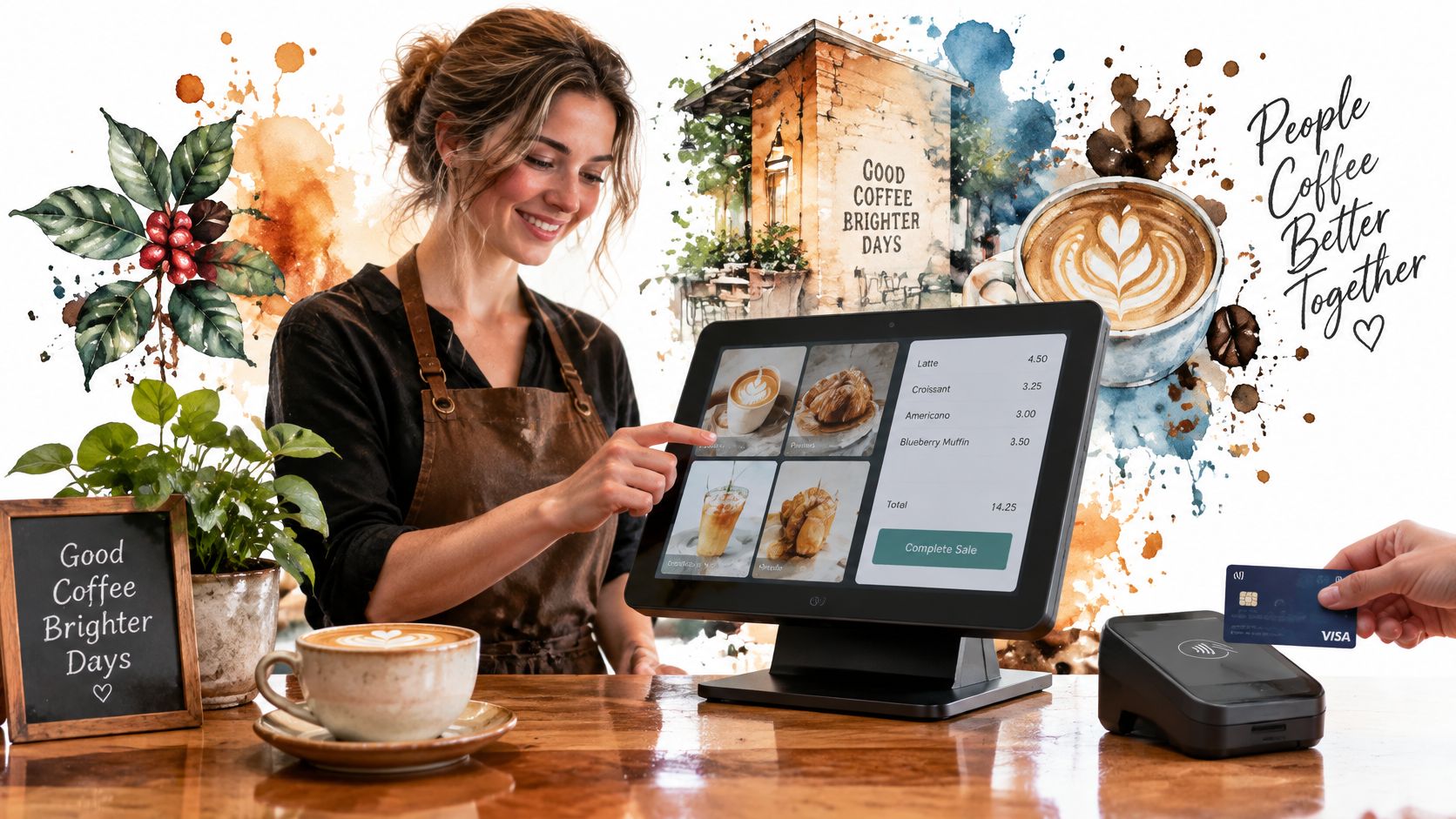
A standalone rental at roughly S$30 to S$70 a month (an illustrative assumption, not a fixed market rate) often looks cheapest, until you count the manual work around it. End-of-day takings have to be matched against the processor's report by hand, takings from a separate POS app have to be keyed across, and staff learn two interfaces instead of one. That hidden admin time is usually worth more than the rental gap itself.
An integrated POS approach flips this. Sambapay pairs smart Android POS terminals with card acceptance across major schemes and selected digital wallets, plus daily summaries and settlement reporting that make it straightforward to match card transactions against funds received. Terminal setup is matched to each business, countertop for retail, mobile terminals for restaurant tables, and merchants can rent or buy depending on their needs. Support is based locally in Singapore.
What to check before committing
A useful terminal review starts with practical questions:
- Connectivity: Does the device stay stable on the counter network, or does it stall during rush periods?
- Speed of use: Can staff take payment, print or send a receipt, and move on without extra taps?
- Payment coverage: Can it handle major cards, contactless wallets, and local QR-linked methods in one workflow?
- Form factor: Is it a fixed countertop unit, or does the business need a mobile terminal for tables, pop-ups, or treatment rooms?
- Training burden: Can a new cashier learn the device in a short shift, or does it require repeated coaching?
The terminal also shapes the customer's impression of the business. A delayed tap, a frozen screen, or a rejected transaction after the card has already been presented makes the whole counter feel unreliable. That is not just inconvenient. It can undermine trust in a business that is otherwise running well.
The video below is useful for seeing how terminal usability affects day-to-day checkout flow.
The final question is whether the terminal, software, and settlement behave like one system. If they do not, reconciliation gets messy and staff waste time on work that should have been automated.
How and When You Get Your Money
For a café, salon, or clinic, the sale is only half the story. The other half is when that money becomes usable cash in the business account. If the terminal approves transactions quickly but the settlement arrives slowly, the owner can still face a working capital squeeze even when sales are healthy.
Why slower settlement hurts
Here is the arithmetic in concrete terms. Assume a café doing SGD 5,000 per day in card sales settles about SGD 35,000 per week. With T+3 settlement, roughly SGD 10,000 of that sits in the processor's pipeline for two extra working days. That is money that cannot pay the milk supplier, the weekend casual staff, or the GST instalment. At an illustrative 15% annual overdraft rate, holding SGD 10,000 for two extra days costs about S$4.11 per day, or roughly S$8.22 for the two days. Across a month of operations, that delay could cost approximately S$123, before accounting for missed stock purchases. Faster settlement effectively gives a small operator an invisible working-capital buffer.
Settlement speed compared
| Provider | T+1 | T+2 | Same-day | Notes |
|---|---|---|---|---|
| Sambapay | Verify with provider | Verify with provider | Verify with provider | Daily summaries and settlement reporting support matching funds to transactions |
| HitPay | Verify with provider | Verify with provider | Verify with provider | Check current published settlement schedules |
| Stripe | Verify with provider | Verify with provider | Verify with provider | Payout cadence varies by account standing |
| PayPal | Verify with provider | Verify with provider | Verify with provider | Timelines vary by currency and account type |
| Local bank acquiring | Verify with provider | Verify with provider | Verify with provider | Depends on the acquirer's batch cutoff times |
Always confirm the exact cutoff in your merchant agreement. A transaction batched at 6pm may not count as that day's batch.
Singapore's digital payment adoption reached 92.0% in 2025, and merchants increasingly expect near-real-time fund movement. When stock has to be reordered, wages still need to be paid, and suppliers do not wait for month-end statements, settlement speed becomes operational, not technical.
Working capital rule: if the business buys inventory every day, the payment system should return cash fast enough to support that cycle.
The right comparison is not only fee versus fee. It is fee plus settlement versus fee plus settlement. A cheaper processor that holds money longer can be more expensive in practice. For merchants that already receive collections from abroad on top of local sales, tools like how to get a USD account for cross-border receipts can speed up transfers, but in-store Singapore merchants feel the settlement issue first in local operating cash.
For a closer look at how funds move after authorisation, the card payment settlement overview is a useful local reference.
How I Tested and Selected These Payment Solutions
When evaluating a payment solution for small business operations, we would weigh several criteria heavily rather than relying on a single metric. Sambapay was built for exactly this segment, Singapore SMEs across retail, food and beverage, salons, clinics, and gyms, so the editorial criteria below reflect what those owners negotiate over: rate, payout speed, hardware model, and support reachability. Finding the best small business payment solution requires looking past marketing materials.
We suggest filtering candidates through five areas: published and quoted card rates, settlement speed from merchant agreement terms, hardware and integration model, onboarding effort, and whether support is a local contact or a ticketing queue. We would also weigh a sixth factor that sellers rarely volunteer: how the pricing behaves three months in, once premium cards, contactless wallets, and refunds enter the picture. Where numbers are estimates, they are flagged as such. Verify quotes directly with each provider before signing.
How to Choose a Payment Provider in Singapore
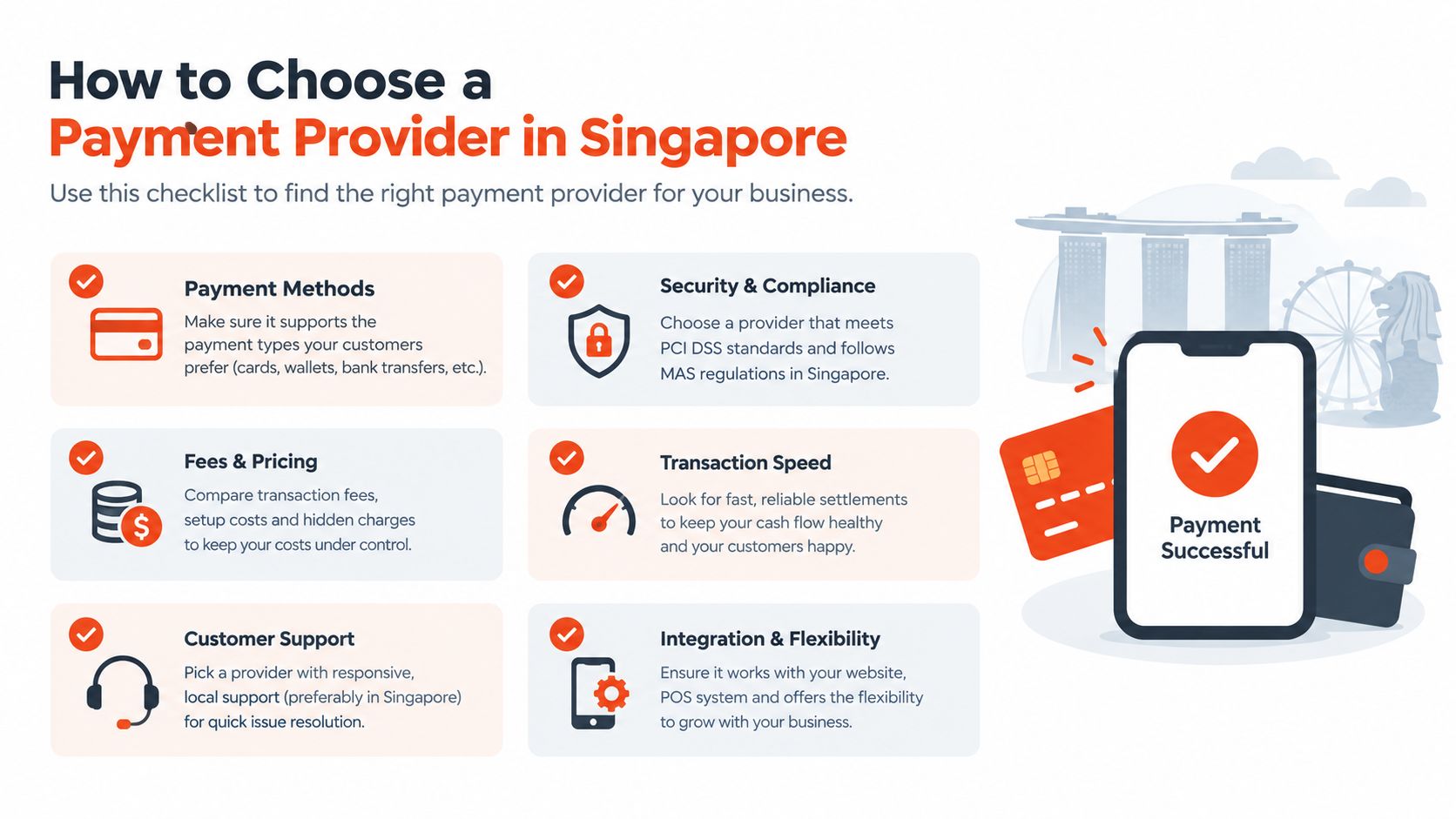
The right provider in Singapore should solve daily operational problems, not just sell payment acceptance. That means looking past the polished brochure and checking whether the offer is transparent, stable, and easy for staff to live with. A merchant is buying a working system, not a promise. Comparing payment solutions for small businesses requires balancing cost, hardware, and support.
Scale gives you a sense of why this decision deserves scrutiny: in the first half of 2024 alone, Singapore recorded approximately 1.982 billion card transactions worth SGD 141.882 billion, including 610 million point-of-sale credit and charge-card transactions worth SGD 45.003 billion, according to MAS retail payment statistics.
Here is how the main provider categories compare. Rates and specific features change frequently, so verify current published rates directly with each provider before making a decision:
- Sambapay. An ISO that onboards merchants through Fiserv Merchant Solutions Pte Ltd as acquirer and processor, with blended card acceptance targeting under 3% for most standard industries, Android POS hardware matched to the counter, daily summaries and settlement reporting, and a Singapore-based support team. Verdict: a strong option for a café, salon, or clinic that wants transparent pricing, hardware, and local support from one provider.
- Stripe. Known for strong APIs and clean integration with e-commerce platforms. Verdict: excellent if online transactions dominate. For counter-heavy retail, you will need to add a terminal solution on top. Verify current published rates.
- HitPay. Often positioned for lean, low-margin sellers with next-day payouts on some rails. Verdict: competitive on cost for small sellers, but support and hardware depth may be lighter than a full-service ISO arrangement. Verify current published rates.
- PayPal. Offers instant buyer recognition for customers who expect it at checkout. Verdict: fine as a supplementary online button. Verify current published rates and check whether dedicated POS hardware is available for counter use.
- Local bank acquiring. Banks such as DBS or OCBC offer acquiring services, sometimes bundling terminal rental. Verdict: strong for large retailers with dedicated finance staff. The paperwork and less-flexible onboarding suit slow-moving, stable operations more than a new café. Verify current published rates.
The checklist that actually matters
A solid provider comparison should test five areas:
- Pricing clarity: Are the fees blended, understandable, and free of teaser rates or surprise add-ons?
- Hardware fit: Does the terminal match the counter, the staff workflow, and the payment types the business needs?
- Settlement speed: Does the business get funds quickly enough to manage stock, payroll, and daily operating costs?
- Support quality: Is there a local team that can solve issues without a long email chain?
- Migration and onboarding: Can the provider switch a merchant over without interrupting trading hours?
Card usage still matters even in a market that talks a lot about wallets and QR. Card payments represented 34.72% of point-of-sale transaction value in 2025 in Singapore, according to Statrys' market summary. That means the provider has to handle cards well, but it also has to make room for QR codes and wallets without making reconciliation a mess.
When comparing payment solutions small business owners use daily, ask how they handle refunds, failed taps, settlement questions, and terminal faults on a busy Friday evening. Provider approaches diverge: Sambapay runs real local support for Singapore merchants, while some pure-play platforms resolve issues only through ticket queues. A local contact who understands operations is worth more than a vague promise of "24/7 service".
Making the Right Choice for Your Business
A payment processor is part cashier, part treasury tool, and part customer experience layer. Get the features and pricing right, and everything else falls into place. Selecting the best payment solution for small business operations depends on daily workflows.
Features that earn their place
- Multi-currency acceptance: essential only if you serve tourists at scale. Otherwise it is a billing add-on, not a need.
- Fraud and chargeback protection: 3-D Secure on card-not-present flows and clear dispute handling on in-store taps. Chargebacks eat margin faster than fees do.
- POS integration: payments and sales records in one system, so end-of-day reconciliation takes minutes, not hours.
- Wallet and QR coverage: customers should never need a second device to pay.
- Real support: a named contact beats a chatbot when the terminal freezes mid-service.
What a typical café actually pays
Take a café turning over SGD 50,000 a month in card sales, roughly SGD 1,660 a day. The figures below use illustrative assumptions to show how different pricing models compare:
| Model | Effective rate (illustrative) | Fixed costs (illustrative) | Approx. monthly cost |
|---|---|---|---|
| Blended ~2.8% | ~S$1,400 | Assume terminal rental S$40 | ~S$1,440 |
| Interchange-plus (~1.2% pass-through + 0.4% markup) | ~S$800 | Assume S$25 statement + hardware fees S$45 | ~S$870 plus premium-card variance |
| Tiered ("2% to 3%") | Often lands ~3.2% effective | Assume rental S$50 | ~S$1,650 |
The pattern is the lesson: blended pricing costs a little more for total predictability, interchange-plus rewards owners who read statements, and tiered pricing penalizes small ticket sizes. Owners who switch providers often do so to escape unexpected tiered costs.
Owners who plan carefully do not chase the cheapest headline rate. They choose a system that fits the way the business earns money, serves customers, and pays suppliers. In Singapore's cashless environment, that decision has a direct effect on daily operations.
If a Singapore café, shop, salon, clinic, or gym needs a practical in-store payment setup, Sambapay offers card processing, modern POS terminals, selected digital wallet acceptance, and settlement options designed for everyday merchant cash flow. Visit Sambapay to review the setup, compare the commercial terms, and see whether it fits the way the business operates at the counter.
Frequently Asked Questions
What do payment solutions do?
They authorise customer payments, route them through card networks and acquirers, settle the funds into your business account, and report on all of it. In practice, that covers card and wallet acceptance, QR methods, terminal management, settlement reporting, and refund or chargeback handling. These are all the steps between a customer's tap and usable cash in your bank.
Is Stripe allowed in Singapore?
Yes. Stripe operates in Singapore and is widely used for online payment acceptance here. Always check the provider's current licensing status with MAS before integrating any financial service. For in-store counter payments, you would typically pair it with a terminal-focused provider.
Who is considered a payment service provider?
Any company that handles the movement of money between buyers and sellers on behalf of merchants. That includes acquirers, payment gateways, wallet operators, and ISOs such as Sambapay, which facilitates merchant onboarding and processing services for Singapore businesses through its acquiring partners.
What settlement speed should I expect?
Faster settlement is generally better for in-store card acceptance in Singapore. Anything slower should be justified by a lower fee, otherwise it costs working capital. See the table above and verify timelines directly with your chosen provider.