
Your cashier is staring at a terminal that keeps approving payments, but the bank balance still looks tight because yesterday's takings haven't landed yet. The owner knows card acceptance matters, the brochure says the fees are “simple”, and the provider keeps pushing a new package with a lower headline rate. That is exactly where many Singapore shops get it wrong.
A merchant account in Singapore is not just a payment line item. It decides how fast cash comes in, how painful chargebacks become, how much admin the team inherits, and whether a switch to a new provider turns into a messy weekend. For retail, F&B, clinics, salons, and gyms, the core question isn't whether to accept cards. It's which setup protects cash flow and keeps the till moving.
A hawker-style outlet, a café counter, or a clinic front desk all run into the same moment. The customer taps, inserts, or swipes, and the payment either clears smoothly or starts a chain of delays the staff cannot see. That chain is what a merchant account sits behind.
A merchant account is the contract that lets a business accept card payments through an acquiring bank or payment provider. The terminal sends the transaction, the acquirer routes it through the card network, and the issuer approves or declines it. Once approved, the funds settle into the business's account, often on a T+1 basis depending on the provider and agreement.
That is different from a simple PayNow QR or a third-party wallet payout, which follows its own rails and payout schedule. If a merchant accepts cards through a merchant account, the business also gets clearer control over pricing, a proper Merchant Category Code, and access to chargeback workflows. Those details matter more than the glossy feature sheets usually admit.
Practical rule: if the payment acceptance setup does not give control over settlement timing and dispute handling, it is not solving the core till-side problem.
For Singapore merchants, this is not theoretical. MAS retail payment statistics show card payments remain very large in value, with S$148.909 billion in total card payments in 2024, and S$73.965 billion in card payments in H1 2025 alone, which explains why card acceptance keeps sitting at the centre of retail and service operations (MAS card payment statistics coverage). POS credit-and-charge-card payments also hit 682 million transactions in H1 2025, so the terminal at the counter still matters, a lot.
For a practical merchant-facing walkthrough of in-store card acceptance, see Sambapay's guide on paying by credit card.
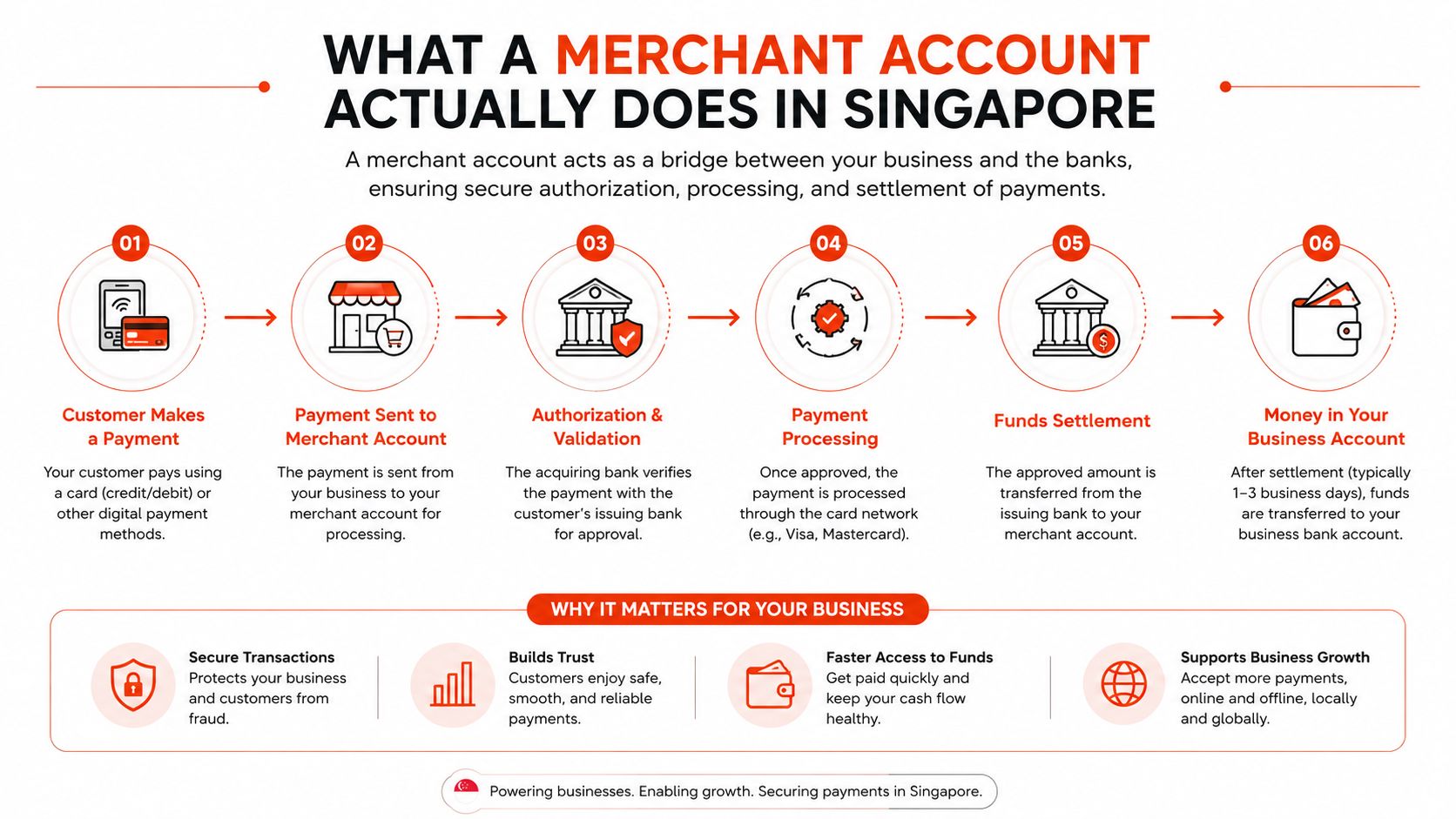
The biggest difference is control. A merchant that owns the account can negotiate pricing properly, challenge bad assumptions on fees, and manage disputes through a clear process instead of relying on a reseller's opaque support desk. That matters most when a shop has regular card volume and cannot afford random holds or slow settlement.
The second difference is operational. A real merchant account is tied to the business's compliance profile, not just a terminal rental. That means better visibility over how refunds, reversals, and chargebacks are handled, which is exactly where small merchants get bruised when they switch on price alone.
Most Singapore merchants don't get rejected because the business is weak. They get slowed down because the provider doesn't like the story the documents tell. A clean entity, a realistic volume estimate, and a consistent business address usually do more for approval than a hard negotiation on pricing.
Local acquirers and Payment Facilitators usually want an ACRA-registered entity, such as a sole proprietorship, partnership, LLP, or Pte Ltd, with a Singapore-registered business address and a lawful storefront, physical or online. Newer entities can still get onboarded, but they usually face tighter pricing and more review. That is just how risk screening works.
Providers also look closely at the business model. They review the MCC risk band, likely monthly processing volume, average ticket size, refund pattern, and chargeback history. Beneficial owners can also be screened against sanctions and compliance checks under MAS-related obligations for payment service providers operating in Singapore (MAS ongoing requirements for payment service providers).
Some sectors attract more questions because their transactions are messier or more dispute-prone. These often include delivery-heavy F&B, clinics, wellness businesses, travel-related services, and stockists near CBD or vaping-adjacent categories. The provider isn't being difficult for sport. It's trying to understand whether refunds, cancellations, or disputed tickets will become a recurring cost.
A clean UEN and a matching bank account usually beat a polished sales pitch. Underwriters want consistency first, ambition second.
The fastest approvals usually come from merchants that already know their volume range and can explain their model without exaggeration. If the UEN, bank account, and stated turnover all line up, the application usually moves faster. If the numbers look guessed, the file sits.
The fastest applications are the ones that arrive complete the first time. A Singapore merchant account request gets delayed most often because a founder uploads the wrong file version, leaves out a signatory, or sends a BizFile extract that's already stale. That sort of friction is avoidable.
The first item is the ACRA business profile or BizFile extract showing the UEN, registration date, and directors. After that, attach the Singapore-registered business bank account confirmation and the list of authorised signatories. Those basics let the provider check whether the account name, entity name, and payout destination match.
For ownership checks, providers often ask for NRIC or passport copies for directors and ultimate beneficial owners. They also want proof of the trading address, such as a recent utility bill or tenancy agreement, plus recent bank statements covering three to six months to show cash flow behaviour.
Card-present shops should be ready with outlet photos or the planned terminal location if asked. Online sellers need to show the website URL, product list, and a sample checkout flow so the provider understands what customers are buying. That matters because the underwriting decision often depends on whether the merchant is selling stable everyday goods or something more dispute-sensitive.
Common application stalls include outdated BizFile extracts, complex ownership across multiple entities, and overseas-issued IDs with no clear Singapore residential trail. Any one of those can trigger another round of checks. None of them are glamorous, but each one can add days.
The easiest file to approve is the one that reads like a real business, not a half-finished pitch deck. Clean documentation doesn't just help compliance. It shortens the path to activation.
A merchant wants two things fast, approval and a working terminal. In Singapore, a clean application usually gets there within a week or two. Messy files drag because the provider cannot price the risk with confidence, not because anyone is being difficult.
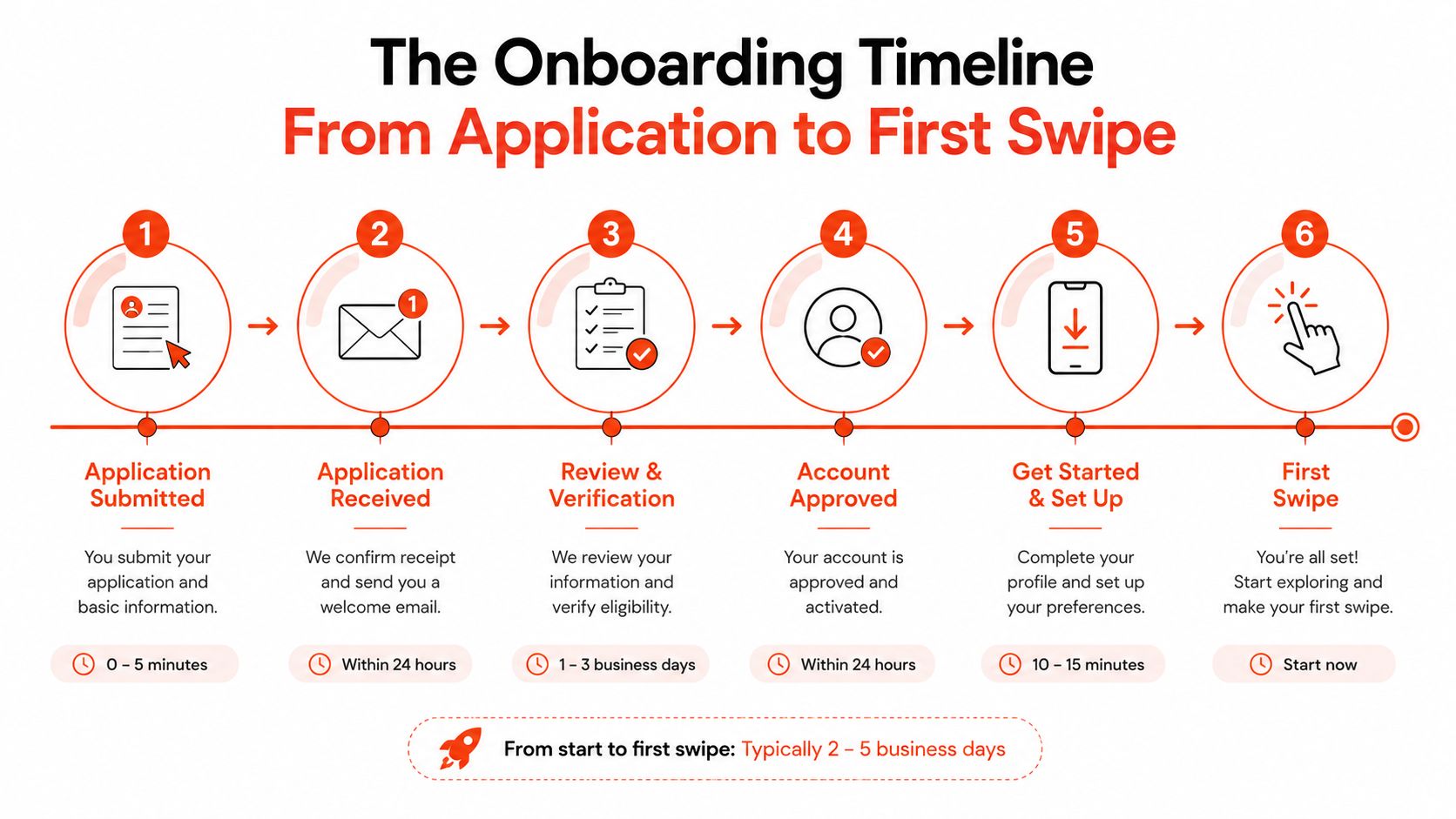
First comes enquiry and pre-qualification. The provider checks what the business sells, how it takes payment, and whether the expected volume makes sense. If the model sits in a sensitive category, that usually shows up here.
Then comes document submission. Matching names, current bank details, and clean PDFs save time. After that, underwriting and risk review starts. The provider checks beneficial owners, business type, and whether the MCC needs closer scrutiny.
Deployment is next for physical outlets. That can mean site coordination, terminal setup, and testing the live connection. The last stage is first settlement, and that is when the merchant sees whether the promised cash flow works at the till.
Send the ACRA profile, recent bank statements, and a plain-English summary of expected monthly volume before the provider asks. That removes the easiest excuse for delay. For retail and F&B shops, outlet details also matter, especially if there is more than one location.
Best practice: submit the operating story as if a cautious accountant will read it, because that is usually who reviews it.
Higher-risk categories take longer because the provider may need extra checks on KYC, outlet details, or scheme registration for MCC-sensitive activity. The file is not dead. It just needs more review than a standard retail shop, and that extra review affects how fast you get to first swipe.
Most price sheets are designed to win a signature, not to tell the truth. The headline rate may look low, but the actual cost depends on ticket size, card mix, refund behaviour, settlement timing, and the pile of smaller fees hiding underneath. That is where merchants overpay without noticing.
A blended rate bundles the major cost components into one clean percentage. An interchange-plus model separates the network-related cost from the provider's markup, which can be easier to assess if the merchant has enough volume and the right kind of cards. Neither model is automatically better.
Take a S$12 bubble tea, a S$68 pharmacy sale, and a S$420 electronics purchase. At a simple merchant-facing level, blended pricing is easier to read, while interchange-plus can become more attractive when the business's card mix and ticket size make the effective total lower. For a practical comparison of the two structures, see this Singapore rate breakdown.
| Ticket Size | Blended 1.8% MDR | Interchange-Plus 0.5% + S$0.10 | Winner |
|---|---|---|---|
| S$12 | S$0.216 | S$0.16 | Interchange-Plus |
| S$68 | S$1.224 | S$0.44 | Interchange-Plus |
| S$420 | S$7.56 | S$2.20 | Interchange-Plus |
The table is blunt on purpose. Small merchants often care less about theoretical rate purity and more about what leaves the account each day. A transparent blended quote can still be the right choice if the merchant wants simplicity, while interchange-plus can suit businesses with larger tickets and steady volume.
Beyond MDR, merchants need to watch payment gateway fees, statement fees, batch fees, chargeback fees, terminal rental or purchase costs, and PCI-related charges. Settlement timing matters too, because T+1 is a cash flow advantage over slower payout cycles. In a business with daily stock replenishment, that difference is not cosmetic.
Operationally, the right question isn't “which rate is lowest on paper?”. It's “which structure leaves more usable cash after refunds, fees, and payout timing are all counted?” That's the answer most pricing brochures skip.
The trap is assuming the cheapest quote is the cheapest outcome. In Singapore, that mistake usually shows up after the contract is signed, when the merchant finds the exit window is narrow, support is slow, and the statement has more line items than the brochure suggested. By then, the savings are often gone.
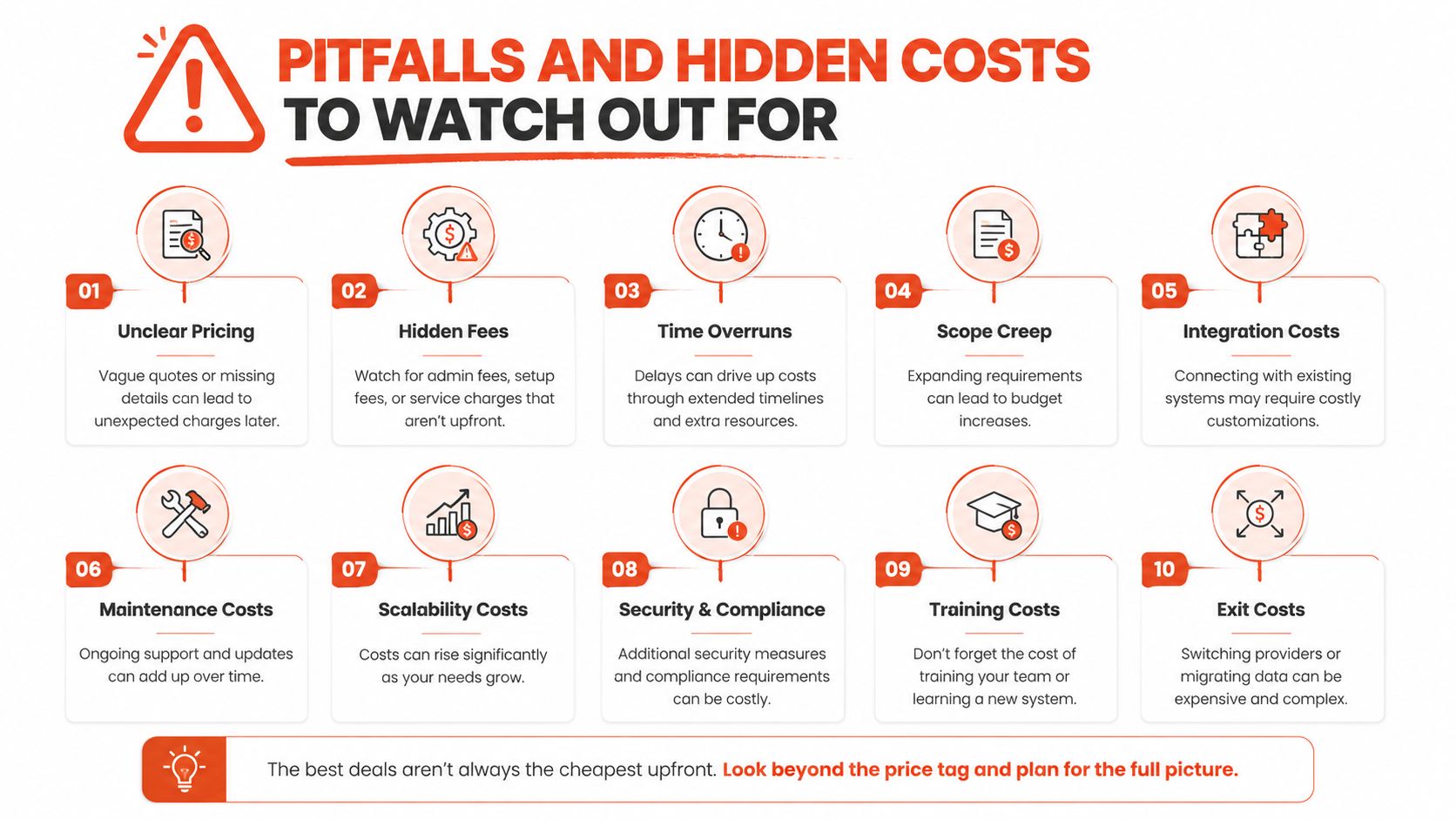
Chargebacks are a prime example. One Singapore risk guide notes that chargeback processing fees can sit at S$15 to S$50 per case, and network monitoring thresholds can start around 1.0% for Visa and 1.5% for Mastercard before a merchant enters stricter programmes (Singapore payment risk guide). For small-ticket merchants, that fee can hurt more than the original sale.
PayNow has its own reality. It is instant and irrevocable, with no chargeback mechanism, so the merchant's prevention controls have to carry the load. Card acceptance is different, because dispute handling becomes a core operating task rather than an afterthought.
Auto-renewing agreements with short cancellation windows are common enough to deserve suspicion. So are minimum monthly service charges that punish seasonal businesses and early termination fees that make switching look expensive even when the new provider is better. Settlement cut-off times and refund processing SLAs can also create friction if the business depends on tight daily reconciliation.
Ask for the exit clause before anything else. If the provider won't spell out termination terms in plain English, the merchant should assume the clause favours the provider.
One more point needs to be clear during negotiation. The provider should confirm zero monthly minimums, a capped chargeback liability where possible, and a clear written exit process before the contract is signed. If the gateway and terminal stack can double-bill, that needs to be in writing too, or the merchant may discover the add-on later.
Switching merchant accounts should not mean a dead till. It becomes messy only when the merchant rips out the old setup before the new one is tested, or tries to switch during a peak period when staff are already stretched. Most of that pain is avoidable.
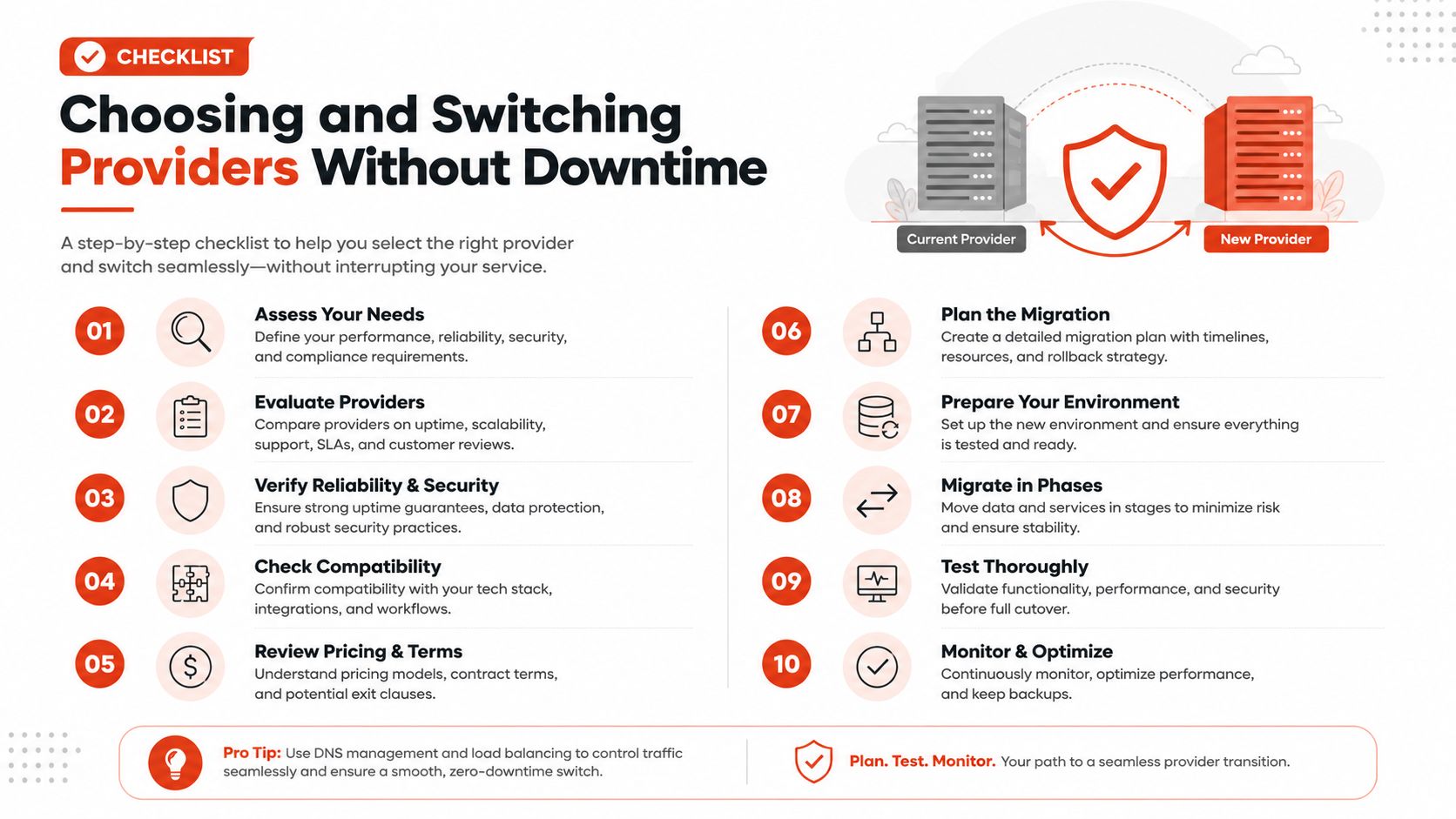
The decision should start with five things, effective rate, settlement window, terminal compatibility, support response times, and contract exit terms. Those are the parts that affect the till. A slick onboarding deck doesn't matter if the terminal can't handle the shop's workflow or if settlement is slower than expected.
For merchants reviewing a new setup, it helps to look at the merchant account as part of the wider POS stack. A practical switching checklist for store owners is laid out in this POS migration guide.
The safest pattern is a parallel run. The new and old terminals operate side by side for one to two weeks, so refunds, chargebacks, and outstanding settlements can clear properly before the old account closes. That reduces the risk of a stranded balance or a support headache after the old MID is shut down.
Festive peaks are the wrong moment to switch. Chinese New Year, 11.11 sales, and any busy campaign week are exactly when merchants need the fewest unknowns. A cutover should happen when the team can test, compare, and absorb a small problem without losing a Saturday lunch rush.
Downtime is usually a sequencing problem, not a technology problem. If the merchant closes the old setup only after the new one has already worked in live trading, the switch is manageable.
Sambapay provides Singapore merchants with in-store card acceptance, Android POS terminals, fast settlement, and guided migration support for retail, F&B, clinics, salons, and gyms. Merchants comparing provider economics can review the setup and speak with the local team at Sambapay before they sign a new contract or cut over from an old one.