
A customer steps up to a café counter, taps a card or phone, hears the approval tone, and moves aside before the next order is ready. For the customer, paying with a credit card feels almost instant. For the merchant, that brief tap depends on a terminal, connectivity, payment processor, card network, issuing bank, security controls, settlement rules, and staff who know what to do when the screen doesn’t behave as expected.
That operational detail matters because card acceptance is no longer reserved for large purchases. In Singapore, POS credit and charge card payments reached 682 million transactions worth S$54.54 billion in H1 2025, according to MAS payment statistics. A small business therefore needs to assess cards as part of everyday checkout economics, not merely as a convenience feature.
At a neighbourhood café, the payment choice often comes after the customer has selected the product. They may tap a physical card, hold a phone near the terminal, or insert a chip card if contactless payment is unavailable. The expected outcome is straightforward: a clear approval message, a receipt when needed, and no awkward pause at the counter.
That expectation has made card acceptance part of everyday retail. Customers use contactless payments for lunch, personal-care services, medicine, clothing, and quick household purchases. Card use now covers routine spending, not only occasional high-value purchases.
For merchants, the benefit goes beyond more payment methods appearing on a counter. Offering cards can reduce the time customers spend counting cash, keep checkout moving during busy periods, and serve visitors who carry little physical currency. It also creates a more consistent transaction record than a cash-only process, although reconciliation still relies on accurate sales and batch records.
The commercial question is whether those benefits outweigh the costs. A merchant should compare provider fees, equipment or service charges, settlement timing, refund handling, and the staff time required to resolve failed or disputed payments. Card acceptance can improve net profit when it helps complete more sales or shortens queues without adding costs that exceed the extra margin.
The terminal must support the methods customers use, but the device does not guarantee a smooth transaction. Stable connectivity, clear prompts, reliable receipt handling, settlement visibility, and responsive support determine whether payments keep moving during a lunch rush or a crowded appointment schedule.
Staff readiness matters as much as the hardware. Employees should know how to check an approval, retry a failed payment safely, issue a refund, and record exceptions without creating a duplicate charge. Owners should also confirm how transaction data reaches settlement. NETS states that transaction records are uploaded daily for payment and settlement, and no later than seven days after the transaction date. Batch submission and exception handling therefore belong in the daily operating routine (NETS merchant agreement).
A card setup should be judged by the full daily workflow, not by the tap speed shown during a sales demonstration. For an SME, reliable acceptance is valuable when it protects checkout flow, produces usable records, and leaves sufficient margin after payment costs.
At a busy Singapore checkout, the customer normally chooses among three routes: tap a contactless card or phone, insert a chip card, or swipe a magnetic stripe where that method remains supported. The available route depends on the card, wallet, terminal, and the merchant’s acceptance setup. For an SME, each option also affects queue speed, staff instructions, and the likelihood of a failed payment.
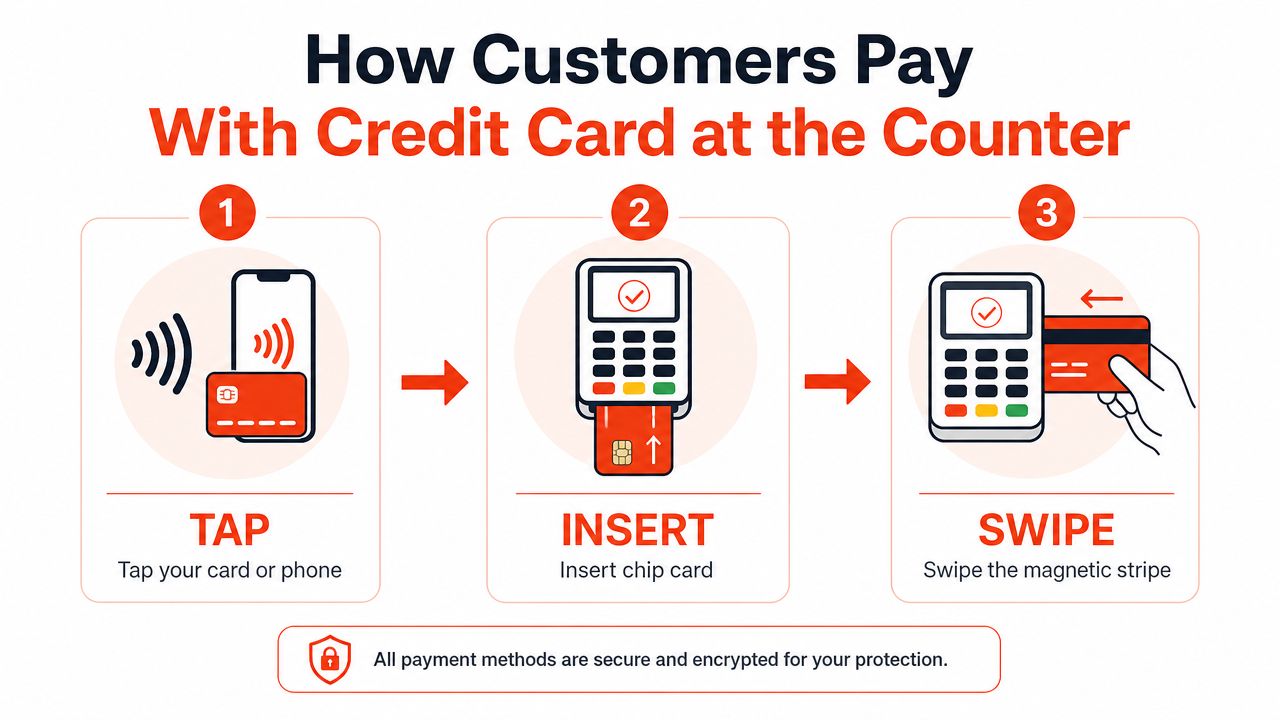
For contactless payment, the customer checks the amount shown on the terminal, then holds the card near the contactless symbol. A phone or smartwatch follows a similar process, although the wallet may require the customer to open the device or authenticate before presenting it.
The terminal reads the contactless credential and sends the request for authorisation. If the bank approves the transaction, the screen confirms payment and the customer removes the card or device. The terminal or issuer may still request a PIN or another verification step.
Mobile wallets use a tokenised credential instead of exposing the underlying card number during every purchase. PwC describes tokenised credentials as one factor supporting tap-to-pay adoption, alongside the significant role of credit cards in transaction value (PwC Singapore payments overview).
For merchants, tap-to-pay works well only when the terminal recognises contactless cards and wallets consistently. Sambapay’s payment terminals provide one place to compare supported acceptance methods before choosing equipment.
If contactless is unavailable or the terminal requests a chip transaction, the customer inserts the card into the reader and leaves it in place. The terminal communicates with the embedded chip, displays instructions, and may request a PIN or other verification.
Customers should follow the on-screen prompts and remove the card only after approval. The merchant can then print or send the receipt digitally, depending on the configured setup. Staff should know this sequence because removing a card early can interrupt the transaction and create uncertainty about whether payment succeeded.
Swiping reads the static magnetic stripe on the back of a card. It offers less protection than an EMV chip transaction because the stripe contains reusable payment data rather than generating transaction-specific authentication.
For Singapore-issued credit, charge, and debit cards, point-of-sale acceptance moved away from magnetic-stripe use from 1 July 2012. Customers and merchants should therefore generally expect chip or contactless payment rather than swipe-only acceptance. The benefit extends beyond more payment methods appearing on a counter. A terminal that handles the customer’s preferred method can reduce avoidable retries and keep staff focused on completing the sale.
At a busy Singapore counter, a tap can produce an approval message in seconds because several parties exchange data in sequence. The POS terminal captures the card or wallet credential and purchase amount, then sends the request through the merchant’s payment setup.
A gateway or processor routes the request to the acquirer, the financial institution or acquiring provider supporting the merchant. The acquirer passes it through the relevant card scheme, such as Visa or Mastercard, to the issuing bank, which issued the customer’s card.
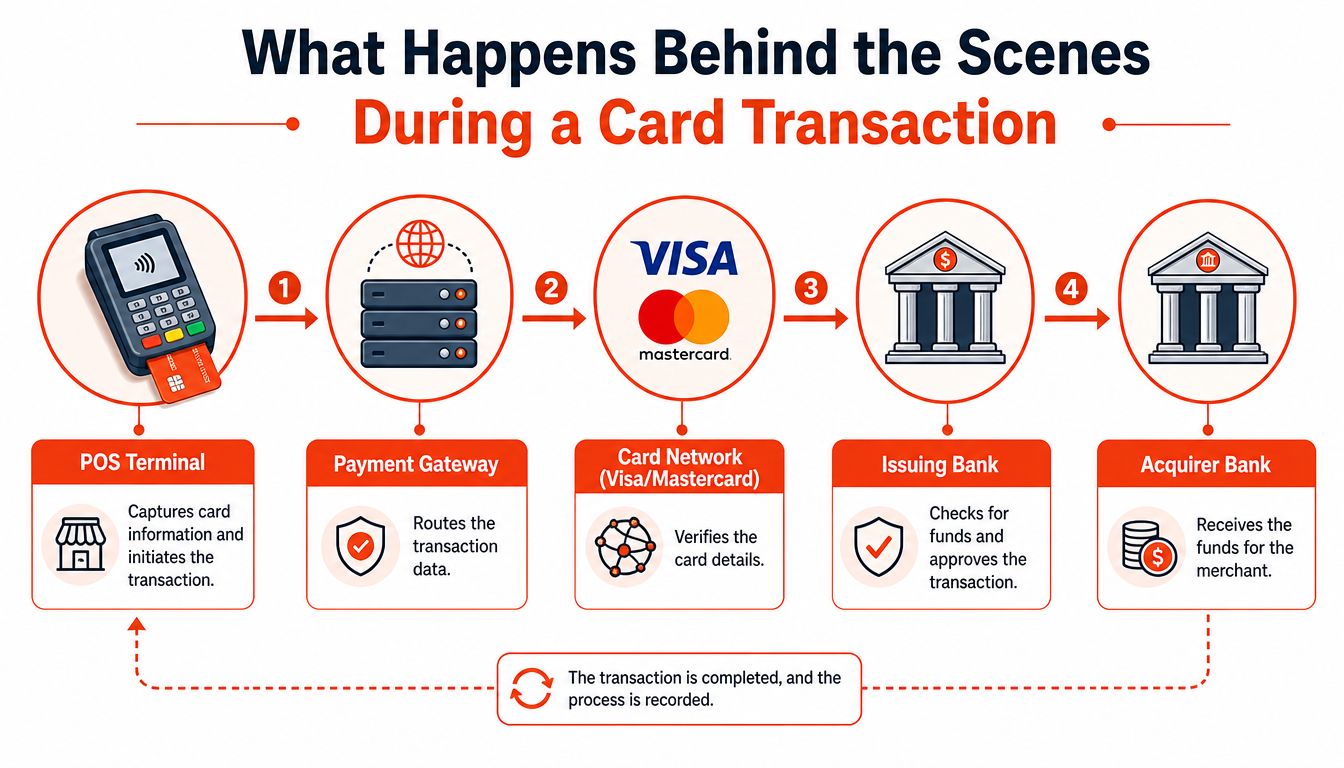
The issuing bank checks the request against its approval rules. These checks can cover card validity, suspicious transaction signals, and available credit under the issuer’s controls. The response travels back through the scheme and acquirer to the terminal, which displays approval or decline.
EMV chip transactions strengthen this process through chip-generated cryptographic authentication at the terminal. Contactless cards apply the same broad principle in tap form, while mobile wallets use tokenised credentials that reduce direct exposure of the underlying card details during each purchase.
Singapore’s move away from magnetic-stripe acceptance supports this security model. As noted earlier, Singapore-issued cards generally use EMV chip or contactless flows, so merchants should make sure their terminal and staff procedures support those methods.
Approval signals that the transaction has been accepted for processing. The merchant still needs the later clearing, settlement, refund, and dispute workflows to complete before the funds become part of usable business cash flow.
Merchants typically submit transaction records in batches or through an automated processing arrangement. For a setup governed by scheduled submission requirements, the timing affects cash-flow planning, reconciliation, and the handling of failed or incomplete records. Staff should also know how to identify an approved transaction, a declined attempt, and a receipt that requires follow-up.
The commercial arrangement determines which party handles routing, settlement reporting, refunds, and dispute support. A provider such as Sambapay’s acquiring service should therefore be assessed against the merchant’s daily workflow, reporting needs, and expected settlement timing. Terminal acceptance is only one part of the operating result.
For an SME, these steps have a direct financial effect. A transaction can appear successful at checkout while still requiring accurate batch submission, reconciliation, and refund handling. Gaps in those processes create staff queries, delayed investigation, and harder cash-flow forecasting.
The following video offers a visual explanation of the transaction path. Treat it as general education, while the merchant agreement remains the controlling document for settlement and support terms.
At a busy café counter, a terminal that approves taps quickly still creates work if staff must re-enter amounts, chase failed transactions, or reconcile unclear settlement reports. A workable setup combines hardware, acquiring access, accepted schemes and wallets, connectivity, security controls, pricing, settlement, and support.
A compact café may prioritise a fast standalone terminal that works reliably beside the ordering system. A clinic may need a clear receipt process and careful refund handling. A boutique may benefit from linking card payments to its point-of-sale records, reducing manual amount entry. Modern Android terminals, including devices such as the PAX A920 Pro, can suit businesses seeking a touchscreen interface and broader software environment. The device should match the counter routine, staff capability, and transaction volume.
The processor or acquiring provider sets the onboarding process, available schemes, transaction reporting, and payout arrangements. Review whether pricing is blended, which services cost extra, and whether the agreement contains terms affecting cancellation, hardware replacement, refunds, or disputes. Ask how quickly support responds when a terminal fails during trading hours.
Sambapay offers modern POS terminals, major card-scheme acceptance, selected digital wallets, blended transaction pricing, settlement options from as early as T+1 depending on the agreement, and Singapore-based support. Compare those features with competing offers alongside the full fee structure, reporting quality, and operating requirements.
For teams managing referral-led growth, a resource on automated referral program setup can explain how payment processing may connect with wider customer-acquisition workflows. Keep that work separate from the core acceptance review. The payment setup still needs clear pricing, reliable operation, practical reconciliation, and responsive support.
| Feature | What to Look For |
|---|---|
| Terminal hardware | Contactless support, readable prompts, suitable battery life, receipt options, and a form factor that fits the counter |
| Connectivity | Reliable Wi-Fi or mobile connectivity, clear offline rules, and a support process for connection failures |
| Card and wallet coverage | The card schemes and wallets customers actually request, including contactless credentials |
| Pricing | Transparent blended pricing, clear inclusions, and no unexplained add-ons |
| Settlement | A documented payout schedule, batch cut-off rules, and accessible settlement reports |
| Reconciliation | Transaction exports that match the POS record and make refunds or exceptions easy to trace |
| Support | Local assistance for activation, terminal faults, disputes, and account questions |
| Security | EMV and contactless capability, secure processing, and appropriate safeguards for card data |
Merchant test: Ask a provider to explain one successful payment, one declined payment, one refund, and one missing batch. The quality of those answers often reveals more than a headline rate.
A card terminal can raise revenue and still reduce profit if the added sales do not cover processing and operating costs. Card acceptance improves profit when the incremental contribution from additional or retained sales exceeds the full cost of taking those payments. Include more than the transaction fee in the calculation: basket value, staff time, checkout capacity, refunds, settlement timing, and sales lost when customers cannot use their preferred payment method all affect the result.
Singapore’s card market is large enough for this to matter to ordinary SMEs. In H1 2025, POS credit and charge card payments reached 354 million transactions worth S$28.247 billion, according to the MAS semi-annual retail payment statistics. The practical question is whether card acceptance supports the merchant’s own margins and customer behaviour.
A retailer with healthy margins may benefit when customers use cards for multi-item purchases or return more often because checkout is easier. A café with tighter margins has less room for payment costs. Its calculation should compare the contribution from card-funded sales with the amount remaining after ingredients, labour, rent, packaging, and other variable costs.
For a salon, accepting cards may help customers pay for a full appointment without looking for cash. A clinic may gain a clearer payment record and an easier patient experience, while still accounting for refunds, deposits, and reconciliation work. These conditions do not guarantee higher profit. They identify where payment convenience may protect revenue or reduce operational friction enough to justify its cost.
Track payment mix by business line, then compare customer behaviour across payment methods. Ask:
Run the test by outlet, shift, or business line where practical. A low-margin merchant should not accept every payment method without measuring the contribution left after costs. Refusing cards also has a cost if customers choose a competitor with a more convenient checkout. The right payment mix preserves customer choice while keeping net profit visible.
A switch should begin with checkout evidence, not a terminal catalogue. Identify where the current process loses sales, slows staff, or creates reconciliation work, then test replacement options against those problems.
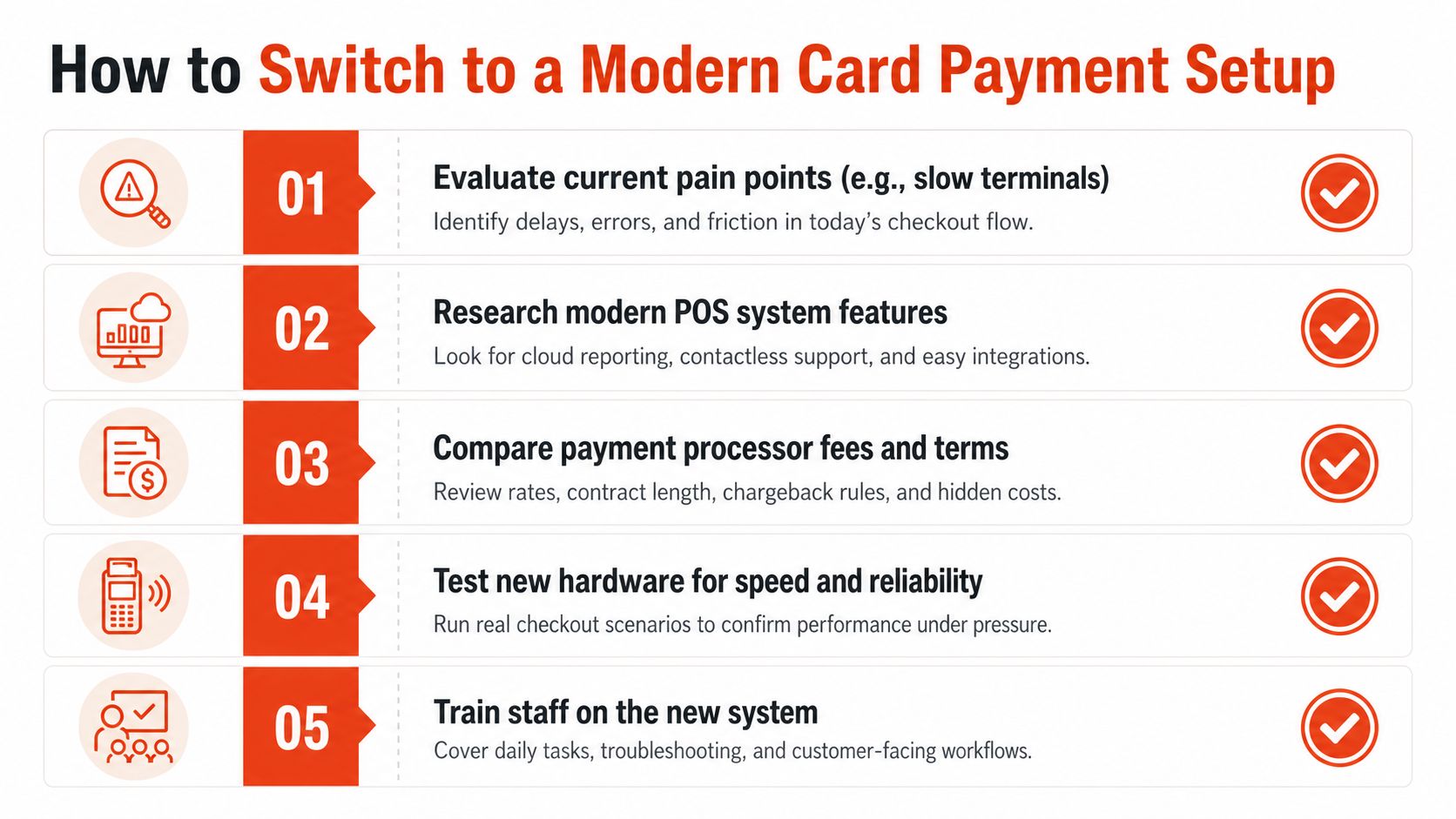
Record the issues staff see during normal service. A terminal might wake slowly, lose connectivity, reject contactless attempts, print receipts unreliably, or make refunds hard to find. Finance staff may face a separate issue when settlement reports do not match POS totals.
Define the acceptance scope before comparing providers. A retail shop may require Visa, Mastercard, American Express, JCB, and mobile wallets. A food outlet may prioritise quick contactless payments and a small device footprint. A clinic may place more weight on privacy, reporting, and support for refunds.
Review commercial terms and technical workflow together:
Unattended and self-service operators should assess different operating conditions. The cost and ROI of cashless vending tech provides context on how hardware, connectivity, and payment acceptance affect that environment.
Onboarding, installation, migration, and local support can reduce disruption when one provider coordinates them. Before agreeing to an implementation schedule, merchants can review this practical guide to switching a POS solution for a store.
Staff need clear steps for a decline, a failed contactless retry, chip insertion, refunds, receipt printing or resending, and terminal or settlement escalation. A short procedure at the counter helps staff respond consistently during a busy shift.
Test the complete workflow before retiring the old setup. Sales capture, settlement records, reporting, refunds, and support should align. A quick terminal that leaves unclear payout records still adds avoidable administrative work, so the replacement should be judged by the net result at the counter.
Customers can pay by tapping a card or mobile wallet, inserting an EMV chip card, or using another terminal-supported method. Approval may appear quickly, while the transaction still passes through the terminal, processor, acquirer, card scheme, and issuing bank before settlement reaches the merchant.
For SMEs, card acceptance must work financially and operationally. Contactless support, reliable connectivity, transparent pricing, predictable settlement, accurate reconciliation, and local assistance affect the result as much as the terminal. Net profit can improve when card payments protect sales, suit the business’s basket sizes, reduce queue friction, or strengthen operational control enough to cover payment costs.
Tap-to-pay and tokenised mobile-wallet credentials are becoming more important in Singapore. Adoption rates alone do not prove profitability. Test the full workflow, including refunds, reporting, settlement, and staff handling, then compare the outcome with the business’s margins.
Sambapay provides modern POS terminals, major card and selected wallet acceptance, transparent blended pricing, settlement options from as early as T+1 depending on the agreement, and Singapore-based onboarding and support. Visit Sambapay to assess a setup suited to the counter workflow, settlement needs, and business economics.